|
~ Topographical
Engineers ~
In 1813 as part of the General Staff, the U.S. Army
organized the first group of Topographical Engineers.
This group of individuals usually worked independently,
and did not follow normal Army protocols or regulations.
They were map makers who went out on a horse in unknown
territory with a compass and surveyed the land. In 1831,
they became their own separate Corps of Engineers. There
primary duty officially was to make maps, aid the troops
in selecting the best ground to fight the enemy, and
plot routes for troop movement and concealment from the
enemy. By 1863, the Topographical Engineers was absorbed
into the Corps of Engineers.
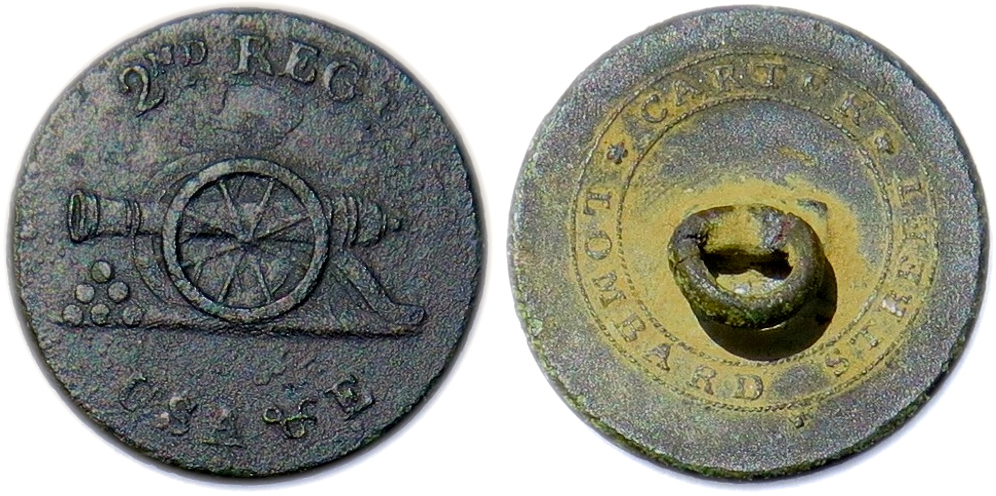
1799-1802 Artillerists & Engineers
2nd Regiment
Color: A Golden Pewter.
Metal: Flat, 1-Piece, Raised Design, Gilded Brass.
Size: 22mm. Coat Size
Albert's Number: AY 09: RV: 65
Tice's Number: AEO41
Variation: Ringed Cannon with a Large Breech / Six
Cannon Balls / 2nd REGt./ US
/ A
& E.
Present Condition: An Excavated Example, Good
Planchet Casting, Good High Relief Relief.
Isabela's Notes: The Regiment of Artillerist and
Engineers was originally organized on April 27, 1798. These
new regiments would consist of three battalions, and each
would have three companies within. On March 2, 1799, an
additional battalion was added, and on Mach 3, 1799 the
regiment was designated as the Second Regiment of
Artillerists and Engineers. The button's pattern depicts a
Ringed Cannon with a Large Breech sitting on a field
pointing right. Under the cannon's muzzle is a stack of
Six
Cannon Balls in a pyramidal shape. Above is the regiment
designation,
"2nd REGt." and below is the country's initials,
"US" and military units designation initials, "A & E" in all capital
letters. The high relief pattern is set on a plain flat
field. Specimens rarely surface on the market, and when they
do they usually demand a hefty premium.
Reverse Button Analysis: This is a flat one-piece
button with a loop shank. The shank is original and intact,
but bent inward. *CARTER*/LOMBARD STREET rm within a channel
of a rope rm rings.
Dug in Upstate New Hampshire.~
The RJ. Silverstein Collection.
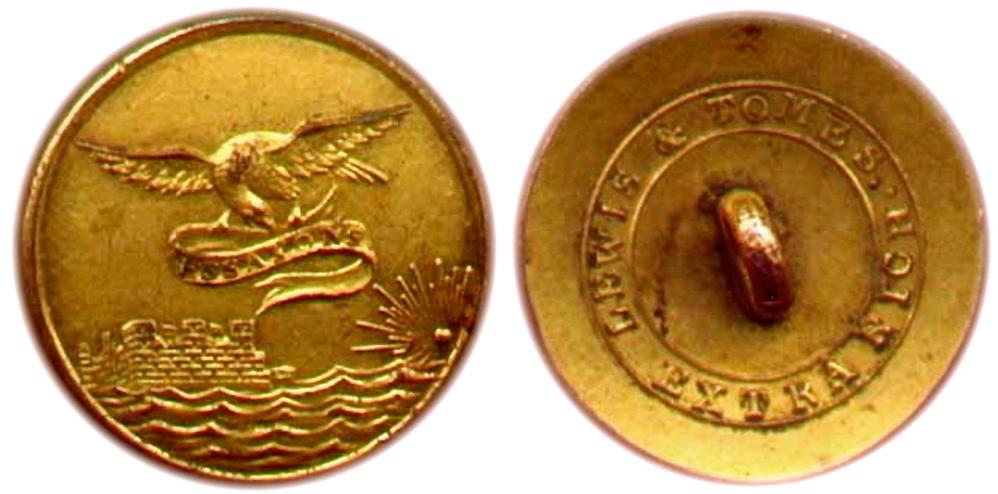
1815-30's Army Corps of Engineers
Color: Tinted Down Gold.
Metal: Flat 1-Piece, Raised Design, Gilt Brass.
Size: 24mm. Coat Size
Albert's Number: EG 3: RV 25
Tice's Number: EG100
Variation: Flying Eagle / Wings Spread Wide
/ Banner Ribbon / Stone Fortress on the Water / Single Ring
Edge Border.
Present Condition: A Non Excavated Example,
Exceptional Planchet Casting, Exceptional High Relief
Pattern.
Isabela's Notes: The British made all these
one-piece specimens with a single ring border and plain
field. There are two die variants known. One depicts shorter
sun rays, and the others sun rays reach just short of the
buttons center. There are three sizes known. Two with short
rays, and one with long. The button's pattern depicts a
Flying Eagle
with it's
Wings Spread Wide.
The eagle is looking down with a
Banner Ribbon
grasped in it's beak and claws. The ribbon carries the
motto, "ESSAYONS" in all capital letters. Below the eagle is
a Stone Fortress on the Water, and a Sun with Short Rays.
The high relief pattern is set on a plain flat field with a
Single Ring Edge Border.
Reverse Button Analysis: This is a one-piece
button with a loop shank. The shank is original, straight,
and intact. LEWIS & TOMES / EXTRA RICH rm within a 2ring rm
channel.
The Robert Blackwell Collection.
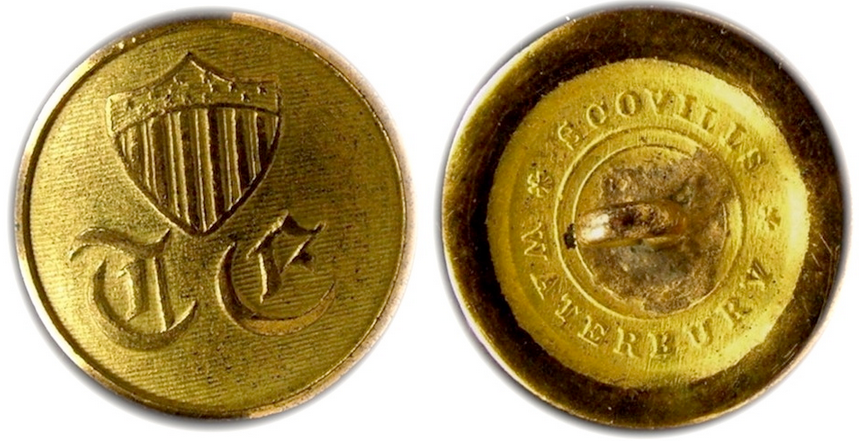
1832 Topographical Engineers
Color: Gold!
Metal: 1-Piece, Low Convex Gilded Brass.
Size: 23mm. Coat Size
Albert's Number: TE 3: RV 25
Tice's Number: TE206B.2
Variation: 1-Piece/ 2 Stars on Top Row.
Present Condition: A Non Excavated Example,
Exceptional Planchet Casting, Exceptional High Relief
Pattern.
Isabela's Notes: This button was made to the
Army's specifications of 1832. The button depicts A
large American Shield with 13 five-pointed stars on the
top lined field. (Some Variants have one star on top
row). There are thirteen alternating thickness vertical
stripes on the lower half of the shield. Below the
shield is the initials in Old English, "TE" for
Topographical Engineers. The whole pattern is set upon a
lined field with a thin raised edge border.
Reverse Button Analysis: This is a one-piece
button with a loop shank. The shank is possibly
re-soldered or original, straight, and intact. *SCOVILLS
* WATERBURY 2 inner rm rings.
Picture Courteous of Harry
Ridgeway.
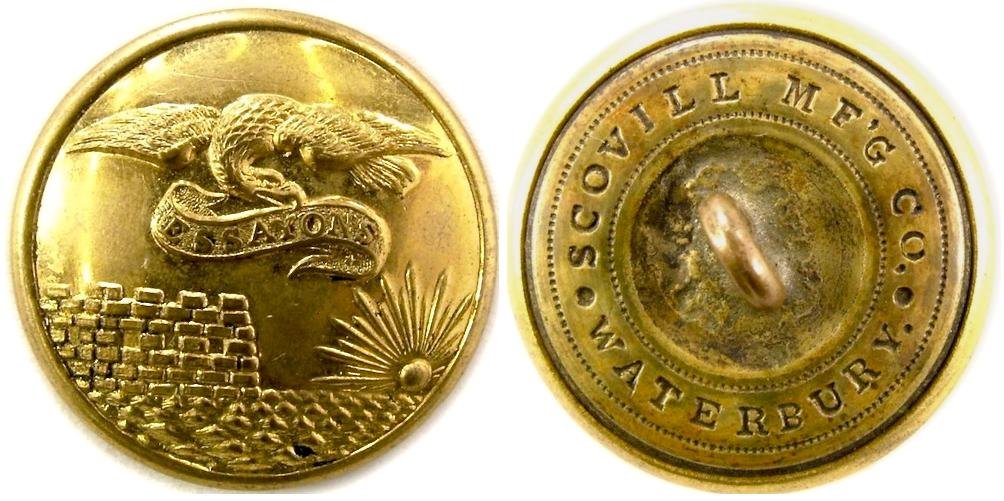
1860's Army Corps of Engineers
Color: Tarnished Gold.
Metal: Low-Convex 2-Piece, Raised Design, Gold
Plate.
Size: 22.7mm. Coat Size
Albert's Number: EG 6: RV
05
Tice's Number: EG 215-A.2
Variation: Flying Eagle / Touching the Outer Edge
Ring / Pebbled Field / Sun's Rays Touch the Banner
Ribbon.
Present Condition: A Non Excavated Example?,
Strong Planchet Casting, Exceptional High Relief
Pattern.
Isabela's Notes: The Army of Engineers have
used similar two piece buttons with this pattern since
the early 1840's. We know lots of different manufactures
made this pattern, and there are at least 12 die
variants. Most differentiate in the depiction of the
eagle and the sun's rays. This button's pattern depicts
a
Flying Eagle
with it's
Wings Spread Wide
almost
Touching
the Outer Edge Ring.
The wing's trailing edges also points toward the top of
the design. The eagle is looking down with a
Banner Ribbon
grasped in it's beak. The ribbon carries the motto, "ESSAYONS"
in all raised capital letters on a
Pebbled Field.
Below the eagle is a
Stone Fortress on the Water
with a Sun. The
Sun's Rays Touch the Banner Ribbon.
The high relief pattern is set on a plain field with a
single ring edge border.
Reverse Button Analysis: This is a one-piece
button with a loop shank. The shank is possibly
re-soldered or original, straight, and intact. .SCOVILL
MF'G CO,./ WATERBURY dm.
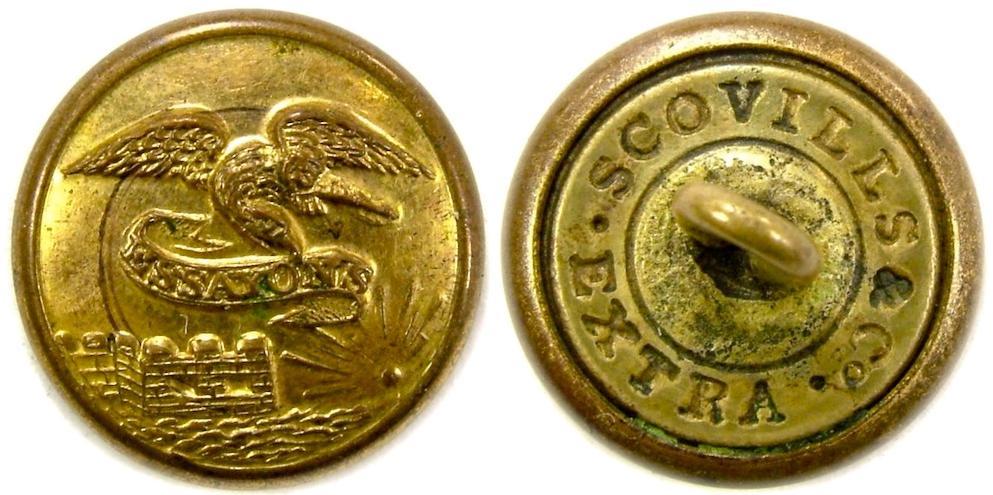
1846-60's Army Corps of Engineers
Color: A Golden Brown.
Metal: Low-Convex 2-Piece, Raised Design, Gold
Plate.
Size: 15.03mm. Hat or Sleeve Size
Albert's Number: EG 6-B: Not Listed
Tice's Number: EG 215Bs.1
Variation: Flying Eagle / Touching the Outer Edge
Ring / Pebbled Field / Sun's Rays Touch the Banner
Ribbon.
Present Condition: A Non Excavated Example,
Strong Planchet Casting, Exceptional High Relief
Pattern.
Isabela's Notes: This early cuff button was
designed by Scovill for officers serving in the Corps of
Engineers. Scovill made this pattern in 1840. In this
die variant, there is a blank space between the sun and
it's rays. Also the eagles wing tops are pointed upward. This button's pattern depicts
a
Flying Eagle
with it's
Wings Spread Wide
almost
Touching
the Outer Edge Ring.
The eagle is looking down with a
Banner Ribbon
grasped in it's beak. The ribbon carries the motto, "ESSAYONS"
in all raised capital letters on a
Pebbled Field.
Below the eagle is a
Stone Fortress on the Water
with a Sun. The
Sun's Rays Touch the Banner Ribbon
in three spots.
The high relief pattern is set on a plain field with a
single raised edge.
Reverse Button Analysis: This is a one-piece
button with a loop shank. The shank is original, straight, and intact. .SCOVILL
& CO./ EXTRA dm. inner ring dm 1840's back mark
(ScovillC15Small).
Picture Courteous of Harry Ridgeway.
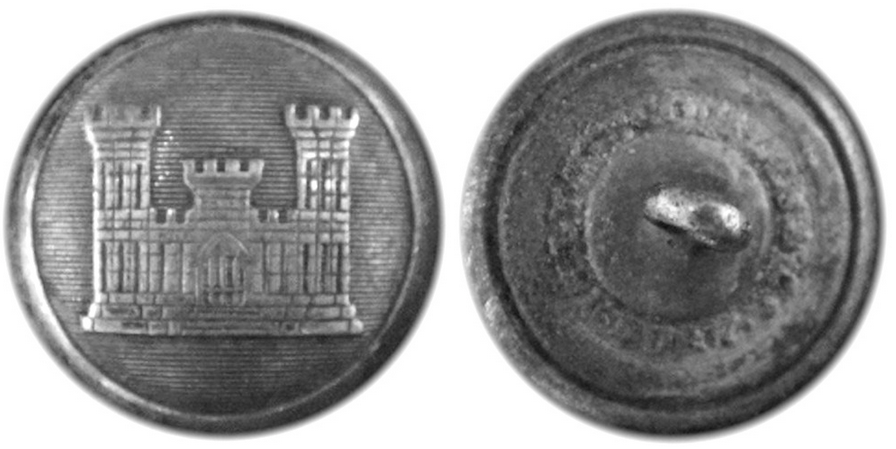
1847-62 New York 7th Militia Regiment, 10th Company
Engineer Corps
Color: Gold!
Metal: 2-Piece, Low Convex Silver Plated Copper.
Size: 20mm.
Albert's Number: NY 40: RV 10
Tice's Number: NY224A.1
Variation: Fortress on Lined Field.
Present Condition: An Excavated Example, Strong
Planchet Casting, Strong High Relief Pattern.
Isabela's Notes: This button's pattern depicts a
Fortress or Castle with three towers on a lined field.
There is a small raised edge border.
Reverse Button Analysis: This is a two-piece
button with a loop shank. The shank is is original,
straight, and intact. .SCOVILLS &Co./ WATERBURY rmdcwith
a stippled channel.
|

