~ The Ordnance Dept
1812-1860 ~
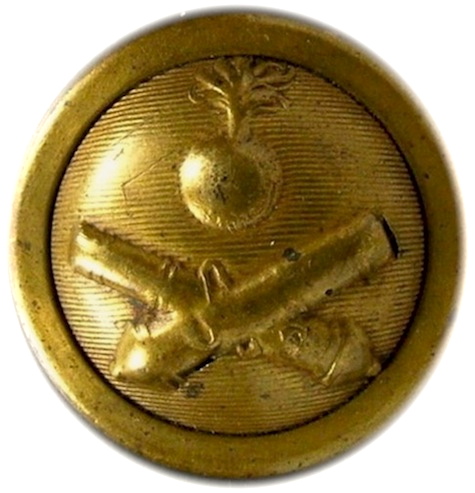
1830-40's Ordnance Department
The Ordnance Department was first established in May of
1812. The department came about because the Army had
difficulties in supplying ordnance materials to their
troops during the
War of 1812. Their main function and assignment was the development,
and procurement of weapons for the army. The department
reached it's height by 1815, and then with the reduction of the Army
1821,
it was merged with Artillery. Even though it was merged,
it still kept it's distinct function and
designation. In 1832 under Andrew Jackson, the
department was reorganized and fully restored to it's
previous status as it's own entity. Their main mission
remained the development and procurement of weapons to
the Army.
The earliest reference to buttons is a General Order
Adjt. & Inspection of March 15, 1816:
The uniforms will be the same as the Artillery, except
for the buttons which will have an Eagle on a cross
cannon pattern.~
.png)
1812-21 Federal Ordnance Department
Color: A Rusted Silver with Golden Highlights.
Metal: Flat, 1-Piece, Raised Design, Gilt Brass.
Size: 23mm. Coat Size
Albert's Number: OC 1-B: RV 35
Tice's Number: ORD100B.1
Variation: Eagle Facing Left / Ringed Cross
Cannons / 3 Cannon Balls Underneath the Cross hatch.
Present Condition: A Non Excavated Example,
Strong Planchet Casting, Strong High Relief Pattern.
Isabela's Notes: This is the first ordnance
pattern that was issued. There are three known die
variants in this original series. All depict the eagle
facing left standing on a set of cross cannons. This
button's pattern depicts an
Eagle Facing Left
while
perched on a set of
Ringed Cross Cannons. There are
Three Cannon Balls underneath the Cross Hatch
of the
Cannon Barrels. The pattern is set on a circular lined
field in high relief. There is an outside 1.5mm raised
picture frame border around the inner lined field. The
is an exceptional example of this old button.
Reverse Button Analysis: This is a flat one-piece
button with a loop shank. The shank is original,
straight, and intact. LEWIS & TOMES. EXTRA RICH. In a
depressed channel
The J. Baldwin Collection.
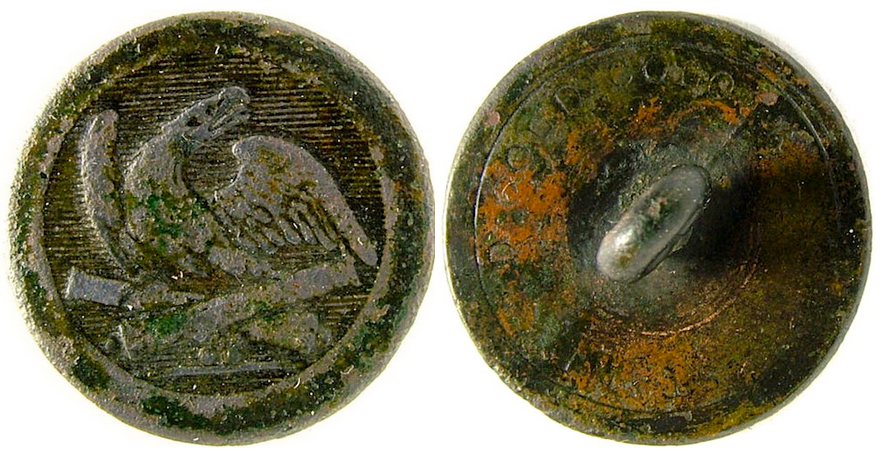
1812-1821s Federal Ordnance Department
Color: A Golden Silver with Green Encrustations.
Metal: Flat, 1-Piece, Raised Design, Gilt Brass.
Size: 21.5mm. Coat Size
Albert's Number: Similar to OC 1-C: RV 35
Tice's Number: Similar to ORD100A.1
Variation: Flat Head Eagle Facing Left / Ringed
Cross Cannon / Three Cannon Balls underneath the Cross
Hatch.
Present Condition: An Excavated Example, Strong
Planchet Casting, Good High Relief Pattern.
Isabela's Notes: This is an earlier die variant
of the first series. Either this button was supplied by
an English manufacturer prior to Armitage, or Armitage
didn't over stamp the reverse planchet. We know that
Armitage / Phil used this earlier planchet and struck
over the H. T & D Treble Gilt Strand Colour English Back
mark. This button's pattern depicts a
Flat Head Eagle
Facing Left
while perched on a set of
Ringed Cross
Cannons. There are
Three Cannon Balls underneath the
Cross Hatch
of the Cannon Barrels. The pattern is set on
a circular lined field in high relief. There is a raised
picture frame border around the inner lined flat field.
This button could have been issued later and used in the
1830's. (Treble 55)
Reverse Button Analysis: This is a flat one-piece
button with a loop shank. The shank is original,
straight, and intact. TREBLE GILT STANDD COLOUR within a
2 dm ring.
This Button was Dug in Charleston, South Carolina.~
Picture Courtesy of Harry Ridgeway.
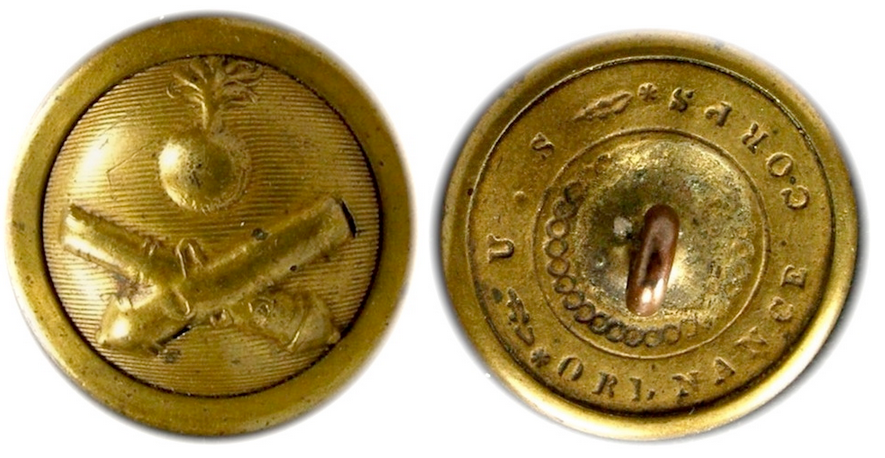
1834-51 Federal Ordnance Department Officer's Staff
Button
Color: A Gilded Brown.
Metal: Low Convex, 3-Piece Wide Rim, Raised
Design, Gilded Brass.
Size: 21.70mm. Coat Size
Albert's Number: OC 3: RV 12
Tice's Number: ORD 200D.1
Variation: Large Bomb with a Tree like Flame /
Double Ring Cross Cannons / Initials U S.
Present Condition: An Excavated Example, Strong
Planchet Casting, Strong High Relief Pattern.
Isabela's Notes: This button was intended for
officers who served in the Ordnance Department. The
pattern was made by a number of American manufacturers
between 1834 & 1851. This button has been found at
several Civil War sites, but was mostly used during the
Mexican War. There appears to be 4 categories of die
variants that differentiate by the bomb's fuse. The
first has a wide fuse hole, the second has a medium fuse
hole, the third has a spaghetti like fuse hole, and the
fourth has a narrow spout or tree like fuse The button's
pattern depicts a
Large Bomb with a Tree like Flame,
that is set above
Double Ringed Cross Cannons. Upon the
Cannon's Barrels is the
initials, "U S"
in high relief.
There is a flat picture frame border around the inner
lined convex field.
Reverse Button Analysis: This is a three
one-piece button with a copper loop shank. The shank is
original, straight, and intact. * graphic design U.S.
graphics design* / ORDNANCE CORPS dm inner ring of
circles. (United States 10)
Picture Courtesy of Harry Ridgeway.
Robert's Notes: The combination of the outdates style of
the button as well as the location of this style button
makes it very likely the Confederacy re-purposed this
button for the use by Artillerymen.
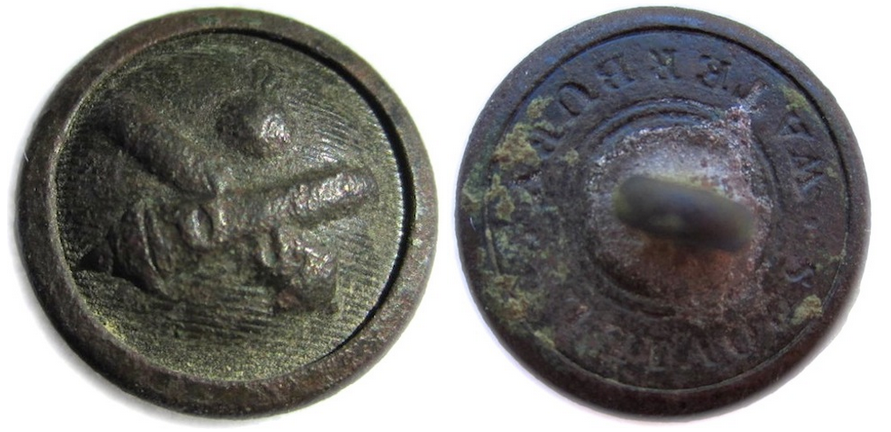
1834-51 Federal Ordnance Department
Color: A Silvery Brown.
Metal: Low Convex, 3-Piece Wide Rim, Raised
Design, Gilded Brass.
Size: 15.06mm. Cuff Size
Albert's Number: OC 3Bv.: RV 12
Tice's Number: ORD200 Bsa.1
Variation: Small Bomb with a Small Fuse Flame /
Double Ring Cross Cannons / U S Initials.
Present Condition: An Excavated Example, Good
Planchet Casting, Good High Relief Pattern.
Isabela's Notes: This button has three known
die variants for the bomb's fuse flame in the small cuff
pattern. The first has a small fuse flame, the second
has a feathery fuse flame, and the last has a wind blown
fuse flame. The button's pattern depicts a
Small Bomb with a
Small Fuse Flame
that is set over a pair of
Double Ringed Cross Cannons. Upon the Cannon's Barrels
is the country's initials, "U S"
in high relief. The
high relief pattern is set on a lined convex field with
an angled picture frame edge border. Ordnance cuff
buttons are usually hard to obtain without shanks, and
un dug specimens are the rarity.
Reverse Button Analysis: This is a 3-piece button
with a loop shank. The shank is original, straight, and
intact. .SCOVILLS./WATERBURY dm.
Excavated on a Civil War Battle field site, Berkley's
Plantation, (near Harrison's Landing) VA. Most likely
Army of the Potomac.
The RJ Silverstein Collection.
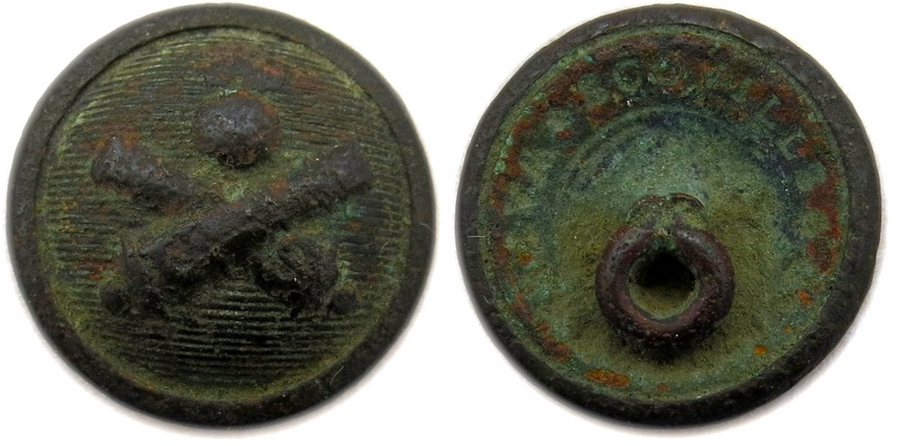
1834-51 Federal Ordnance Department
Color: A Greenish-Brown Patina.
Metal: Low Convex, 3-Piece Wide Rim, Raised
Design, Gilded Brass.
Size: 15mm. Cuff Size
Albert's Number: Unlisted Die Variant Similar to
OC 3Bv.: RV 100
Tice's Number: Unlisted Die Variant Similar to
ORD 200 Bsb
Variation: Small Bomb with a Wind Blown Fuse
Flame / Double Ring Cross Cannons / U S Initials.
Present Condition: An Excavated Example, Good
Planchet Casting, Good High Relief Pattern.
Isabela's Notes: This is another die variant made
by scovills. The button's pattern depicts a
Small Bomb
with a Wind Blown Fuse Flame
that is above a pair of
Double Ringed Cross Cannons.
On the Cannon's Barrels is the country's initials, "U S"
in high relief. The high
relief pattern is set on a lined convex field with an
angled picture frame edge border. This die variant would
be the most difficult to obtain by collectors.
Reverse Button Analysis: This is a 3-piece button
with a loop shank. The shank is original, straight, and
intact. .SCOVILLS./WATERBURY dm.
The RJ Silverstein Collection.
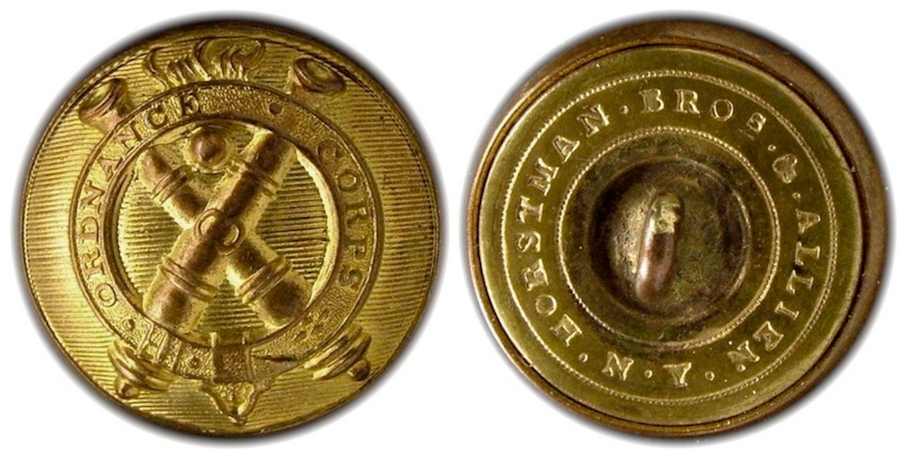
1860's to Post War Federal Ordnance Department
Color: Antique Golden Brown.
Metal: 2-Piece, Convex, Raised Design, Gilded
Brass.
Size: 23.20mm. Coat Size
Albert's Number: OC 4: RV 5
Tice's Number: ORD 209B.1
Variation: Four Double Ringed Cross Cannons /
Large Angled Ringed Breech / 90 Degree Angles / Raised
Dots / Four Small Decorative Elongated Diamond.
Present Condition: A Non Excavated Example,
Exceptional Planchet Casting, Exceptional High Relief
Pattern.
Isabela's Notes: The pattern dates from the early
1840's, but this particular button's back mark dates to
1860. Steele & Johnson could have subcontracted these (Horstman
A01) There are two known die variants made for this
pattern. One with single ring cannon tubes, and the
other with double ringed tubes. More then one
manufacturer did make this pattern, so the buckled
garter is distinctive to each manufacturer. The button's
pattern depicts
Four Double Ringed Cross Cannons
with a
Large Angled Ringed Breech.
In this die variant, the cannon's tubes are crossed at
angles
Less then 90 Degrees.
There is a flaming bomb set between the cannon's top
cross hatch, and has it's flame above the buckled
garter. Circling on top of the cannon's tubes is a
Buckled Garter with a foundation of
Raised
Dots.
Written within the garter's channel is the designation
"ORDNANCE * CORPS" in raised Roman Font Capital Letters;
followed by
Four Small Decorative Elongated Diamonds, a
buckle/strap, a Buckle Hole, a small Buckle, and an
Additional Buckle Hole. The high relief pattern is set
on a convex lined field, with a thin raised collar's
edge. Collectors usually take distinctive note between
manufacturer's specimen's who's cannon barrels are
crossed at angles less then 90 degrees, and the ones
that are crossed at right angles. Both types were
manufactured from the early 1840's. Also there is a
decorative distinction to the buckled garters
themselves.
Reverse Button Analysis: This is a
two-piece-piece button with a copper loop shank. The
shank is original, straight, and intact. dm HORSTMAN .
BROs . & . ALLIEN./N.Y. within a dotted channel ring.
shank is shallow concave well.
Picture Courtesy of Harry Ridgeway.
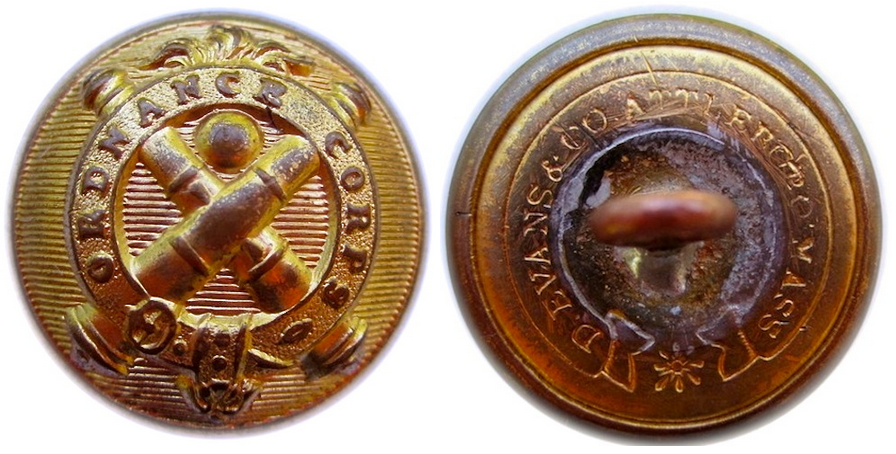
1840's to Post War Federal Ordnance Department
Color: Antique Golden Brown.
Metal: 2-Piece, Convex, Raised Design, Gilded
Brass.
Size: 22.93mm. Coat Size
Albert's Number: OC 5.: RV 2
Tice's Number: ORD 215A.1
Variation: Four Single Rings Cross Cannons /
Right Angles / Buckled Garter - Pebbled / One Decorative
Elongated Diamond / Buckle.
Present Condition: A Non Excavated Example,
Exceptional Planchet Casting, Exceptional High Relief
Pattern.
Isabela's Notes: The pattern dates from the early
1840's, but this particular button's back mark dates to
the early 1850's. It was originally intended for
officers of the Ordnance Dept. who were responsible for
the procurement and development of weapons for the Army
to use. This pattern was made by several manufacturers,
so several die variants are known. The button's pattern
depicts Four
Single Rings on a set of Cross Cannons. In
this die variant, the cannon's tubes are set at Right
Angles. There is a flaming bomb set between the cannon's
top cross hatch, and it's flame is above the buckled
garter. Circling over the cannon's tubes is a raised
Buckled Garter that is Pebbled. Written within the
garter's channel is the designation, "ORDNANCE CORPS" in
Thick Roman Font Capital Letters. This is followed by
One Decorative Elongated Diamond, a circling buckle
strap followed by a
Round Buckle. The high relief
pattern is set on a convex lined field with a thin
raised edge. Collectors usually take distinctive note
between manufacturer's specimen's who's cannon barrels
are crossed at angles less then 90 degrees, and the ones
that are crossed at right angles. Both types were
manufactured from the early 1840's. Also there is a
decorative distinction to the buckled garters
themselves.
Reverse Button Analysis: This is a
two-piece-piece button with a copper loop shank. The
shank is original, straight, and intact. dm D.EVANS &
CO.ATTLEBORO. MASS within swallow tailed ribbon with
rosette between the ends.
The RJ Silverstein Collection.
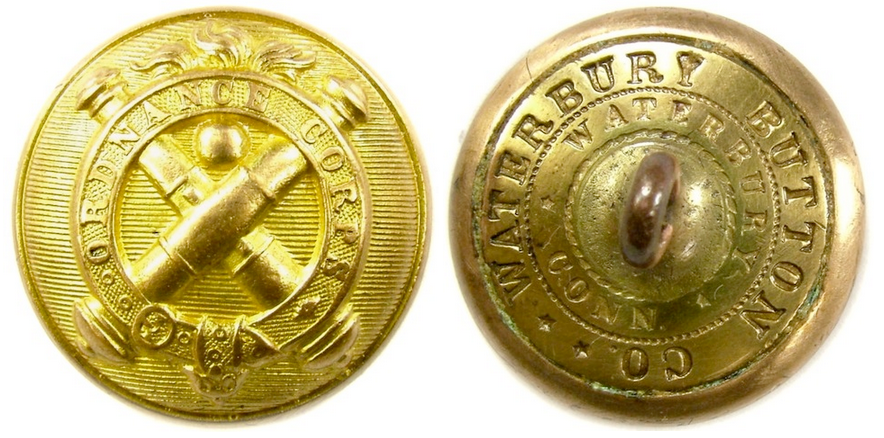
1860's to Post War Federal Ordnance Department
Color: A Bright Gold.
Metal: 2 Piece, Convex, Raised Design, Gilded
Brass.
Size: 23.03mm. Coat Size
Albert's Number: OC 5.: RV 2
Tice's Number: ORD 215A.6
Variation: Four Single Ringed Cross Cannons /
Right Angles / Buckled Garter - Raised Dots 4 Additional
Buckle Holes / One Decorative Elongated Diamond.
Present Condition: A Non Excavated Example,
Exceptional Planchet Casting, Exceptional High Relief
Pattern.
Isabela's Notes: This is another manufacturer's
pattern who's die variant is just slightly different. In
this variant, the buckle holes are open circles, and the
Roman Font capital letters are thinner. The button's
pattern depicts
Four Single Rings on a set of Cross
Cannons. In this die variant, the cannon's tubes are set
at Right Angles. There is a flaming bomb set between the
cannon's top cross hatch, and it's flame is above the
buckled garter. Circling on top of the cannon's tubes is
a
Buckled Garter with a Raised Dot foundation. Written
within the garter's channel is the designation,
"ORDNANCE CORPS" in Thin Roman Font Capital Letters.
This is followed by
One Decorative Elongated Diamond, a
circling buckle strap followed by a
Buckle Hole, a Round
Buckle, and
Two more Buckle Holes. The high relief
pattern is set on a convex lined field with a thin
raised edge. Collectors usually take distinctive note
between manufacturer's specimen's who's cannon barrels
are crossed at angles less then 90 degrees, and the ones
that are crossed at right angles. Both types were
manufactured from the early 1840's. Also there is a
decorative distinction to the buckled garters
themselves.
Reverse Button Analysis: This is a
two-piece-piece button with a copper loop shank. The
shank is original, straight, and intact. *WATERBURY
BUTTON CO. **/ WATERBURY * CONN.* is within 2 dm ring of
dots, and large periphery ring.
The RJ Silverstein Collection.
|

