|
|
Revolutionary War "Era" Buttons 1775 to 1805
%20Button%2018mm%20Virginia%20Dug%20RJ%20SILVERSTEIN'S%20GEORGEWASHINGTONINAUGURALBUTTONS.COM%20R.jpg)
Robert's Notes: If there is a date next to the button,
this indicates the year, or period the button was in
use, not when the Military Regiment was originally
formed or disbanded. Some Regiments were known to use
multiple patterns depending on the dates of service.
Some button's patterns also transitioned through the
same time period that others were used. Some regiments
were known to absorb other companies or regiments, and
may have had a company use their old numbers within the
incorporation. So I will try to do my best for giving
you an accurate time period of use. |
|
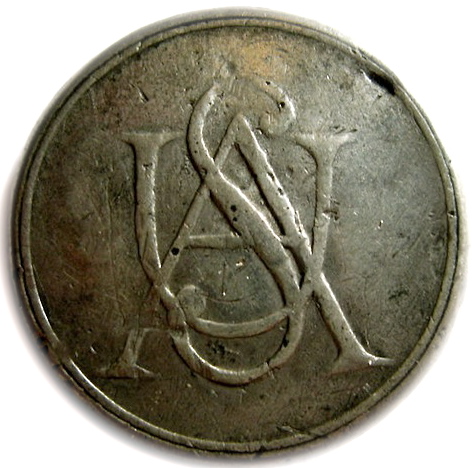
1780-84 CONTINENTAL ARMY OFFICER'S U.S.A. BUTTON (French
Import)
Color: A Silvery Gray.
Metal: 2-Piece, Raised Design, Tinned Pewter Repousse.
Size: 26.5mm.
Present Condition: A Non Excavated Example, Strong Repousse, Strong High Relief Pattern.
Isabela's Notes: This button is the large size officers
pattern. The button's pattern depicts a French-style overlaid U.S.A.
pattern within a double concentric ring border.
The serifs of the letter "A" just fall short of touching
the border. This unique pattern is mirrored from Lafayette's
French made belt plates, and infantry sword hangers. This is a
wonderful example, that has been well kept through the
ages.
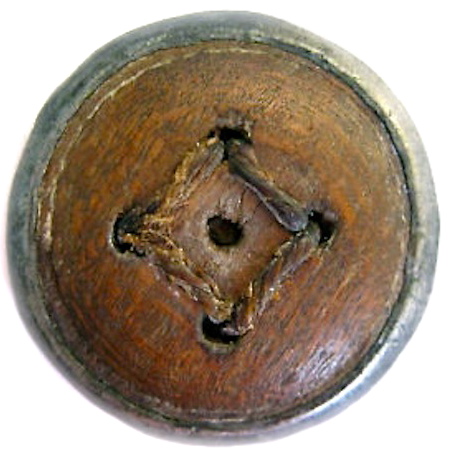
Reverse Button Analysis: This button has a wood back,
and uses a cat gut cord for the attachment.
Library Records Has Limited Information on R-1:
History: Yes Recorded Sales Price:
Yes
Current Button Owner and Location:
~ Virginia ~
Civilwarbuttons.com
The William Leigh Collection.
|
|
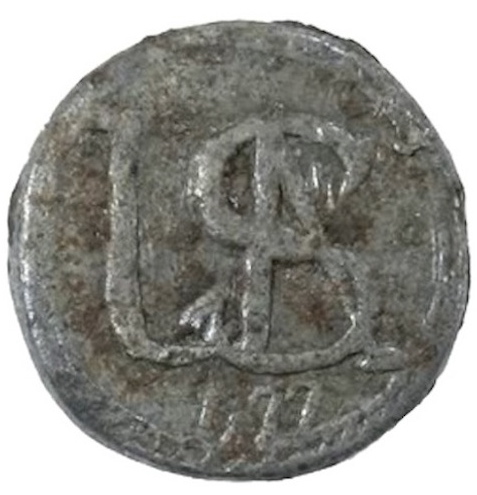
1777 CONTINENTAL ARMY ENLISTED MAN'S PATTERN U.S.A.
Button
Color: A Silvery Grey.
Metal: Flat, 1-Piece, Raised Design, Cast Pewter.
Size: 20mm.
Present Condition: A Excavated Example, Strong Planchet,
Strong High Relief Pattern.
Isabela's Notes: This button is another variation of the
U.S.A. pattern that was used by the enlisted men in the
Continental Army. The button's pattern depicts an intertwined
and overlaid "USA" pattern in high relief. The date, "1777"
in in the lower legend. The high relief pattern is set
on a flat plain field with a raised cable or link
border around the periphery. This button still retains a
nice clear image in high relief. Unfortunately, part of
the date and the cable link border is worn flat into the
surface.
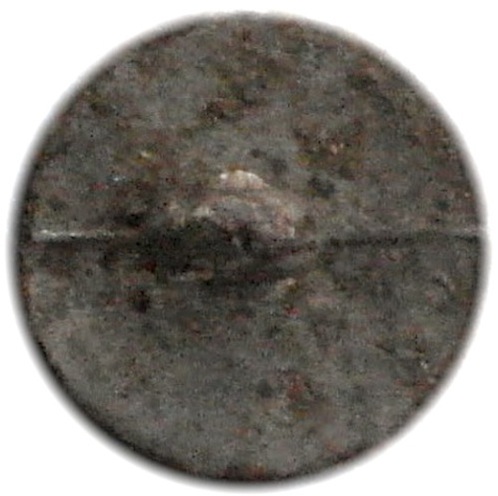
Reverse Button Analysis: This is a One-Piece Casting for
the Reverse Shank. The shank is unfortunately broken
off.
Library Records Has Limited Information on R-2:
History: Yes Recorded Sales Price:
Yes
Current Button Owner and Location: ~ Connecticut ~
Excavated on a farm in Connecticut, 2007.~ |
%20Button%2018mm%20Virginia%20Dug%20RJ%20SILVERSTEIN'S%20GEORGEWASHINGTONINAUGURALBUTTONS.COM%20O.jpg) 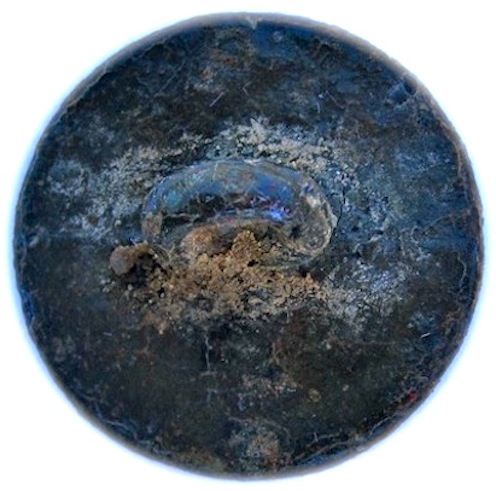
|
1778 CONTINENTAL ARMY ENLISTED MAN'S PATTERN U.S.A.
BUTTON
Color: A Silvery Grey.
Metal: Flat, 1-Piece, Raised Design, Cast Pewter.
Size: 19mm.
Present Condition: An Excavated Example, Strong Planchet
Casting, Strong High Relief Pattern.
Isabela's Notes: This is the most common pattern used
for enlisted men in the Continental Army. This pattern
has been found in almost all campsites and battlefields
from the beginning to the end of the war. This USA
button is the small size enlisted man's pattern. The
button's pattern depicts a large intertwined
"USA" on a flat field with a raised
pie-crust border. The button's planchet is solid and flat, and
shows no edge loss or deterioration which is rare
condition for an aged pewter button. The surface is a
bit uneven with several indents, but seems to give it
some nice character. The intertwined USA pattern still
shows nicely in high relief. The pie-crust border's is
still nicely raised, but notch design is worn on the
right hand side. Overall, this is an solid example for
it's age.
Reverse Button Analysis: This is a One-Piece Casting for
the Reverse Shank. The Shank is original, straight, and
intact.
Library Records Has Limited Information on R-3:
History: Yes Recorded Sales Price:
Yes
Current Button Owner and Location:
~ New York ~
Excavated near Fredericksburg, Virginia.~
The
RJ Silverstein Collection. |
|
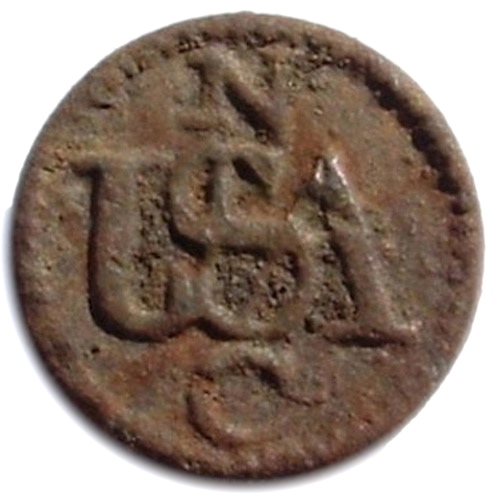
1778 NORTH CAROLINA U.S.A.
BUTTON
Color: A Brownish Grey with Orange Undertones.
Metal: Flat, 1-Piece, Raised Design, Cast Pewter.
Size: 16mm.
Present Condition: An Excavated Example, Strong
Planchet Casting, Strong High Relief Pattern.
Isabela's Notes: We do not know when exactly NC
USA buttons were adopted, but current theory thinks
toward the end of the war. Unfortunately none have been
recovered from any tightly dated sites. Most of these
buttons have been found in North Carolina, and only a
few were dug in the south. The current theory is that
these were used as regimental buttons. The button's
pattern depicts a large intertwined USA in the center,
with an "N" above, and a "C" underneath. The high relief
pattern is set on a flat plain field with a raised
scalloped border.
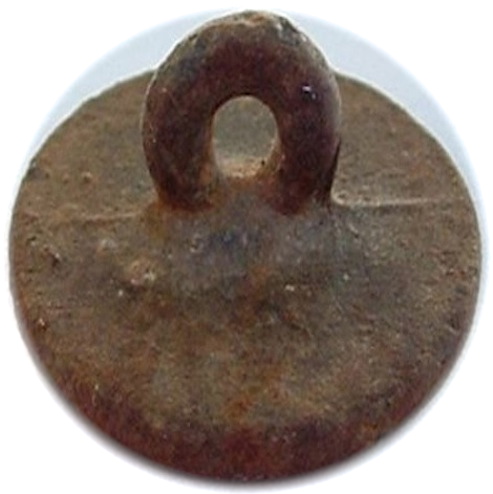
Reverse Button Analysis: This is a One-Piece
Casting for the Reverse Shank. The Shank is original,
straight, and intact.
Library Records Has Limited Information on R-3.2:
History: Yes
Recorded Sales Price: Digger Owner
Current Button Owner and Location:
~ New York ~
Excavated near Wilmington, North Carolina.~
The Keith Nixon Collection. |
%20Button%2018mm%20Virginia%20Dug%20RJ%20SILVERSTEIN'S%20GEORGEWASHINGTONINAUGURALBUTTONS.COM%20O%20(1).jpg)
|
1781-82 CONTINENTAL ARMY ENLISTED MAN'S PATTERN U.S.A.
BUTTON (French Import)
Color: A Silvery Charcoal Brown.
Metal: Slightly Convex, 1-Piece, Raised Design, White
Metal.
Size: 18mm.
Present Condition: An Excavated Example, Strong Planchet
Casting, Strong High Relief Pattern.
Isabela's Notes: This pattern is a little more rarer
variation of the USA patterns. It's a French import
style that was issued to the enlisted men still in the
Continental Army toward the end of the war. This button
is a small size enlisted man's pattern. The button's
pattern depicts an
intertwined "USA" on a slightly convex field with
no raised edge border.
This button is in exceptional condition for it's age,
and the intertwined high relief "USA" has a good clear
image. The planchet is solid with no metal or edge loss,
but the surface is slightly porous.
Reverse Button Analysis: This is a One-Piece Casting for
the Reverse Shank. The Shank is original and intact, but
slightly bent to the right.
Library Records Has Limited Information on R-4:
History: Yes Recorded Sales Price:
Yes
Current Button Owner and Location:
~ New York ~
Excavated in Virginia.~
The
RJ. Silverstein Collection. |
|
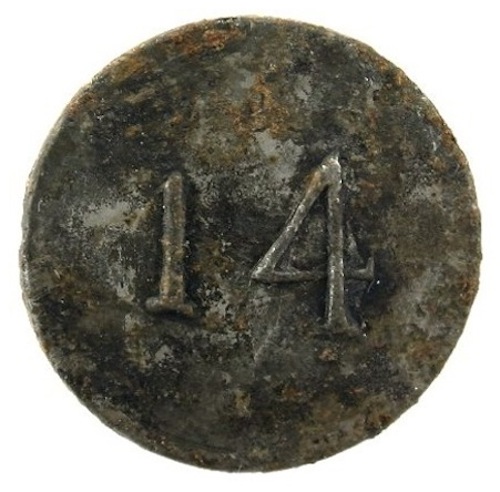
1776 14th CONTINENTAL REGIMENT
Color: A Charcoal Gray Mix.
Metal: Flat, 1-Piece, Raised Design, Cast Pewter.
Size: 22 mm.
Present Condition: An Excavated Example, Strong Planchet
Casting, Strong High Relief Pattern.
Isabela's Notes: The 14th Continental Regiment was
organized from Glover's Massachusetts regiment on
January 1, 1776. During the year, they engaged in the
siege of Boston, participated in both the Long Island
and New York campaigns, along with the battle at
Trenton-Princeton. The regiment officially disbanded
December 31,1776 in Pennsylvania. This is probably one
of the finest early regimental buttons to survive, a
true jewel in an American Revolutionary War Collection.
The buttons simple pattern depicts an Arabic style Regimental number "14" on
an open field with no edge border.
Reverse Button Analysis: This is a One-Piece Casting for
the Reverse Shank. The Shank is reportedly original,
straight, and intact.
Library Records Has Limited Information on R-5:
History: Yes Recorded Sales Price:
No
Current Button Owner and Location: ~ Connecticut ~
The Don Troiani Collection.
historicalartprints.com |
|
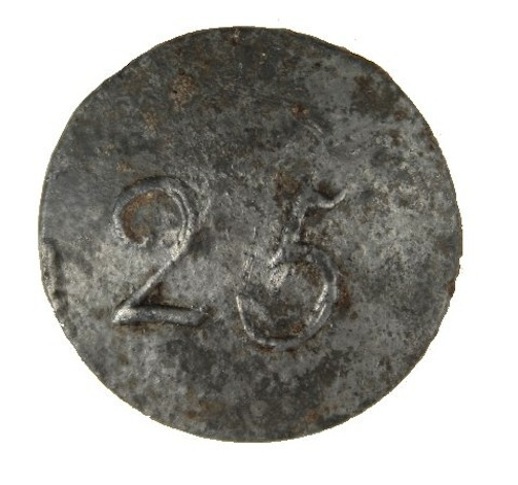
1776-77 25th CONTINENTAL REGIMENT
Color: A Pewter Gray.
Metal: Flat, 1-Piece, Raised Design, Cast Pewter.
Size: 22 mm.
Present Condition: An Excavated Example, Strong Planchet
Casting, Strong High Relief Pattern.
Isabela's Notes: The 25th regiment was organized from
Gardner's Massachusetts Regiment, with additional
companies from Cotton's and Danielson's Regiments in
January 1776. This regiment served at the siege of
Boston, and helped with the defense of Canada, had
actions in Lake Champlain, and in New Jersey in 1776.
they consolidated with the 24th regiment in January of
1777, and were re-designated as Greaton's Regiment. This
is an extremely nice example of an early continental
regiment button. Another Gem in an American
Revolutionary War button Collection. The button's simple
pattern depicts an
Arabic style Regimental number "25" on an open field
with a thin raised rim.
Reverse Button Analysis: This is a One-Piece Casting for
the Reverse Shank. The Shank is original, straight, and
intact.
Library Records Has Limited Information on R-6:
History: Yes Recorded Sales Price:
No
Current Button Owner and Location: ~ Connecticut ~
The Don Troiani Collection.
historicalartprints.com |
.jpg) 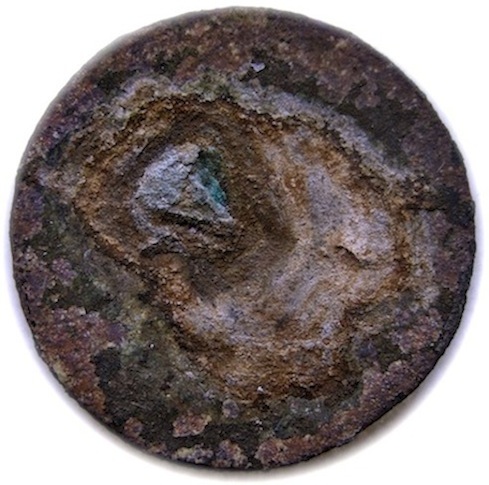
|
1776 CONTINENTAL ARTILLERY
Color: An Ocher Brown with Green Encrustations.
Metal: Slightly Convex, 1-Piece, Raised Design, Cast
Brass.
Size: 22mm. (21mm)
Present Condition: An Excavated Button, Fair Planchet,
Good High Relief Pattern.
Isabela's Notes: In 1776, Congress authorized the first
three Artillery regiments for the Continental Army.
Records indicate that Henry Knox placed an order for his
regiment early in 1776 with a Mr. Clark who was a button
maker. Several buttons of this style were also found in
the ruins of Fort Clinton, which was destroyed in the
early part of the war of October, 1777. Records show
there were three types of Continental Artillery buttons
manufactured: solid cast brass, copper repousse with
wood backs, and cast pewter. The first example pictured
above is of solid cast brass. This is an American
manufactured button that was issued to the enlisted
soldiers early on in the war. This was continually made
and issued right up to nearly the of the war. This
specimen is the enlisted man's pattern. The button's
pattern depicts a Cannon with a raised Grand Union Flag in
behind it. The button's design has a plain edge
border.
Reverse Button Analysis: This Reverse has a sweated on
Copper Loop Shank. The shank is missing.
Library Records Has Limited Information on R-7:
History: Yes Recorded Sales Price:
Yes
Current Button Owner and Location:
~ New York ~
Robert's Notes: Records show that in 1781, there was an
order placed to James Byers, a Philadelphia manufacturer
for a smaller waistcoat/vest size of this pattern in
cast brass, but the order was denied. Only one size was
manufactured. Most likely because of limited funds.
Excavated in the Hudson Highlands.~
The
RJ Silverstein Collection. |
|
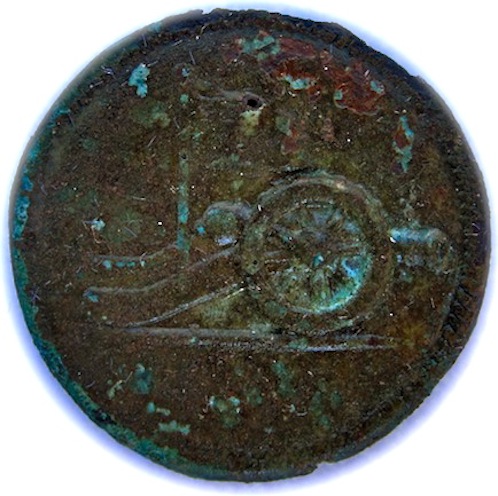
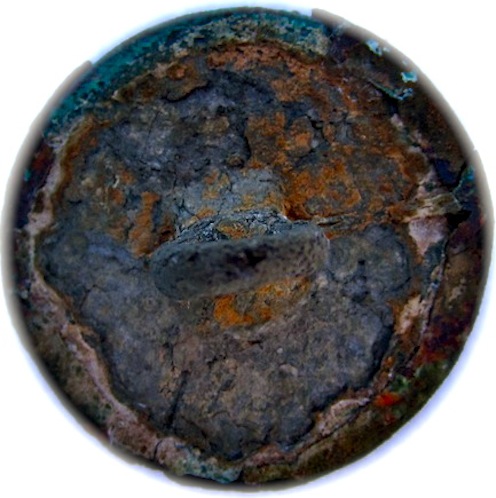
1781 CONTINENTAL ARTILLERY (French Import Style)
Color: An Ochre Pigment with Green Encrustations.
Metal: 2-Piece Repousse Sheet Copper, Possibly Gilded.
Size: 24mm.
Rarity: R-3 (Only two examples are known to have
survived with a pewter replaced backs for the shank).
Present Condition: An Excavated Example, Fair Planchet
Casting, Good High Relief Pattern.
Isabela's Notes: The first appearance of these French
Import style copper repousse buttons probably comes from
an order placed by Colonel John Laurens in April 1781.
The order was filled by Sabatier Sons and Despres. It
arrived on the French ship Duque Dourin in Boston Harbor
in August 22, 1781. Originally this button was slated
for officers, but it's quantities found throughout the
Hudson Valley indicate that it was used by enlisted men
as well. This button has been known to have been
originally wrapped around Florida's Boxwood for the
shank, and also
soldiers in the field crimped them around pewter cast U.S.A. buttons. This
French
import style artillery button is made of repousse sheet
copper, and was intended to be used with a wooden back
with cat gut cord. The button's pattern depicts a Cannon
with a raised Grand Union Flag behind. The high relief
pattern is set on a flat field with a raised pie crust
border. This button has been mostly excavated around the
various forts in the New York's Hudson Valley Region, and around
West Point.
Reverse Button Analysis: This is a four hole wooden back
type shank that and uses cat gut cord for the
attachment.
Library Records Has Limited Information on R-8:
History: Yes Recorded Sales Price:
Yes
Current Button Owner and Location:
~ New York ~
Excavated in the Hudson Highlands.~
The
RJ Silverstein Collection. |
|
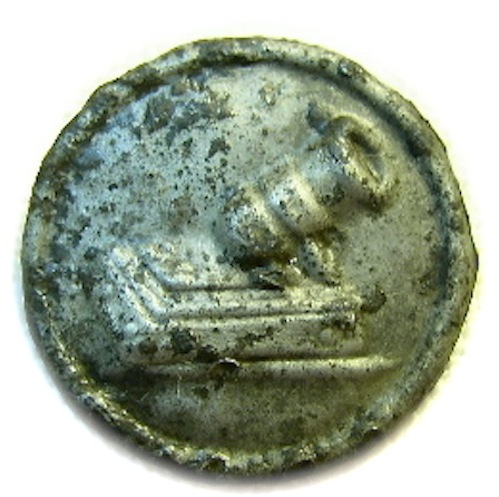
1778 CONTINENTAL ARTILLERY COEHORN MORTAR BUTTON
Color: An Orange Silvery Mix.
Metal: Flat, 1-Piece, Raised Design, Cast Pewter.
Size: 17mm.
Present Condition: A Strong Planchet with a Strong High
Relief Pattern
Isabela's Notes: This example is the third type of
manufactured Artillery button, which is made in a
one-piece cast pewter. The Coehorn Mortar design was
used as the small size button to be worn in-conjunction
with the large size cannon pattern. This design has also
been found in sheet copper for officer's use. The Copper
Officer's pattern only differentiates by a single raised
line border; instead of a double concentric ring border
for the enlisted man's pewter issue. This pattern is
usually difficult to obtain, and most found for sale are
in poor shape. This example above is an exceedingly nice
example of this issue. The button's pattern depicts a Coehorn
Mortar on a flat field with a raised double concentric
ring border. The planchet on this button is solid, and
shows no metal deterioration or edge loss. The motif has
a clear image, and the border is still nicely raised.
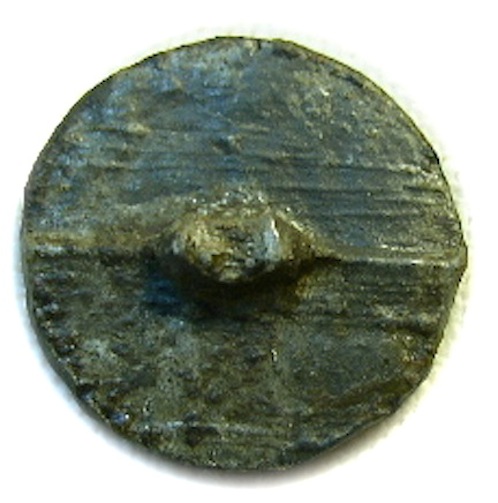
Reverse Button Analysis: This is a One-Piece Casting for
the Reverse Shank. The Loop Shank is unfortunately
broken off.
Library Records Has Limited Information on R-9:
History: No Recorded Sales Price: Not For Sale
Current Button Owner and Location: ~ New Jersey ~
Jim Dews, The Keemakoo's Collection.
beltplates.com
Isabela's Notes: There is another Cast Pewter Pattern
for Artillery that has been recovered around the West
Point Area, and is thought to date to the early part of
the revolution. The design has two field guns placed
back to back with a collection of striped flags.~ |
|
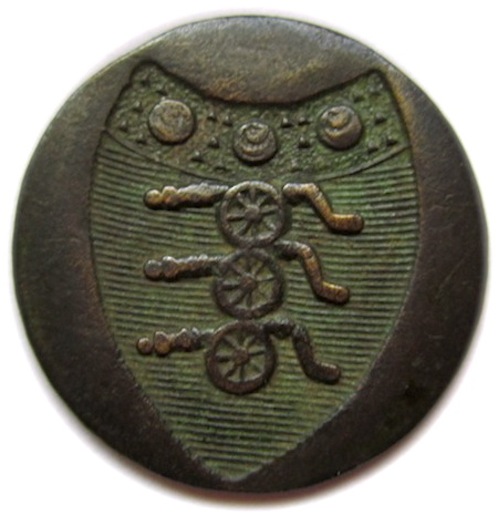
1783 ROYAL ARTILLERY BUTTON (First Seen Post Revolution)
Color: A Brass Yellow/Brown with Green Encrustations.
Metal: Flat, 1-Piece, Raised Design, Cast Brass.
Size: 25mm.
Present Condition: A Non Excavated Example, Exceptional
Planchet Casting, Exceptional High Relief Pattern.
Isabela's Notes: In 1779 an unofficial battalion was
raised and fought in almost every campaign in America.
In the American Revolution, British soldiers wore blank
unmarked flat brass buttons. There may have been two
possible types of officers repousse buttons with bone
backs and cat gut cords that may have been used, but
there have been no known excavated examples in North
America. In 1782, the official Artillery button was
adopted for all ranks. The button's pattern depicts three cannons
at rest in the
center. There are three cannon balls above the cannons in an arc. The design was placed
in a sunken lined Norman
Shield. Some button's reverses could have the raised
Samuel Firmin back mark of "SF". The first order
fulfillment probably wasn't until 1783, after the war
ended. There have been no battlefields or campsites
prior to 1784 that have shown this pattern to be found.
In the example above, the brass planchet is solid and
flat, and has no metal fatigue or deterioration. The
surface has a clear image of all three Cannons, and the
Cannon Balls have a clear unobstructed image in their
field. The sunken Norman shield shows all the lines
clearly, and has a nice aged green patina. This is an
outstanding example, and makes a nice representation of
this first pattern issue.
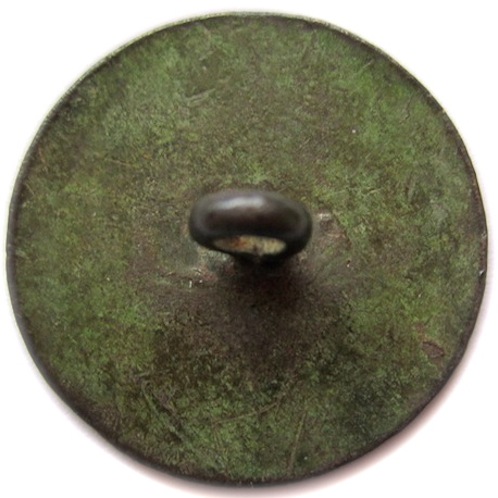
Reverse Button Analysis: This is a One Piece Casting for
the Reverse Shank. The shank is original, straight, and
intact.
Library Records Has Limited Information on R-11:
History: Yes Recorded Sales Price:
Yes
Current Button Owner and Location:
~ New York ~
Comes from England.~
The
RJ Silverstein Collection. |
|
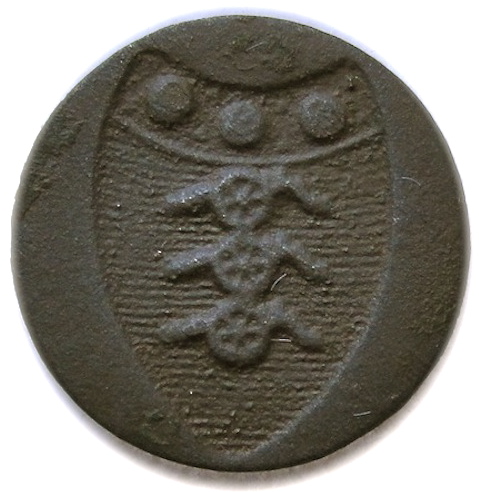
1783 ROYAL ARTILLERY VEST/CUFF BUTTON (Post Revolution)
Color: This has an Olive Brown Patina.
Metal: Flat, 1-Piece, Raised Design, Cast Brass.
Size: 17mm. Cuff /Vest Size
Rarity: R-2
Present Condition: An Excavated Example, Strong Planchet
Casting, Strong High Relief Pattern.
Robert's Comments: In 1779 an unofficial battalion was
raised and fought in almost every campaign in America.
In the American Revolution, british soldiers wore blank
unmarked flat brass buttons. There may have been two
possible types of officers repousse buttons with bone
backs and cat gut cords that may have been used, but
there have been no known excavated examples in North
America. In 1782, this official Artillery button was
adopted for all ranks. The button's pattern depicts three cannons
at rest in the
center. There are three cannon balls above the cannons in an arc. The design was placed
in a sunken lined Norman Shield.
Some button's reverses should have the Samuel Firmin's
raised back mark of "SF". The first order fulfillment
probably wasn't until 1783, after the war ended. Even
though the button above was excavated, it still clearly
shows a good image of the original pattern.
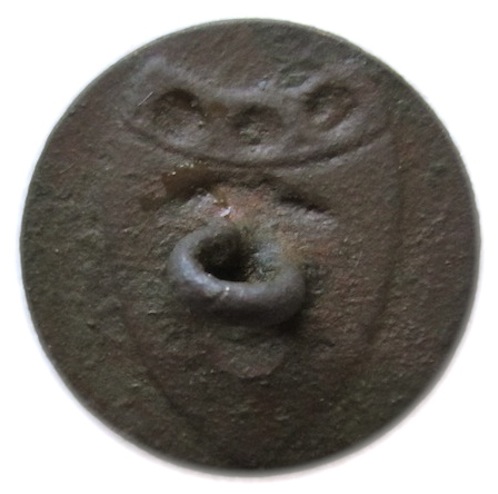
Reverse Button Analysis: This is a One Piece button with
a loop shank. The shank is original, straight, and
intact.
Library Records Has Limited Information on R-12:
History: Yes Recorded Sales Price:
Yes
Current Button Owner and Location:
~ New York ~
Excavated in Upstate New York.~
The RJ Silverstein Collection. |
|
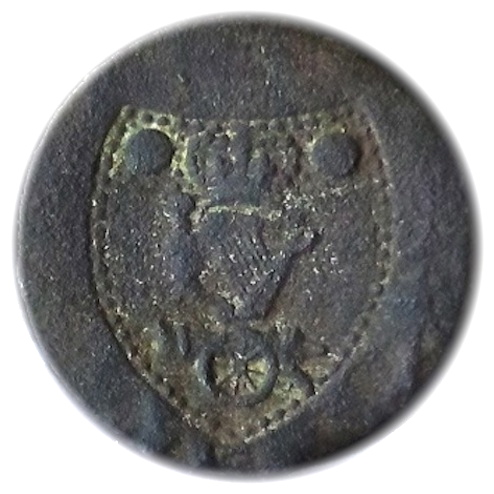
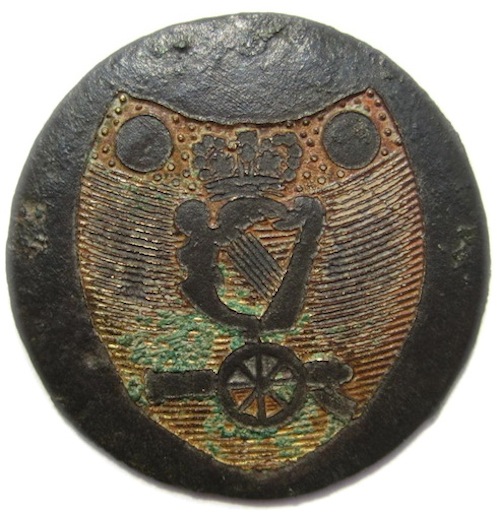
1785-1801 ROYAL IRISH ARTILLERY
Color: Charcoal Ask Grey with White
Encrustations.
Metal: Flat, 1-Piece, Raised Design, Cast Brass.
Size: 24mm.
Rarity: R-4
Variation: Dotted Shield Perimeter / Canon Wheel
Even with Cannon Top / Modern Cannon.
Present Condition: An Excavated Example, Good
Planchet Casting, Good High Relief Pattern.
Robert's Comments: This Artillery Unit was
originally raised in Dublin Ireland in 1756, and was
mostly comprised of various Royal Artillery Detachments.
There are some records that show there was a small
detachment from this regiment that served with
Burgoyne's expedition in 1777; but for the most part,
this regiment mostly served in the West indies in the
1790's. They they officially disbanded in 1801. The
button's pattern depicts a Royal Crown surmounting an
Irish harp. This is above a modern style cannon. The
cannon has a short carriage, and the cannon's wheel is
even with the top of the cannon. There are two raised
dimples on each side of the crown. The high relief
pattern is set within a sunken Norman Shield that has a
lined field. This die variant does have the perimeter
dots which completely goes around the inside of the
shield's edge border. There are rarer die variants known
that do not posses these perimeter dots.
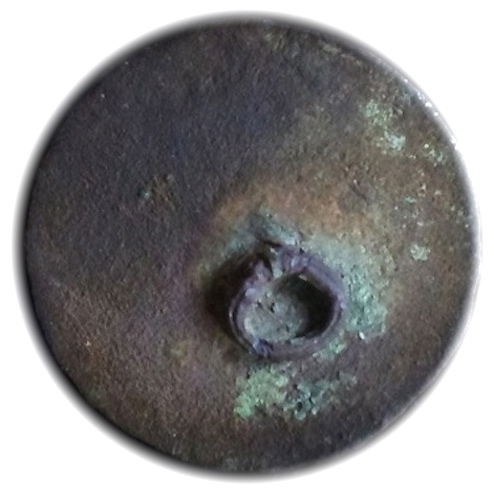
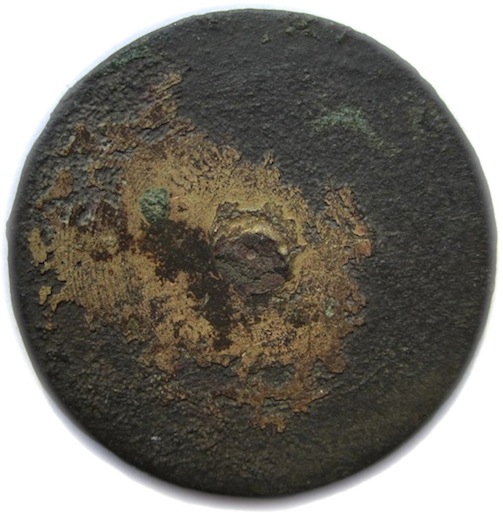
Reverse Button Analysis: This is a one piece
button with a Loop Shank. The shank is original and
intact, but bent over.
Library Records Has Limited Information on R-13:
History: No
Recorded Sales Price: Yes
Current Button Owner and Location: No
The Isabela Collection.~ |
|
1785-1801 ROYAL IRISH ARTILLERY
Color: Aged Brown with Orange & Green Undertones.
Metal: Flat, 1-Piece, Raised Design, Gilded
Brass.
Size: 24mm.
Rarity: R-5
Present Condition: An Excavated Example, Good
Planchet, Strong High Relief.
Variation: Canon Wheel Extends Past Cannon Top /
Old Style Cannon at Rest / Crown Pattern Dotted / No
Perimeter Dots.
Robert's Comments: This is the another die
variant that was used by the Royal Irish Artillery. This
button's pattern is slightly different then the other
two examples I list. First, this might have been
intended for officers instead of enlisted men since it
is Gilded Brass. This button's pattern depicts an old
style cannon at rest, with a ribbed breech. The cannon
has a short carriage, and the wheel extends above the
cannon. The crown itself is also a slightly different
style. The perimeter uses a raised dotted pattern, as
found on some other gilded buttons. The third noticeable
variation is that there is no raised dotted border on
the inside edge of the shield. This Artillery Unit was
originally raised in Dublin Ireland in 1756, and was
mostly comprised of various Royal Artillery Detachments.
There are some records that show there was a small
detachment from this regiment that served with
Burgoyne's expedition in 1777; but for the most part,
this regiment mostly served in the West indies in the
1790's. They they officially disbanded in 1801.
Reverse Button Analysis: This is a one piece
button with a Loop Shank. The loop shank is missing. The
surface is porous, corroded, and a bit uneven.
Library Records Has Limited Information on R-13.1:
History: No
Recorded Sales Price: Yes
Current Button Owner and Location:
~New York~
The Isabela Collection.~ |
|
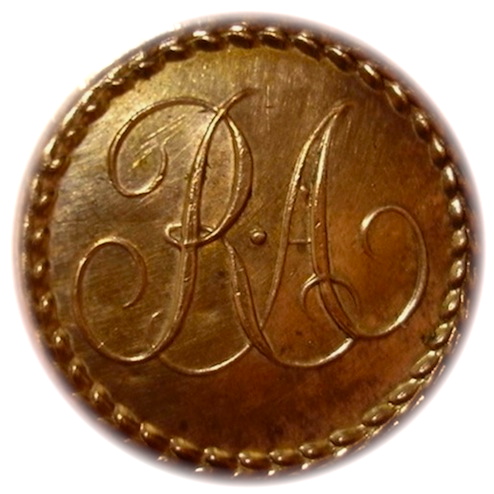
1784 HONORABLE EAST INDIA
COMPANY (ROYAL ARTILLERY)
Color: Coppery Orange.
Metal: Flat, 2-Piece, Raised Design, Copper
Repousse.
Size: 24mm.
Rarity: R-4
Present Condition: Anon Excavated Example,
Exceptional Planchet, Exceptional High Relief Pattern.
Variation: Raised Leaf Border / Script Initials.
Robert's Comments: This is a Post Revolutionary
War button, and has nothing to do with the American
Revolution. In Don Troiani's new book, "Insignias of
Independence", he states there is a portrait of an
officer of the Madras Artillery by Thomas Hicky circa
1784, and the button belongs to the Honorable East India
Company. The button's pattern depicts two large script
initials, "R.A" in the center. The high relief pattern
is set on a plain flat field, it has a raised dot in the
center of the initials, and a thin leaf edge border.
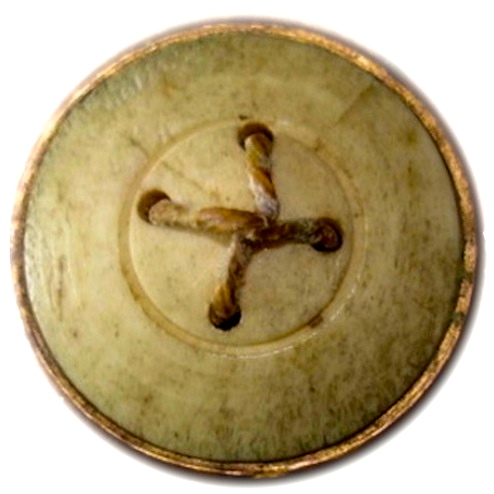
Reverse Button Analysis: This is a Bone back
button with cat gut cord attachment.
Library Records Has Limited Information on R-13.4:
History: No
Recorded Sales Price: Yes
Current Button Owner and Location: No |
|
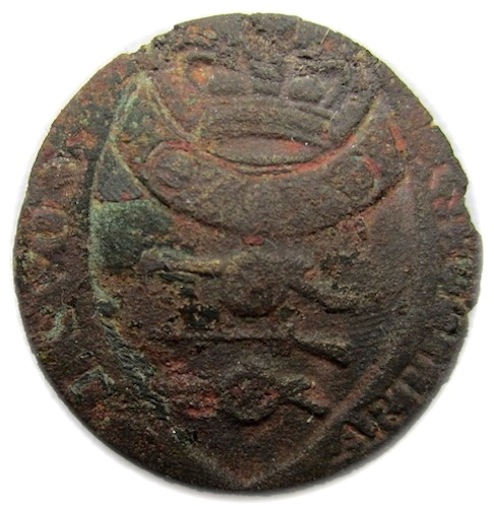
1785-1800 ENGLISH MILITIA
ARTILLERY
Color: An Aged Brown Patina with Red Undertones.
Metal: Slightly Convex, 1-Piece, Raised Design,
Brass.
Size: 26mm.
Rarity: R-5
Present Condition: An Excavated Example, Good
Planchet Casting, Strong High Relief Pattern.
Variation: Sunken Shield / 2 Cannons & Brown Bess
In-Between / Artillery.
Robert's Comments: This is a rare Post-Revolution
English Militia Artillery button. Most likely not an
officer's button. After talking with Don. Troiani, I
have come to believe that this button was most likely
worn by someone serving in one of the many militia
artillery units stationed in England. Most likely around
the beginning of the 19th Century, maybe a few years
before. The button's pattern depicts a sunken Norman
Shield with a surmounting crown above. Within the shield
there are two old style cannons pointing right, with a
brown Bess musket in-between. The cannon's carriages are
short, and the wheels extend past the top of the cannon.
The left hand-side of the button's edge, the word,
"ARTILLERY", is impressed in in capital letters, and the
right hand-side, I believe says, "COAST". The high
relief part of the pattern is set above and within the
sunken shield. There is also a lined foundation within
the shield. Outside of the shield is a wide oval edge
border.
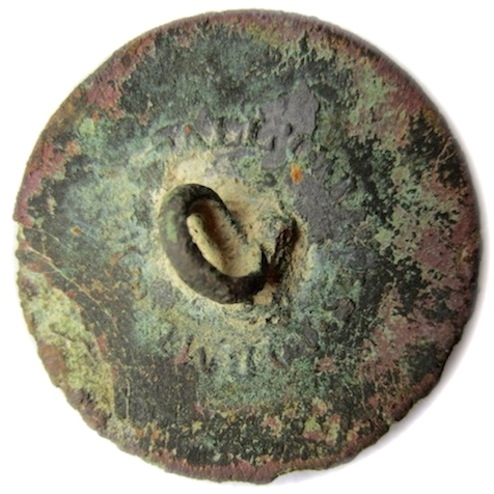
Reverse Button Analysis: This is a flat one-piece
button with a Loop Shank. The shank is original,
straight, and intact.
Library Records Has Limited Information on R-13.2:
History: Yes
Recorded Sales Price: Yes
Current Button Owner and Location:
~New York~
The Isabela Collection.~
My guess is English Militia , it's certainly not a
regular army artillery button. Probably dug in UK where
the unit stayed for it's entire existence. There was a
huge number of UK militia units at the time , all with
their own buttons and plates that sat out all the wars .
dt |
|
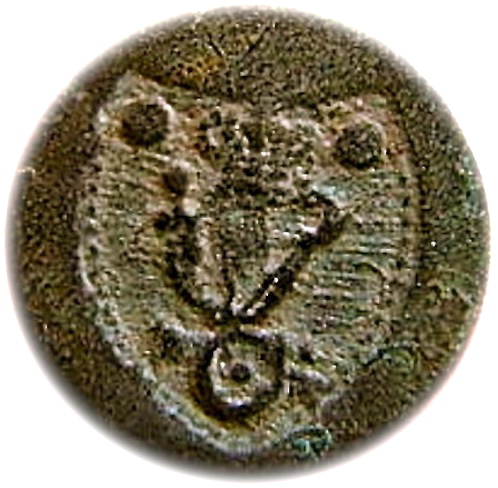
1785-1801 ROYAL IRISH ARTILLERY BUTTON
Color: This has an Olive Brown Patina.
Metal: Flat, 1-Piece, Raised Design, Cast Brass.
Size: 16.5mm. Cuff /Vest Size
Rarity: R-5
Present Condition: An Excavated Example, Fair Planchet,
Fair High Relief Pattern.
Robert's Comments: The button's pattern depicts a crown
surmounting a harp which is above a cannon. There are
two raised dimples on each side of the crown. This
button's Royal
Artillery Unit was originally raised in Dublin Ireland
in 1756, from a Royal Artillery Detachment that was sent
from England. There was a small detachment that served
with Burgoyne's expedition in 1777, but this regiment
mostly served in the West indies in the 1790's. They
officially disbanded in 1801.
Reverse Button Analysis: This is a soldered Copper Loop
Shank. The copper loop is missing. The surface is
extremely porous, and granular.
Library Records Has Limited Information on R-14:
History: Yes Recorded Sales Price: Yes
Current Button Owner and Location: No |
 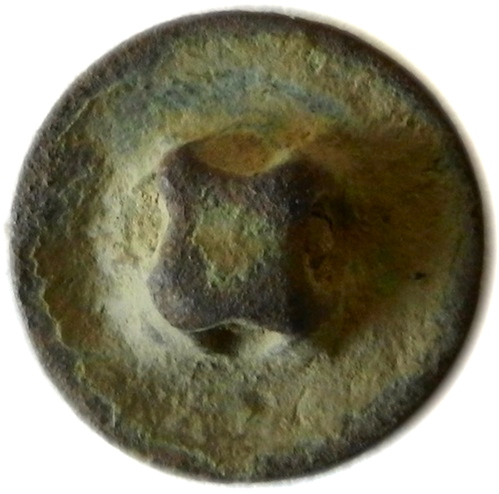
|
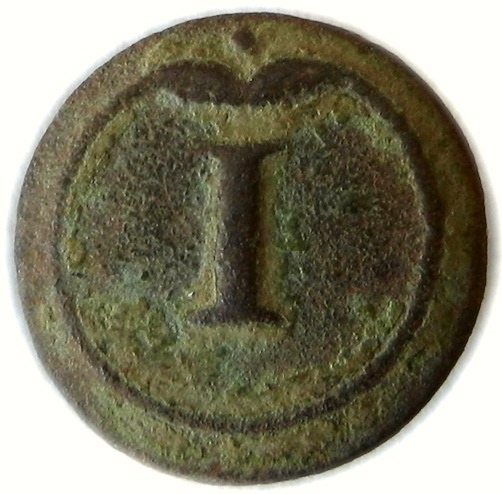
1762-80 1st REGIMENT
Picardie Regiment.
Color: A Sea foam Greenish-Brown Mix.
Metal: Flat, 1-Piece, Raised Design, White Metal
or Brass.
Size: 16mm.
Rarity: R-5
Present Condition: An Excavated Example, Strong
Planchet Casting, Strong High Relief Pattern.
Isabela's Notes: This is a French enlisted man's
pattern for the soldiers in the 1st Regiment. The
button's pattern depicts the regimental number "1" in
the center, which is enclosed by a broken circle with
tulip or lili ends. The circle break is surmounted by a
raised dimple. The high relief pattern is set on a plain
field with a very thin raised edge collar. A detachment
of this unit served as, "Ship Garrison" troops during
the Yorktown, Virginia campaign in 1781.
Reverse Button Analysis: This is birdcage to
turret shank. Shank is original, straight and intact.
Library Records Has Limited Information on R-15.1:
History: Yes
Recorded Sales Price: Yes
Current Button Owner and Location:
~ New York ~ |
|
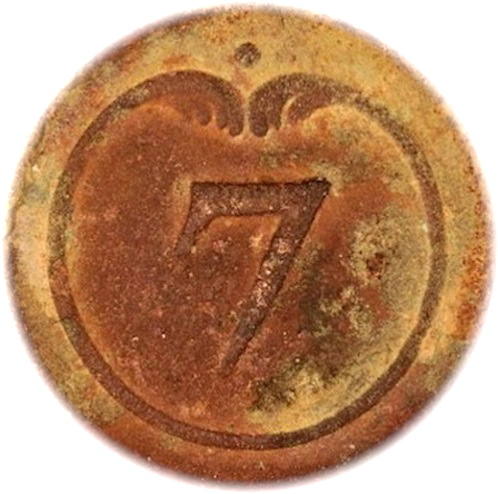
1775-83 7th REGIMENT
Bourbonnais Regiment in 1775.
Piermont Regiment in 1776.
Champagne Regiment in 1779
Color: A Charcoal Brown with Rusty Orange Highlights.
Metal: Flat, 1-Piece, Raised Design, Cast Brass.
Size: 17mm.
Rarity: R-3,4
Present Condition: An Excavated Example, Good Planchet
Casting, Good High Relief Pattern.
Isabela's Notes: This issue is the French enlisted man's
pattern for the large coat button. In Sept-Oct 1779,
they had a detachment at the siege of Savannah. In 1782,
they had detachments in Portsmouth, New Hampshire, and
Rhode Island. This older example probably dates back
from when Bourbonnais had a regiment in Yorktown,
Virginia. The button's pattern depicts a crude style
regiment number, "seven" in the center of a broken
circle with iris ends, and a dot above. The high relief
pattern is set on a flat field with no raised edge
border.
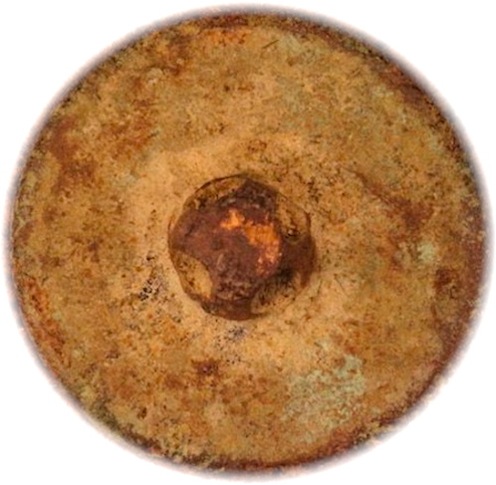
Reverse Button Analysis: This issue has a Turret style
shank. The Shank is original, upright, and intact.
Library Records Has Limited Information on R-15:
History: Yes Recorded Sales Price: Yes
Current Button Owner and Location: ~ Yes ~
Excavated near Yorktown, Virginia.~
RegimentalHeadquarters.com |
|
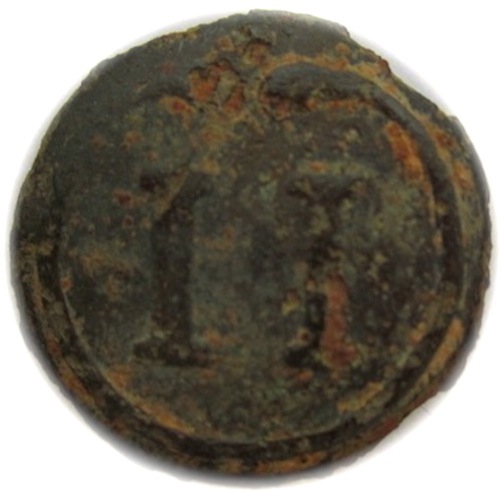
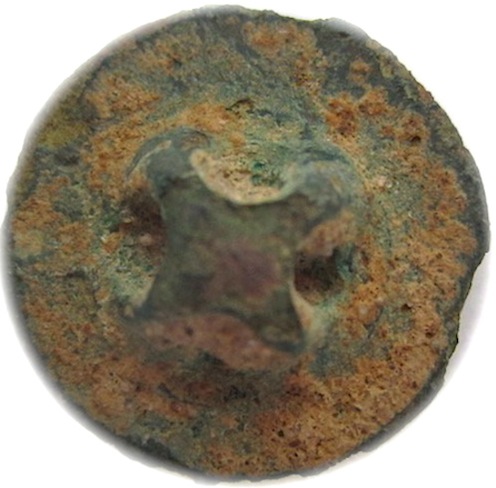
1776-91 11th REGIMENT
Guyenne Regiment 1762-1775~ (Bore 11, then re-designated
21st Reg.)
La Marine Regiment 1776-1791.
Color: A Charcoal Brown with Rusty Orange Highlights.
Metal: Flat, 1-Piece, Raised Design, Cast Brass.
Size: 17mm.
Rarity: R-6
Present Condition: An Excavated Example, Fair Planchet,
Good High Relief Pattern.
Isabela's Notes: This French issue is the small size
enlisted man's pattern that was used for a vest or cuff
button. This regiment number is rarely excavated, and
extremely hard to find. Another example has been found
near Yorktown, VA. The button's pattern depicts the
crude style regiment number, "eleven" in the center of a
broken circle with iris ends, and a dot above. The high
relief pattern is set on a flat field with a thin raised
edge border.
Reverse Button Analysis: This issue has a Turret style
shank. The Shank is original, upright, and intact.
Library Records Has Limited Information on R-16:
History: Yes Recorded Sales Price: Yes
Current Button Owner and Location: ~ New York ~
Excavated in Central Virginia.~
The Isabela Collection.~ |
|
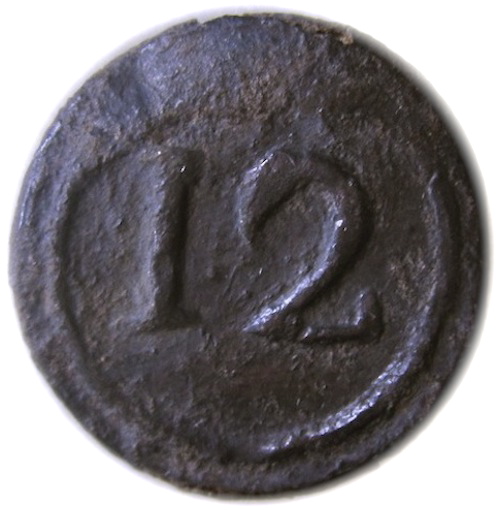
1777-83 12th REGIMENT
Auxerrois Regiment 1777-83.
Color: Dirt Brown.
Metal: Flat, 1-Piece, Raised Design, Cast Brass.
Size: 17mm.
Rarity: R-6
Present Condition: An Excavated Example, Strong Planchet
Casting, Strong High Relief Pattern.
Isabela's Notes: This French issue is the small size
enlisted man's pattern. This is also extremely rare, and
hard to find, only a few known to exist. This regiment
had a detachment at the siege of Savannah in Sept-Oct
1779. In August of 1781, a detachment of this regiment
played a small part on the raid on that took place on
the Fort Prince of Wales, in Hudson Bay. The button's
pattern depicts the crude style regiment number,
"twelve" in the center of a broken circle with iris
ends, and a dot above. The high relief pattern is set on
a flat field with no raised edge border.
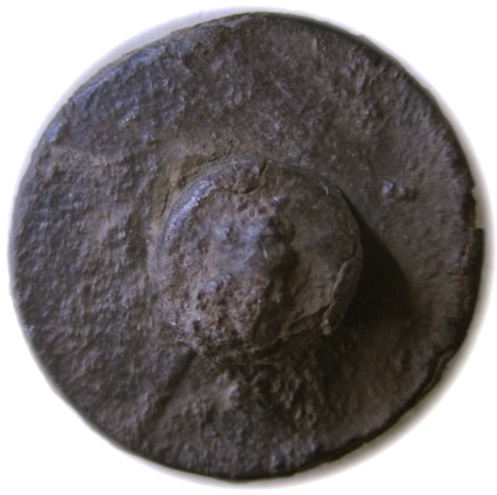
Reverse Button Analysis: The Boss is still intact, but
the loop is broken off.
Library Records Has Limited Information on R-17:
History: Yes Recorded Sales Price: Yes
Current Button Owner and Location: ~ New York ~
Excavated in Savannah, Georgia.~
The Isabela Collection.
One other specimen found in North Carolina.~ |
|
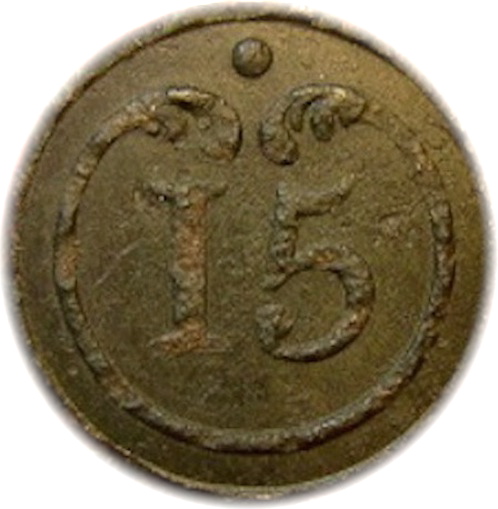
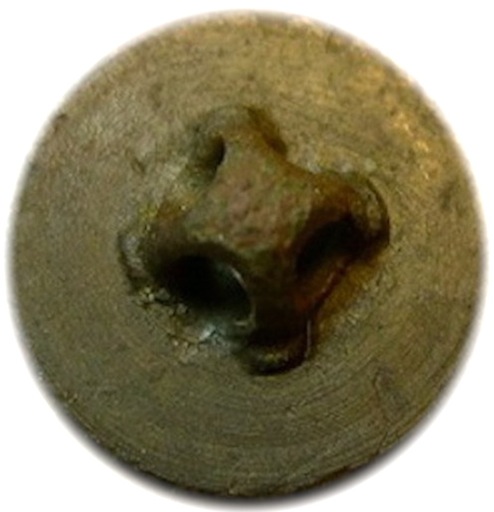
1776-79 15th REGIMENT
Bourbonnias Regiment 1776-1779.
Bearn Regiment 1779-1781.
Color: A Golden with Brown.
Metal: Flat, 1-Piece, Raised Design, Cast Bronze.
Size: 17mm.
Rarity: R-4
Present Condition: An Excavated Example, Strong Planchet
Casting, Strong High Relief Pattern.
Isabela's Notes: This French issue is the enlisted man's
pattern for a vest or cuff. This pattern has the old
style numbers, with the combination of a raised edge.
The button's pattern depicts the crude style regiment
number, "fifteen" in the center of a broken circle with
iris ends, and a dot above. The high relief pattern is
set on a flat field with a thin raised edge border.
Reverse Button Analysis: This issue has a Turret style
shank. The Shank is original, upright, and intact.
Library Records Has Limited Information on R-18:
History: Yes Recorded Sales Price: For Sale
Current Button Owner and Location: ~ New Jersey ~
The Keemakoo's Collection.~
www.Beltplates.com |
|
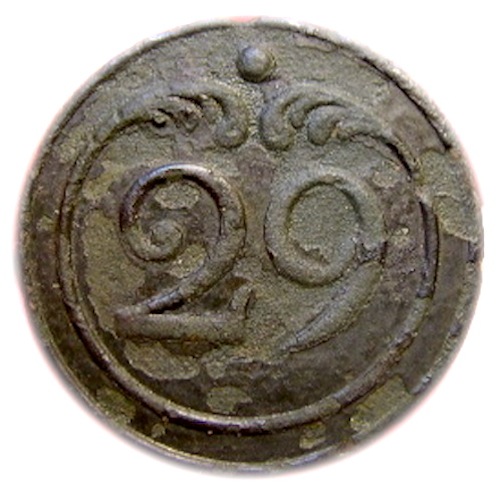
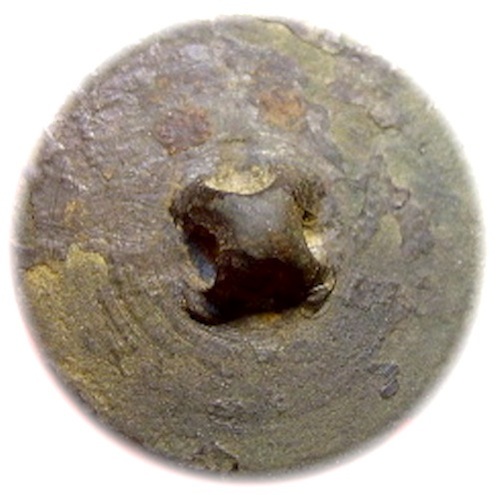
1776-91 51st REGIMENT
The Du Maine Regiment 1776-91
Color: An Olive Brown.
Metal: Flat, 1-Piece, Raised Design, Cast Brass.
Size: 23mm.
Rarity: R-4
Present Condition: An Excavated Example, Strong Planchet
Casting, Strong Raised Relief Pattern.
Isabela's Notes: This French issue is the large enlisted
man's pattern for a coat button. This regiment had a
detachment serving on fleet, as well as Gloucester Point
during the siege of Yorktown Virginia in 1781. The
button's pattern depicts the crude style regiment
number, "twenty nine" in the center of a broken circle
with iris ends, and a dot above. The high relief pattern
is set on a flat field with a thin raised edge border.
Reverse Button Analysis: This issue has a Turret style
shank. The Shank is original, upright, and intact.
Library Records Has Limited Information on R-19:
History: Yes Recorded Sales Price: For Sale
Current Button Owner and Location: ~ New Jersey ~
The Keemakoo's Collection.~
www.beltplates.com |
 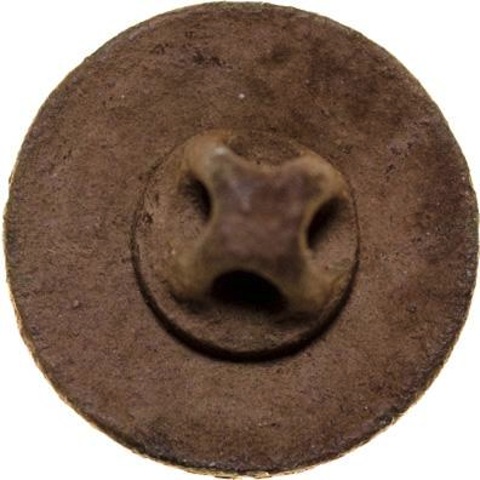
|
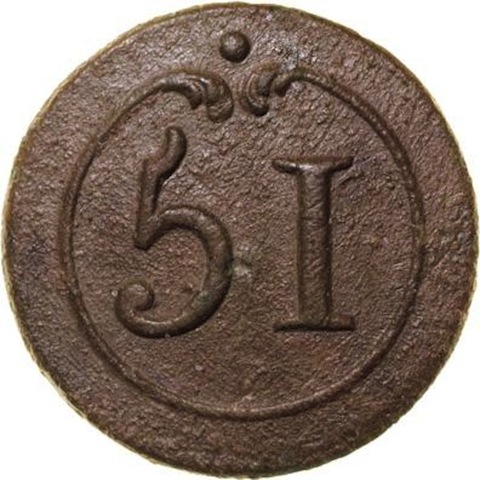
1776-91 51st REGIMENT
Hainault Regiment, Martinique 1778-1783.
Color: A Bright Mustard Brown.
Metal: Flat, 1-Piece, Raised Design, Cast Brass.
Size: 23mm.
Rarity: R-4
Present Condition: An Excavated Example, Strong Planchet
Casting, Strong Raised Relief Pattern.
Isabela's Notes: This French issue is the enlisted man's
pattern for a coat button. Originally the 33rd Regiment
from 1762-75, and then the 40th until 1776. From 1776 to
1791 it used the 51st Regiment number. This regiment had
a detachment at the siege of Savannah, in Sept-Oct of
1779.The button's pattern depicts the crude style
regiment number, "twenty nine" in the center of a broken
circle with iris ends, and a dot above. The high relief
pattern is set on a flat field with no edge border.
Reverse Button Analysis: This issue has a Turret style
shank. The Shank is original, upright, and intact.
Library Records Has Limited Information on R-20:
History: Yes Recorded Sales Price: Yes
Current Button Owner and Location: No
Excavated near Savannah, Georgia.~ |
|
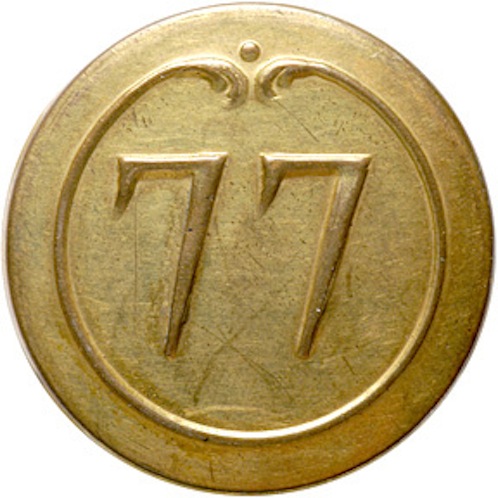
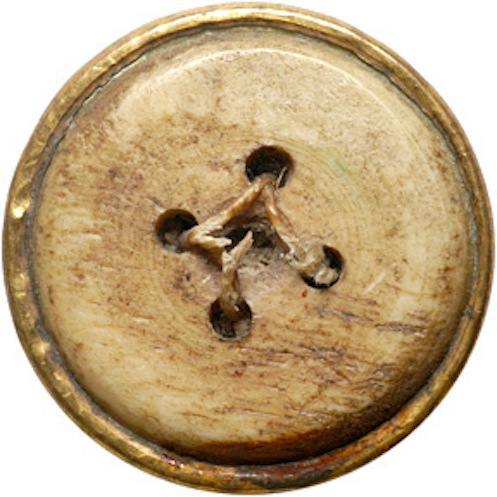
1776-86 77th REGIMENT
Buckley's Regiment 1767-1775.
Beaujolais Regiment 1776-1786.
Color: A Yellowish-White.
Metal: 2-Piece, Raised Pattern, Gilded Brass.
Size: 26mm.
Rarity: R-5
Present Condition: A Non Excavated Example, Exceptional
Casting, Exceptional High Relief Pattern.
Isabela's Notes: This is a French Officer's pattern for
a large coat button. This regiment traces it's origins
to both the 2nd Light Royal Italian Regiment of 1671,
and the Konigsmarch Regiment of 1680. It was dissolved
in 1940. This button was kept in an extraordinary state,
and was reported by the seller as having been removed
from the original uniform. The button's pattern depicts
the crude style regiment number, "seventy seven" in the
center of a broken circle with iris ends, and a dot
above. The high relief pattern is set on a flat field
with no edge border.
Reverse Button Analysis: This is a Bone Back with Cat
Gut Cord.
Library Records Has Limited Information on R-21:
History: Yes Recorded Sales Price: Yes
Current Button Owner and Location: No |
|
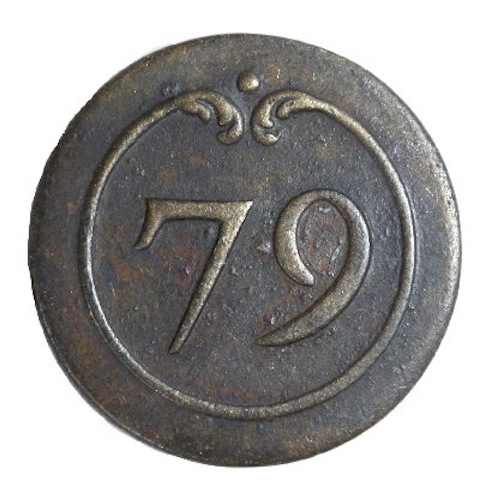
Pre-1776 79th REGIMENT
Pre-Dillion 1776.
Color: A Yellowish-White.
Metal: Flat, 1-Piece, Raised Design, Cast Brass.
Size: 17mm.
Rarity: R-5
Present Condition: An Excavated Example, Exceptional
Casting, Exceptional High Relief Pattern.
Isabela's Notes: This is the French enlisted man's vest
or cuff button. The number was assigned to the 90th
regiment prior to 1776. This number was not given to
another regiment after that date, so any buttons found
were earlier buttons still in use. The button's pattern
depicts the crude style regiment number, "seventy nine"
in the center of a broken circle with iris ends, and a
dot above. The high relief pattern is set on a flat
field with no edge border.
Reverse Button Analysis: This issue has a Turret style
shank. The Shank is original, upright, and intact.
Library Records Has Limited Information on R-22:
History: Yes Recorded Sales Price: Yes
Current Button Owner and Location: ~ Connecticut ~
|
|
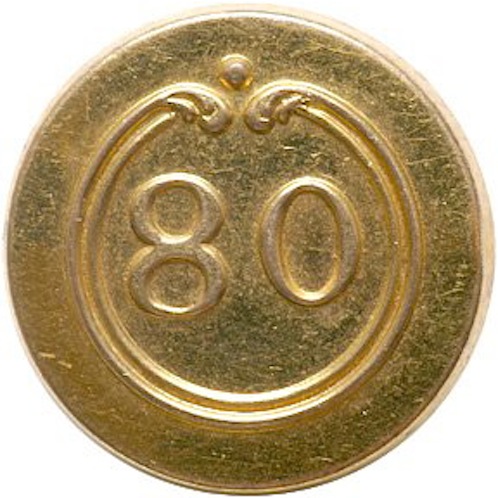
1781 80th REGIMENT
Lamarck's German Regiment.
Color: A Brass Yellow With Remnants of Gold.
Metal: 2-Piece, Raised Pattern, Gilded Brass.
Size: 17mm.
Rarity: R-5
Present Condition: A Non Excavated Example, Exceptional
Casting, Strong High Relief Pattern.
Isabela's Notes: This French officer's vest or cuff
button was nicely preserved. The button has a raised
regimental number "80" in the center, that is enclosed
by a raised broken circle with tulip or lili ends. The
circle break is adorned by a raised dot. About 5% of
it's original gilding appears to be retained. A
detachment was known to be stationed in Rhode Island in
June 1781, and participated in the raid on Lloyds Neck
in July. A detachment was also known to serve with the
Royal-Deux-Ponts (104 Regiment). The button's pattern
depicts the crude style regiment number, "eighty" in the
center of a double broken circle with iris ends, and a
dot above. The high relief pattern is set on a flat
field with no edge border.
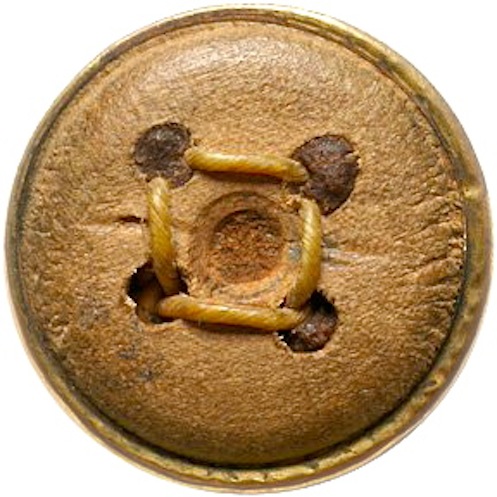
Reverse Button Analysis: This is a wooden back with cat
gut cord attachment.
Library Records Has Limited Information on R-23:
History: Yes Recorded Sales Price: Yes
Current Button Owner and Location: No |
|
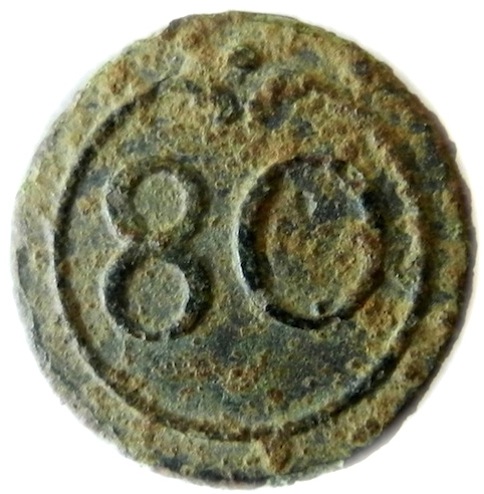
1781 80th REGIMENT
Lamarck Regiment.
Color: A Sea foam Greenish-Brown Mix.
Metal: Flat, 1-Piece, Raised Design, White Metal
or Brass.
Size: 17mm.
Rarity: R-5
Present Condition: An Excavated Example, Strong
Planchet Casting, Strong High Relief Pattern.
Isabela's Notes: This is a French enlisted man's
pattern for the 80th Regiment. The button's pattern
depicts the regimental number "80" in the center, which
is enclosed by a broken circle with tulip or lili ends.
The circle break is surmounted by a raised dimple. The
high relief pattern is set on a plain field with a very
thin raised edge collar. Not sure if this numbered
button reached stateside. This was a German regiment.
There was a detachment assigned to Royal Deux Ponts
104th Regiment, and was stationed in Rhode Island in
1781. There was a detachment that participated in the
Raid on Lloyd's Neck Bridge.
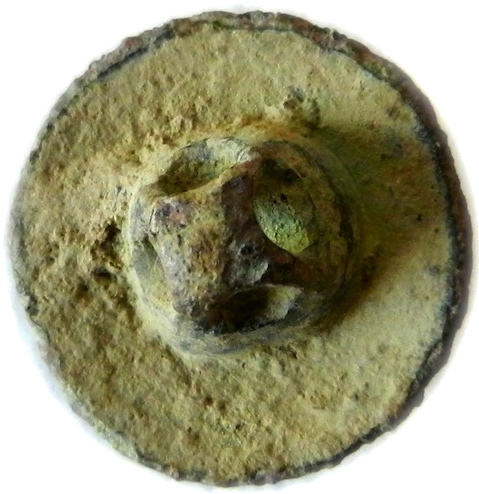
Reverse Button Analysis: This is birdcage to
turret shank. Shank is original, straight and intact.
Library Records Has Limited Information on R-23.1:
History: Yes
Recorded Sales Price: Yes
Current Button Owner and Location:
~ New York ~ |
|
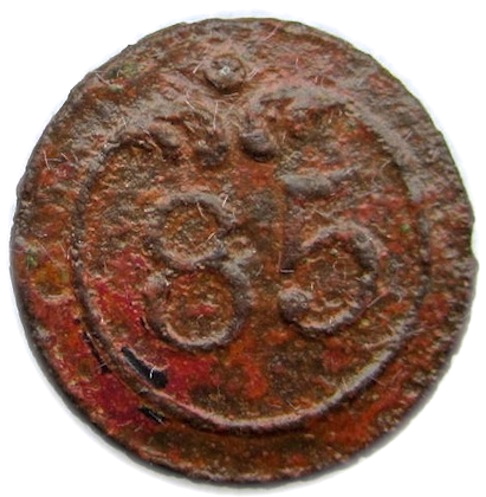
1780-83 85th REGIMENT
Saintonge Regiment.
Color: A Reddish Orange Brown Mix.
Metal: Flat, 1-Piece, Raised Design, White Metal
or Brass.
Size: 15mm.
Rarity: R-5
Present Condition: An Excavated Example, Strong
Planchet Casting, Strong High Relief.
Isabela's Notes: This is a French enlisted man's
pattern vest or cuff button. The button's pattern
depicts the regimental number "85" in the center, which
is enclosed by a broken circle with tulip or lili ends.
The circle break is surmounted by a raised dimple. The
high relief pattern is set on a plain field with a thin
raised edge border.
This regiment had service in the United States between
May of 1780 to June of 1783. They participated in the
raid on Lloyd's Neck in July of 1781; and were at the
siege of Yorktown, VA in Sept-October of 1781.
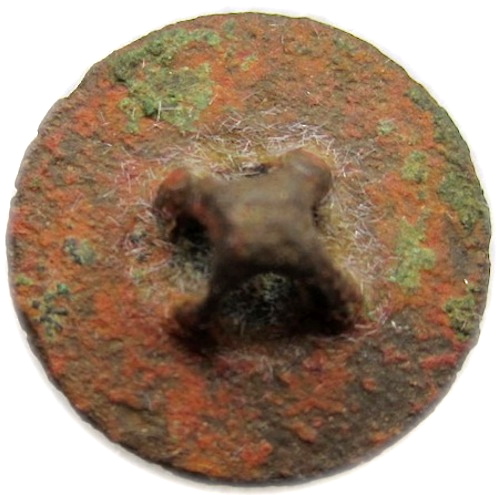
Reverse Button Analysis: This is birdcage to
turret shank. Shank is original and intact.
Library Records Has Limited Information on R-23.1:
History: Yes
Recorded Sales Price: Yes
Current Button Owner and Location:
~ New York ~
Excavated near Yorktown, VA
The Isabela Collection~ |
|
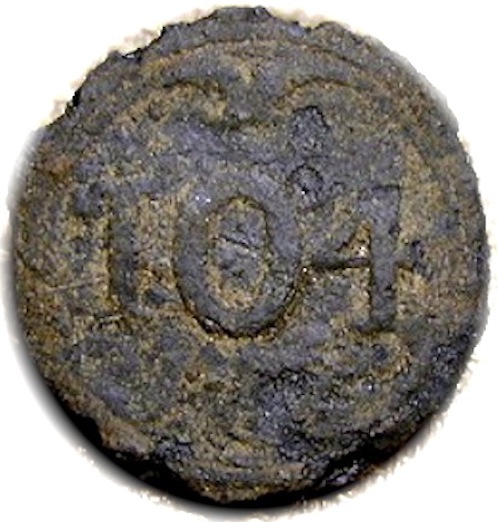
1776-91 104th REGIMENT (German)
Royal-Deux-Ponts Régiment 1776-1791.
Color: A Pewter Gray with Brown Encrustations.
Metal: Flat, 1-Piece, Raised Design, Cast Pewter.
Size: 26mm.
Rarity: R-5
Present Condition: An Excavated Example, Fair Planchet
Casting, Fair High Relief Pattern.
Isabela's Notes: Two battalions served in the United
States from May 2, 1780 to June 1783. The regiment
participated in the raid on Lloyd's Neck in July of
1781. The button has a raised regimental number "104" in
the center of a raised broken circle with lili ends.
There is a raised ornate dot above the top center. The
surface is corroded and decayed, but the raised
regimental number "104" is easy to see. The broken
circle is mostly worn flat, but there still is a clear
image in areas. The button's pattern depicts the crude
style regiment number, "104" in the center of a double
broken circle with iris ends, and a dot above. The high
relief pattern is set on a flat field with a thin raised
edge border.
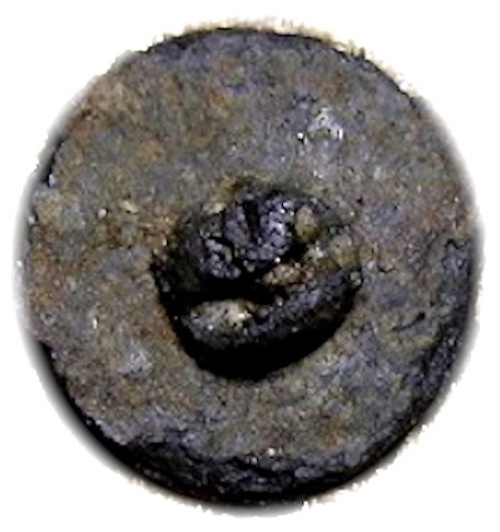
Reverse Button Analysis: This is a one-piece button with
a loop shank. The Boss is deteriorated, and
the loop is missing.
Library Records Has Limited Information on R-24:
History: Yes Recorded Sales Price: Yes
Current Button Owner and Location: ~ New Jersey~
Excavated in the Battlegrounds of Green Spring
Virginia.~
The Keemakoo's Collection.~ |
|
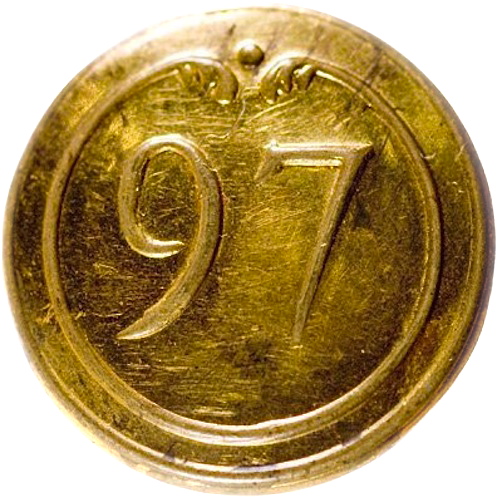
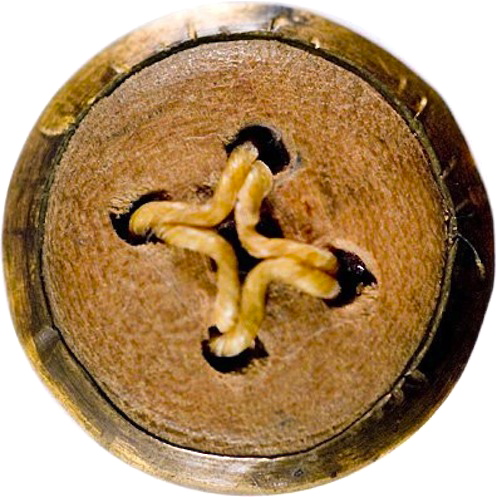
1781-83 97th REGIMENT - FRENCH OFFICER'S VEST BUTTON
Royal-Hesse-Darmstadt Regiment 1781-1783.
Color: A Golden with Brown.
Metal: 2-Piece, Raised Pattern, Gilded Brass.
Size: 17mm.
Present Condition: A Non Excavated Example, Exceptional
Repousse, Exceptional High Relief.
Isabela's Notes: This is another example that was known
to have been taken directly off a preserved uniform.
This particular regiment was not known to have served in
the American Theatre during war time. They were
stationed mostly in the West Indies in December 1781 to
April 1783. The button is an exceptional example of a
French brass repousse button which has a wood back and
uses cat gut cord for the attachment. The raised
regimental number, broken circle, and raised dot has a
good strong image. The surface unfortunately shows light
scratches and abrasions, but it doesn't take away from
the button's beauty, or high relief design. The
button's pattern depicts the crude style regiment
number, "ninety seventy seven" in the center of a broken
circle with iris ends, and a dot above. The high relief
pattern is set on a flat field with a thin raised edge
border.
Reverse Button Analysis: This is a two-piece button with
a wood back and cat gut cord. Still intact.
Library Records Has Limited Information on R-25:
History: Yes Recorded Sales Price: Yes
Current Button Owner and Location: No
|
|
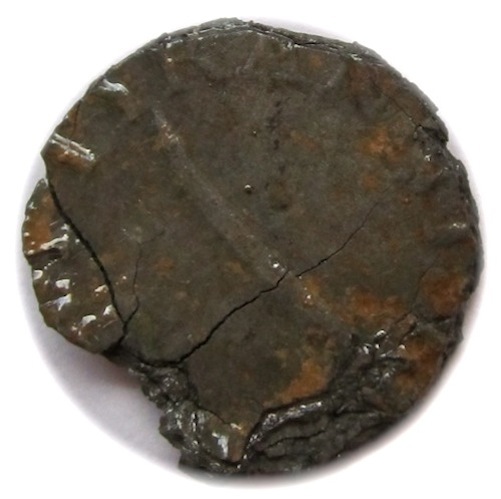
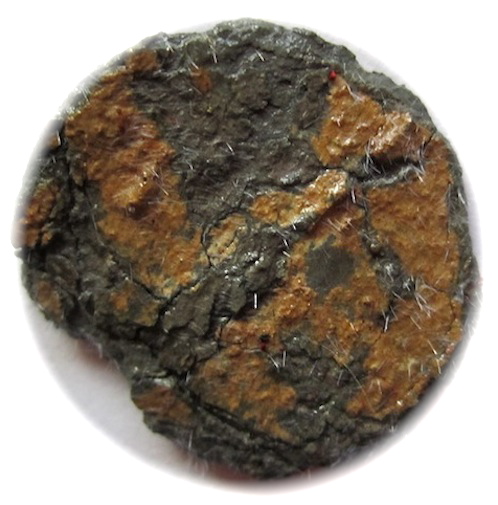
1776 INIMICA TYRANNIS PATTERN FROM BOSTON'S INDEPENDENT
MILITIA
Color: An Olive Brown Orange Mixture.
Metal: Flat, 1-Piece, Raised Design, Cast Pewter
Size: 23mm.
Rarity: R-5
Present Condition: An Excavated Example, Poor Planchet,
Fair High Relief Pattern.
Isabela's Notes: Originally this button was suppose to
say "Hec Manus Inimica Tyrannis" on a plain field, but
the design of a hand holding a drawn sword was thought
to be more expressive then a motto, and also thought to
be more representative of a fighting company. The
original pattern idea also included a broken scabbard,
but the design was never used for unknown reasons. The
company's original Commander Henry Jackson was given an
additional regiment in 1777, who were also issued this
pattern. The button was used until 1781, and then they
were consolidated with the 9th Massachusetts regiment.
This button has been found in the Hudson Highlands, and
also the New Boston Cantonment along with Massachusetts
9th Regiment buttons. Some additional research theorizes
this button may have been pre-cast as early as July or
August of 1776, which was before the General Court of
Massachusetts received a petition for the uniform code
which was in December 1776.
Reverse Button Analysis: This is a One-Piece Casting for
the Reverse Shank. The shank is unfortunately missing.
Library Records Has Limited Information on R-26:
History: Yes Recorded Sales Price: Yes
Current Button Owner and Location: ~ New York ~
The Isabela Collection. |
|
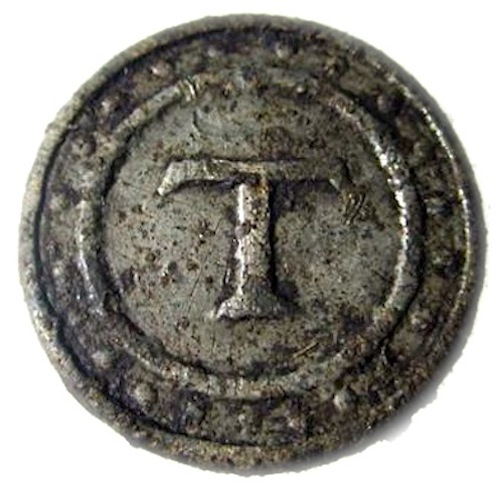
1775 THOMAS 2ND REGIMENT OF MASSACHUSETTS GRAND ARMY
Color: A Silvery Ocher.
Metal: Flat, 1-Piece, Raised Design, Cast Pewter.
Size: 22mm.
Rarity: R-7 (Only 2 known to exist)
Present Condition: An Excavated Example, Strong Planchet,
Strong Raised Relief Pattern.
Isabela's Notes: This is an exceptional example that has
stood the test of time. The most likely theory is that
this pattern is an exact style match for The
Massachusetts Grand Army of 1775. Thomas commanded the
2nd regiment, and this button would be attributed to
him. The button uses his initial instead of "2" for the
regiment he commanded. This unit later consolidated with
Cotton's 4th Regiment to form Washington's 23rd
Continental Army Regiment. The pattern has the initial
"T" in high relief, which is encompassed by a channeled
double ring concentric border. Inside the channel is a
series of 21 raised dots. An outstanding example of this
exceedingly rare button.
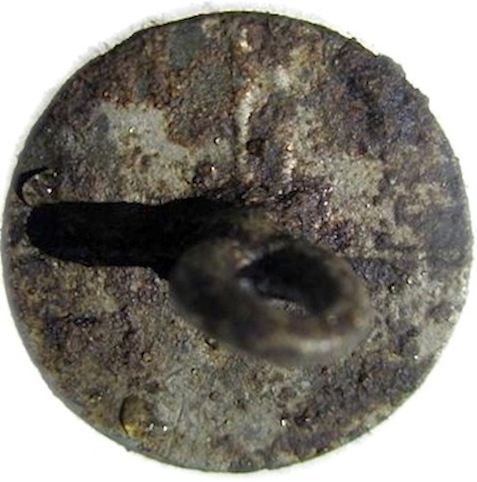
Reverse Button Analysis: This is a One-Piece Casting for
the Reverse Shank. The Shank is original, straight, and
intact.
Library Records Has Limited Information on R-27:
History: Yes Recorded Sales Price: Yes
Current Button Owner and Location: ~ New York ~
The second one known was found on
Mount Independence.~
This was excavated on the New York-Massachusetts Border
portion of the General Knox's trail.
This path was used by Knox to bring the Cannons over to
George Washington when he was in Dorchester Heights
Boston, from Fort Ticonderoga.~ |
|
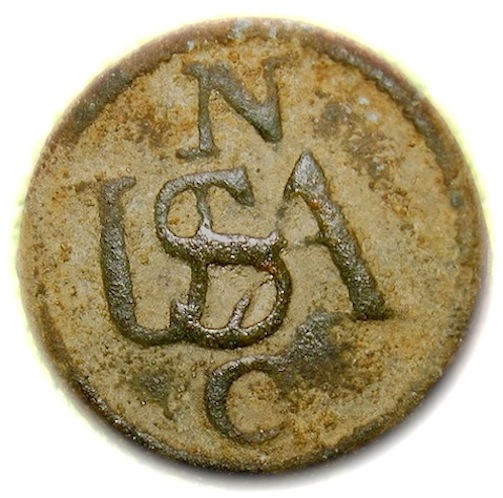
THE
NORTH CAROLINA USA PATTERN
Color: A Dusty Brown.
Metal: Flat, 1-Piece, Raised Design, Cast Pewter.
Size: 22mm.
Rarity: R-5
Present Condition: An Excavated Example, Strong Planchet,
Strong High Relief Pattern.
Isabela's Notes: This is an exceptionally rare pattern
that is rarely seen or sold in the market. There is no data to when
this pattern was first issued, but we do know the
pattern was used during the Revolutionary War time
frame. The current theory is that these were used by
troops mostly stationed within North Carolina. There
have been a few examples found with other regiment
numbers, and also a few in South Carolina, and one in
Maryland. The button's pattern depicts a large
intertwined and over lapping USA in the center. There is
a crude style N above, and C below the USA. The high
relief pattern is set on a flat field with a thin
pie-crust border.
Reverse Button Analysis: This is a One-Piece Casting for
the Reverse Shank. The Shank is original, straight, and
intact.
Library Records Has Limited Information on R-28:
History: Yes Recorded Sales Price: No
Current Button Owner and Location: ~ North Carolina ~
Found along the banks of the town Creek in Bruinswick
County, March 2011.~
There was a skirmish there when Cornwall came up from
S.C and took Wilmington, N.C.
Excavated by Allen Gaskins. |
|
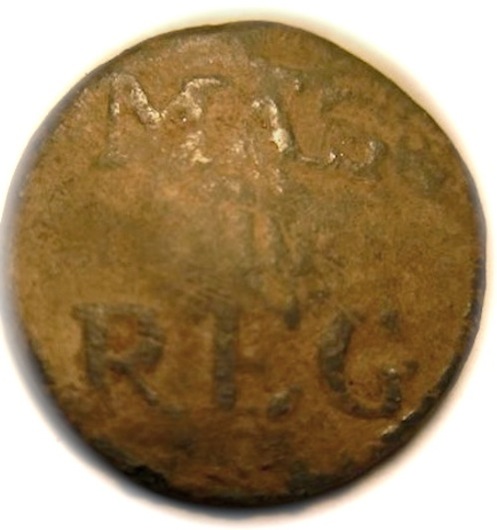
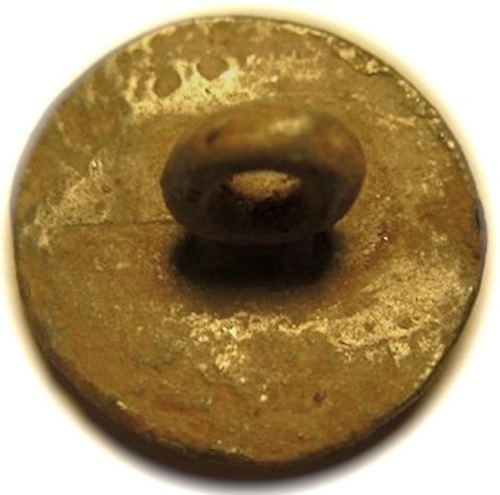
3RD
MASSACHUSETTS'S REGIMENT of 1781
Color: A Clear Polish Golden Brown
Metal: Flat, 1-Piece, Raised Design, Cast Pewter.
Size: 23.5mm.
Rarity: R-3
Present Condition: An Excavated Example, Good Planchet,
Fair High Relief Pattern.
Isabela's Notes: This button's pattern depicts the
abbreviation for Massachusetts above the Roman numeral,
"III", below is the abbreviation for Regiment. The high
relief pattern is set on a flat field with a thin
scalloped edge border. This example has
been found in some quantities in encampments in Boston and New York.
Reverse Button Analysis: This is a one-piece button with
a loop shank. The Shank
is original, straight, and intact.
Library Records Has Limited Information on R-29:
History: Yes Recorded Sales Price: Yes
Current Button Owner and Location: ~ New York ~
Excavated on Knox's Trail Massachusetts/Connecticut
Border.~
|
|
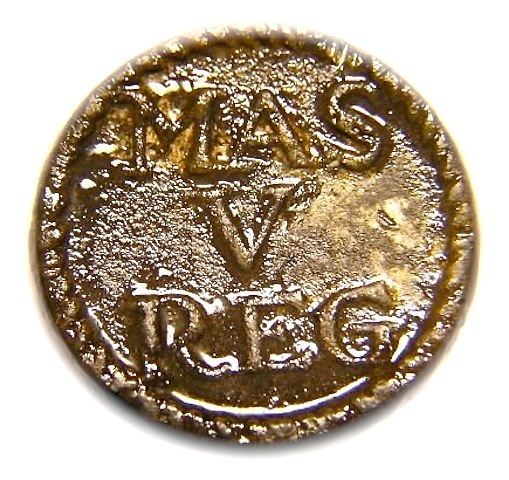
5TH
MASSACHUSETTS'S REGIMENT of 1781
Color: A Clear Polish Golden Brown.
Metal: Flat, 1-Piece, Raised Design, Cast Pewter.
Size: 19mm. Vest or Cuff Size
Rarity: R-3
Present Condition: An Excavated Example, Strong Planchet,
Strong High Relief Pattern.
Isabela's Notes: This is the small enlisted man's 1st
pattern. This button's pattern depicts the abbreviation
for Massachusetts above the Roman numeral, "IV", below
is the abbreviation for Regiment. The high relief
pattern is set on a flat field with a thin rope edge
border. This button is in
surprisingly good condition, and was treated with some
kind of clear crystalline enamel for preservation.
Reverse Button Analysis: This is a one-piece button with
a loop shank. Unknown
information.
Library Records Has Limited Information on R-30:
History: Yes Recorded Sales Price: Yes
Current Button Owner and Location: No |
|
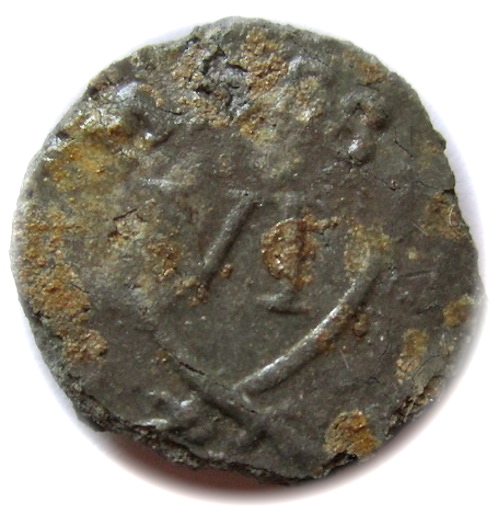
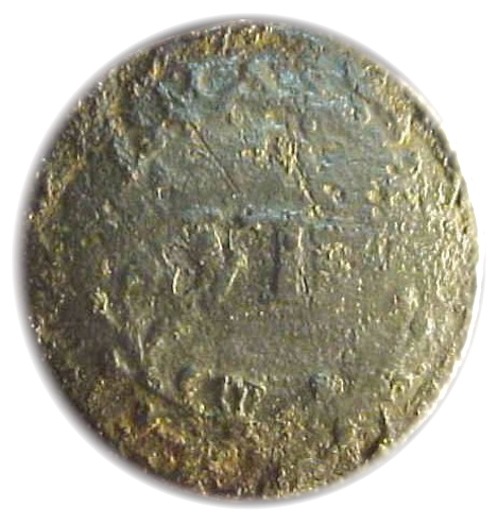
6TH
MASSACHUSETTS'S REGIMENT of 1781
Color: A Pewter Gray with Golden Orange Spots.
Metal: Flat, 1-Piece, Raised Design, Cast Pewter.
Size: 17mm.
Rarity: R-3
Present Condition: An Excavated Example, Fair Planchet,
Fair High Relief Pattern.
Isabela's Notes: This unit was part of the Continental
Army's reorganization of 1781. There service was
primarily garrison duty in the Hudson Valley and around
West Point. This is the enlisted man's 2nd pattern,
small size. The button's pattern depicts an arced "MASS"
over the Roman numeral "VI" with crossed sword hangers
below.
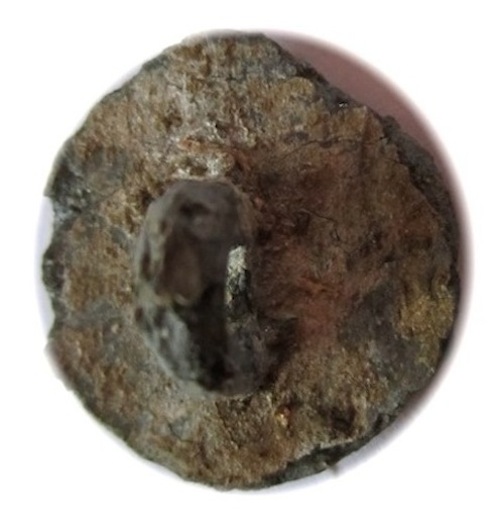
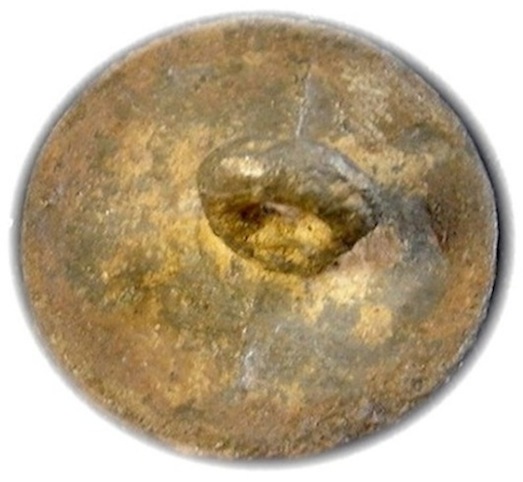
Reverse Button Analysis: This is a one-piece button with
a loop shank. The Shank
is original, straight, and intact.
Library Records Has Limited Information on R-31:
History: Yes Recorded Sales Price: Yes
Current Button Owner and Location: ~ New York ~
Excavated in the Hudson Valley, New York.~
The Isabela Collection. |
|
7TH
MASSACHUSETTS'S REGIMENT of 1781
Color: A Pewter Gray with A Glossy Finish .
Metal: Flat, 1-Piece, Raised Design, Cast Pewter.
Size: 17mm. Cuff Size
Present Condition: An Excavated Example, Good Planchet,
Fair High Relief Pattern.
Isabela's Notes: This unit was part of the Continental
Army's reorganization of 1781. There service was
primarily garrison duty in the Hudson Valley, and around
West Point. This is the enlisted man's 2nd pattern. The
button's pattern depicts a small letter abbreviation for
Massachusetts, "MASS" over the Roman numeral "VI" with a
wreath below.
Reverse Button Analysis: This is a one-piece button with
a loop shank. The shank
is original, straight, and intact.
Library Records Has Limited Information on R-32:
History: Yes
Recorded Sales Price: Yes
Current Button Owner and Location: ~ Virginia ~
The B. Henderson Collection.~
Picketpost.com |
|
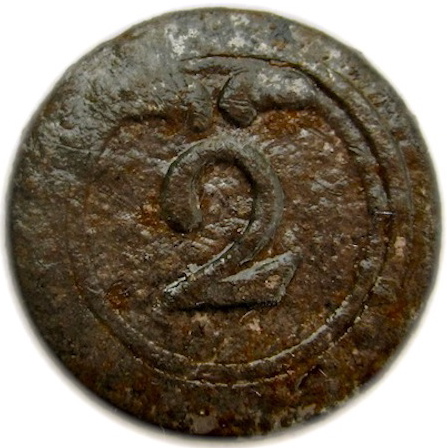
THE
MASSACHUSETTS ORDNANCE BUTTON of 1778 - 2nd REGIMENT
Color: An Ocher Pigment of Brownish-Red.
Metal: Flat, 1-Piece, Raised Design, White Metal.
Size: 17mm.
Rarity: R-1
Present Condition: An Excavated Example, Strong Planchet,
Strong High Relief Pattern.
Isabela's Notes: This button was originally purchased by
the state of Massachusetts, but it's use was widespread
by the troops throughout all of the New England Lines.
This button was extremely common to campsites that were
occupied by troops between the years of 1779-83. Records
indicate that in 1778, the State of Massachusetts
received over 2600 gross of what was termed Ordnance
Buttons in both large 24mm., and small 17mm. sizes. They
numbered one through ten. The small sizes 1, 2, 5, 7, &
9 appear to have been found in some quantities, while
the larger pattern are more scarce. Only the larger 1,
2, and 9 in the 24mm. have been found to date. Most
likely these were not attached to uniforms given or
issued. Most likely these were issued loose, and they
were given with no regard as to if the numbering
coincided with the units that received them. Since
supplies were scarce, they were probably given out, and
you got what you got kind of thing is the most probable
scenario. The button's pattern depicts a crude style
regiment number, "2" on a slightly recessed field. The
high relief pattern is set within a set of rings with
the inside one broken with iris ends. T
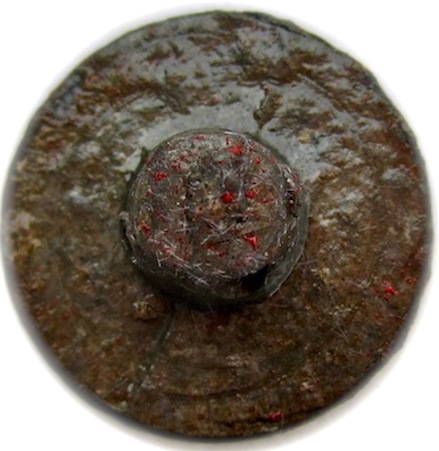
Reverse Button Analysis: This is a Turret Style shank.
The Turret is straight, upright and intact.
Library Records Has Limited Information on R-33:
History: Yes Recorded Sales Price: Yes
Current Button Owner and Location: ~ New York
The Isabela Collection.~ |
|
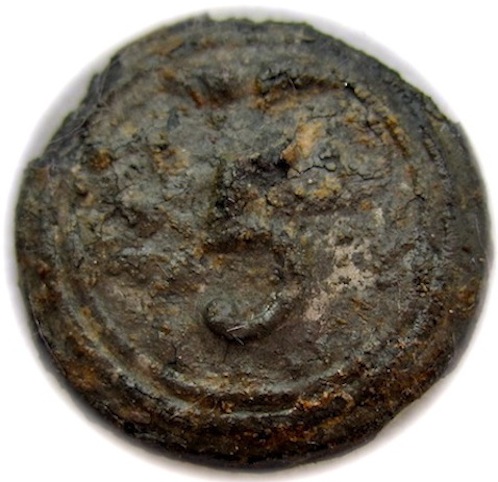
THE
MASSACHUSETTS ORDNANCE BUTTON of 1778 - 5TH REGIMENT
Color: An Earthy Grayish-Brown.
Metal: Flat, 1-Piece, Raised Design, White Metal.
Size: 17mm.
Rarity: R-1
Present Condition: An Excavated Example, Good Planchet,
Good High Relief Pattern.
Isabela's Notes: This button was originally purchased by
the state of Massachusetts, but it's use was widespread
by the troops throughout all of the New England Lines.
This button was extremely common to campsites that were
occupied by troops between the years of 1779-83. Records
indicate that in 1778, the State of Massachusetts
received over 2600 gross of what was termed Ordnance
Buttons in both large 24mm., and small 17mm. sizes. They
numbered one through ten. The small sizes 1, 2, 5, 7, &
9 appear to have been found in some quantities, while
the larger pattern are more scarce. Only the larger 1,
2, and 9 in the 24mm. have been found to date. Most
likely these were not attached to uniforms given or
issued. Most likely these were issued loose, and they
were given with no regard as to if the numbering
coincided with the units that received them. Since
supplies were scarce, they were probably given out, and
you got what you got kind of thing is the most probable
scenario. The button's pattern depicts a crude style
regiment number, "5" on a slightly recessed field. The
high relief pattern is set within a set of rings with
the inside one broken with iris ends. T
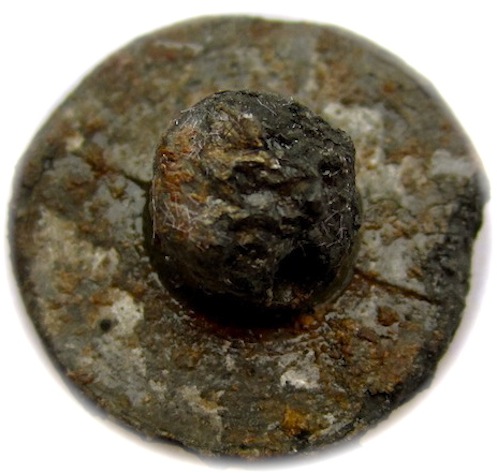
Reverse Button Analysis: This is a Turret Style shank.
The Turret is straight, upright and intact.
Library Records Has Limited Information on R-34:
History: Yes Recorded Sales Price: Yes
Current Button Owner and Location: ~ New York ~
The Isabela Collection. |
|
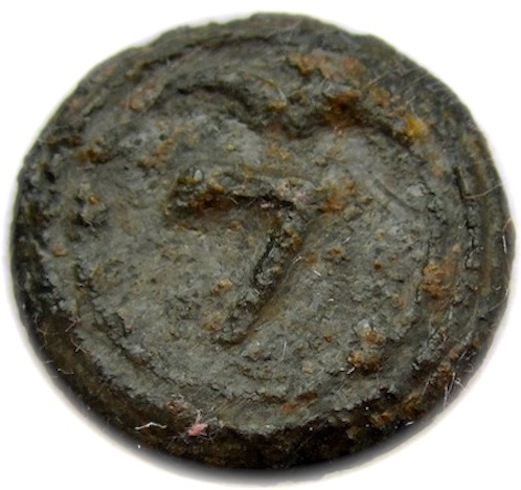
THE
MASSACHUSETTS ORDNANCE BUTTON of 1778 - 7TH REGIMENT
Color: An Olive Gray.
Metal: Flat, 1-Piece, Raised Design, White Metal.
Size: 17mm.
Rarity: R-1
Present Condition: An Excavated Example, Good Planchet,
Good High Relief Pattern.
Isabela's Notes: This button was originally purchased by
the state of Massachusetts, but it's use was widespread
by the troops throughout all of the New England Lines.
This button was extremely common to campsites that were
occupied by troops between the years of 1779-83. Records
indicate that in 1778, the State of Massachusetts
received over 2600 gross of what was termed Ordnance
Buttons in both large 24mm., and small 17mm. sizes. They
numbered one through ten. The small sizes 1, 2, 5, 7, &
9 appear to have been found in some quantities, while
the larger pattern are more scarce. Only the larger 1,
2, and 9 in the 24mm. have been found to date. Most
likely these were not attached to uniforms given or
issued. Most likely these were issued loose, and they
were given with no regard as to if the numbering
coincided with the units that received them. Since
supplies were scarce, they were probably given out, and
you got what you got kind of thing is the most probable
scenario. The button's pattern depicts a crude style
regiment number, "7" on a slightly recessed field. The
high relief pattern is set within a set of rings with
the inside one broken with iris ends. T
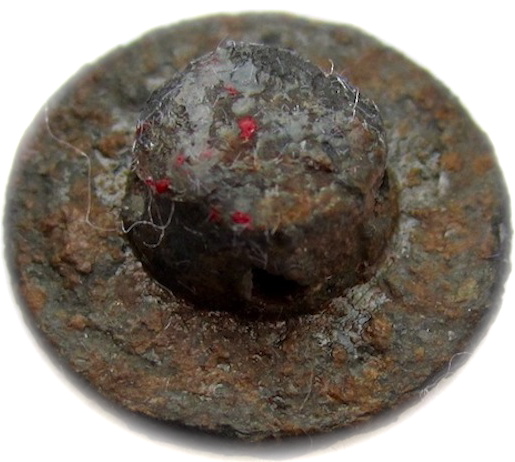
Reverse Button Analysis: This is a Turret Style shank.
The Turret is straight, upright and intact.
Library Records Has Limited Information on R-35:
History: Yes Recorded Sales Price: Yes
Current Button Owner and Location: ~ New York ~
Previously Robert Thebert Sr. Collection.~
The Isabela Collection. |
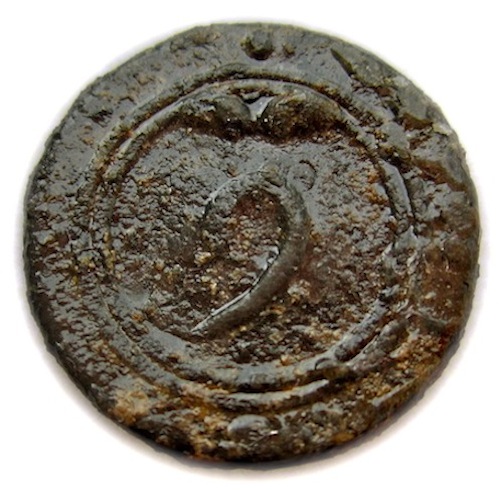 
|
THE
MASSACHUSETTS ORDNANCE BUTTON of 1778 - 9TH REGIMENT
Color: An Ocher Pigment of Brownish-Yellow.
Metal: Flat, 1-Piece, Raised Design, White Metal.
Size: 17mm.
Rarity: R-1
Present Condition: An Excavated Example, Strong Planchet,
Strong High Relief Pattern.
Isabela's Notes: This button was originally purchased by
the state of Massachusetts, but it's use was widespread
by the troops throughout all of the New England Lines.
This button was extremely common to campsites that were
occupied by troops between the years of 1779-83. Records
indicate that in 1778, the State of Massachusetts
received over 2600 gross of what was termed Ordnance
Buttons in both large 24mm., and small 17mm. sizes. They
numbered one through ten. The small sizes 1, 2, 5, 7, &
9 appear to have been found in some quantities, while
the larger pattern are more scarce. Only the larger 1,
2, and 9 in the 24mm. have been found to date. Most
likely these were not attached to uniforms given or
issued. Most likely these were issued loose, and they
were given with no regard as to if the numbering
coincided with the units that received them. Since
supplies were scarce, they were probably given out, and
you got what you got kind of thing is the most probable
scenario. The button's pattern depicts a crude style
regiment number, "9" on a slightly recessed field. The
high relief pattern is set within a set of rings with
the inside one broken with iris ends.
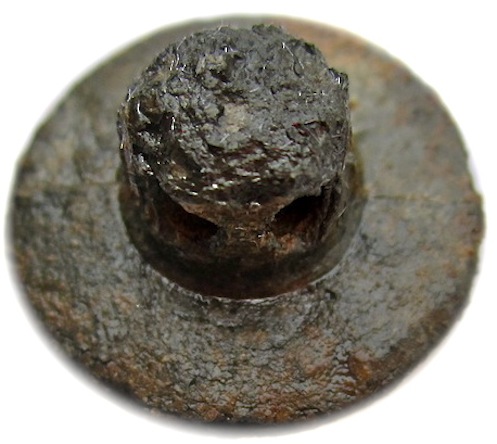
Reverse Button Analysis: This is a Turret Style shank.
The Turret is straight, upright and intact.
Library Records Has Limited Information on R-36:
History: Yes Recorded Sales Price: Yes
Current Button Owner and Location: ~ New York ~
The Isabela Collection. |
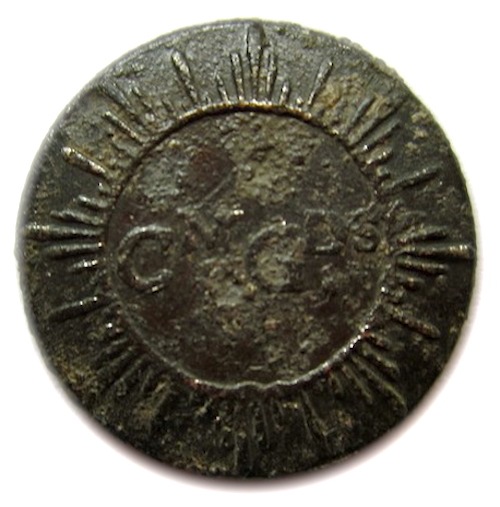 
|
2nd
Foot Guards (Coldstream Guards) 1773-87
Color: Dark Brown.
Metal: Flat, 1-Piece, Raised Design, Gilded Brass.
Size: 17mm.
Rarity: R-5
Present Condition: An Excavated Example, Strong Planchet,
Good High Relief Pattern.
Isabela's Notes: This is the small size officer's
button. The button's pattern depicts a shallow recessed center circle with
the letters, "Cm.Gds." This is surrounded by a raised
circle of rays. These officers composed a composite
Brigade of Guards with the 1st and 3rd of Foot. There
campaigns included the New York in 1776, Philadelphia in
1777, Monmouth Courthouse in 1778, Fort Lafayette on
Verplank's Point in 1779, Fort Tyron, Spring Field, N.J.
in 1780, then to Camden, and Guilford Courthouse. The
remnants of the brigade was captured at the siege of
Yorktown, Virginia. They returned to Great Britain in
1783.
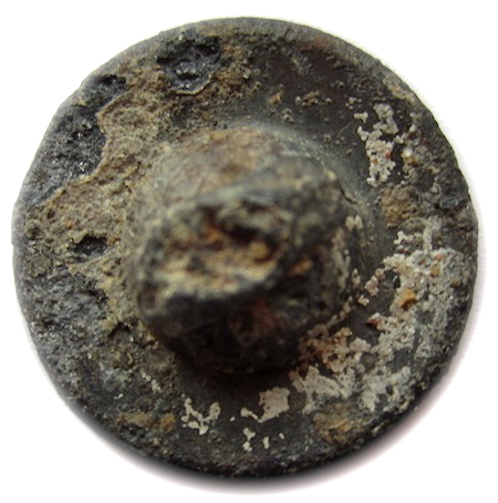
Reverse Button Analysis: This is a one-piece button with
a loop shank.. The Shank is original, straight, and
intact.
Library Records Has Limited Information on R-36:
History: Yes Recorded Sales Price: Yes
Current Button Owner and Location: ~ New York ~
The Isabela Collection.~ |
25mm%20brass%20rj%20georgewashingtoninauguralbuttons.com%20O.jpg) 25mm%20brass%20rj%20georgewashingtoninauguralbuttons.com%20R.jpg)
|
3rd
Foot Guards (Scots Guards) 1st Pattern 1767-70
Color: A Creamy Brown.
Metal: Flat, 1-Piece, Raised Design, Gilded Brass.
Size: 25mm.
Rarity: R-6
Present Condition: An Excavated Example, Strong Planchet,
Strong High Relief.
Isabela's Notes: This pattern was known to have changed
three times by 1775. This is the first pattern and dates
from 1760 to 1770. This is the large coat button. The
button's pattern depicts a raised, "Gds3" in the center
of a dotted raised circle channel. there is a leaf
pattern within the channel. These officers composed a composite
Brigade of Guards with the 1st and 2nd of Foot. There
campaigns included the New York in 1776, Philadelphia in
1777, Monmouth Courthouse in 1778, Fort Lafayette on Verplank's Point in 1779, Fort Tyron, Spring Field, N.J.
in 1780, then to Camden, and Guilford Courthouse. The
remnants of the brigade was captured at the siege of
Yorktown, Virginia. They returned to Great Britain in
1783.
Reverse Button Analysis: The Boss is still present, but
the loop is missing.
Library Records Has Limited Information on R-37:
History: Yes Recorded Sales Price: Yes
Current Button Owner and Location: ~ Canada ~
The P.E.I. Collection. |
%20Enlisted%20Man's%20Pattern%2024mm.%20Pewter%20georgewashingtoninauguralbuttons.com%20O.jpg) %20Enlisted%20Man's%20Pattern%2024mm.%20Pewter%20georgewashingtoninauguralbuttons.com%20R.jpg)
|
3rd
Foot Guards (Scots Guards) 3rd Pattern 1775-83
Color: Dark Brown.
Metal: Flat, 1-Piece, Raised Design, Pewter.
Size: 24mm.
Rarity: R-5
Present Condition: An Excavated Example, Strong Planchet,
Strong High Relief.
Isabela's Notes: This is the third pattern for the
enlisted man's large size coat button. The button's
pattern has a
depressed center well that is surrounded by a series of
alternating long and short rays. In-between the rays are
rectangles made of 5
lines. Within the center well is a
raised Arabic "3" on the left and a "G" on the right.
This is separated by a surmounting Stemmed Thistle in relief.
These officers composed a composite Brigade of Guards
with the 1st and 2nd of Foot. There campaigns included
the New York in 1776, Philadelphia in 1777, Monmouth
Courthouse in 1778, Fort Lafayette on Verplank's Point
in 1779, Fort Tyron, Spring Field, N.J. in 1780, then to
Camden, and Guilford Courthouse. The remnants of the
brigade was captured at the siege of Yorktown, Virginia.
They returned to Great Britain in 1783.
Reverse Button Analysis: The Boss is still present, but
the loop is missing.
Library Records Has Limited Information on R-38:
History: Yes Recorded Sales Price: Yes
Current Button Owner and Location: ~ New York ~
Excavated in New Jersey.~
The Isabela Collection. |
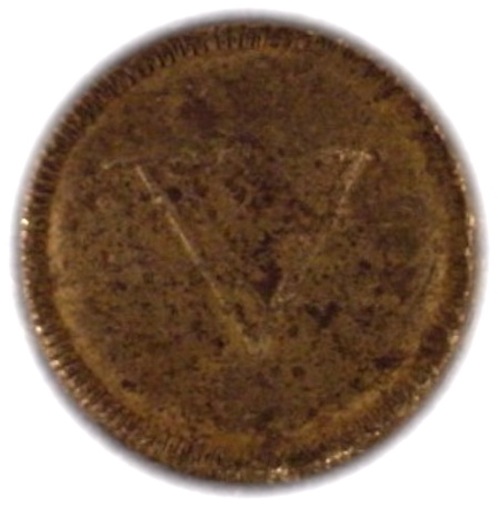 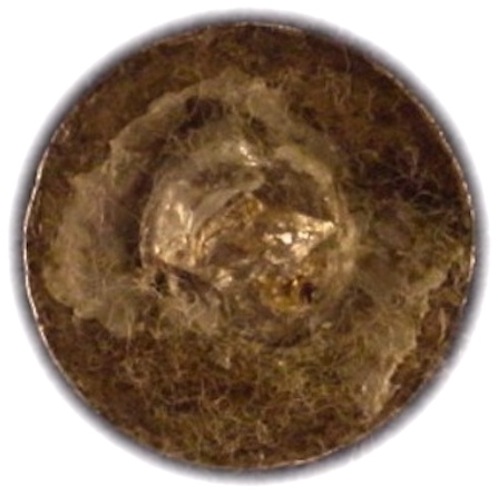
|
5th
Regiment of Foot (Pre-1778)
Color: A Pewter Brown.
Metal: Flat, 1-Piece, Raised Design, White Metal.
Size: 23mm.
Rarity: R-2
Present Condition: An Excavated Example, Strong Planchet,
Strong High Relief Pattern.
Isabela's Notes: This regiment arrived in Boston in July
of 1774. They fought in Lexington-Concord, Bunker Hill,
Long Island, White Plains, Germantown, and Brandywine.
Left for the West Indies in 1778. In 1782, they received
the title, "Northumberland Regiment." This button is the
large enlisted man's pattern. The button's pattern
depicts a raised Roman regimental number, "V" in the center.
The high relief pattern is set on a plain field with a
thin a pie-crust border.
Reverse Button Analysis: This is a one-piece button with
a loop shank. The Boss is still present, but
the loop is missing.
Library Records Has Limited Information on R-39:
History: Yes Recorded Sales Price: Yes
Current Button Owner and Location: ~ Virginia ~ |
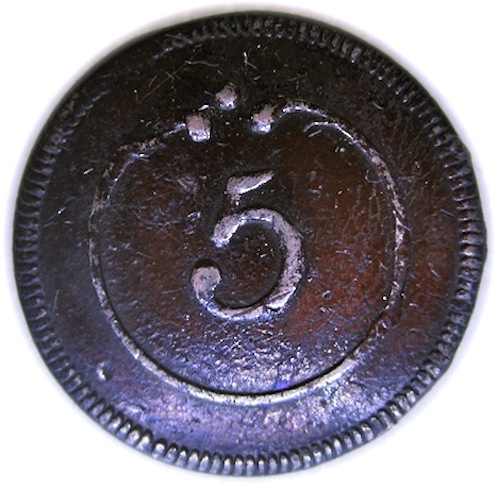 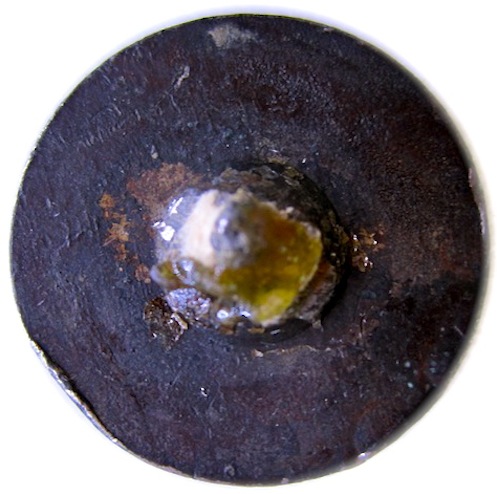
|
5th
Regiment of Foot (1790-97)
Color: A Reddish Brown.
Metal: Flat, 1-Piece, Raised Design, White Metal.
Size: 23mm.
Rarity: R-2
Present Condition: A Non Excavated Example, Strong
Planchet, Strong High Relief.
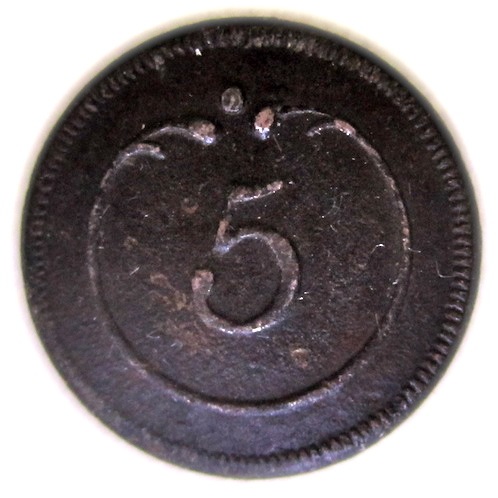
Isabela's Notes: This is the large enlisted man's
pattern. The button's pattern depicts an Arabic number,
"5" within a broken circle with iris ends, and a
surmounting dot. The high relief pattern is set on a
plain flat field with a pie crust border. This
pattern dates to after the Revolutionary War, but
examples have been found at Fort Erie.
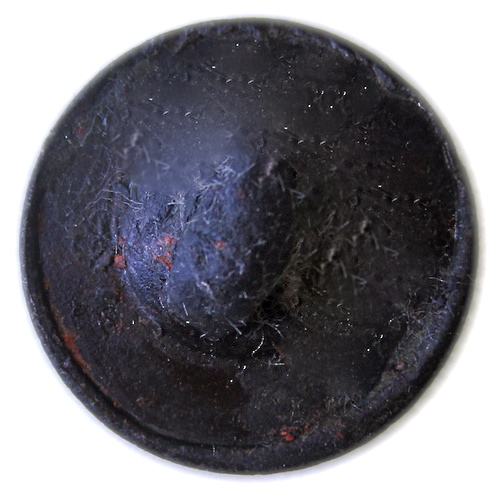
Reverse Button Analysis: This is a one-piece button with
a loop shank. The Boss is still present, but the loop is
missing
Library Records Has Limited Information on R-40:
History: Yes Recorded Sales Price: Yes
Current Button Owner and Location: ~ New York ~
The RJ & Debra Silverstein Collection. |
|
5th
Regiment of Foot (1790-97)
Color: A Dark Brown.
Metal: Flat, 1-Piece, Raised Design, White Metal
Size: 17mm. Cuff or Vest Size.
Rarity: R-3
Present Condition: A Non Excavated Example, Strong
Planchet, Strong High Relief.
Isabela's Notes: This is the small enlisted man's
cuff or vest button. The button's pattern depicts an
Arabic number, "5" within a broken circle with iris
ends, and a surmounting dot. The high relief pattern is
set on a plain flat field with a pie crust border. This
pattern dates to after the Revolutionary War, but
examples have been found at Fort Erie.
Reverse Button Analysis: This is a one-piece button with
a loop shank. The Boss is still present, but the loop is
missing
Library Records Has Limited Information on R-41:
History: Yes Recorded Sales Price: Yes
Current Button Owner and Location: ~ New York ~
The David Gerber Collection. |
|
1768-86 8th Regiment of Foot (King's)
Color: An Ochre Brown With A Slight Red Undertone.
Metal: Slightly Convex 1-Piece, Raised Design, Pewter.
Size: 23mm.
Rarity: R-2
Present Condition: An Excavated Example, Good Planchet,
Strong Impression.
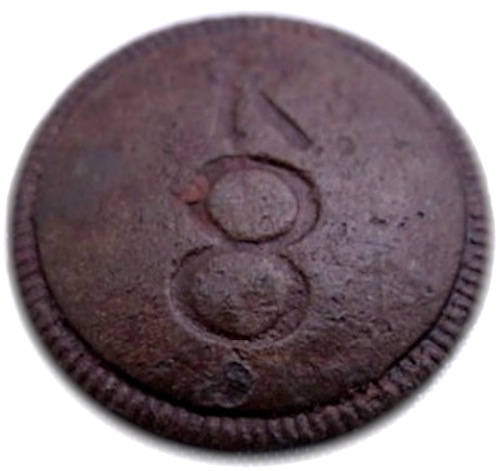
Isabela's Notes: This is the large size enlisted man's
pattern. The button's pattern depicts a medium size," K"
stamped over a large Arabic number, "8". This
impressed pattern is set on a slightly convex field with
a cable border. This regiment mostly served
along the Canadian / New York border. Most service was in
cooperation with Loyalists, and native Indians. Many
skirmishes were in the defense of Canada against the
French.
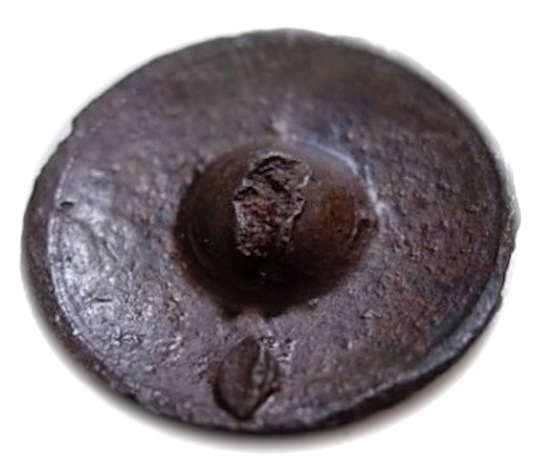
Reverse Button Analysis: This is a one-piece button with
a loop shank. The Boss is still present, but the loop is
missing
Library Records Has Limited Information on R-42:
History: Yes Recorded Sales Price: Yes
Current Button Owner and Location: No
Excavated near Savannah, Georgia.~ |
|
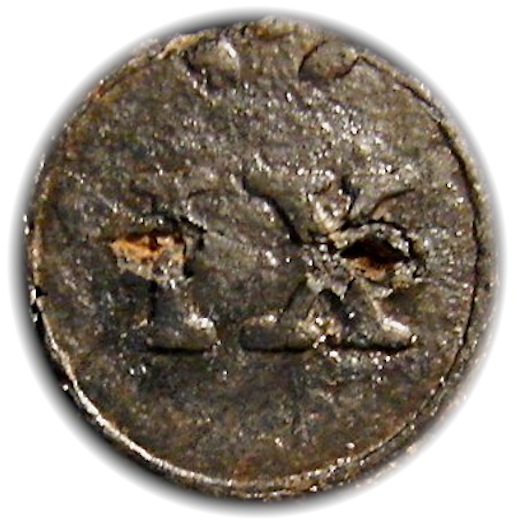
9th
Regiment of Foot 1775-81
Color: A Pewter Gray.
Metal: Flat, 1-Piece, Raised Design, Cast Pewter.
Size:18mm.(21.4mm) This was cut down to cuff size.
Rarity: R-3
Present Condition: An Excavated Example, Fair Planchet,
Fair Impressions.
Isabela's Notes: This regiment landed in Quebec in May
of 1776, and served in military actions with Carleton
and Burgoyne. Imprisonment at Saratoga in 1777, and
remained prisoners of war until they finally returned to
Great Britain in 1781. This is an enlisted man's pattern
coat size pattern that was cut down and turned into a
toy Wizzer (i believe). The button has a slightly domed
face with a raised Roman IX in the center, and is
encircled by a raised border.
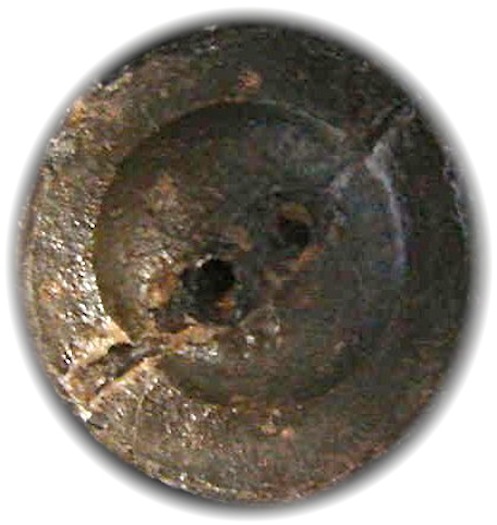
Reverse Button Analysis: This is a one-piece button with
a loop shank. The shank boss has been added and then 2
attachment holes drilled.
Library Records Has Limited Information on R-43:
History: Yes Recorded Sales Price: Yes
Current Button Owner and Location: ~ Virginia ~
The B. Henderson Collection.
The Picketpost.com |
|
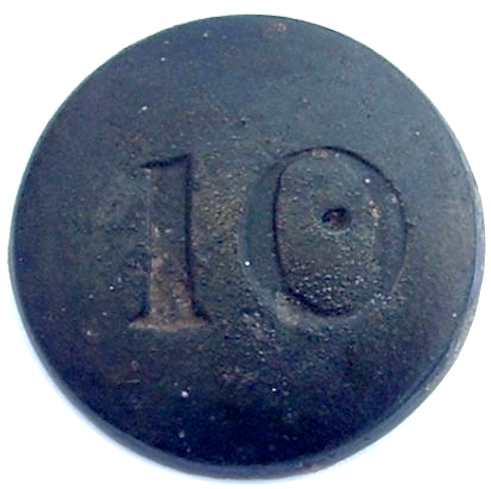
10th Regiment of Foot 1768-1778
Color: A Charcoal Gray.
Metal: 1-Piece, Slightly Convex, Impressed
Design, Cast Pewter.
Size: 17mm.
Present Condition: An Excavated Example, Strong
Planchet Casting, Strong Impressions.
Isabela's Notes: This is the enlisted man's
pattern. It button's pattern depicts an Arabic number
"10" impressed in the center on a plain field with no
edge border. An interesting fact is that their belt
plates, swords and other insignia bears a Roman "X",
their buttons use an Arabic number. In October of 1774,
the regiment was sent to Boston. They served in a
regiment of in detachments at Bunker Hill,
Lexington-Concord, and then in the New York Campaign in
1776. In 1777, on to the Philadelphia campaign, and then
home to England in october of 1777. Enlisted men were
drafted into other regiments. Titled the "North
Lincolnshire Regiment in 1782.
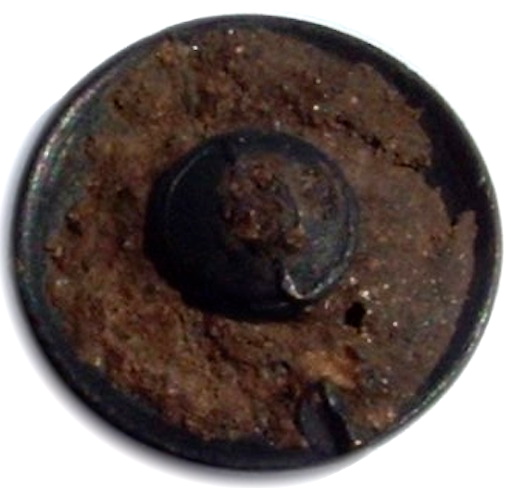
Reverse Button Analysis: This is a one-piece
button with a loop shank. The loop shank is broken off
of the boss.
Library Records Has Limited Information on R-88:
History: Yes
Recorded Sales Price: Yes
Current Button Owner and Location:
~
South Carolina
~
Excavated in Beaufort County, South Carolina~
The K. Nixon Collection |
|
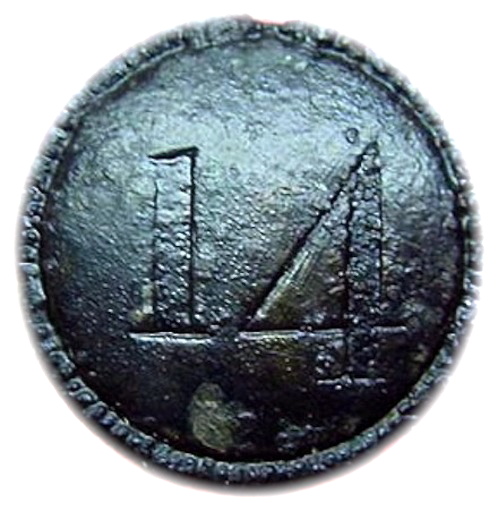
1767-82 14th Regiment of Foot
Color: A Dark Pewter Gray.
Metal: Slightly Convex, 1-Piece, Raised Design, Cast
Pewter.
Size: 17mm.
Rarity: R-3
Present Condition: An Excavated Example, Fair Planchet,
Good Impression.
Isabela's Notes: In 1768, they arrived in Boston from
Halifax. In 1772 the regiment was sent to East Florida.
In 1775, part of the regiment was sent to Virginia, and
in 1776, they participated in actions at the Great
Bridge. In 1776, they were sent to New York, and the
remaining men were drafted into other regiments.
Officers returned to England. This is the enlisted man's
pattern of a small vest or cuff button. The button's
pattern shows an incuse
Arabic number "14" on a slightly convex field with a pie-crust border.
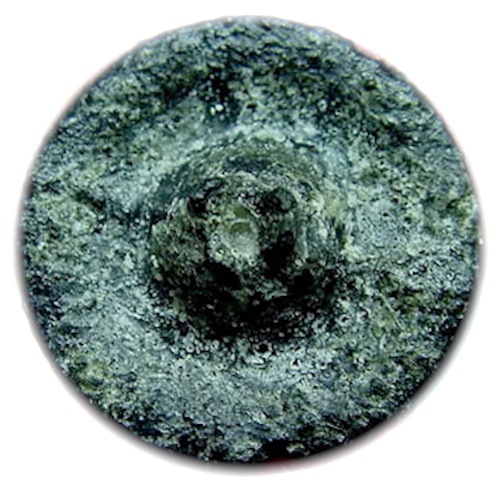
Reverse Button Analysis: This is a one-piece button with
a loop shank. The boss is still present, but
the loop shank is missing.
Library Records Has Limited Information on R-44:
History: Yes Recorded Sales Price: Yes
Current Button Owner and Location: ~ Florida ~
Excavated in New Smyrna Beach, Florida.~ |
|
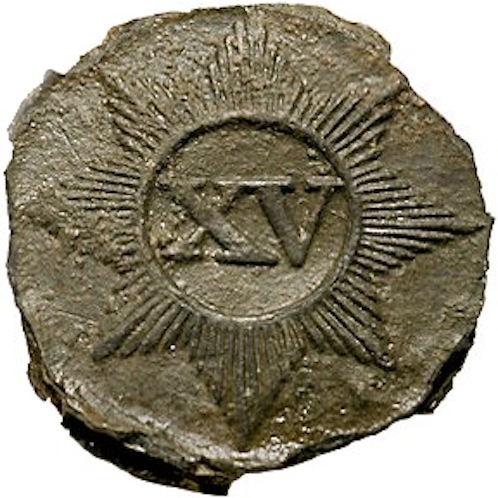
15th Regiment of Foot (Post Rev. 1786-93)
Color: A Silvery Brown.
Metal: Flat, 1-Piece, Raised Design, Cast Pewter.
Size: 20mm.
Rarity: R-2
Present Condition: An Excavated Example, Poor Planchet,
Strong High Relief Pattern.
Isabela's Notes: This newer style is the enlisted
man's pattern. Dates to post Rev War, and most likely was
limited to service in Canada. Probably replaced the J5
shortly after the war ended. The button's pattern shows a raised
eight pointed star with a raised Arabic Roman Numeral, "XV"
within a center well circle. The high relief pattern is
set on a flat field with no raised border edge.
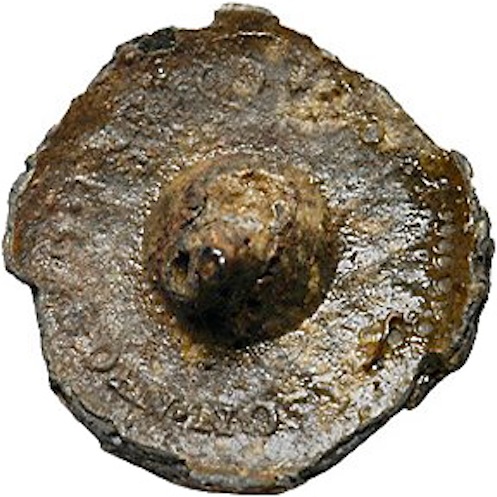
Reverse Button Analysis: This is a one-piece button with
a loop shank. The boss is still present, but
the loop shank is missing.
Library Records Has Limited Information on R-45:
History: Yes Recorded Sales Price: Yes
Current Button Owner and Location: No |
|
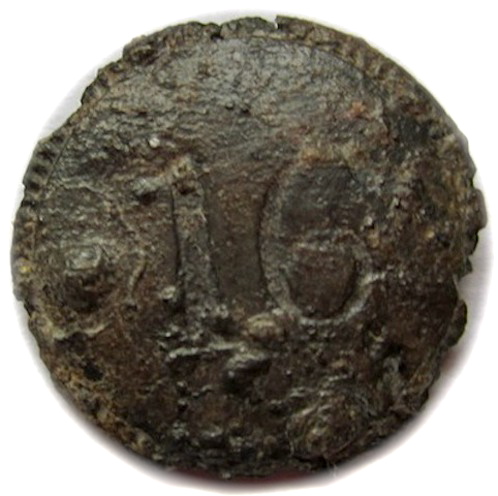
16th Regiment of Foot 1767-82
Color: A Pewter Gray.
Metal: Slightly Convex, 1-Piece, Raised Design, Cast
Pewter.
Size: 17mm.
Present Condition: An Excavated Example, Fair Planchet,
Good Impression.
Isabela's Notes: This is the enlisted man's small size
button. The button's pattern depicts an incised Arabic
number, "16" with a thin pie crust edge
border. This regiment arrived in Pensacola Florida in
1767, and then went on to several southern ports. In
August 1776, a small detachment from this regiment went
to New York. In 1778, four companies from this regiment
were stationed in Baton Rouge, and then later captured
in 1779. They had a light infantry company fight at
Cowpens, S.C. in 1781, and then finally returned to
England in 1782.
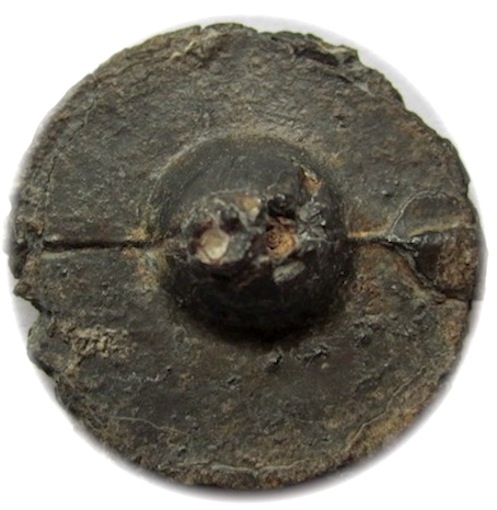
Reverse Button Analysis: This is a one-piece button with
a loop shank. The boss is still present, but
the loop shank is missing.
Library Records Has Limited Information on R-46:
History: Yes Recorded Sales Price: Yes
Current Button Owner and Location: ~ New York ~
Previously the Robert Thebert Collection.~
The Isabela Collection. |
|
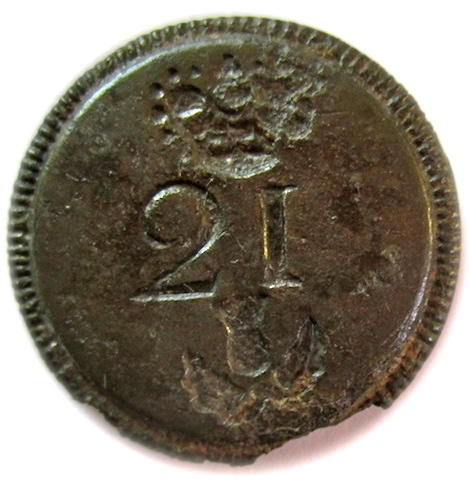
21st REGIMENT of FOOT ( Royal North British Fuzileers )
1775-82
Color: A Dark Silver.
Metal: Flat, 1-Piece, Raised Design, Cast Pewter.
Size: 25mm.
Present Condition: An Excavated Example, Good Planchet,
Strong Impressions.
Isabela's Notes: This is the enlisted man's large size
coat button. The button's pattern depicts an
incised Arabic numeral "21" in the center with a Crown
above. Under the number is a Thistle. The impressed
pattern is set on a flat field with a thin cable edge
border. This regiment was
stationed in West Florida from 1765-70, then went to
Quebec for three years. In 1773, the regiment returned
to Great Britain. In May of 1776, they went back to
Quebec and had operations on Lake Champlain and Valcour
Island. In 1777, they were in the Saratoga campaign, and
then returned home to England again in 1781.
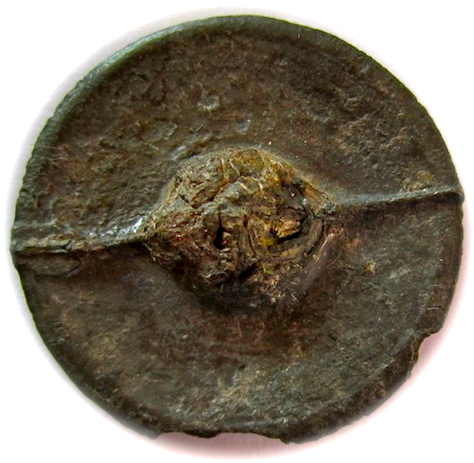
Reverse Button Analysis: This is a one-piece button with
a loop shank. The boss is still present, but
the loop shank is missing.
Library Records Has Limited Information on R-47:
History: Yes Recorded Sales Price: Yes
Current Button Owner and Location: ~ New York ~
Excavated in Upstate New York.~
The Isabela Collection. |
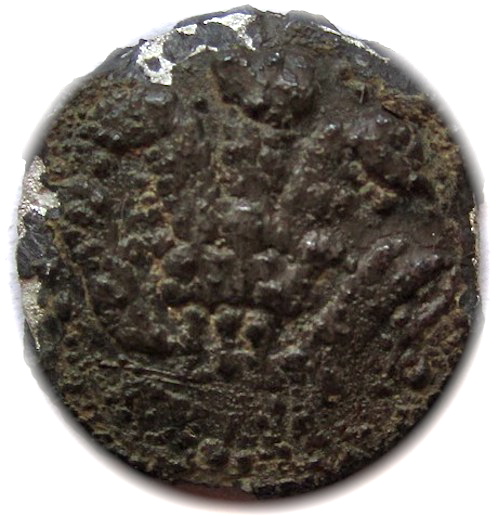 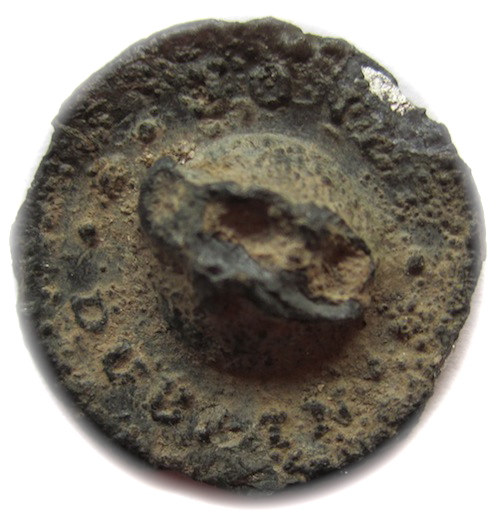
|
23rd REGIMENT of FOOT (Royal Welsh Fuzileers)
Color: A Deep Chocolate.
Metal: Flat, 1-Piece, Raised Design, Cast Pewter.
Size: 16mm.
Present Condition: An Excavated Example, Fair Planchet,
Fair High Relief Pattern.
Isabela's Notes: A very active company during the
American Revolutionary War. All companies were fighting
at Lexington-Concord on April 19, 1775, and they had
flank companies at Bunker Hill. From 1776 to 1783 they
had detachments stationed in New York City. New York
Campaign of 1776, including White Plains, Long Island,
and Fort Washington. Then in 1777, the Philadelphia
Campaign, and also including Brandywine. They retreated
into New Jersey in 1778 from Monmouth. They also served
as Marines on ships off the coast of Rhode Island from
July to September of 1778. In 1779 they were at Fort
Lafayette, Stony Point and Verplank's point. In the
December of 1779, they went to Charleston S.C., and had
many skirmishes and operations in the Carolinas,
including Guilford Court House, and Camden. Went to
Virginia, and served there until the surrender at
Yorktown in 1781. A small company was sent to New York
from Charleston in 1782. They returned home to England
in 1783. This button is the small enlisted man's pattern
worn in 1780. The button's pattern shows the insignia of
the Prince of Whales; which is Three Feathers over a
small ribbon. The Roman
Numeral, "XXIII " with a beaded border is in the legend
below.
Reverse Button Analysis: This is a one-piece button with
a loop shank. The Boss is still present, but
the loop shanks is missing.
Library Records Has Limited Information on R-48:
History: Yes Recorded Sales Price: Yes
Current Button Owner and Location: ~ New York ~
Excavated in Virginia.~
The Isabela Collection. |
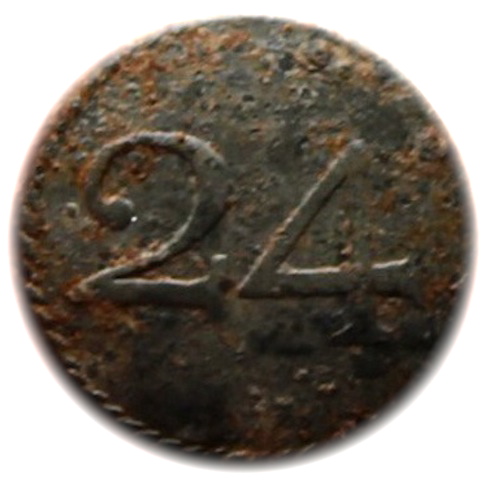 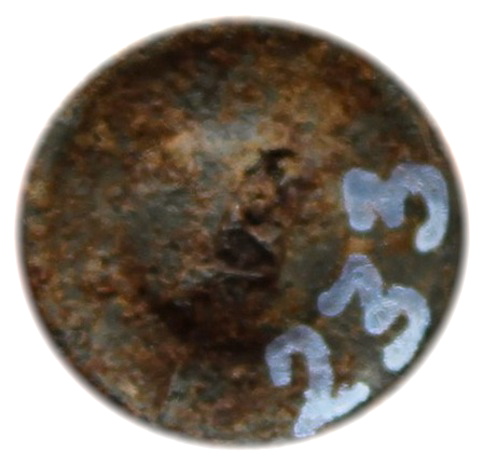
|
24th REGIMENT of FOOT 1768-81
Color: A Pewter Gray with Rusty Orange Patches.
Metal: Slightly Convex, 1-Piece, Raised Design, Cast
Pewter..
Size: 22mm.
Present Condition: An Excavated Example, Good Planchet,
Good High Relief Pattern.
Isabela's Notes: This regiment first arrived in Quebec
in June of 1776. They saw action at Sorel, and the
Carleton expedition on Lake Champlain. In 1777, the
Burgoyne campaign with a battle at Freeman's farm
against American soldiers commanded by General Horatio
Gates and Benedict Arnold. This is one of the harder
buttons to obtain since most of Burgoyne's men were
taken prisoners. This is the enlisted man's
large size coat button. The button's pattern depicts a
large Arabic style number, "24" in the center of a plain
field. This high relief pattern is set on a slightly
convex field with a narrow cable edge border.
The regiment
received the title "2nd Warwickshire" in 1782.
Reverse Button Analysis: This is a one-piece button with
a loop shank. The Boss is still present, but
the loop shank is missing.
Library Records Has Limited Information on R-49:
History: Yes Recorded Sales Price: Yes
Current Button Owner and Location: ~ Connecticut ~
Excavated on a Burgoyne Campsite.~
The D. Troiani Collection. |
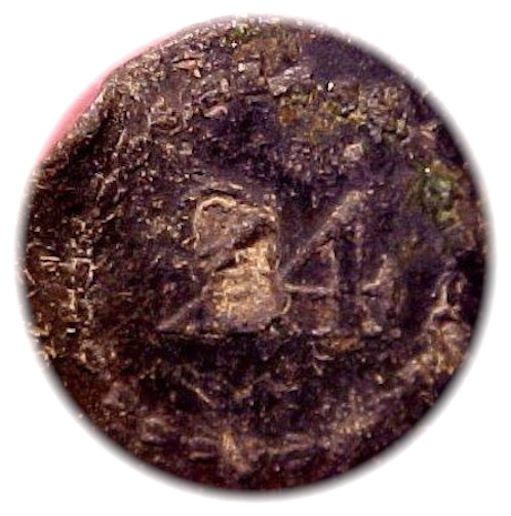 
|
24th REGIMENT of FOOT 1789-96
Color: A Dark Chocolate Brown.
Metal: Flat, 1-Piece, Raised Design, White Metal.
Size: 15mm. Cuff or Vest Size.
Present Condition: An Excavated Example, Good Planchet,
Fair High Relief Pattern.
Isabela's Notes: This button pattern is post Rev. War
which pattern dates from 1796-96. This is the small size
enlisted man's vest or cuff button. The button's
pattern shows a
raised leaf border encompassing the Arabic style number, "24"
in the center. The high relief pattern is set on a flat
field with a raised leaf design edge border. Some specimens have been found in Fort
Mackinac. The British built a fort during the American
Revolutionary War to control the strategic straights of
Mackinac between Lake Michigan and Lake Huron. This was
done to secure the fur trade. The British actually
didn't release it until 15 years after the war. It
became an American military outpost at the end of the
18th, and beginning of 19th century.
The regiment
received the title "2nd Warwickshire" in 1782.
Reverse Button Analysis: This is a one-piece button with
a loop shank. The Boss is still present, but
the loop shank is missing.
Library Records Has Limited Information on R-50:
History: Yes Recorded Sales Price: Yes
Current Button Owner and Location: ~ Canada ~
Excavated in Canada.~
The P.E.I. Collection. |
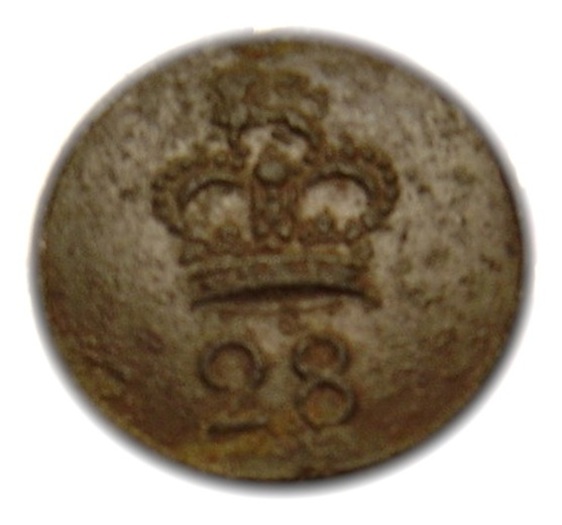
|
28th REGIMENT of FOOT 1776-78
Color: A Pewter Gray with An Earthy Brown Texture.
Metal: Slightly Convex, 1-Piece, Raised Design, Cast
Pewter.
Size: 25mm.
Present Condition: An Excavated Example, Strong Planchet,
Strong High Relief Pattern.
Isabela's Notes: Unsure if this is a later variation of
the pattern Troiani lists as B28.a Officer's Pattern.
The only variation is there is no leaf border. The
button's pattern
has the same raised motif of a lion on top of a crown,
which is above the raised Arabic style number, "28". The
high relief pattern is set on a slightly convex field
with no edge border. This pattern
would have only been used until 1778. This regiment
arrived in New York in 1778. They were involved in the
Battle of White Plains, and in 1777 the raid on Danbury.
The regiment was involved in the Philadelphia campaign,
including Brandywine and Germantown. In 1778, a small
battle at Quintin's Bridge, in New Jersey. In the winter
of 1778 they went to Florida and then on to St. Lucia,
and Barbados.
They were granted the title, "Gloustershire
Regiment" in 1782.
Reverse Button Analysis: This is a one-piece button with
a loop shank. The Boss is still present, but
the loop is missing.
Library Records Has Limited Information on R-51:
History: Yes Recorded Sales Price: Yes
Current Button Owner and Location:
No
Paul's button collection. |
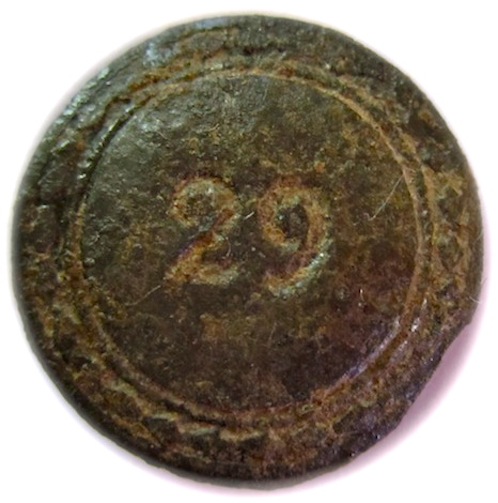 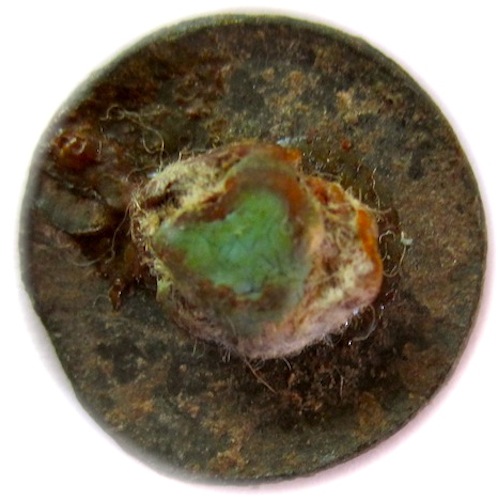
|
29th REGIMENT of FOOT 1773-87
Color: A Silvery Green Patina.
Metal: Flat, 1-Piece, Raised Design, White Metal.
Size: 17mm. Cuff or Vest.
Present Condition: An Excavated Example, Good Planchet,
Good Impressions.
Isabela's Notes: This is the enlisted man's small size
vest or cuff button. The button's pattern has thin
raised wall channel with
a leaf design within. The button's pattern shows a crude
style Arabic number, "29" in the center. A small party of this
regiment was involved in the Boston Massacre of 1770.
The regiment was in Florida from 1771 until 1773 when
they returned to England. Re-outfitted, they arrived in
Quebec in 1776, and had action in Sorel, Montreal, and
Three Rivers. Four companies from this regiment served
as Marines on Valcour Island Flank companies from this
regiment were captured at Saratoga. Remainders of this
regiment served at various posts in Canada until 1787
when they returned again to England. Also Carlton
expedition in 1780.
They were granted the title,
"Worcestershire Regiment" in 1782.
Reverse Button Analysis: This is a one-piece button with
a loop shank. The Boss is still present, but
the loop is missing.
Library Records Has Limited Information on R-52:
History: Yes Recorded Sales Price: Yes
Current Button Owner and Location: ~ New York ~
Excavated in Upstate New York.~
The Isabela Collection. |
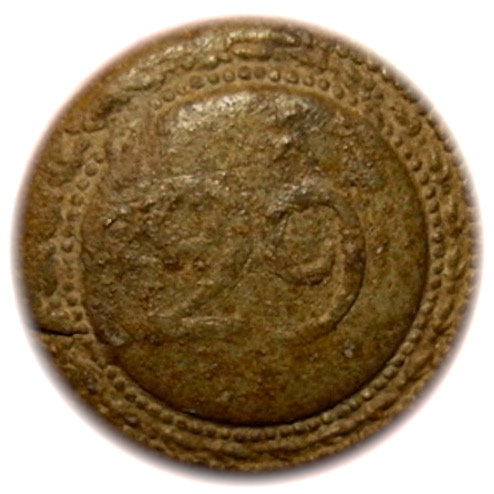 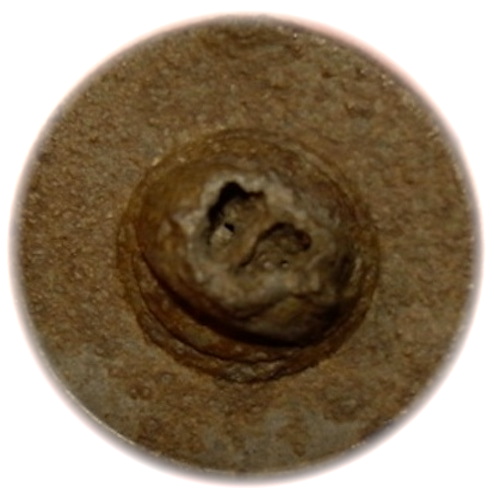
|
29th REGIMENT of FOOT 1775-87
Color: A Silvery Green Patina.
Metal: 1-Piece, Slightly Convex, Raised Design,
Pewter.
Size: 17mm. Cuff or Vest.
Present Condition: An Excavated Example, Good
Planchet Casting, Good High Relief Pattern.
Isabela's Notes: There appears to be two die
variants with this pattern. One that is in relief, and
one that is incised. This is the enlisted man's small
size vest or cuff button. The button's pattern has thin
raised dotted channel with a floral leaf design within.
The button's pattern shows a crude style Arabic number,
"29" on a roundish dome in the center. The high relief
pattern is set on a plain field with a flat edge border.
A small party of this regiment was involved in the
Boston Massacre of 1770. The regiment was in Florida
from 1771 until 1773 when they returned to England.
Re-outfitted, they arrived in Quebec in 1776, and had
action in Sorel, Montreal, and Three Rivers. Four
companies from this regiment served as Marines on
Valcour Island Flank companies from this regiment were
captured at Saratoga. Remainders of this regiment served
at various posts in Canada until 1787 when they returned
again to England. Also Carlton expedition in 1780. They
were granted the title, "Worcestershire Regiment" in
1782.
Reverse Button Analysis: This is a one-piece
button with a loop shank. The Boss is still present, but
the loop is missing.
Library Records Has Limited Information on R-52.1:
History: Yes
Recorded Sales Price: Yes
Current Button Owner and Location:
~ New York ~
Excavated in Upstate New York |
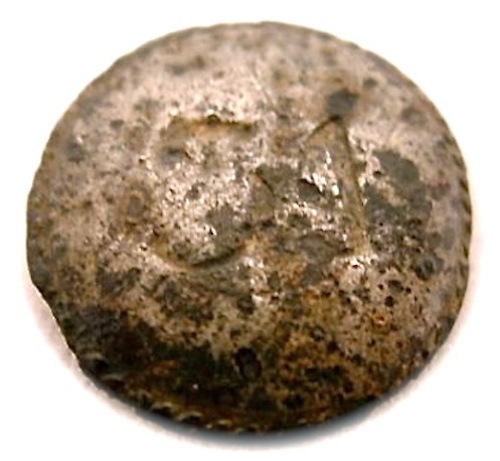 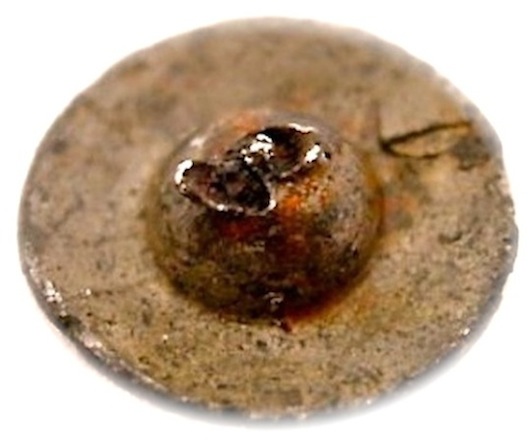
|
31st REGIMENT of FOOT
Color: A Pewter Gray with Charcoal & Orange Patches.
Metal: High-Convex, 1-Piece, Raised Design, Cast Pewter.
Size: 17mm. Cuff or Vest.
Present Condition: An Excavated Example, Good Planchet,
Good Impressions.
Isabela's Notes: This is the enlisted man's smaller vest
or cuff button. The pattern dates from 1770 to 1784. The
button shows a high-convex obverse, with the stamped Arabic
style number,
"31" in the center. The button's edge is adorned with a
thin cable border. This regiment came to Florida in
1765, and remained until 1772 when it got stationed in
St. Vincent. Went to Quebec in 1776, and was stationed
at various outposts including Sorel, St. Anthony, and
St. Denis until the winter of 1777. The regiment had
flank companies join Burgoyne's invasion, which led to
the capture at Saratoga. They remained prisoners until
1781, and then returned back to their regiment.
Remainder of the regiment that stayed in Canada until
1787. In 1780 they had a light expedition to
Ticonderoga.
They were granted the title, "Huntingtonshire"
in 1782.
Reverse Button Analysis: This is a one-piece button with
a loop shank. The Boss is still present, but
the loop is missing.
Library Records Has Limited Information on R-53:
History: Yes Recorded Sales Price: Yes
Current Button Owner and Location: No
Excavated in St. Augustine Florida.~ |
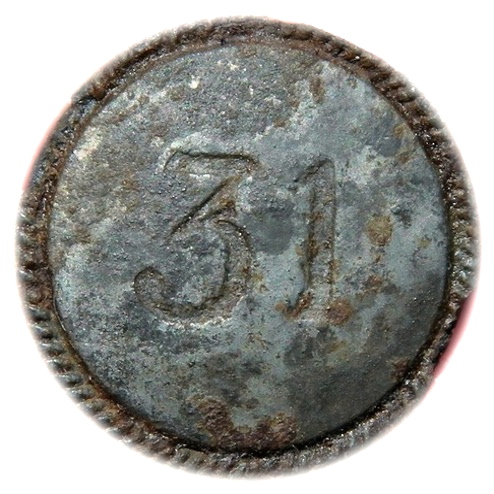 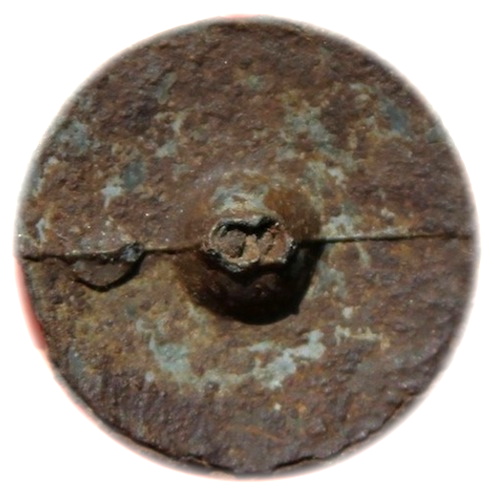
|
31st REGIMENT of FOOT 1770-84
Color: A Pewter Gray.
Metal: 1-Piece, Slightly Convex, Impressed
Design, Cast Pewter.
Size: 24mm.
Present Condition: An Excavated Example, Strong
Planchet Casting, Strong Impressions.
Isabela's Notes: This is the enlisted man's coat
size pattern which dates from 1770 to 1784. The button's
pattern has a stamped Arabic style number "31" in the
center. The impressed pattern is set on a slightly
convex field with a narrow cable border. This regiment
came to Florida in 1765, and remained until 1772 when it
got stationed in St. Vincent. Went to Quebec in 1776,
and was stationed at various outposts including Sorel,
St. Anthony, and St. Denis until the winter of 1777. The
regiment had flank companies join Burgoyne's invasion,
which led to the capture at Saratoga. They remained
prisoners until 1781, and then returned back to their
regiment. Remainder of the regiment that stayed in
Canada until 1787. In 1780 they had a light expedition
to Ticonderoga. They were granted the title, "Huntingtonshire"
in 1782.
Reverse Button Analysis: This is a flat one-piece
button with a loop shank. The Boss is still present, but
the loop is missing.
Library Records Has Limited Information on R-53.1:
History: Yes
Recorded Sales Price: Yes
Current Button Owner and Location:
~
Florida
~
D. Troiani Collection |
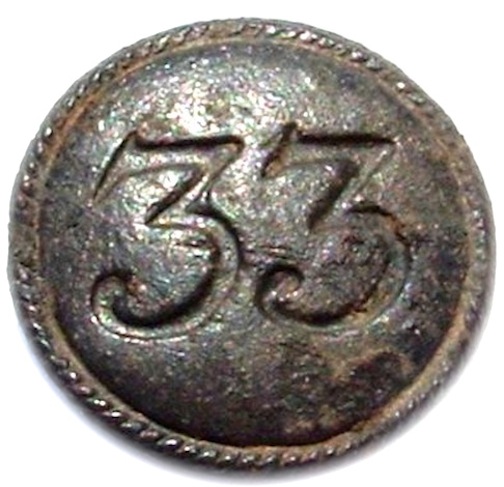 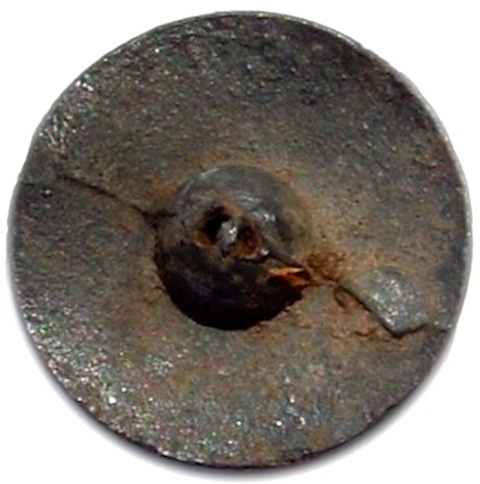
|
33 Regiment of Foot 1776-1783
Color: A Pewter Gray.
Metal: 1-Piece, Slightly Convex, Impressed
Design, Cast Pewter.
Size: 23mm.
Present Condition: An Excavated Example, Strong
Planchet Casting, Strong Impressions.
Isabela's Notes: This is the enlisted man's
pattern. The button's pattern depicts an Arabic number
"33" impressed in the center of a plain field with a
cable border. This is the most common pattern found from
this regiment. The 33rd Regiment arrived in Cape Fear
North Carolina in 1776. They were very active in
Charleston South Carolina in the beginning of the war.
In 1776 they went up to New York for campaigns in Long
Island, White Plains, and Fort Washington. In 1777, they
went to Pennsylvania for the Philadelphia campaign, and
also participated in Brandywine, Germantown, and
Whitemarsh. There was a small detachment of 50 men which
joined in the Burgoyne expedition which was taken in
Saratoga. In 1778, they retreated through New Jersey and
had actions at Monmouth Courthouse. 1779, some action in
Old Tappan New York. Latter in December 1779 they were
sent to Charleston for that siege. A small detachment
stayed in Charleston, while others has operations in the
other part of the Carolina's including Camden and
Guilford Courthouse. Has some action in Green Spring,
VA, and then finally surrendered at Yorktown, VA in
1781. Returned home in 1783 after being imprisoned. In
1782 they were granted the title
"1st Yorkshire West Riding".
Reverse Button Analysis: This is a slightly
concave one-piece button with a loop shank. The shank is
broken off of the boss. Blank back, mold line.
Library Records Has Limited Information on R-89:
History: Yes
Recorded Sales Price: Owner Dug it
Current Button Owner and Location:
~
South Carolina
~
Excavated in Charleston ,South Carolina~
The K. Nixon Collection |
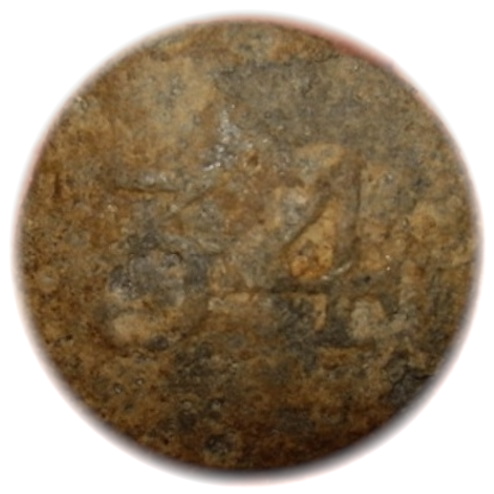 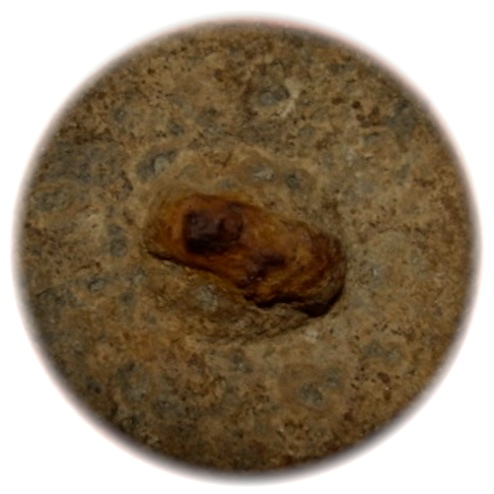
|
34th REGIMENT of FOOT 1768-80
Color: A Dark Silver Mixed With A Light Green
Patina.
Metal: 1-Piece, Slightly Convex, Raised Design,
Cast Pewter.
Size: 22mm.
Present Condition: An Excavated Example, Good
Planchet Casting, Good High Relief Pattern.
Isabela's Notes: This is the enlisted man's coat
button. This pattern has a larger size 25mm. Officer's
silver Repousse and a smaller 17.5mm.for a soldier's
vest or cuff. The button's pattern has a raised Arabic
style number, "34" in the center of a plain field with a
cable border. This regiment arrived in Quebec in May of
1776. Flanking companies joined Burgoyne's 1777
campaign, and got taken prisoners at Saratoga. There was
a small detachment stationed at Fort Stanwix and
Oriskany, and light companies from this regiment at
Oswego in 1780. In Post War 1784-86, they had a
detachment at Fort Mackinac to secure fur trade.
They received the title, "Cumberland Regiment" in 1782.
Reverse Button Analysis: This is a one-piece
button with a loop shank. The Boss is still present, but
the loop is missing.
Library Records Has Limited Information on R-54:
History: Yes
Recorded Sales Price: Yes
Current Button Owner and Location:
~ New York ~
Excavated in New York~ |
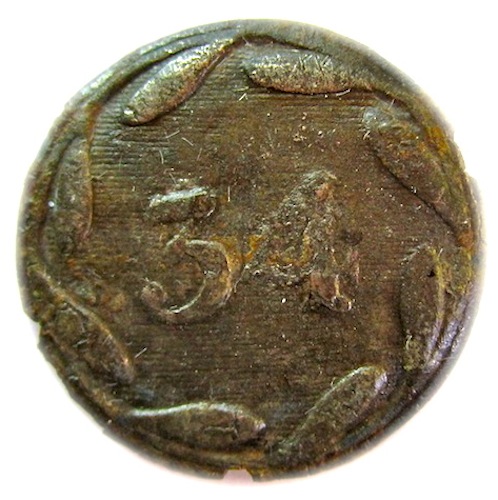 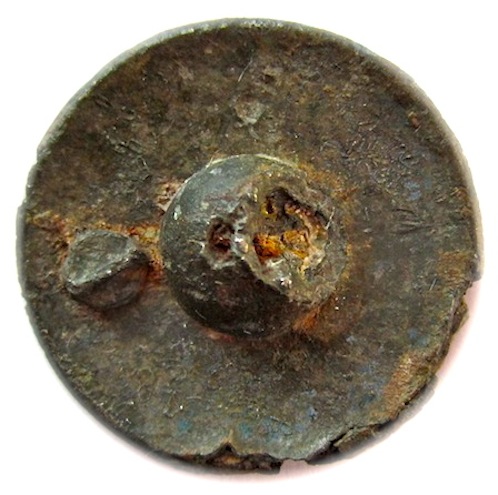
|
34th REGIMENT of FOOT 1776-86
Color: A Dark Silver Mixed With A Light Green Patina.
Metal: Flat, 1-Piece, Raised Design, Cast Pewter.
Size: 25mm.
Present Condition: An Excavated Example, Good Planchet,
Good High Relief Pattern.
Isabela's Notes: This button is the large size officer's
coat button. This is more then one die variant, and this
die variant has the thick numbers. The button's pattern has an Arabic
style number, "34" in the center with large
petals surrounding. The high relief pattern is set on a
lined field with a thin raised edge border. This regiment arrived in Quebec in May of
1776. Flanking companies joined Burgoyne's 1777
campaign, and got taken prisoners at Saratoga. There was
a small detachment stationed at Fort Stanwix and
Oriskany, and light companies from this regiment at
Oswego in 1780. In Post War 1784-86, they had a
detachment at Fort Mackinac to secure fur trade.
They
received the title, "Cumberland Regiment" in 1782.
Reverse Button Analysis: This is a one-piece button with
a loop shank. The Boss is still present, but
the loop is missing.
Library Records Has Limited Information on R-54:
History: Yes Recorded Sales Price: Yes
Current Button Owner and Location: ~ New York ~
Excavated in New York.~
The Isabela Collection. |
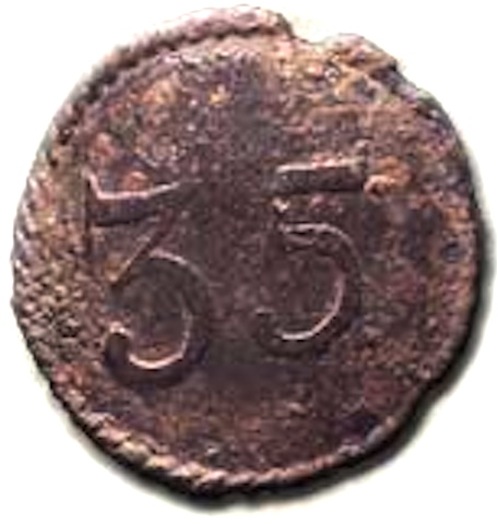
|
35th REGIMENT of FOOT 1775
Color: A Silvery Brown.
Metal: Flat, 1-Piece, Raised Design, White Metal.
Size: 21mm.
Present Condition: An Excavated Example, Fair Planchet,
Good High Relief.
Isabela's Notes: This is the large size enlisted
man's coat button. The button's pattern shows a raised Arabic
style number, "35" in the
center of a plain field. The high relief pattern is set
on s flat field with a thin raised cable border. This regiment arrived in Boston on June 12,
1775, and immediately sent flank companies to Bunker
Hill for the confrontation on June 17, 1775. In 1776,
they were involved in the New York Campaign, as well as
the battles in Long Island and White Plains. In 1778
they were sent to the Indies, and then to St. Lucia in
1779. In 1782 they captured St. Eustaius, and then went
back to St. Lucia later in the year.
They received the title,"Dorsetshire" in 1782.
Reverse Button Analysis: This is a one-piece button with
a loop shank. The Boss is still present, but the loop is
missing.
Library Records Has Limited Information on R-55:
History: Yes Recorded Sales Price: Yes
Current Button Owner and Location: ~ New York ~
Excavated in Piscataway, New Jersey.~ |
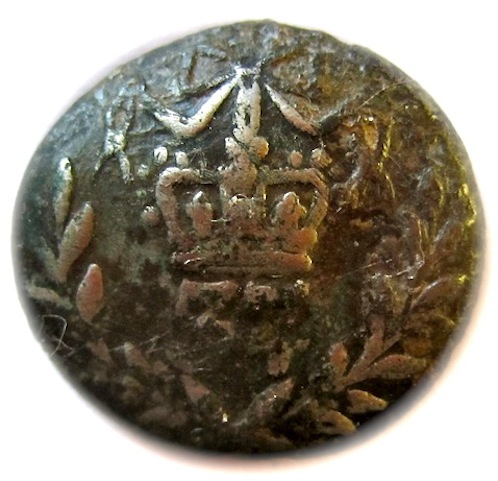 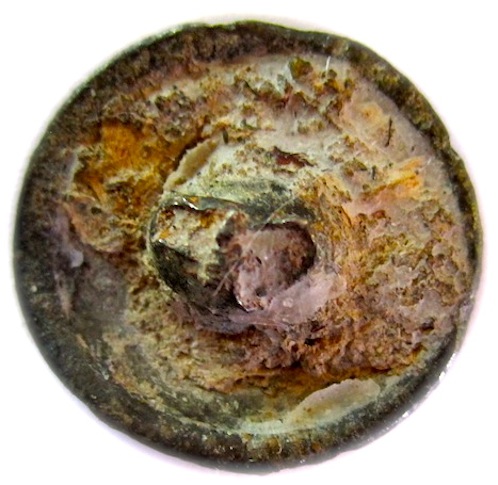
|
1776-89 37th REGIMENT of FOOT
Color: A Silvery Brown Mix.
Metal: Slightly Convex, 1-Piece, Raised Design, White
Metal.
Size: 16mm. Cuff or Vest Size.
Present Condition: An Excavated Example, Strong Planchet,
Good High Relief Pattern.
Isabela's Notes: This is the enlisted man's small size
cuff or vest button. The pattern shows a raised crown
surmounting the Arabic style number, "37". There is a
ribbon above the crown, and a wreath below the number in
the bottom legend.
In 1776, they arrived in Cape Fear, North Carolina, and
then preceded to Charleston, S.C. by May. Afterward they
went to New York and took part in the battle of Long
Island and Fort Washington. In 1777, the regiment was in
the Philadelphia campaign, including Brandywine and
Germantown. In 1778, they retreated through New Jersey,
and were involved in the battle at Monmouth Courthouse.
In the winter of 1778-79 they camped in Staten Island,
and then went to Newton Long Island for the preceding
winter of 1779-80. In June of 1780, they were involved
with the raid on Elizabethtown, New Jersey. They
remained stationed in New York, and Staten Island up
until October of 1783, and then stationed in Nova
Scotia. Some detachments were stationed in St. Augustine
Florida, and Newfoundland. The regiment returned home to
Great Britain in 1789.
Reverse Button Analysis: This is a one-piece button with
a loop shank. The Boss is still present, but
the loop is missing.
Library Records Has Limited Information on R-56:
History: Yes Recorded Sales Price: Yes
Current Button Owner and Location: ~ New York ~
Previously The Robert Thebert Collection.
The Isabela Collection. |
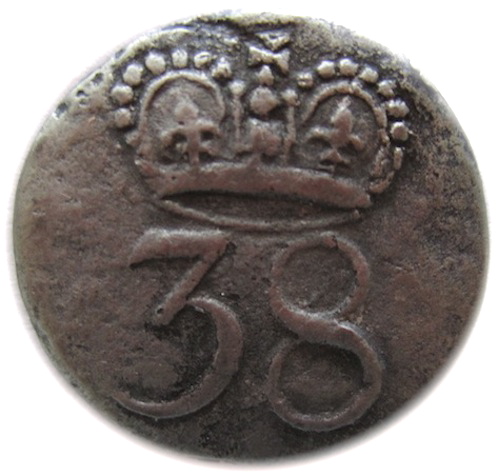
|
38th REGIMENT of FOOT
Color: A Pewter Gray.
Metal: Flat, 1-Piece, Raised Design, White Metal.
Size: 17mm.
Present Condition: An Excavated Example, Strong Planchet
Casting, Good High Relief Pattern.
Isabela's Notes: This is the small size enlisted man's
cuff or vest button. The button's pattern depicts a large crown
surmounting a large Arabic style regimental
number, "38". This high relief pattern
is set on a plain flat field with no edge border. This regiment first arrived in Boston's
port in July of 1774. They had flanking companies at
Lexington-Concord, and an entire unit was present at
Bunker Hill's battle. In 1776, the regiment was involved
in the New York Campaign, including actions at Long
Island, and the capture of Fort Lee. In the winter of
1779-80 they were in Flushing and Whitestone, N.Y. In
the beginning of June 1780, they were in the
Elizabethtown raid. At the end of June, they were
involved in the battle of Springfield. In the spring of
1781, they were in Kingsbridge, and later they were in
the raid of New London. In the winter of 1781-82 they
were back in Flushing, N.Y. Afterward they were
re-stationed at Fort Knyphausen in the city of New york
for 8 months through 1782. In 1783, they returned to
Great Britain. The regiment
received the title "1st Staffordshire Regiment" in 1782.
Reverse Button Analysis: This is a one-piece button with
a loop shank. The Boss is still present, but
the loop is missing.
Library Records Has Limited Information on R-57:
History: Yes Recorded Sales Price: Yes
Current Button Owner and Location: ~ New York ~
The Isabela Collection.~ |
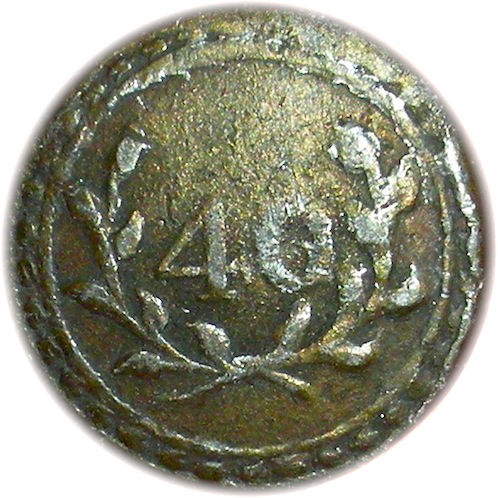 
|
40th REGIMENT of FOOT (Post 1775 Pattern)
Color: A Silvery Mix of Greenish/Brown.
Metal: Flat, 1-Piece, Raised Design, White Metal.
Size: 16mm.
Present Condition: An Excavated Example, Strong Planchet
Casting, Good High Relief Pattern.
Isabela's Notes: This is the enlisted man's small size
cuff or vest button. The button's pattern depicts a
small Arabic regimental number "40" in the center
of a wreath. The high relief pattern is set on a flat
plain field with a raised channel border with a leaf
design within. This
regiment first arrived in Boston in June of 1775. They
engaged in the New York campaign in 1776, and then went
on to the battle at Princeton, New Jersey. Afterward
they were in the Philadelphia campaign, with also
engagements at Brandywine, a light company at Paoli, and
the defense of the Chew House at Germantown. they
returned to New York in 1778, and then went on to East
Florida later in November of that year. They served in
Antigua, and Barbados for three years, and then returned
to New York in September of 1781. In 1781 they served as
Marines. In the winter of 1781-82 they had a small
company at Paulus Hook, and also participated on the New
London Raid , and the assault on Fort Griswold. In 1783,
they returned home to England.
Reverse Button Analysis: This is a one-piece button with
a loop shank. The Boss is still present, but
the loop is missing.
Library Records Has Limited Information on R-58:
History: Yes Recorded Sales Price: Yes
Current Button Owner and Location: ~ Pennsylvania ~
Valley Forge Antiques.~
Isabela's Notes: An interesting fact is that in 1775,
the uniforms intended for the British 40th, and 22nd of Foot were
captured on the ship Hope. The uniforms were dyed and
issued to the patriot soldiers serving in the
Continental Army during the late months of
1775-76. |
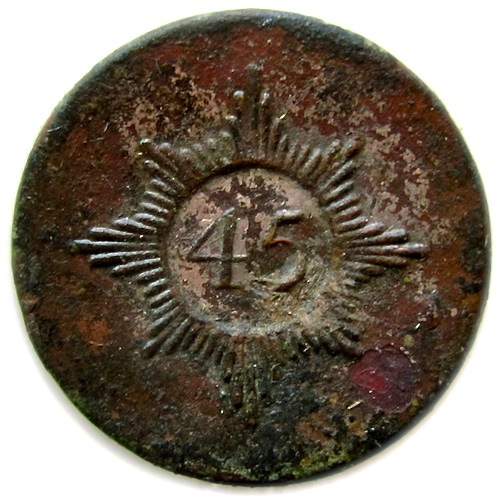 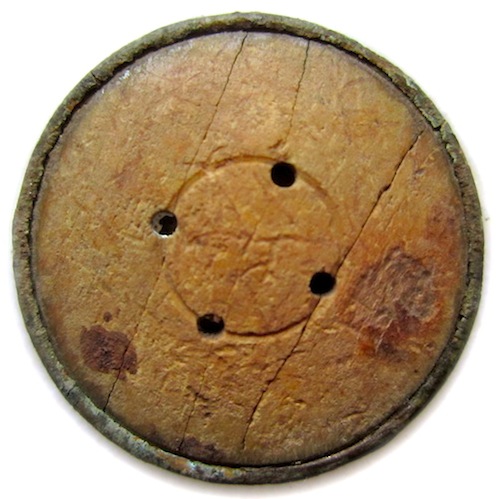
|
45TH REGIMENT of FOOT 1778-94
Color: An Ochre of Yellow, Brown & Red.
Metal: Flat, 2-Piece, Repousse Silvered Copper.
Size: 24mm.
Rarity: R-6
Present Condition: An Excavated Example, Strong Copper
Repousse, Strong High Relief Pattern.
Isabela's Notes: This is a large size officer's coat
button. The button's pattern depicts a raised Arabic
style regimental number, "45" in a center well.
Surrounding the well is a raised star pattern. The high
relief pattern is set on a flat plain field with no edge
border. This regiment arrived in Boston in July of 1775.
The regiment saw action in the New York campaign of
1776, including the Battle of Long Island. The regiment
had a small detachment of a 100 men in the Danbury raid
of 1777. In 1777, they had flanking companies in the
Philadelphia campaign, including actions in Brandywine
and Germantown. The regiment was primarily stationed for
the defenses of upper Manhattan, which included
Kingsbridge and Fort George. In September of 1778, the
officers went back to England, and the men were drafted
into other regiments. The officers that went back to
England and reconstructed the regiment and was given the
name, "Nottinghamshire" in 1782.
Reverse Button Analysis: This 2-piece button uses a wood
/ bone back
with a cat gut cord for attachment. The wood is still in great shape,
but the Cord is missing.
Library Records Has Limited Information on R-59:
History: Yes Recorded Sales Price: Yes
Current Button Owner and Location: ~ New York ~
The Isabela Collection. |
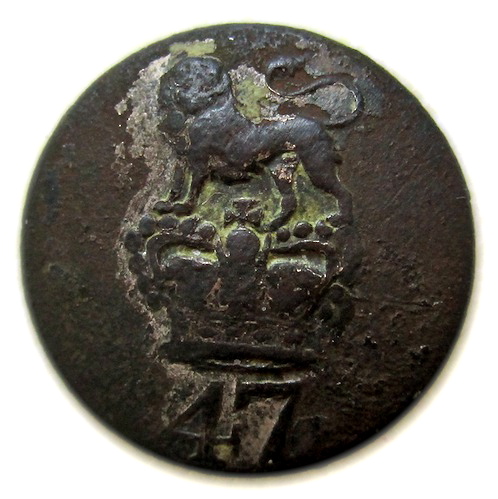
|
47TH REGIMENT of FOOT
Color: A Rusty Brown.
Metal: Slightly Convex, 1-Piece, Raised Design, White
Metal.
Size: 17mm.
Present Condition: An Excavated Example, Good Planchet,
Good High Relief.
Isabela's Notes: This is the small size enlisted man's
cuff or vest button. This button's pattern has the officer's style
motif of a Lion surmounting a Crown over the Arabic
style number, "47". The 47th regiment arrived in Boston in
October of 1774. The Regiment had Flank companies at
Lexington-Concord, and the rest of the regiment was at
Bunker Hill. By March 1776, the regiment went to
Halifax, and then on to Quebec. Other notable
engagements was the successful defense of Diamond
Island, Lake George by two companies. the remainder of
the regiment surrendered at Saratoga. They also had a
detachment involved in operations in Ohio in 1780. In
1781, they had two companies at Fort Michilimackinac. In
1782, all privates were rafted into the 8th of Foot.
Officers and NCOs went back to England in October of
1782. They were granted the title," Lancashire" regiment
in 1782.
Reverse Button Analysis: This is a one-piece button with
a loop shank. The Boss is present present,
but the Loop shank is crushed inward.
Library Records Has Limited Information on R-60:
History: Yes Recorded Sales Price: Yes
Current Button Owner and Location: ~ New York ~
The Isabela Collection. |
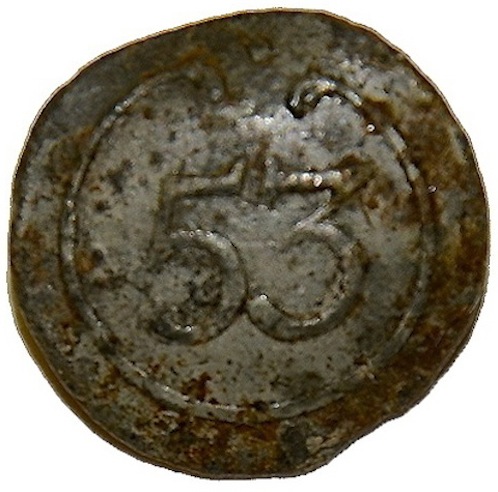 
|
53rd REGIMENT of FOOT
Color: A Rusty Gray.
Metal: Flat, 1-Piece, Raised Design, White Metal.
Size: 21mm.
Present Condition: An Excavated Example, Fair Planchet,
Good High Relief Pattern.
Isabela's Notes: This is the 1st pattern of this
style used for the enlisted men. This is the large size
coat button. The button's pattern depicts
an Arabic style regimental number, "53" in the center of
a broken circle with iris ends, and a surmounting dot.
The high relief pattern is et on a flat plain field with
thin raised edge border. The 53rd was originally raised in 1755 as the
55th Regiment, and then was re-numbered to the 53rd
Regiment in 1757. The regiment would see it's first
confrontation with Continental Troops when it arrived in
Quebec city for the siege in May of 1776. The next
notable campaign was under Guy Carlton in the Battle of Trois-Rivieres, and then the Battle of Valcour island in
1776. Except for some flank companies, the regiment
missed the surrender with General Burgoyne at Saratoga
in 1777, because they were part of the garrison at Fort
Ticonderoga. Men from the other eight companies would
serve under major Christopher Carleton, for Carleton's
raid in 1778, and the burning of the valley's campaign
in 1780. They finally returned home to England in 1787,
after a few more lessor skirmishes.
Reverse Button Analysis: This is a one-piece button with
a loop shank. The Boss is still present, but
the loop is missing.
Library Records Has Limited Information on R-61:
History: Yes Recorded Sales Price: For Sale
Current Button Owner and Location: ~ Pennsylvania ~
The Horse Soldier.~
|
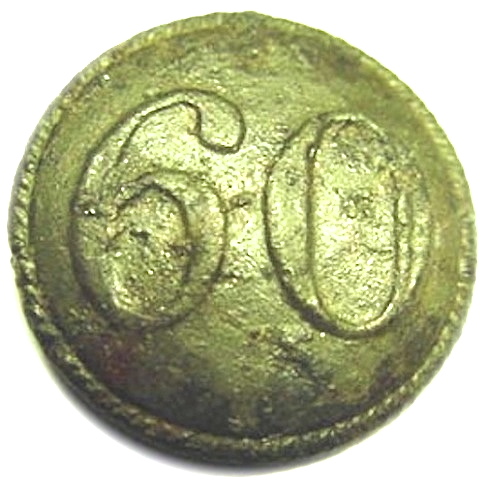 
|
60th REGIMENT of FOOT 1768-72
Color: A Silvery Gray with Green Encrustations.
Metal: 1-Piece, Slightly Convex, Impressed
Design, Cast Pewter.
Size: 24mm.
Present Condition: An Excavated Example, Strong
Planchet, Strong High Relief Pattern.
Isabela's Notes: This is the 1st pattern for the
enlisted man's large size coat button. The button's
pattern has a raised Arabic number "60" in it's center.
The high relief pattern is set on a plain convex field
with a thin cable border. Many of these buttons were
found around Fort Ticonderoga and Crown Point. I guess
this regiment was broken up into 4 battalions which
served in various locations though out North
America-Canada, Caribbean Islands, West Indies, and the
southern U.S. states like Georgia and Florida.
Reverse Button Analysis: The Boss is still
present, but the loop is harshly broken off.
Library Records Has Limited Information on R-62:
History: Yes
Recorded Sales Price: No
Current Button Owner and Location:
~ Florida ~
J. Baldwin Collection |
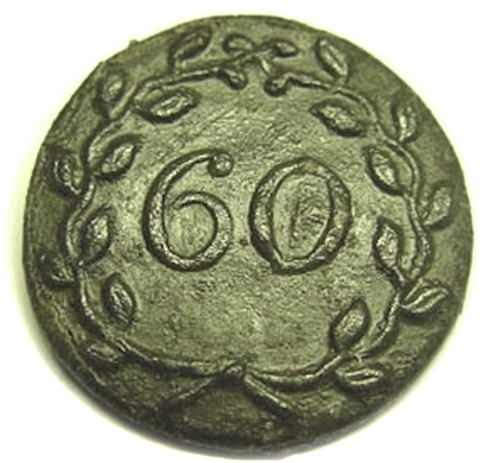 
|
60th REGIMENT of FOOT 1775-85
Color: A Silvery Gray with Green Encrustations.
Metal: 1-Piece, Slightly Convex, Impressed
Design, Cast Pewter.
Size: 17mm.
Present Condition: An Excavated Example, Strong
Planchet Casting, Strong High Relief Pattern.
Isabela's Notes: This is the 3rd pattern for the
enlisted man's large size coat button. The button's
pattern has a raised wreath surrounding the Arabic style
number "60" within it's center. The high relief pattern
is set on a slightly convex plain field with no edge
border. I guess this regiment was broken up into 4
battalions which served in various locations though out
North America-Canada, Caribbean Islands, West Indies,
and the southern U.S. states like Georgia and Florida.
Reverse Button Analysis: The Boss is still
present, but the loop is harshly broken off.
Library Records Has Limited Information on R-62.1:
History: Yes
Recorded Sales Price:
No
Current Button Owner and Location:
~ Florida ~
J. Baldwin Collection |
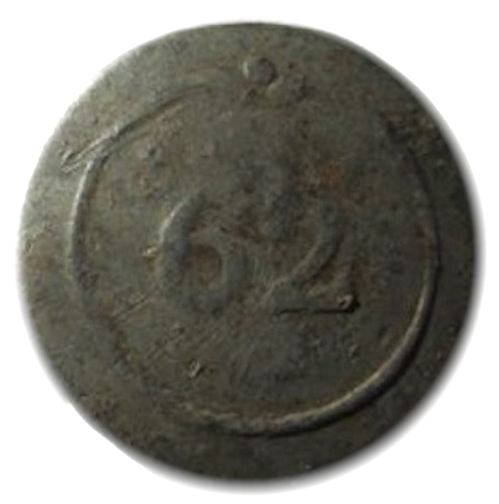 
|
62nd REGIMENT of FOOT 1776
Color: A Dull Pewter Gray.
Metal: Flat, 1-Piece, Raised Design, Cast Pewter.
Size: 24mm.
Present Condition: An Excavated Example, Good Planchet,
Strong Relief Pattern.
Isabela's Notes: This is the large size enlisted
man's coat button. The button's pattern has an Arabic
style regimental number, "62" within a broken
circle with iris ends, and a surmounting dot. The 62nd arrived
in Canada in 1776, and participated in the Battle at Trois Rivieres in June of that year. Several operations
in Lake Champlain in 1776, and then joined in Burgoyne's
expedition in 1777. They were captured at Saratoga, and
returned home from prison in 1780. It was given the name
"The Wiltshire Regiment" in 1782.
Reverse Button Analysis: This is a one-piece button with
a loop shank. The Boss is still present, but
the loop shank is missing.
Library Records Has Limited Information on B-63:
History: Yes Recorded Sales Price: Yes
Current Button Owner and Location: ~ New York ~
Excavated on a home site on the New
York-Massachusetts Border.~ |
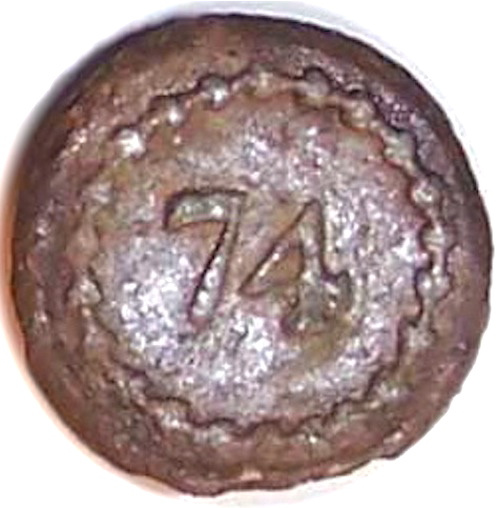 
|
74th REGIMENT of FOOT 1779-83
Color: A Pewter Gray.
Metal: Slightly Convex, 1-Piece, Raised Design, Cast
Pewter.
Size: 18mm.
Present Condition: An Excavated Example, Good Planchet,
Good Relief Pattern Pattern.
Isabela's Notes: This is the enlisted man's large
size coat button. This button's pattern depicts a raised
decorative leaf
ring with the Arabic style regimental number, "74" in it's center.
The high relief pattern is set on a slightly convex
field with no edge border. The
regiment landed in Halifax in 1778, and sent flank
companies to New York in 1779, and the rest of the
regiment went to fortify Castine, Maine. Several
skirmishes, and kept a garrison there until the close of
the war in 1783, then they went back to England.
Reverse Button Analysis: This is a one-piece button with
a loop shank. The shank is missing.
Library Records Has Limited Information on R-64:
History: Yes Recorded Sales Price: Yes
Current Button Owner and Location:
No
Excavated in Maine.~ |
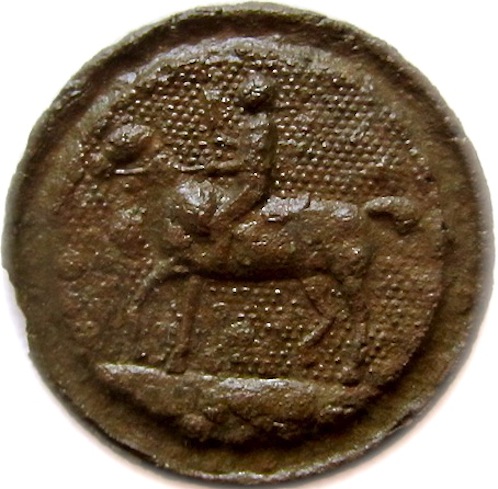 
|
1770's SOUTH CAROLINA LOYALIST MOUNTED CAVALRY
Color: A Coppery Brown With Olive Undertones.
Metal: Flat, 1-Piece, Raised Design, Copper.
Size: 28mm.
Rarity: R-6
Present Condition: An Excavated Example, Strong Planchet
Casting, Strong High Relief Pattern.
Isabela's Notes: The current theory put forth is that
this is a Loyalist Mounted Cavalry button belonging to
the South Carolina Dragoons. The loyalist were known to
have a cavalry as well as infantry, and there was a
South Carolina mounted unit of them. The button's
pattern depicts a mounted rider with a drawn
saber. The horse is shown charging upon a grassy mound.
The high relief pattern is set on a stippled field with a channel border.
Since fall 2010, several copper and pewter examples have
surfaced.
Reverse Button Analysis: This is a one-piece button with
a loop shank. Boss is still present, but
the loop shank is missing.
Library Records Has Limited Information on R-66:
History: Yes Recorded Sales Price: Yes
Current Button Owner and Location: ~ New York ~
Excavated in South Carolina .~
The Isabela Collection. |
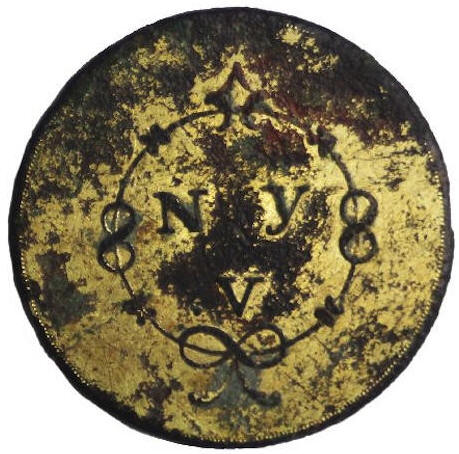
|
1777 NEW YORK VOLUNTEER LOYALIST BUTTON:
Color: A Flat Gold with Brown.
Metal: Flat, 1-Piece, Raised Design, Gilded Brass.
Size: 22mm.
Rarity: R-7
Present Condition: An Excavated Example, Good Planchet,
Good High Relief Pattern.
Isabela's Notes: A very nice New York volunteer Button.
Appears to retain a fair amount of gilt with a clear
image of the original pattern. The button's pattern
depicts the initials, N Y over V in the center.
Encircling is an ornamental circle with two figure
eights on the side and a bow below. The high relief
pattern is set on a plain flat field with a thin raised
dotted edge border.
Reverse Button Analysis: This is a one-piece button with
a loop shank. The shank is reportedly original,
straight, and intact.
Library Records Has Limited Information on R-67:
History: Yes Recorded Sales Price: Yes
Current Button Owner and Location: ~ Connecticut ~
The Don Troiani Collection.
Historicalartprints.com |
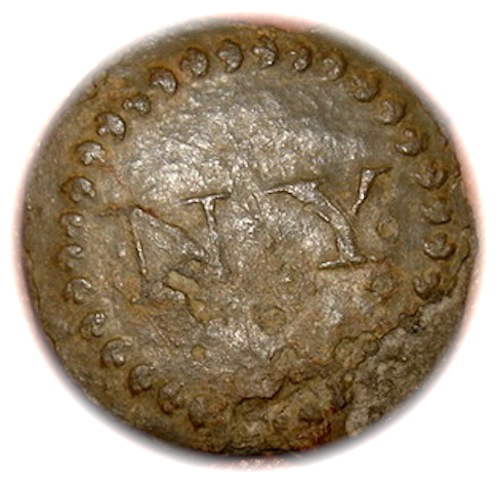 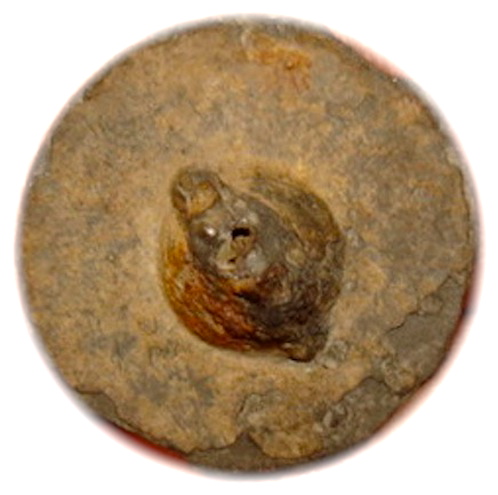
|
1770's NEW YORK LOYALIST BUTTON
Color: Silvery Brown.
Metal: Flat, 1-Piece, Raised Design, Cast Pewter.
Size: 22mm.
Present Condition: An Excavated example, Fair Planchet,
Good High Relief Pattern.
Isabela's Notes: This could be a another variation of a
NY Loyalist button. The lettering is reminiscent of the
style used in that era, but again this could just be a
button from around the late 18th century. There is no
documentation that this was ever worn by loyalists during the war.
The button's pattern depicts the abbreviation for New
York in the center of a decorative ring. The high relief
pattern is set on a flat plain field with no edge
border.
Reverse Button Analysis: The Boss is still present, but
the loop shank is missing.
Library Records Has Limited Information on R-68:
History: Yes Recorded Sales Price: Yes
Current Button Owner and Location: ~ New York ~ |
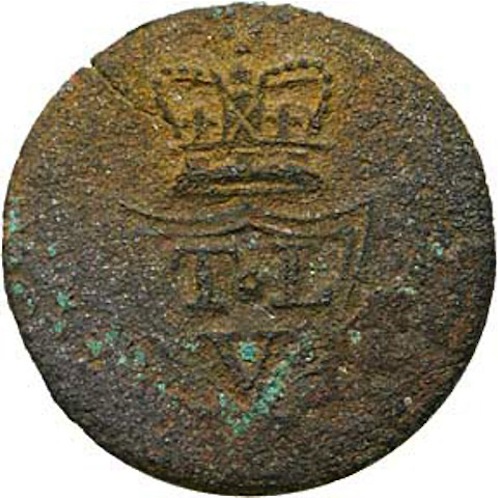 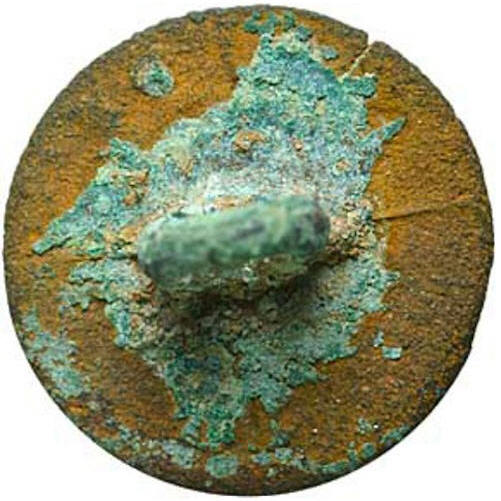
|
BRITISH LOYALIST VOLUNTEER BUTTON
Color: Golden Ochre Brown.
Metal: Flat, 1-Piece, Raised Design, Brass.
Size: 14mm.
Rarity: R-5
Present Condition: An Excavated Example, Fair Planchet,
Fair High Relief Pattern.
Isabela's Notes: The pattern and the provenance for this
button is Great Britain, but seller noted it was dug in
New York. The seller also noted in the listing that
there is an "RP" for Royal Provincials somewhere on the
button, but i fail to detect it. So i will list it as a
possible volunteer button that an English person brought
over and used during the late 18th century. The button
has a die crack at the eleven o'clock position from the
edge to the crown. The button has a granular texture,
and shows micro porosity though out the surface. The
button's pattern depicts a double wall raised shield
with the initials, "T*L over a V. There is a Crown above
the shield. The high relief pattern is set on a plain
flat field with no edge border. still has a viewable image that is easy
to see.
Reverse Button Analysis: This is a one-piece button with
a loop shank. The shank is original, straight, and
intact. The surface is coarse, and has green
encrustations.
Library Records Has Limited Information on R-69:
History: Yes Recorded Sales Price: Yes
Current Button Owner and Location: No |
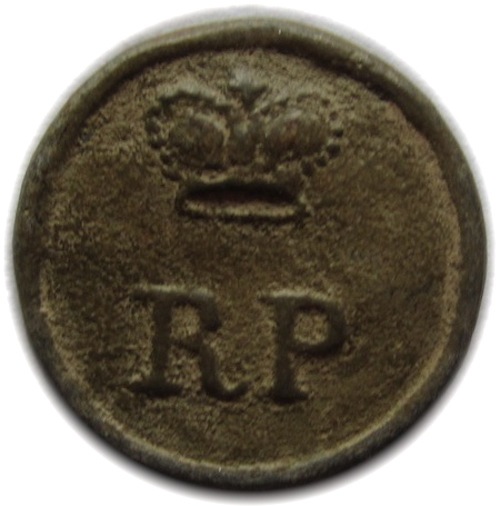 
|
1780 ROYAL PROVINCIAL LOYALIST BUTTON
Color: A Metal Brown with Orange Flair.
Metal: Flat, 1-Piece, Raised Design, Copper.
Size: 22mm.
Rarity: R-7 (With this Border Variation)
Present Condition: An Excavated example, Good Planchet,
Strong High Relief Pattern.
Isabela's Notes: This button is most likely an enlisted
man's large size coat button. The button's pattern
depicts a small crown over the initials, "RP".
The high relief pattern is set on a flat plain field
with a raised border edge. One theory put
forth is that these "RP" buttons did not exist before
1780. We do know by records that British loyalists used
plain white metal buttons that were sent from England as
early as 1776 for their Loyalist Troops. I am told by
Don T. that this is an extremely rare type of Royal
Provincial pattern, because it has a raised border.
Reverse Button Analysis: This is a flat one-piece button
with a loop shank. The shank is original, straight, and
intact.
Reverse Button Analysis: The Boss is still present, and
the Iron loop shank is intact.
Library Records Has Limited Information on R-70:
History: Yes Recorded Sales Price: Yes
Current Button Owner and Location: ~ New York ~
Excavated near Monck's Corners Charleston, South
Carolina.~
The Isabela Collection.
Isabela's Notes: There are only two known patterns to
exist for an officer's "Royal Provincial" button. The
first is a 22mm. gilded Copper Repousse with a wood
back. This was made for the Royal North Carolina
Volunteers. This type has never been excavated, but
examples have been found on period uniform jacket that
dated around 1782-3. The second, is a 22mm. gilded
one-piece copper button with a loop shank. This pattern
has a raised Crown with flowers and thistles above the
above foliated or script letters "RPV" (Royal Provincial
Volunteers). There have been a few recovered specimens
of this type from South Carolina, but again this was
probably not commonly used. |
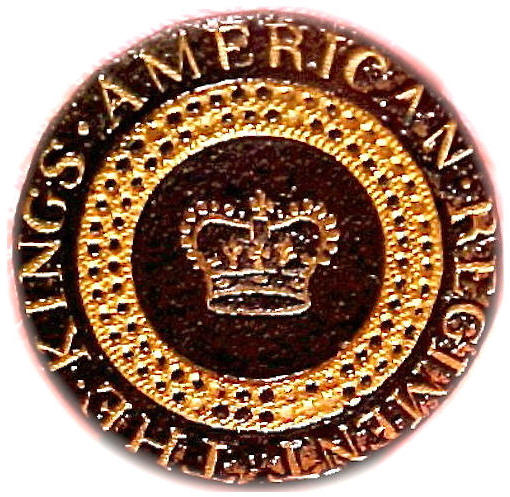
|
1776 THE KING'S 4th AMERICAN REGIMENT
Color: White Gold Face with Gold Inlay.
Metal: Flat, 1-Piece, Raised Design, Gilded Brass.
Size: 25mm.
Rarity: R-4
Present Condition: An Excavated Example, Exceptional
Planchet Casting, Exceptional Impressions.
Isabela's Notes: The design has a small incised English
Crown inside the center field. This is encompassed by a
double row of high relief stars that is set in a channel
upon a stippled background. Circling around the border
is the legend, "The Kings American Regiment" engraved in
all Roman Font Capital Letters. There is also four high
relief Separation Dots in-between each word. This type
of officer's button was designed and made with the
highest quality of manufacturing available at the time.
They were usually made of gilded brass, and had Samuel
Firmin's "SF" backmark. This regiment was originally
raised as a New York garrison in 1777, and was called,
"The Associated Refugees." They were stationed in
several places in New York including, Flatbush,
Flushing, and Kings Bridge. Their early campaigns
included the attacks on Forts Clinton and Montgomery in
the Hudson Valley, and in 1778, they joined part of the
Rhode Island Garrison; and participated in the raid on
Nantucket. Afterwards they returned back to New York in
1779. In 1780, they went to Virginia, and then onto
Charleston, South Carolina. Afterwards they went onto
Savannah, and had several operations in Georgia and
Florida. They were titled the 4th American Regiment in
1781. The regiment was officially disbanded in 1784.
Reverse Button Analysis: This is a One-Piece Casting for
the Reverse Shank.
Library Records Has Limited Information on R-71:
History: Yes Recorded Sales Price: Not for Sale
Current Button Owner and Location: ~ Canada ~
The P.E.I. Collection.
Isabela's Notes: The Original Buttons were Gold with
White Faces, and then after 1778 they changed to Gold
with Olive Green or Blue Faces.~ |
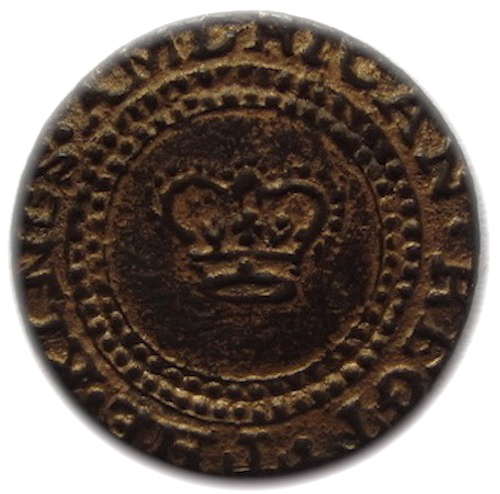 
|
1776 THE KING'S 4th AMERICAN REGIMENT
Color: Charcoal Gray Face with Gold Inlay.
Metal: Flat, 1-Piece, Raised Design, Gilded Brass.
Size: 16mm. (17mm.) Cuff Size.
Rarity: R-4
Present Condition: An Excavated Example, Strong Planchet
Casting, Strong Impressions.
Isabela's Notes: This is the small size officer's vest
or cuff button. The design has a small incised English
Crown inside the center field. This is encompassed by a
double row of high relief stars that is set in a channel
upon a stippled background. Circling around the border
is the legend, "The Kings American Regiment" engraved in
all Roman Font Capital Letters. There is also four high
relief Separation Dots in-between each word. This type
of officer's button was designed and made with the
highest quality of manufacturing available at the time.
They were usually made of gilded brass, and had Samuel
Firmin's "SF" backmark. This regiment was originally
raised as a New York garrison in 1777, and was called,
"The Associated Refugees." They were stationed in
several places in New York including, Flatbush,
Flushing, and Kings Bridge. Their early campaigns
included the attacks on Forts Clinton and Montgomery in
the Hudson Valley, and in 1778, they joined part of the
Rhode Island Garrison; and participated in the raid on
Nantucket. Afterwards they returned back to New York in
1779. In 1780, they went to Virginia, and then onto
Charleston, South Carolina. Afterwards they went onto
Savannah, and had several operations in Georgia and
Florida. They were titled the 4th American Regiment in
1781. The regiment was officially disbanded in 1784.
Reverse Button Analysis: This is a One-Piece Casting for
the Reverse Shank.
Library Records Has Limited Information on R-72:
History: Yes Recorded Sales Price: Yes
Current Button Owner and Location: ~ New York ~
The Isabela Collection. |
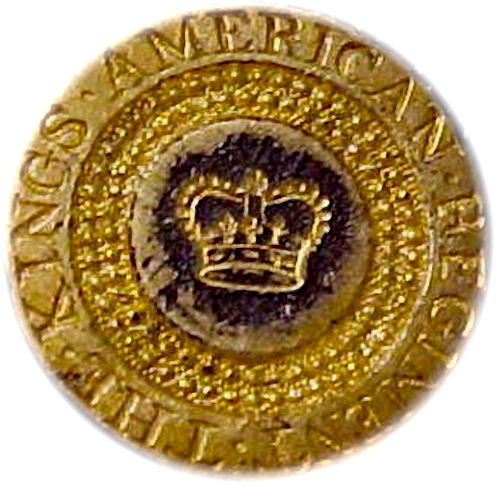 
|
1778 THE KING'S 4th AMERICAN REGIMENT
They were titled the 4th American Regiment in 1781
Color: Yellow Gold With Purple/Blue Face.
Metal: Flat, 1-Piece, Raised Design, Gilded Brass.
Size: 25mm.
Rarity: R-4
Present Condition: An Excavated Example, Exceptional
Planchet Casting, Exceptional Impressions.
Isabela's Notes: The design has a small incised English
Crown inside the center field. This is encompassed by a
double row of high relief stars that is set in a channel
upon a stippled background. Circling around the border
is the legend, "The Kings American Regiment" engraved in
all Roman Font Capital Letters. There is also four high
relief Separation Dots in-between each word. This type
of officer's button was designed and made with the
highest quality of manufacturing available at the time.
They were usually made of gilded brass, and had Samuel
Firmin's "SF" backmark. This regiment was originally
raised as a New York garrison in 1777, and was called,
"The Associated Refugees." They were stationed in
several places in New York including, Flatbush,
Flushing, and Kings Bridge. Their early campaigns
included the attacks on Forts Clinton and Montgomery in
the Hudson Valley, and in 1778, they joined part of the
Rhode Island Garrison; and participated in the raid on
Nantucket. Afterwards they returned back to New York in
1779. In 1780, they went to Virginia, and then onto
Charleston, South Carolina. Afterwards they went onto
Savannah, and had several operations in Georgia and
Florida. They were titled the 4th American Regiment in
1781. The regiment was officially disbanded in 1784.
Reverse Button Analysis: This is a One-Piece Casting for
the Reverse Shank. The shank is original straight, and
intact.
Library Records Has Limited Information on R-73:
History: Yes Recorded Sales Price: Not for Sale
Current Button Owner and Location: ~ Canada ~
The P.E.I. Collection.~
Isabela's Notes: In 1778 the buttons changed to Gold
with Blue Faces.~ |
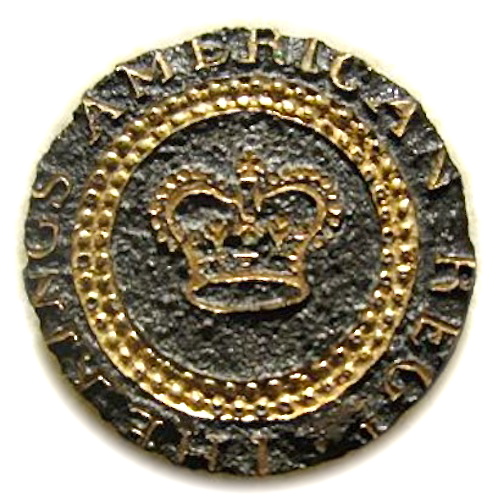 
|
1776 THE KING'S 4th AMERICAN REGIMENT
Color: Charcoal Gray Face with Gold Inlay.
Metal: Flat, 1-Piece, Raised Design, Gilded Brass.
Size: 16mm. (17mm.) Cuff Size.
Rarity: R-4
Present Condition: An Excavated Example, Strong Planchet
Casting, Strong Impressions.
Isabela's Notes: This is the small size officer's vest
or cuff button The design has a small incised English
Crown inside the center field. This is encompassed by a
double row of high relief stars that is set in a channel
upon a stippled background. Circling around the border
is the legend, "The Kings American Regiment" engraved in
all Roman Font Capital Letters. There is also four high
relief Separation Dots in-between each word. This type
of officer's button was designed and made with the
highest quality of manufacturing available at the time.
They were usually made of gilded brass, and had Samuel
Firmin's "SF" backmark. This regiment was originally
raised as a New York garrison in 1777, and was called,
"The Associated Refugees." They were stationed in
several places in New York including, Flatbush,
Flushing, and Kings Bridge. Their early campaigns
included the attacks on Forts Clinton and Montgomery in
the Hudson Valley, and in 1778, they joined part of the
Rhode Island Garrison; and participated in the raid on
Nantucket. Afterwards they returned back to New York in
1779. In 1780, they went to Virginia, and then onto
Charleston, South Carolina. Afterwards they went onto
Savannah, and had several operations in Georgia and
Florida. They were titled the 4th American Regiment in
1781. The regiment was officially disbanded in 1784.
Reverse Button Analysis: This is a One-Piece Casting for
the Reverse Shank. The shank is original straight and
intact. Even though there are some scratches, most of
the gilt remains on the surface.
Library Records Has Limited Information on R-75:
History: Yes Recorded Sales Price: Not for Sale
Current Button Owner and Location: ~ New York ~ |
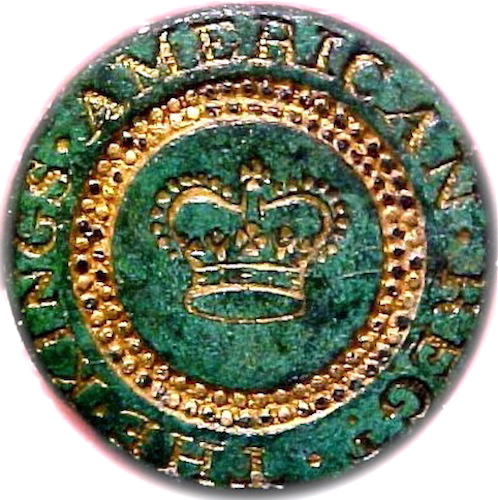 
|
1778 KING'S 4th AMERICAN REGIMENT
Color: Marble Green with Gold Inlay.
Metal: Flat, 1-Piece, Raised Design, Gilded Brass.
Size: 25mm.
Rarity: R-4
Present Condition: An Excavated Example, Exceptional
Planchet Casting, Exceptional Impressions.
Isabela's Notes: The design has a small incised English
Crown inside the center field. This is encompassed by a
double row of high relief stars that is set in a channel
upon a stippled background. Circling around the border
is the legend, "The Kings American Regiment" engraved in
all Roman Font Capital Letters. There is also four high
relief Separation Dots in-between each word. This type
of officer's button was designed and made with the
highest quality of manufacturing available at the time.
They were usually made of gilded brass, and had Samuel
Firmin's "SF" backmark. This regiment was originally
raised as a New York garrison in 1777, and was called,
"The Associated Refugees." They were stationed in
several places in New York including, Flatbush,
Flushing, and Kings Bridge. Their early campaigns
included the attacks on Forts Clinton and Montgomery in
the Hudson Valley, and in 1778, they joined part of the
Rhode Island Garrison; and participated in the raid on
Nantucket. Afterwards they returned back to New York in
1779. In 1780, they went to Virginia, and then onto
Charleston, South Carolina. Afterwards they went onto
Savannah, and had several operations in Georgia and
Florida. They were titled the 4th American Regiment in
1781. The regiment was officially disbanded in 1784.
Reverse Button Analysis: This is a One-Piece Casting for
the Reverse Shank. The shank is original straight, and
intact.
Library Records Has Limited Information on R-74:
History: Yes Recorded Sales Price: Not for Sale
Current Button Owner and Location: ~ Canada ~
The P.E.I. Collection.
Isabela's Notes: In 1778 the buttons changed to Gold
with Olive Green faces.~ |
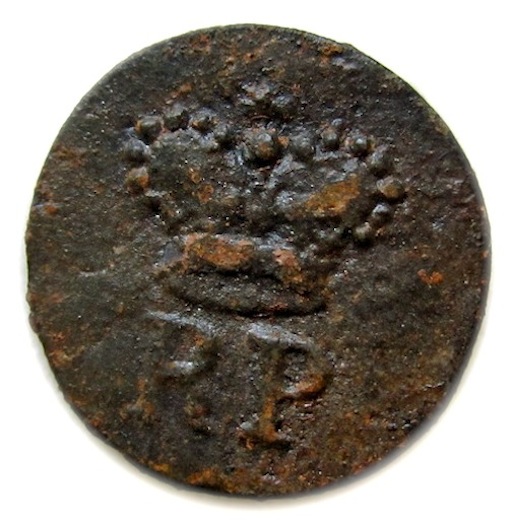 
|
ROYAL PROVINCIAL LOYALIST BUTTON 1780-83
Color: A Metal Brown with Orange Flair.
Metal: Flat, 1-Piece, Raised Design, Copper.
Size: 22mm.
Present Condition: An Excavated example, Good Planchet,
Strong High Relief Pattern.
Isabela's Notes: This button is the enlisted man's large
size coat button. The button's pattern depicts a small crown over the
initials, "RP". The high relief pattern is set
on a flat plain field with a flat edge. One theory put forth is
that these "RP" buttons did not exist before 1780. We do
know by records that British loyalists used plain white
metal buttons that were sent over from England as early
as 1776 for their Loyalist Troops.
Reverse Button Analysis: This appears to be a One-Piece
Casting for the Reverse Shank. The Shank appears to be
squared off, as some kind of transitional or
experimental type for the period.
Library Records Has Limited Information on R-76:
History: Yes Recorded Sales Price: Yes
Current Button Owner and Location: ~ New York ~
Excavated in St. Augustine Florida.~
The Isabela Collection.
Isabela's Notes: There are only two known patterns to
exist for an officer's "RP" button. The first is a 22mm.
gilded Copper repousse with a wood back. This was made
for the Royal North Carolina Volunteers. This type has
never been excavated, but examples have been found on
period uniform jacket that dated around 1782-3. The
second, is a 22mm. gilded one-piece copper button with a
loop shank. This pattern has a raised Crown with flowers
and thistles above the above foliated or script letters
"RPV" (Royal Provincial Volunteers). There have been a
few recovered specimens of this type from South
Carolina, but again this was probably not commonly used. |
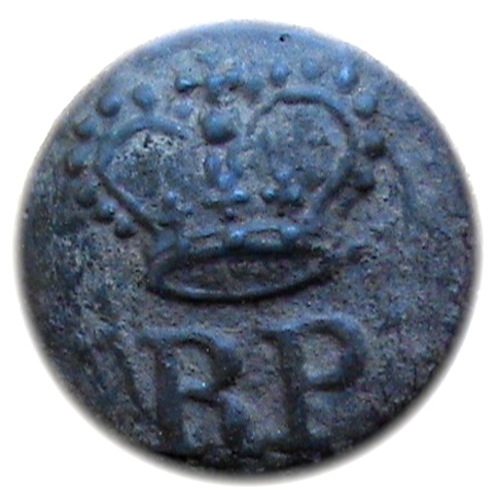 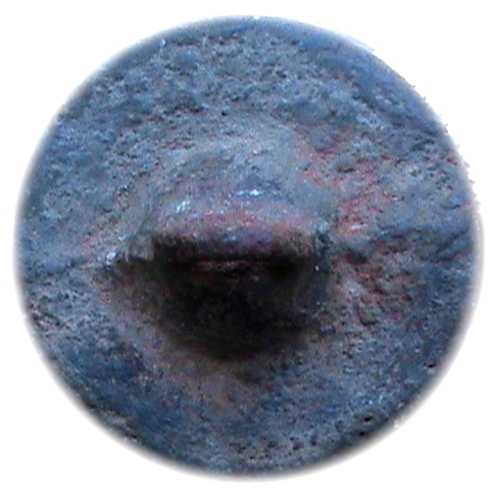
|
ROYAL PROVINCIAL LOYALIST BUTTON 1780-83
Color: A Metal Brown with Orange Flair.
Metal: Flat, 1-Piece, Raised Design, Copper.
Size: 22mm.
Present Condition: An Excavated example, Good
Planchet, Strong High Relief Pattern.
Isabela's Notes: This is another specimen of the
enlisted man's "RP" coat button. The button's pattern
depicts a small crown over the initials, "RP". The high
relief pattern is set on a flat plain field with a flat
edge. One theory put forth is that these "RP" buttons
did not exist before 1780. We do know by records that
British loyalists used plain white metal buttons that
were sent over from England as early as 1776 for their
Loyalist Troops.
Reverse Button Analysis: This appears to be a
One-Piece Casting for the Reverse Shank. The Shank
appears to be squared off, as some kind of transitional
or experimental type for the period.
Library Records Has Limited Information on R-76.1:
History: Yes
Recorded Sales Price: Yes
Current Button Owner and Location:
~ New York ~
Excavated at Stono River, South Carolina.~ |
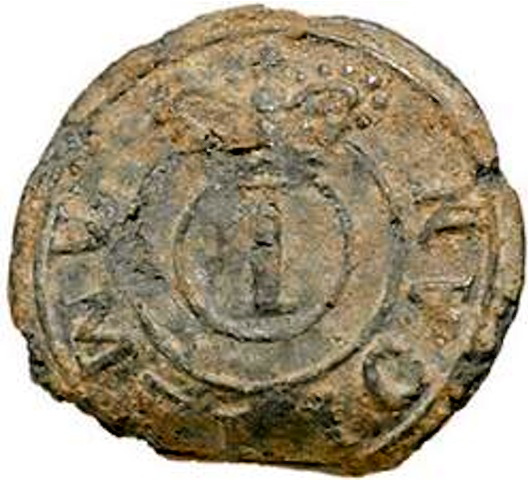 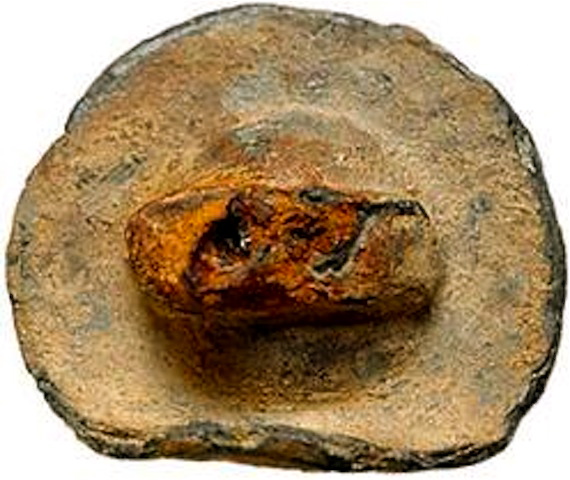
|
1776 QUEEN'S RANGERS (1st AMERICAN)
1779 KING'S AMERICAN DRAGOONS (1st AMERICAN REGIMENT)
Color: A Silvery Brown.
Metal: Flat, 1-Piece, Raised Design, Cast Pewter.
Size: 16mm.
Present Condition: An Excavated Example, Poor Planchet,
Fair High Relief Pattern.
Isabela's Notes: This is the small size enlisted man's
pattern for vest or cuff button. The pattern has a high
relief design of a crown over the Arabic number "1". The
word, "American" is in raised lettering in the bottom
legend set in-between two raised concentric ring. This
unit was originally known as the Queen's Rangers (1st
American). Officially raised in New York in August 1776,
and fought in various campaigns including Philadelphia
in 1777, including the battles at Brandywine and
Germantown. In 1778, they retreated through New Jersey
and were involved at Monmouth Court House. On May 2,
1779, part of the unit merged into the King's American
Dragoons stationed in New York. This is where it was
officially designated as the 1st American Regiment.
There next battle was in Springfield, New Jersey in June
1780, and then onto Virginia in 1781, with the capture
of most of the regiment at Yorktown. The remainder of
the regiment wintered in Hallet's Cove Long island in
1781-82. Except for a small detachment that was sent
down to the Carolinas. To date, the 1st American button
has only been found in a small size. The larger buttons
were never manufactured for the enlisted men.
Reverse Button Analysis: The Boss is still present, but
the loop shank is missing.
Library Records Has Limited Information on R-77:
History: Yes Recorded Sales Price: Yes
Current Button Owner and Location: No |
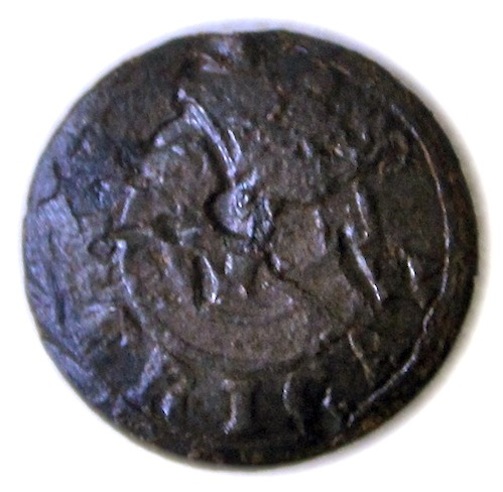 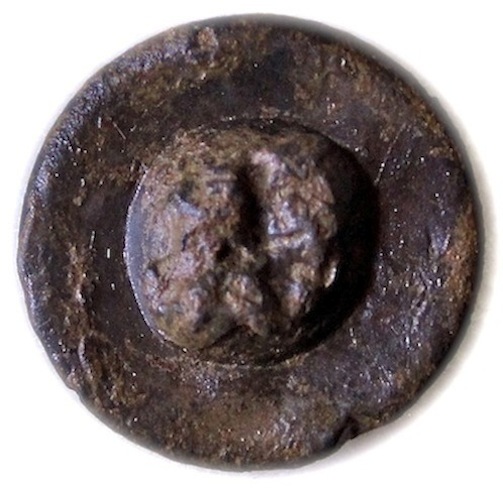
|
1779 KING'S AMERICAN DRAGOONS (1st AMERICAN REGIMENT)
Color: A Flat Grayish Black.
Metal: Slightly Convex, 1-Piece, Raised Design, Cast
Pewter.
Size: 16mm.
Present Condition: An Excavated Example, Fair Planchet,
Poor High Relief Pattern.
Isabela's Notes: This is the small size enlisted man's
pattern for vest or cuff button. The pattern has a high
relief design of a crown over the Arabic number "1". The
word, "American" is in raised lettering in the bottom
channel set in-between two raised concentric ring. This
unit was originally known as the Queen's Rangers (1st
American). Officially raised in New York in August 1776,
and fought in various campaigns including Philadelphia
in 1777, including the battles at Brandywine and
Germantown. In 1778, they retreated through New Jersey
and were involved at Monmouth Court House. On May 2,
1779, part of the unit merged into the King's American
Dragoons stationed in New York. This is where it was
officially designated as the 1st American Regiment.
There next battle was in Springfield, New Jersey in June
1780, and then onto Virginia in 1781, with the capture
of most of the regiment at Yorktown. The remainder of
the regiment wintered in Hallet's Cove Long island in
1781-82. Except for a small detachment that was sent
down to the Carolinas. To date, the 1st American button
has only been found in a small size. The larger buttons
were never manufactured for the enlisted men.
Reverse Button Analysis: This is a one-piece button with
a loop shank. The Boss is still present, but
the loop shank is missing.
Library Records Has Limited Information on R-78:
History: Yes Recorded Sales Price: Yes
Current Button Owner and Location: ~ New York ~
Excavated in New York.~
The Isabela Collection. |
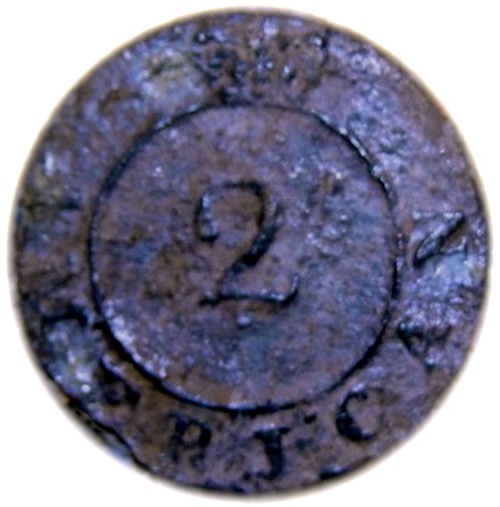
|
THE
VOLUNTEERS of IRELAND (2ND AMERICAN REGIMENT) 1782-83
1782 Re-named "The Kings Irish Regiment" & Designated
105th Regiment of Foot
Color: Pewter Grey with Black.
Metal: Flat, 1-Piece, Raised Design, Cast Pewter.
Size: 17mm.
Present Condition: An Excavated Example, Good Planchet,
Strong High Relief Pattern.
Isabela's Notes: This is the small size enlisted man's
pattern for vest or cuff. The pattern has a high relief
design of a crown over the Arabic number "2" that is
within a raised concentric ring. The word American is in
the legend underneath. The regiment was formed in New
York and Philadelphia in May of 1778. They had some
action in Virginia, King's Ferry, and Stony Point New
York. Went to Charleston South Carolina in 1780, with a
battle in Hobkirk's Hill and Camden. Also had a Garrison
stationed at Camden in 1781. In 1782, they had a raid on
Santee. In 1779, they were recommended to be named 2nd
American Regiment, but the designation didn't take place
until 1782. Later in that same year, they were
re-designated 105th regiment of Foot, and re-named, "The
King's Irish Regiment".
Reverse Button Analysis: This is a one-piece button with
a loop shank. The shank is reportedly intact.
Library Records Has Limited Information on R-79:
History: Yes Recorded Sales Price: Yes
Current Button Owner and Location: ~ New York ~ |
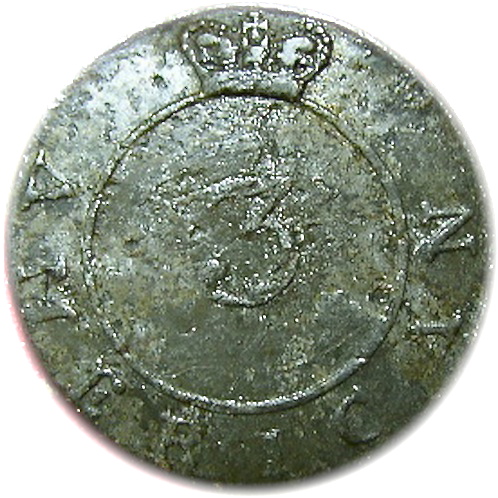
|
NEW
YORK VOLUNTEERS - 3rd AMERICAN REGIMENT
Color: A Silvery Green.
Metal: Flat, 1-Piece, Raised Design, Cast Pewter.
Size: 22mm.
Present Condition: An Excavated Example, Good Planchet,
Strong High Relief Pattern.
Isabela's Notes: This is the large size enlisted man's
coat button. The pattern has a high relief design of a
crown over the Arabic number "3" that is within a
concentric ring. The word American is in raised
lettering in the legend underneath. Originally, this
regiment was raised as two companies in Nova Scotia in
1776, and then went on to fight in the New York
Campaign. In 1777, they expanded to a battalion, and had
a detachment at the battle of Forts Clinton and
Montgomery. In the fall of 1778, they moved down to East
Florida. They joined in the fight at the siege of
Savannah in September of 1779, and then went to
Charleston, S.C. in the spring of 1780. In the summer of
1782, they returned to New York. They officially were
designated the 3rd American Regiment on May 2, 1779.
Reverse Button Analysis: This is a one-piece button with
a loop shank. The shank is reportedly intact.
Library Records Has Limited Information on R-80:
History: Yes Recorded Sales Price: No
Current Button Owner and Location: No |
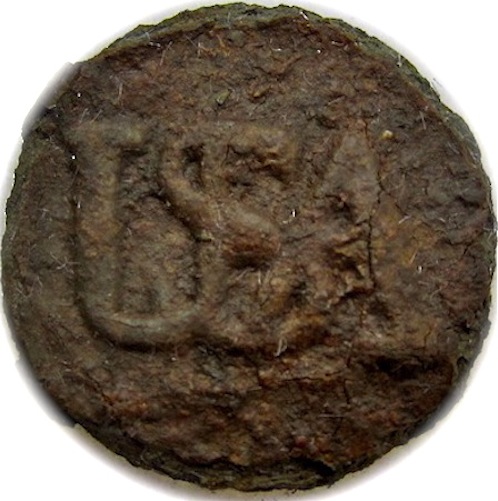 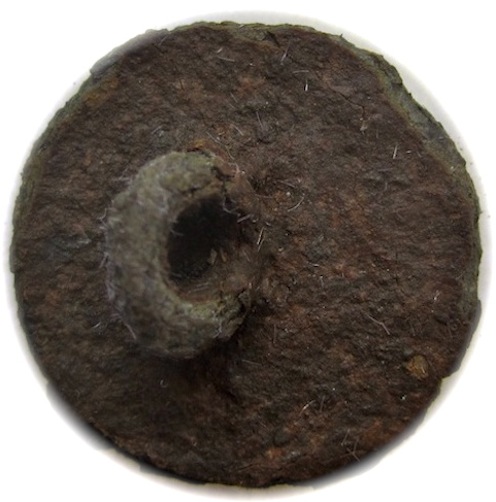
|
1777 CONTINENTAL ARMY U.S.A. BUTTON
Color: A Silvery Grey.
Metal: Flat, 1-Piece, Raised Design, Cast Pewter.
Size: 19mm.
Present Condition: An Excavated Example, Strong Planchet
Casting, Strong High Relief. Pattern
Isabela's Notes: This is the most common pattern used
for enlisted men in the Continental Army. This pattern
has been found in almost all campsites and battlefields
from nearly the beginning to the end of the war. This
USA button has some considerable edge loss, so it could
have been originally a large size enlisted man's
pattern. The pattern shows the "USA" in high relief
intertwined letters. I believe this variation could of
had a smooth border. Otherwise, the intertwined USA
pattern still shows nicely in high relief. The smooth
border's is unfortunately disintegrated. Taking pewter
examples for what there worth, this is just a good
example of a common button dug on a battlefield.
Reverse Button Analysis: This is a one-piece casting for
the reverse shank. shank is original, straight, and
intact.
Library Records Has Limited Information on R-81:
History: Yes Recorded Sales Price: Yes
Current Button Owner and Location: ~ New York ~
Excavated at Saratoga Battlefield, New York.~
The Isabela Collection. |
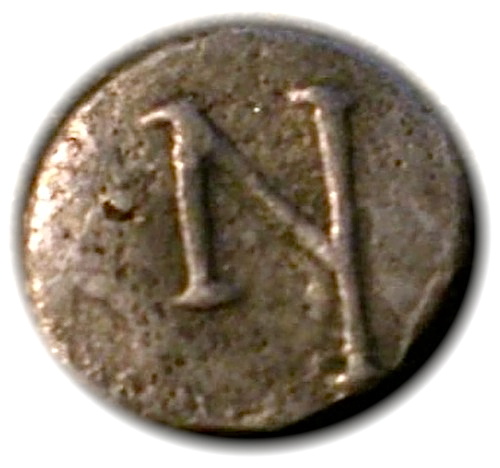
|
NY
BUTTONS 1776-78
Color: A Dull Pewter Gray
Metal: Flat, 1-Piece, Raised Design, Cast Pewter.
Size: 17mm.
Present Condition: An Excavated Example, Good Planchet,
Strong High Relief Pattern.
Isabela's Notes: This pattern was one of the earliest
known used buttons by the New York Continental
Regiments, but it wasn't the first. The Colony of New
York pattern (A British Royal Crown above two dots and
the letters "CN" in the center with raised dot border)
was in use before the declaration of independence. The
joined NY buttons were used for only about two years by
the New York Continental Regiments; and then it vanished
after the French Lottery coats were distributed for use.
The pattern has been found in the Hudson Valley by West
Point, Fishkill Barracks, Fort Clinton & Montgomery, and
also around Fort Stanwix.
Reverse Button Analysis: This is a one piece casting for
the reverse shank. Unknown information.
Library Records Has Limited Information on R-82:
History: Yes Recorded Sales Price: Yes
Current Button Owner and Location: ~ New York ~
Excavated in the Hudson Valley, New York.~ |
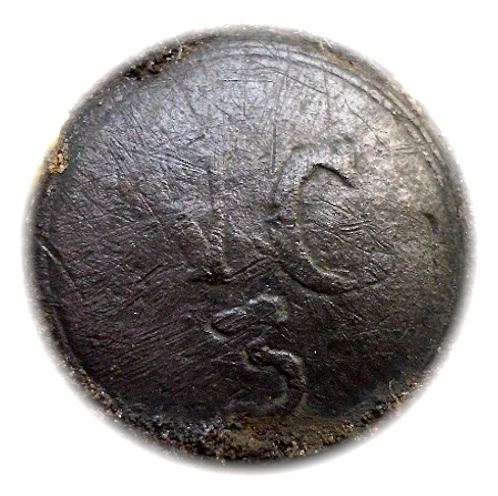 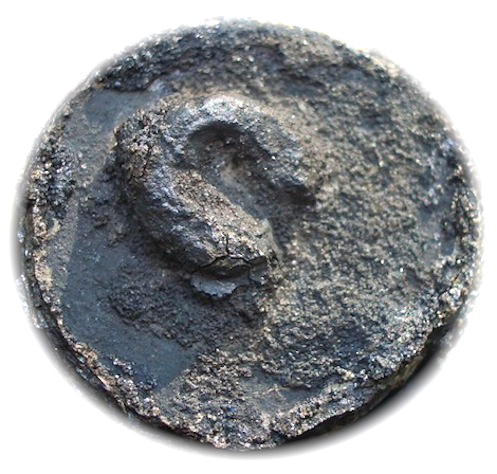
|
3rd
NORTH CAROLINA REGIMENT 1776
Color: Pewter Gray.
Metal: Slightly Convex, 1-Piece, Raised Design, Cast
Pewter.
Size: 25mm.
Present Condition: An Excavated Example, Strong Planchet
Casting, Strong High Relief Pattern.
Isabela's Notes: This is the large size enlisted man's
coat button. The pattern has the letters "NC" over the
Arabic number "3" in the center. This is encompassed by
a raised triple ring border. This regiment was raised in
January of 1776, and served in Charleston, Florida, and
North Carolina until February of 1777. Then it was sent
to re-enforce the Maine Army. Served in the Philadelphia
Campaign, and was present at Monmouth Courthouse. After
the Hudson Highlands in 1778, they went to Halifax North
Carolina in 1779, and then was captured at the siege of
Charleston, S.C. in May of 1780. Officially disbanded in
Spring of 1783.
Reverse Button Analysis: This is a One-Piece Casting for
the Reverse Shank. The shank is original, but bent over.
Library Records Has Limited Information on R-83:
History: Yes Recorded Sales Price: Yes
Current Button Owner and Location: ~ South Carolina ~
Excavated in a N.C. Rev War Camp located in South
Carolina.~ |
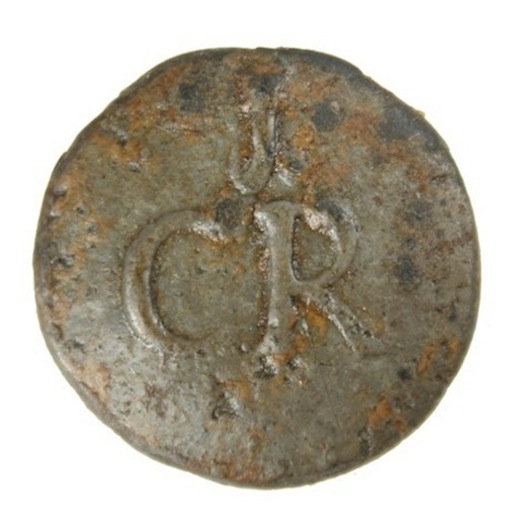
|
1st
CONNECTICUT REGIMENT of 1781
Color: Pewter Gray with Orange Speckles.
Metal: Flat, 1-Piece, Raised Design, Cast Pewter.
Size: 25mm.
Present Condition: An Excavated Example, Strong Planchet
Casting, Strong High Relief Pattern.
Isabela's Notes: This is the large size enlisted man's
pattern. The button has a very slight domed obverse. the
pattern show a raised Arabic number "1" with a slight
"J" foot over the block letters "CR". Don states in his
book that 1st Regiment is the most common of all "CR"
buttons, and this first regiment was most likely best
outfitted with these buttons. There appears to have been
two styles of "CR" buttons that have been excavated. The
first pattern has raised numbers and block letters. The
second has an impressed foliated pattern letter and
number. Overall this is an exceptional example that has
been nicely preserved.
Reverse Button Analysis: This is a one-piece button with
a loop shank. The shank is reportedly intact.
Library Records Has Limited Information on R-84:
History: Yes Recorded Sales Price: Yes
Current Button Owner and Location: ~ Connecticut ~
Excavated in the Hudson Highlands.~
The Don Troiani Collection.~
www.historicalartprints.com |
|
3rd
NEW HAMPSHIRE REGIMENT 1780-81
Color: A Dark Gray with Orange Rust Patches.
Metal: Flat, 1-Piece, Raised Design, Cast Pewter.
Size: 17mm.
Present Condition: An Excavated Example, Good Planchet,
Fair High Relief Pattern.
Isabela's Notes: This is the small size regimental
button for vest or cuff. There is a raised Arabic number
"3" in the center of a plain field. This is the only
known identifying pattern used by the New Hampshire
troops during the American Revolution. This regiment was
mostly stationed in the Hudson Valley, N.Y. around the
West Point, and New Windsor area; this lasted for two
years, 1780 & 1781. This regiment along with the 1st &
2nd New Hampshire, and the 10th Massachusetts, comprised
all of the defenses for West Point. The following year
in the winter of 1782, the regiment was re-stationed up
in Albany, New York. This cantonment was renamed, "Scammellsbourgh".
Reverse Button Analysis: This is a One-Piece Casting for
the Reverse Shank. The shank is original, straight, and
intact.
Library Records Has Limited Information on R-85:
History: Yes Recorded Sales Price: Yes
Current Button Owner and Location: ~ New York ~
Excavated around West Point, New York.~
The Isabela Collection. |
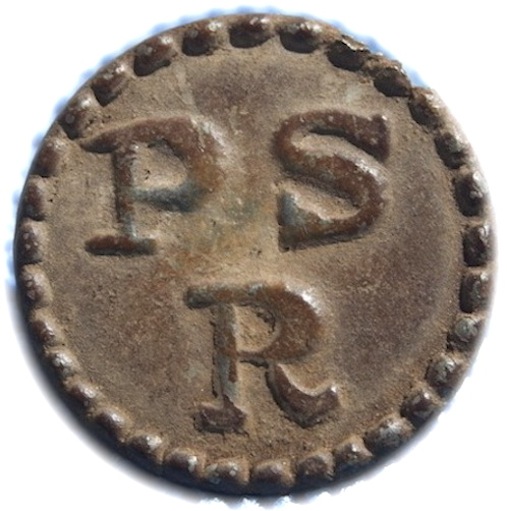 
|
1776 PENNSYLVANIA STATE RIFLE REGIMENT
Color: Milk Chocolate Brown with Orange Undertones.
Metal: Flat, 1-Piece, Raised Design, Cast Pewter.
Size: 24mm.
Present Condition: An Excavated Example, Good Planchet,
Good High Relief Pattern.
Isabela's Notes: This button could possibly be a very
early reproduction. There seems to be some conflict
between the experts who have studied the photo's, and
ones that studied it in hand. Since the people who
studied it in hand said it was, I will graciously give
it the benefit. This will be the only possibly
reproduction i list on my site until either i study it,
or new information presents itself. Originally organized
in 1776 as the Pennsylvania Rifle Regiment. Consolidated
later with the Pennsylvania Musketry Battalion and was
re-designated as the Pennsylvania State Regiment of Foot
in 1777. In 1778 it merged with the 2nd Regiment.
Engaged in the New York Campaign in 1776, and in 1777
involved in the Trenton-Princeton campaign, and then the
Philadelphia Campaign including Brandywine. This button
is in exceptional condition for it's age. The face shows
a scalloped border that surrounds raised block letters.
Reverse Button Analysis: This is a One-Piece Casting for
the Reverse Shank. The Shank is original, straight, and
intact. There is some metal loss or chipping near the
edge.
Library Records Has Limited Information on R-86:
History: Yes Recorded Sales Price: Yes
Current Button Owner and Location: ~ Pennsylvania ~
Excavated in Charlestown, Pennsylvania in August 2011.~
The B. Hanisco Collection. |
|
1776 PENNSYLVANIA 4TH BATTALION
Color: A Grayish Brown.
Metal: Flat, 1-Piece, Raised Design, Cast Pewter.
Size: 23mm.
Present Condition: An Excavated Example, Good Planchet,
Good High Relief Pattern.
Isabela's Notes: This is the large size coat button for
this unit. The pattern has a raised number "4" in-conjuntion
with the capital letters "B &P" in the center. There is
a raised scallop border around the periphery. This unit
was originally organized in January of 1776, in Chester
Pennsylvania. They served in the Northern Department
from March to December of that year. There service
included posts at Fort Ticonderoga, and the Lake
Champlain Valley. By the following year in January 1777,
they were reorganized, and re-designated the 5th
Pennsylvania Regiment.
Reverse Button Analysis: The Boss is still present, and
the loop shank is straight and intact.
Library Records Has Limited Information on R-87:
History: Yes Recorded Sales Price: Yes
Current Button Owner and Location: ~ Virginia ~
The William Guthman Collection.~
The William Leigh Collection.
Civilwarbuttons.com |
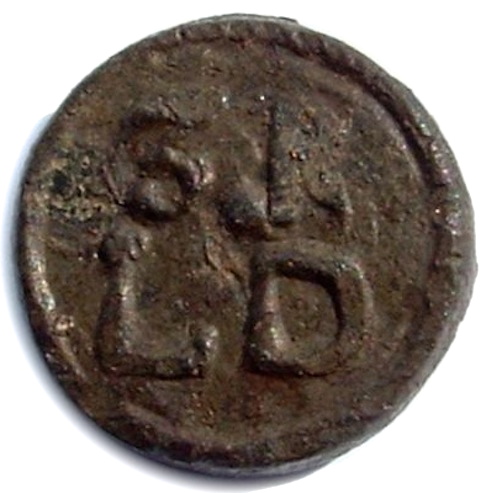 
|
1777-1782 3rd CONTINENTAL LIGHT DRAGOONS
Color: A Pewter Gray With Brown Undertones.
Metal: Flat, 1-Piece, Raised Design, Cast Pewter.
Size: 17mm.
Present Condition: An Excavated Example, Strong
Planchet Casting, Strong High Relief Pattern.
Isabela's Notes: The 3rd Continental Dragoons was
organized in Morristown New Jersey in January of 1777.
This unit was mostly organized from earlier Maryland and
Virginia units. Briefly had action in the northern
states, but primarily saw action in the southern states,
especially South Carolina. From recovery, this button
most likely dates to 1781when the unit operated in South
Carolina under Colonel William Washington. The pewter
button is in remarkable condition for it's age. The
button's pattern depicts the raised number and initials,
"3RLD" in the center. The high relief pattern is set on
a flat plain field with a thin raised edge border.
Reverse Button Analysis: This is a one-piece
casting for the reverse shank. The shank is original,
intact, but bent over.
Library Records Has Limited Information on R-88:
History: Yes
Recorded Sales Price: Owner Dug it.
Current Button Owner and Location:
~ South Carolina ~
Excavated in Charleston, South Carolina near water.~
The K. Nixon Collection |
GO BACK -
TOP
|