|
|
~
U.S. Military Cadets ~
Congress formally authorized the establishment, and
funding of the first U.S. Military Academy at West
Point, New York on March 16, 1802. The Continental Army
first occupied West Point on January 27, 1778, and
became the country's oldest continuously operating
Army-post in the United States. The students who
attended are considered officers-in-training, and are
referred to as, "Cadets" or collectively known as the,
"United States Corps of Cadets". The thought process
behind the establishment was to train US citizens in the
various fields of military academics and practices. This
would enable our country to protect our own self
interests, and free our reliance on various foreign
military disciplines and mercenary's during war time.
The USMA bases a cadets leadership experience as a
specialized development of three pillars of performance:
Academics, Physical, and Military. All cadets are
required to adhere to a Cadet Honor Code, which states
that, "A cadet will not lie, cheat, steal, or tolerate
those who do". Most graduates are commissioned as second
lieutenants in the U.S. Army.
Robert's notes: In 1900, only 8% of all Americans aged
14-17 attended high school, and only 11% of those few
students were expected to attend college. Most Military
schools in the 19th Century had very low enrollments.
Most admissions were under a 100 students, and under 50
for any particular year's class. It was thought to be a
prestigious honor to be a student enrolled in any one of
the country's military academies. |
%20WEST%20POINT%20MADE%20INTO%20A%20PIN%20ALBERTS%20SU-6-TICES%20MA206%20RJ%20Silverstein's%20Georgewashingtoninauguralbuttons.com%20O.jpg)
|
United States Military Academy at West Point, N.Y.
1840-1850's
If you were a Federal or Confederate Officer in the
Civil War, and you graduated from West Point, most
likely you would have worn this Coat button while a
Cadet, and General Robert E. Lee was the Superintendent.
Scovills and Robinson made most of these buttons in the
1840-50's. The button's pattern depicts a Spread-Eagle
in the center, with a Federal Shield on it's chest. The
Eagle has three Arrows in it's left talon, and a large
laurel stem with nine petals in it's right talon. The
word, "CADET" is written above in an arc, and the
initials, "U.S.M.A." for United States Military Academy
below. The high relief pattern is set on a convex lined
field with a thin plain border and rope edge. All
Specimens are Gilded Brass, 20.26mm, 2-Piece button.
Albert's Number: SU 6
Tice's Number: MA 206-A.1 |
%20WEST%20POINT%20MADE%20INTO%20A%20PIN%20ALBERTS%20SU-6-TICES%20MA206%20RJ%20Silverstein's%20Georgewashingtoninauguralbuttons.com%20O.jpg)
|
United States Military Academy at West Point, N.Y.
1840-1850's
If you were a Federal or Confederate Officer in the
Civil War, and you graduated from West Point, most
likely you would have worn this Cuff button while a
Cadet, and General Robert E. Lee was the Superintendent.
Scovills and Robinson made most of these buttons in the
1840-50's. The button's pattern depicts a Spread-Eagle
in the center, with a Federal Shield on it's chest. The
Eagle has three Arrows in it's left talon, and a small
laurel stem with 6 petals in it's right talon. The word,
"CADET" is written above in an arc, and the initials, "U.S.M.A."
for United States Military Academy below. The high
relief pattern is set on a convex lined filed with a
thin plain border and a rope edge. All Specimens are
Gilded Brass, 14mm, 2-Piece button.
Albert's Number: SU 6
Tice's Number: MA 206-As.1 |
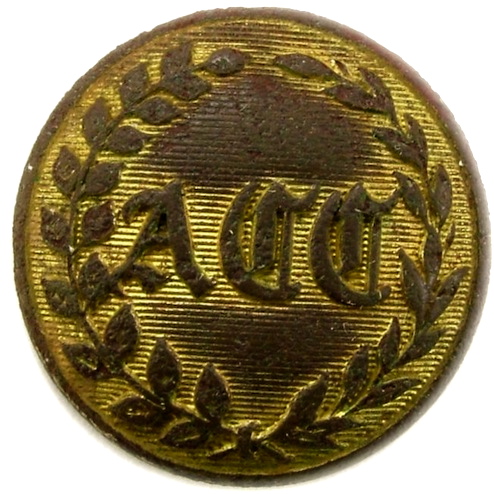
|
Alabama Corps of Cadets, Alabama
1850's-1861
Originally this was the University of Alabama, when the
Civil War started it shifted it's academics and
converted to a military form of governance. It's primary
duty was to produce new officers for the Confederate
Army. The University soon became the, "West Point" of
the South. It ended up supplying the Confederate army
with 7 Generals, 25 Colonels, 14 Lieutenant Colonels, 21
Majors, 125 Captains, 273 Staff and other commissioned
officers, and 294 Privates. The high relief pattern
depicts the old English initials, "ACC" in the center,
with a wreath encircling. The high relief pattern is set
on a low-convex lined field with a thin plain edge
border. Gilt finish, 21mm, 2-Piece button.
Albert's Number: SU 17
Tice's Number: ABS 282A.1 |
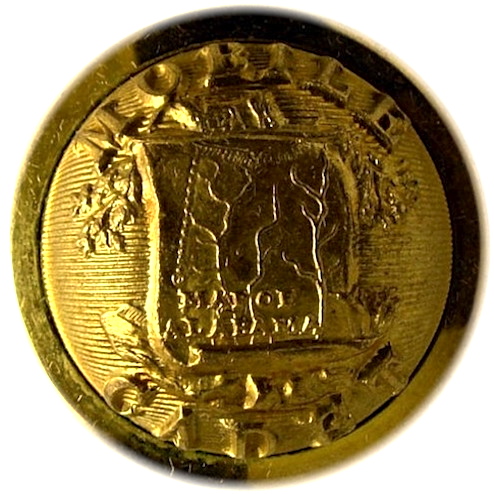
|
Mobile Alabama Cadet, Officers, Mobile Alabama
1845-1871
Originally the Cadets were organized in 1845 as a
volunteer militia company, and then served in the 1st &
3rd Alabama Regiment during the Civil War. Records show
Scovill made these wide rim buttons after the civil war.
The buttons pattern depicts the Alabama Map in the
center, with the city's name, "MOBILE" above, and
"CADET" below. The high relief pattern is set on a
convex lined filed with a plain edge border. Gilt
finish, 24mm, 3-Piece Officer-Staff button.
Albert's Number: AB 6
Tice's Number: ABS 252-A.1 |
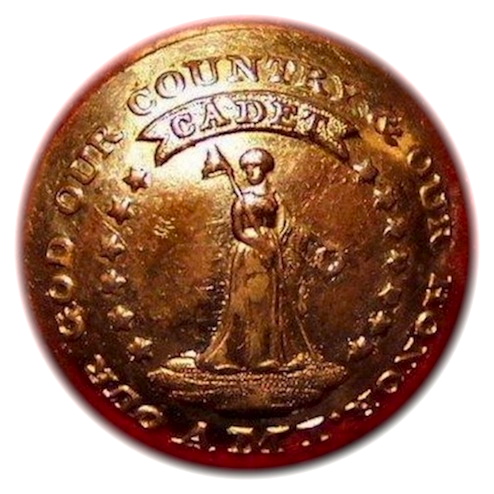
|
Arkansas Military Institute, Tulip Ridge, Arkansas
1850-1861
This military school was organized in 1850, and was part
of the Arkansas military organization. When the Civil
War started, the school was closed and the cadets formed
Company I of the 3rd Arkansas Infantry. The provenance
of this button is debated because none have been dug
around the AMI campus. The button's pattern depicts
Albert's Number: SU 24
Tice's Number: AKS 280-A.1 |
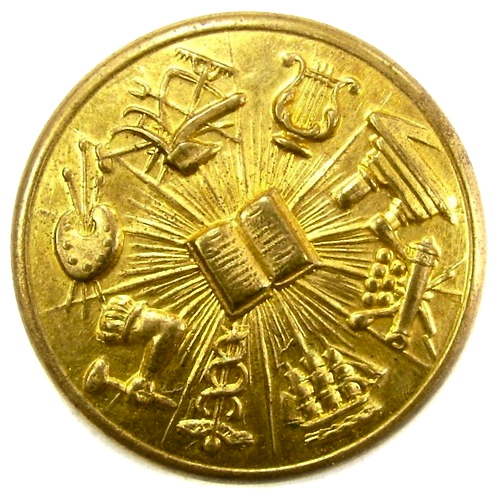
|
Connecticut Collegiate & Commerce Institute, New Haven,
Connecticut
1855-1860
Originally the school was established in 1836 for
business and commerce. When the Civil War broke out,
uniforms were issued with these buttons. The button's
pattern depicts a small open book in the center with
radiating rays. Surrounding is various symbols of
industry and art. The high relief pattern is set on a
plain almost flat field with a thing edge border. Gilt
finish, 22mm, 2-Piece button.
Albert's Number: SU 85
Tice's Number: CTS 278-A.3 |
|
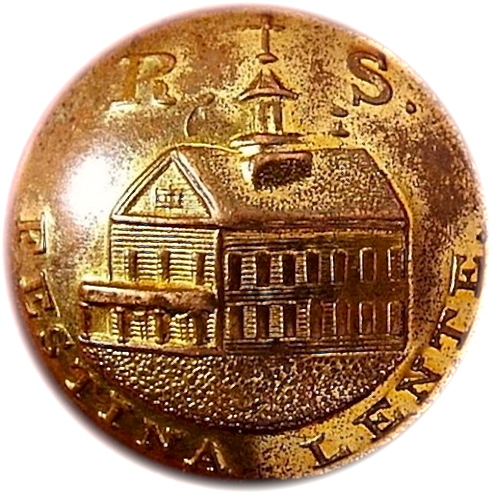
Connecticut Rectory School, Centerville, Connecticut
1860's
Originally founded in 1843, the Rectory School was one
of the first institutes in the Northeast to include a
military drill in it's curriculum. Many specimens were
found at Civil War sites and have been inaccurately
identified as Confederate. The button's pattern depicts
a school building in the center, with the initials, "R.S."
above. There is a small Cross on top, and the Latin
motto, "RESTINA LENTE" acred below. The high relief
pattern is set on a plain convex field with no edge
border. Gilt finish, 20mm, 2-Piece button.
Albert's Number: SU 341
Tice's Number: CTS 284-A.2 |
|
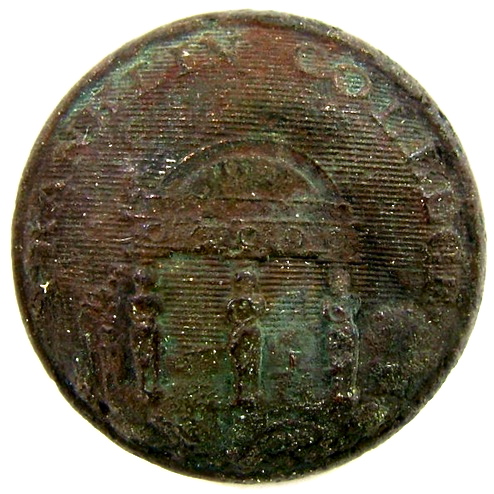
Georgia's Franklin College, Athens, Georgia
1840's
Originally founded in 1801, and was named in honor of
Benjamin Franklin. The Franklin College Cadets began
drilling during the War of 1812. Later formed the,
"College Volunteers" during the Seminole War / Texas War
of Independence. This is one of the most rarest of all
Antebellum southern military school buttons. The
button's pattern depicts Georgia's Coat of Arms. the
Temples columns are made to resemble goddesses. The
college's name, "FRANKLIN COLLEGE" is written above in
an arc. The high relief pattern is set on a convex lined
field with a thin plain edge border. All examples are
Silver Plated Copper. 23mm, 2-Piece button.
Albert's Number: SU 114
Tice's Number: GAS 275-A.1 |
|
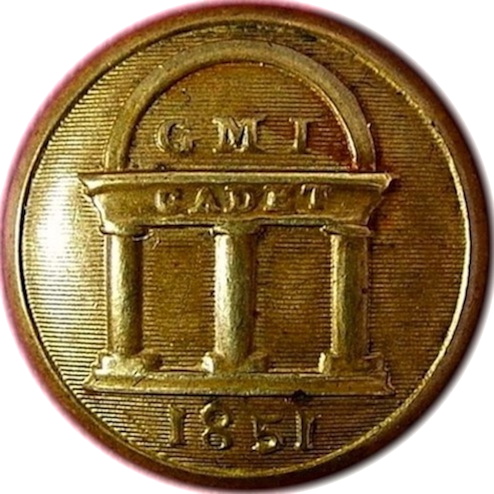
Georgia's Military Institute, Marietta, Georgia
1851-1864.
Established on July 1, 1851 with the enrollment of 7
students. By the end of the first year 28 students were
in attendance. GMI operated regularly until the spring
of 1864. The cadets were formed into two companies and
deployed to West Point, Georgia as a result of the Civil
War. During the Coarse of the war, the superintendent
sent cadets to use as drill instructors for the CSA, and
other cadets volunteered or were drafted. The empty
campus was burned by Sherman's troops on November 15,
1864. After the Civil War GMI was not rebuilt. The
button's pattern depicts the temple of Georgia's Coat of
Arms. The initials, "GMI" is inscribed inside the top
arch, and the word, "CADET" is written onto of the
pillars. The year 1851 lies below. The high relief
pattern is set on a convex lined filed with a plain edge
border. Gilt Finish, 21mm, 2-Piece button.
Albert's Number: SU 128
Tice's Number: GAS 287-B.2 |
|
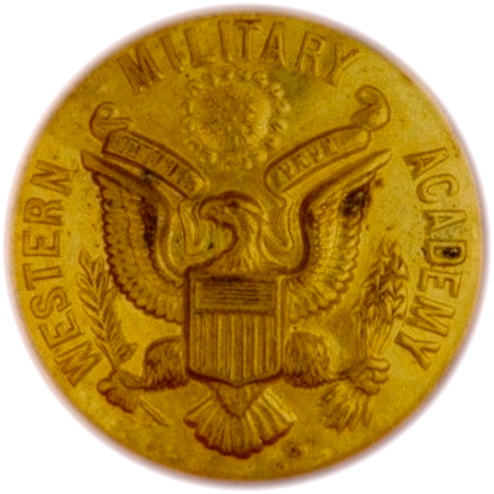
Western Military Academy, Alton, Illinois
1888-1971
The Western Military Academy was established in 1879 by
Edward Wyman. This was originally a private boarding
school whose mission was to give a rounded education to
young men. Upon Wyman's death in 1888, ownership
transferred to Colonel Willis Brown. It was at this time
the school changed it's name to Western Military
Academy, and introduced military training. The school
remained open until 1971. The button's pattern depicts
the United States Military Coat of Arms, surrounded by
the colleges name, "Western Military Academy" around the
border. The high relief pattern is set on a plain flat
field with no edge border. Gilt finish, 23mm, 2-Piece
button.
Albert's Number: SU 421
Tice's Number: Unlisted. |
|
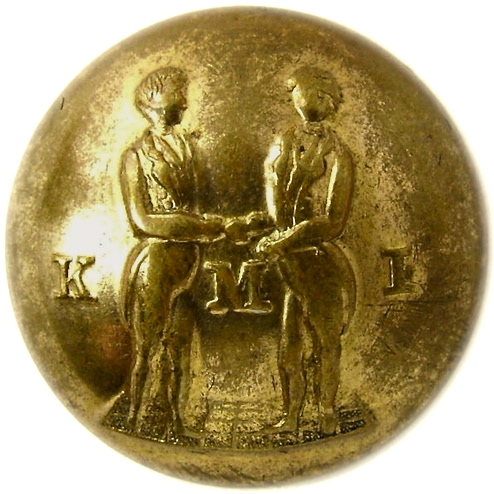
Kentucky Military Institute, Lexington, Kentucky
1850's-1860's
The Kentucky Military Institute was founded by Colonel
Allen in 1845, and is the oldest military school in
Kentucky. It also was the third military school
organized in the United States after the United States
Academy at West Point. All buttons were made prior to
the Civil War. The button's pattern depicts two
gentlemen shaking hands, with, "KMI" written across the
center. The high relief pattern is set on a convex plain
field with no edge border. Gilt Finish, 20mm, 2-Piece
button.
Albert's Number: SU 192
Tice's Number: KYS 275-A.10 |
|
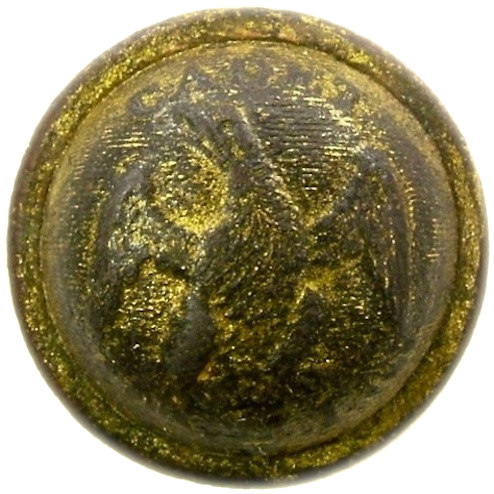
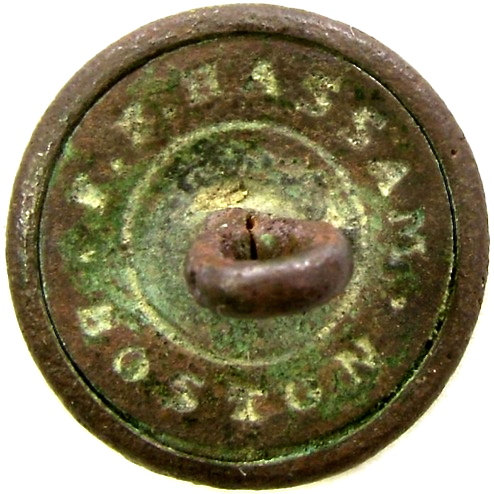
Kentucky Military Institute, Lexington, Kentucky
1855-1865
This Kentucky Military Institute button is not listed in
Tice's Kentucky section. But his back mark analysis does
list this as a 1855 back mark. Further research
indicates that Bazelon & McGuinn lists this company as
operating from 1847 to 1865, and did not appear in any
city directories after the Civil War. This would make
this the oldest officer-staff K.M.I button. So there are
specimens with pre-civil war back marks, they were
produced by F.K. Hassam of Boston, (who operate from
1847-65) These are rare examples, but do exist. Bazelon
& McGuinn would be the correct reference. Gilt Finish,
14mm, 2-Piece Officer-Staff button.
Albert's Number: SU 193
Tice's Number: KYS 280: Unlisted Back mark |
|
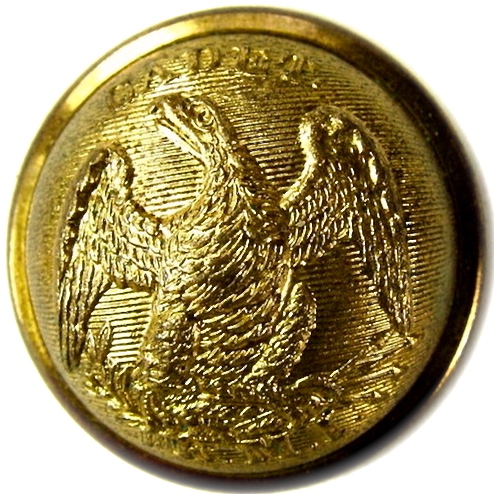
Kentucky Military Institute, Lexington, Kentucky
1865-1877
The Kentucky Military Institute was founded by Colonel
Allen in 1845, and is the oldest military school in
Kentucky. It also was the third military school
organized in the United States after the United States
Academy at West Point. Research shows these
officer-staff K.M.I buttons made by Horstmann are Post
Civil War. The button's pattern depicts an Eagle facing
right with down swept wings. The word, "CADET" is
written above, and, "KMI" below. The high relief pattern
is set on a high-convex lined field with a thin plain
edge border. Gilt Finish, 23mm, 3-Piece Officer-Staff
button.
Albert's Number: SU 193
Tice's Number: KYS 280 |
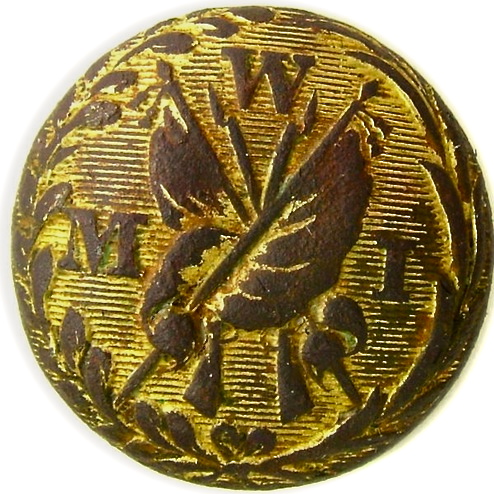
|
Kentucky Western Military Institute, Drennon Springs,
Kentucky
1847-1855
The Kentucky Western Military Institute was formed in
1847, and then later in 1855, it combined the military
portions of the college with the Nashville Military
College of Tennessee, into just Nashville Military
College. The button's pattern depicts Flags and Muskets
in the center, with the initials, "WMI" surrounding.
There is a Wreath surrounding the inside pattern. The
high relief pattern is set on a low-convex lined field
with no edge border. Gilt Finish 19mm, 2-Piece.
Albert's Number: SU 429
Tice's Number: KYS 290-A.3 |
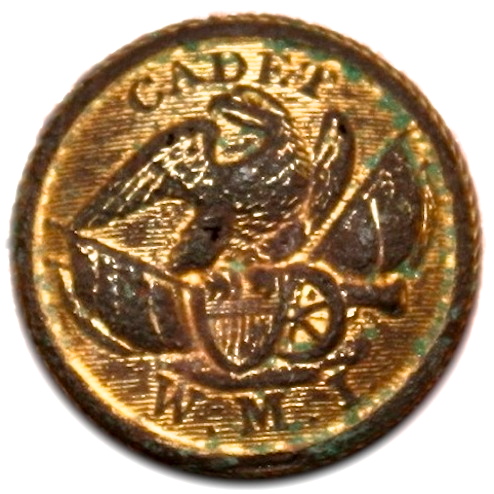
|
Kentucky Western Military Institute, Drennon Springs,
Kentucky
1847-1855
The Kentucky Western Military Institute was formed in
1847, and then later in 1855, it combined the military
portions of the college with the Nashville Military
College of Tennessee, into just Nashville Military
College. The button's pattern depicts an eagle with
upraised wings standing on a federal shield facing
right. Flanking underneath the eagle is four draped
flags and a cannon. The initials, "W.M.I. is arced in
the bottom legend, and the word, "CADET" is arced in the
legend above. The high relief pattern is set on a convex
lined field with a thin plain edge border. Most examples
found are in a Gilt Finish. 20mm, 2-Piece.
Albert's Number: SU 429
Tice's Number: KYS 295-A.1 |
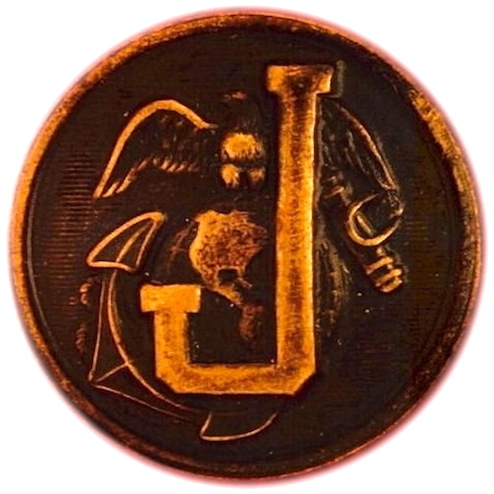
|
Jesuit School, New Orleans, Louisiana
1849-Present
The school was founded in 1847, but did not open until
1849; it was both a secondary school and a college. In
1911, the high school and college divisions were split.
In 1967, Jesuit became the first high school in the
country to have a Marine Corps Junior ROTC program. For
several years this program was mandatory for all
students. The college went on to eventually becoming
Loyola University in New Orleans. The button's pattern
depicts a spread-wing eagle facing right while standing
on a terrestrial globe. There is a large slanted Navy
anchor behind the globe; with only the stock, fluke and
crown showing. There is a large initial, "J" on top of
the globe and over the eagle's left wing. The high
relief pattern is set on a convex lined field with a
thin edge border. Gilt finish, 23mm, 2-Piece button.
Albert's Number: SU 180
Tice's Number: Unlisted. |
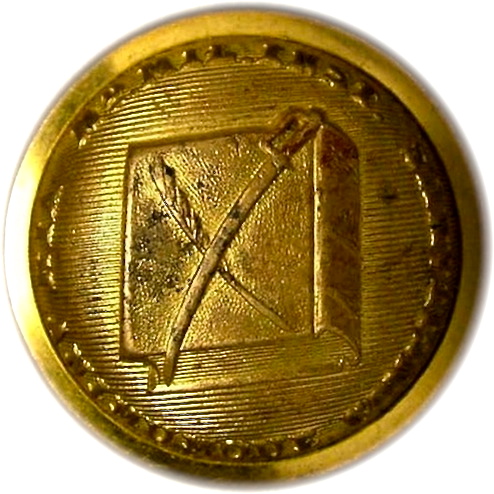
|
Maryland Military Institute, Baltimore, Maryland
1855-1860
This was a very small cadet school located in Baltimore
Maryland. Many of it's student came south of the
Mason-Dixon line, so it was considered a southern
school. The button's pattern depicts a large Bible in
the center, with a Cross quill Pen and a Sword on top.
The high relief pattern is set on a high-convex lined
field with a plain edge border. 22mm, Gilt finish,
3-Piece. Staff button.
Albert's Number: SU 217
Tice's Number: MDS 270-A.1 |
|
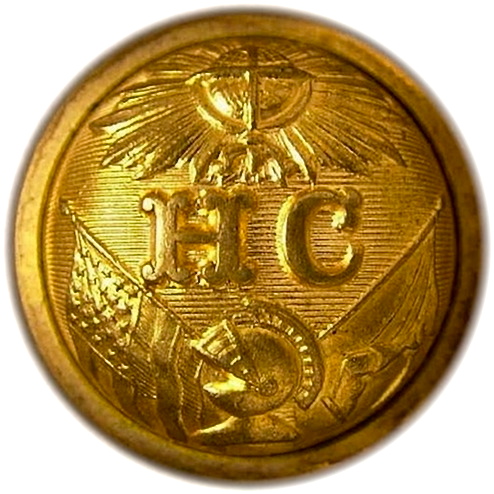
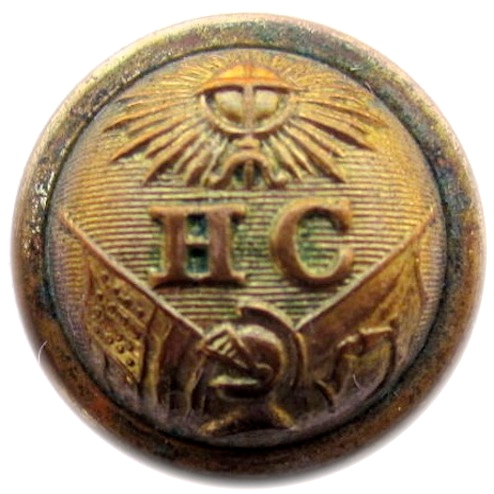
Massachusetts Highland Cadets, Worchester, Massachusetts
1855-1860
This military school was founded in 1855, and opened in
1856. Boys who enrolled in this school received strict
military training. At sunset every night a gun was fired
as the American Flag was hauled down. The button's
pattern depicts the Moline initials, "HC" with serifs.
There is a cross on a round dome with radiating lines
above, and a knight's helmet and two crossed flags. One
is an American Flag, the other is presumably the state
or school flag. The high relief pattern is set on a high
convex lined field with a plain edge border. Gilt
finish, 22mm, 3-Piece Officer-Staff button. / Gilt
finish, 14.9mm, 2-Piece button.
Albert's Number: SU 157
Tice's Number: MSS 390-A.1
Albert's Number: SU 157
Tice's Number: MSS 390-As |
|
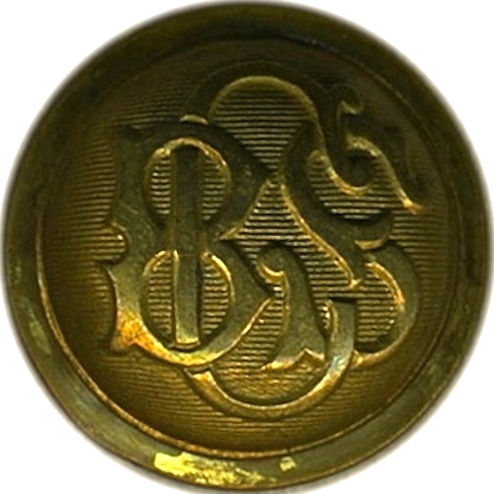
Boston School, Boston, Massachusetts
1880-90's
A small military school in Boston Massachusetts. This is
the Cadet Button to their uniforms. The button's pattern
depicts the school's initials, "BS" in the center with a
large "C" for cadet intertwining. The high relief
pattern is set on a high convex lined field with a thin
flat edge border. Gilt finish, 23mm, 3-Piece button.
Albert's Number: SU 43-A Cadet Staff
Tice's Number: Unlisted. |
|
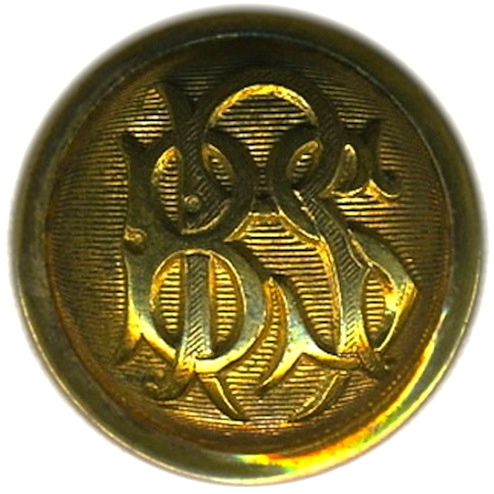
Boston School, Boston, Massachusetts
1880-90's
A small military school in Boston Massachusetts. This is
the Cadet Button to their uniforms. The button's pattern
depicts the school's initials, "BS" in the center with a
large "R" for Regiment intertwining. The high relief
pattern is set on a high convex lined field with a thin
flat edge border. Gilt finish, 23mm, 3-Piece button.
Albert's Number: SU 43-B Regiment, Staff
Tice's Number: Unlisted. |
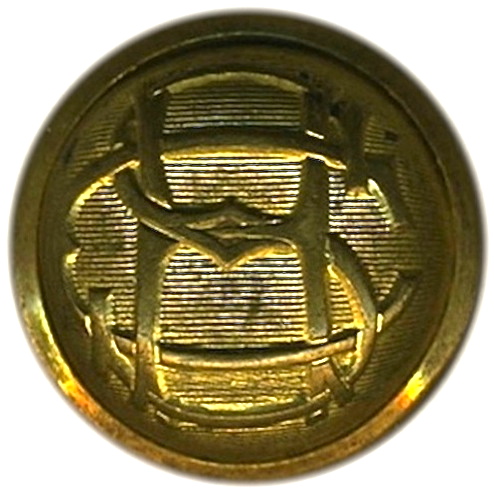
|
Chauncey Hall School, Boston, Massachusetts
1828-1907
Chauncey Hall School was originally established in 1828
by Gideon F. Thayer, and was located on Chauncey place
in Downtown Boston. The school originally trained the
children of wealthy Bostonians for a careers in
business, and prepared students to attend Harvard, MIT,
and other prestigious colleges. Unfortunately the school
burned down in May of 1873, but was later re-built in a
different location, and incorporated two other schools
to make a wider range of study. At one point in the 19th
century, it had a strong cadet program. There are
several manufacturers for this button that date around
the late 19th century. The button's pattern depicts the
school's initials "CHS" in large intertwining letters.
The high relief pattern is set on a high-convex lined
field with a plain flat edge border.
Albert's Number: SU 75
Tice's Number: Unlisted. |
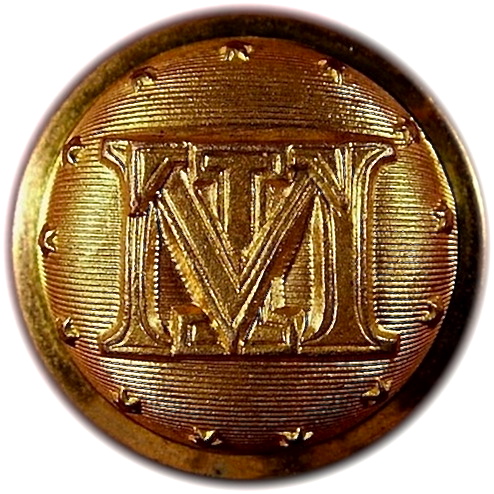
|
Massachusetts Institute of Technology, Cambridge,
Massachusetts
1865
MIT's founding charter was in 1861, but admitted it's
first student four years later in 1865. The school
originally had a cadet program included most likely
because of the states participation in the Civil War.
Waterbury button company may have produced these before
the school opened in 1865. The button's pattern depicts
the school's initials, "MIT" in intertwined capital
letters. The high relief pattern is set on a high convex
lined field with a plain edge border. Gilt finish, 22mm,
3-Piece, Officer-Staff button.
Albert's Number: SU 244
Tice's Number: MSS 395-A.1 |
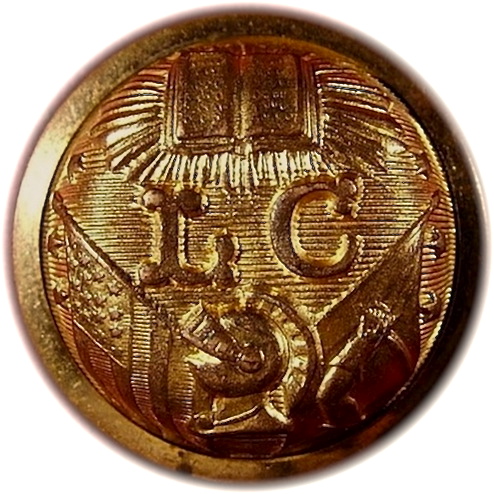
|
Massachusetts Military School Button
1860-Post
This button has been mis-identified as Vermont's Norwich
University button from 1880-84. The thinking is that
Colonel Charles Lewis (class of 1855), offered financial
aid to the school; and in recognition for his help, the
college was briefly renamed, "The Lewis College" from
1880-84. D. Evans did produce buttons during this time
with the initials, L.C. below the eagle, but there are
no records for 3-piece officer-staff buttons produced by
Waterbury Button Co. Unfortunately, Tice does not have a
listing for this variant, but it is similar to other
cadet buttons from the state of Massachusetts. Plus one
of the draped flags has the Mass. motif. It is my belief
that this was a small military school at one point in
the mid 19th century. The button's pattern depicts an
open bible on the top with radiating lines. Below in the
center is the Moline initials, "LC" with serifs. Below
is the knights helmet with two draped flags. One is an
American Flag, the other is a Massachusetts flag with
the bent arm and saber. The high relief pattern is set
on a convex lined field with a flat plain border. Gilt
finish, 22mm, 3-Piece Officer-Staff button.
Albert's Number: SU 208
Tice's Number: Unlisted. |
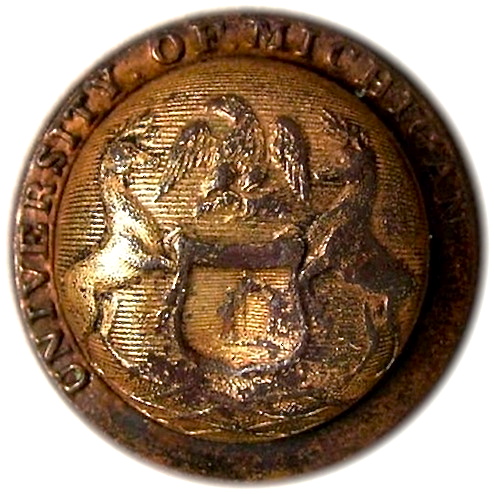
|
University of Michigan, Ann Arbor, Michigan
1837
The University was originally founded in Detroit as the,
"Catholepistemaid" or "University of Mighigania" about
20 years before Michigan Territory became a state! What
we know of the university moved to Ann Arbor in 1837. It
is one of the original eight Public Ivy Universities,
and has been ranked among one of the top five research
universities in the US, and among the top 20 in the
world. Around the Civil War period, it was prudent that
officials thought it prudent to have a military Cadet
program. This button was either made for a staff members
who had military training or cadet program that was
contemplated. The button's pattern depicts the state
Albert's Number: SU 227
Tice's Number: Not Listed. |
|
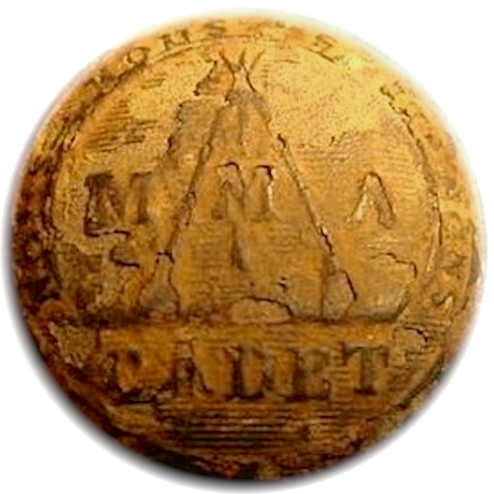
Michigan Military Academy
1877
The Michigan Military Academy was an all boys military
prep school in Orchard Lake Village, Michigan. It was
founded in 1877 by Captain J. Sumner Rodgers. His strict
military protocol had given it a nickname among
journalists as the second West Point. Unfortunately the
school closed in 1908 due to bankruptcy. The button's
pattern depicts three muskets standing in a tripod on
stocks. The initials, "MMA" is centered in raised
capital letters. the word, "CADET" is written below, and
the schools motto is written in an arc above. The high
relief pattern is set on a convex lined filed with no
edge border. Gilt finish, 21mm, 2-Piece button.
Albert's Number: SU 247
Tice's Number: Not Listed. |
|
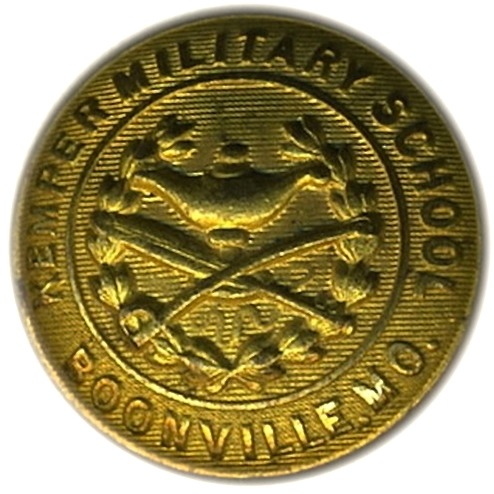
Kemper Military School, Boonville, Missouri
1899
The Kemper school originally opened on June 4, 1844 as
an all boys school. It wasn't until almost 30 years
later after the death of Kemper, that a former student
Colonel Thomas Johnston made great strides and turned it
into a military school. As early as the 1870's, all
Kemper students were required to West Point Style Gray
uniforms, possibly a bit earlier. The school even used a
Drill Master to oversee the military side of operations
as early as 1873. Johnston became carried away with the
idea of hard military training for young men, and
adopted a full military training and structure in 1885.
He even hired graduates from VMI for military
instructors and from that day on, the military feature
became a prominent way of Kemper live. The school
officially changed it's name in 1899, and advertised
it's name as the West Point of the West. The button's
pattern depicts the school's crest of a saber crossed
with a baton. There is a lamp above a wreath
encompassing the motif. There is a raised ring and the
schools name, "KEMPER MILITARY SCHOOL" above, and the
schools location, "Boonville, MO. below. The high relief
pattern is set on a low-convex field with a thing raised
edge border. Gilt finish, 21mm, 2-Piece button.
Albert's Number: SU 188
Tice's Number: Not Listed. |
|
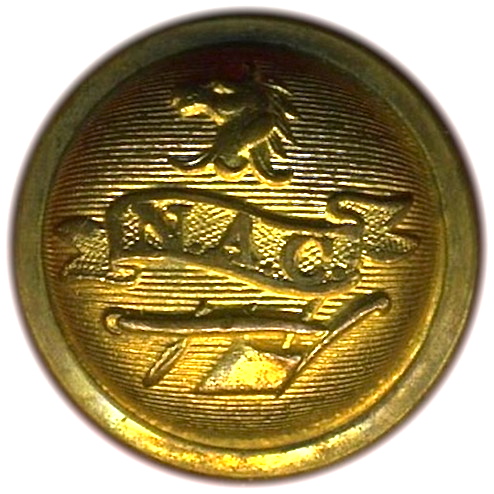
Newark Academy Cadet, Newark, New Jersey
1865
Newark Academy was founded in 1774, by the cleric
Alexander MacWhartor, a friend and advisor to George
Washington. In 1780, the Academy's sympathies to our
fledging nation brought the wrath of the British who
marched across the frozen Hudson River to burn the
original school building to the ground. The school was
rebuilt and continues to emphasize its motto, "Ad Lumen"
which means toward enlightenment. The school was a
unique preparatory school in that it opened it's doors
to students of every conceivable background. They
offered courses in trade, business skills, and taught
military science throughout the civil war. The sole
button used by the school was made around 1865. This
button is extremely similar to the New Jersey Rifle
Corps button of 1863-69. The button's pattern depicts a
Ribbon with the school's initials, "N.A.C" within. Above
the ribbon is a horses head, and below is a plow. The
high relief pattern is set on a high-convex lined field
with a wide flat rim. Gilt finish, 14mm, 3-Piece button.
Albert's Number: SU 271
Tice's Number: NJS 271-As.1 |
|
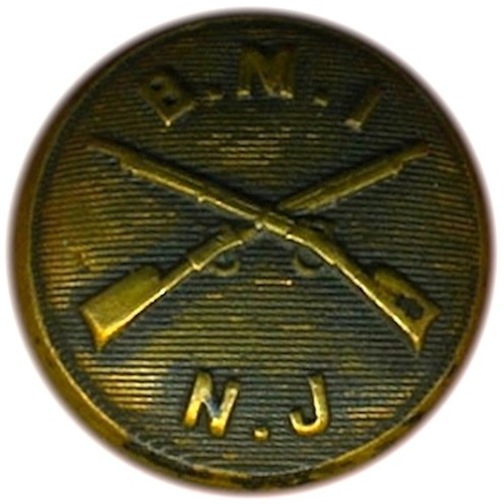
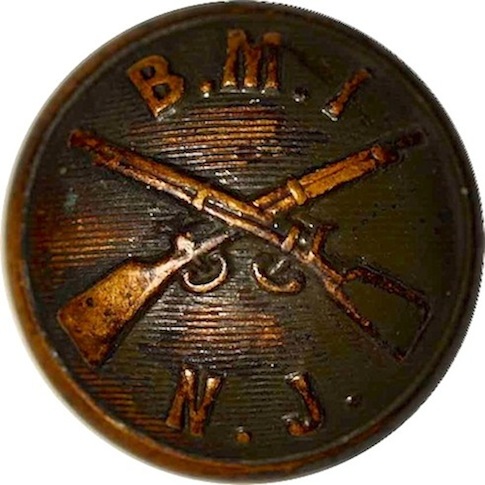
Bordentown Military Institute, Bordentown, New Jersey
1881-1973
The Bordentown Military Institute operated as an
independent military school in Bordentown, NJ for 91
years. In 1972, it merged with the Lenox School for one
year, and then closed down in 1973 because the Vietnam
War reduced the popularity of a military education. This
button dates from the late 1880-90's. There are two
known patterns one with taller cuts within the letters,
with a slightly different pattern rifle. The button's
pattern depicts a set of cross rifles, with the schools
initials, "B.M.I." above and the states initials, "N.J"
below. The high relief pattern is set on a convex field
with a thin plain edge border. Gilt finish, 20mm,
2-Piece button.
Albert's Number: SU 40
Tice's Number: Not Listed. |
|
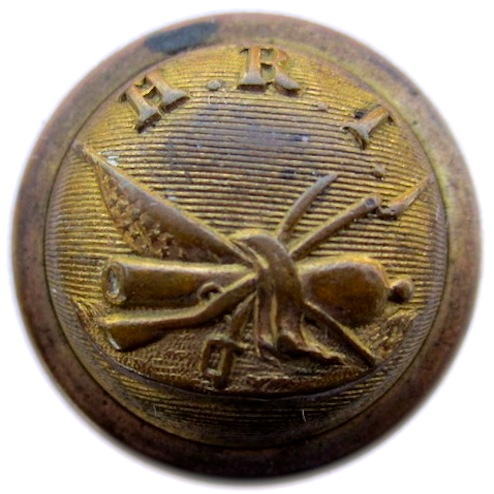
Hudson River Institute, Claverack, New York
1854- to Post Civil War
The Hudson River Institute opened in 1854, and had
programs in classical and foreign studies; part of the
required curriculum was that every student take military
instruction. The campus had an armory and a drill house.
The button's pattern depicts a small grouping of arms:
an cannon, musket, saber, and draped American flag. The
initials, "H.R.I" is arced above. The high relief
pattern is set on a convex field with a plain edge
border. Gilt finish, 23mm, 3-Piece Officer-Staff button.
Albert's Number: SU 166
Tice's Number: NYS 282-A.1 |
|
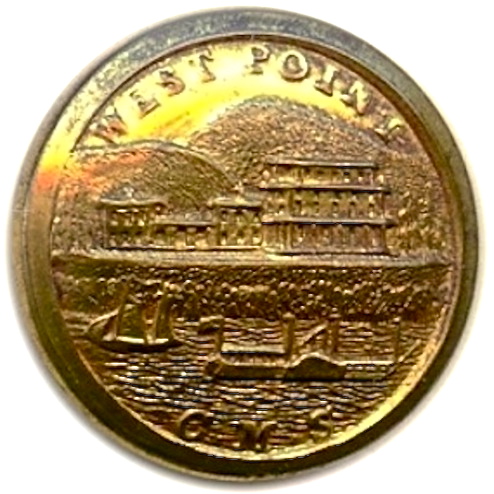
Churchill's Military School, Ossining, New York
1840's
Marlborough Churchill founded the institution as an all
boys school in 1842. Since it was located near West
Point on the bluff's of the Hudson River, it assumed the
nick name, "Mountain House". After a time the name
changed to, "St. John's Military School". Average
enrollment was about 90 students a year. Many of the
Union's officers such as General Alexander Webb
graduated from this institution. Even President Teddy
Roosevelt graduated from here. Scovills produced these
buttons around the 1840's. The button's pattern depicts
a scenic view of the Hudson River and it's surrounding
Mountains. The school building is depicted on a plateau,
with a steam boat and sail boat passing down the river.
The area's location, "West Point" is inscribed above,
and the schools initials, "C.M.S" lies below. The high
relief pattern is set on a low-convex field with a
raised angled plain edge border. Gilt finish, 20mm,
2-Piece button.
Albert's Number: SU 83
Tice's Number: NYS 280-A.1 |
|
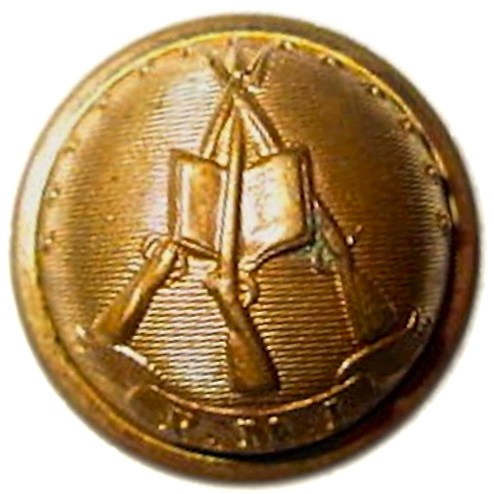
Poughkeepsie Military Institute, Poughkeepsie, New York
1857-
In 1857, Dr. Charles B. Warring and Mr. Bisbee were
running the old College Hill School, or Poughkeepsie
Collegiate School. When the Civil War broke out, SR.
Warring thought it prudent to open a small military
school downtown known as, "The Poughkeepsie Military
Institute". At the time, locals just called it, "Dr.
Warring's Military Institute". The button's pattern
depicts three stated Muskets on and around an open book.
The inside motif is partially surrounded by 13 five
pointed stars. The school initials, "P.M.I" is written
below in a banner ribbon. The high relief pattern is set
on a high-convex lined field with a thin plain edge
border. Gilt Brass, 22mm, 3-Piece Officer-Staff button.
Albert's Number: SU 322
Tice's Number: NYS 288-A.1 |
|
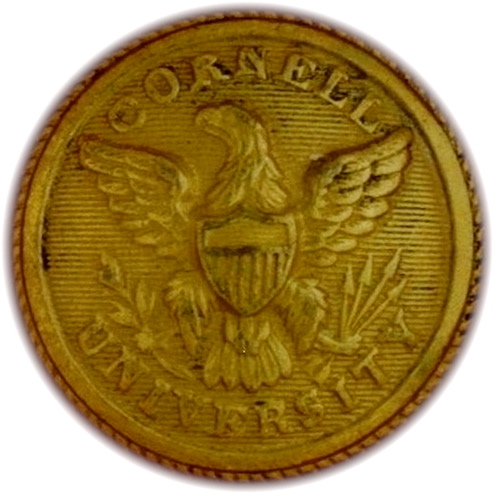
Cornell University, Ithaca, New York
1868
Conception started in 1865, but the university's
inauguration day officially took place October 7, 1868
with 418 applicants who were given an application
examination the previous day. The university was founded
as both a private, and a land-grant institution. Early
on, there was a military program introduced for a more
comprehensive education. The button's pattern depicts
USMA motif of a spread eagle with a federal shield on
it's chest. In the eagle's left talon is four arrows
instead of three, and in the eagle's right talon is a
short laurel stem. The university's name, "CORNELL" is
above, and, "UNIVERSITY" below. The high relief pattern
is set on a lined convex field with a thing plain border
and outer rope edge. Gilt finish, 21mm, 2-Piece button.
Albert's Number: SU 68
Tice's Number: Unlisted. |
|
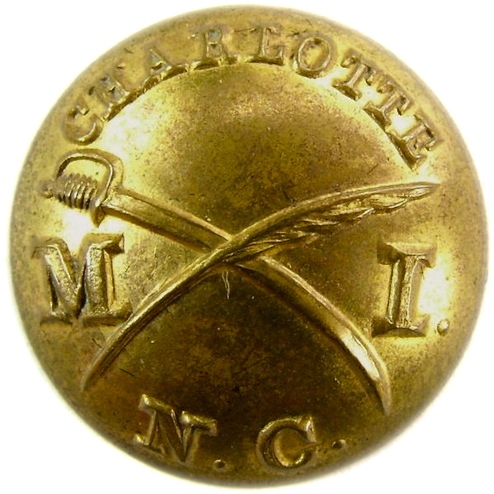
Charlotte Military Institute, North Carolina
Non-Issue
The button is attributed to Charlotte Military
Institute, but Tice notes that it is possible that
Scovill made these buttons for N.C.M.I to replace the
Sun Burst buttons used by Henderson's Male Academy. Most
collectors believe that this pattern was never issued,
since no specimens were ever found. The button's pattern
depicts a large Saber and Quill pen crossed in the
center, with the initials, "MI" on the side cross hatch.
The city's name, Charlotte" is written above, and the
state initials, "N.C." below. the high relief pattern is
set on a convex plain field with no edge border. Gilt
finish, 20mm, 2-Piece button.
Albert's Number: SU 55
Tice's Number: NCS 280-A.1 |
|
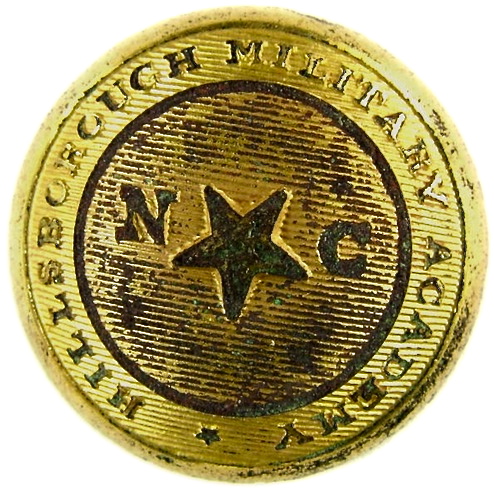
Hillsborough Military Academy, Hillsborough, North
Carolina
1859-1860
The Hillsborough Military Academy opened in 1859, and
modeled their program after the U.S. Military Academy.
Most of the faculty and cadets joined the Confederate
Army at the outbreak of the Civil War. Just before the
fall of Charleston, many of the remaining cadets left to
join General Beauregard; but to the cadet's dismay, many
of the recruiters would not enlist them due to their
impetuous breech of cadet discipline. The remainder of
the Cadet Corps was disbanded shortly before General
Johnston's Army capitulated in 1865. The button's
pattern depicts a large five pointed star in the center
with the prime point oriented downward. The states
initials, "NC" are on each side. There is a raised ring
which encompasses the inside pattern. The academy's name
"HILLSBOROUGH MILITARY ACADEMY" encircles the outside
legend with a five pointed star at the bottom. The high
relief pattern is set on a convex lined field with a
thin plain edge border. Gilt finish, 19mm, 2-Piece
button.
Albert's Number: SU 150
Tice's Number: NCS 270-Am.1 |
|
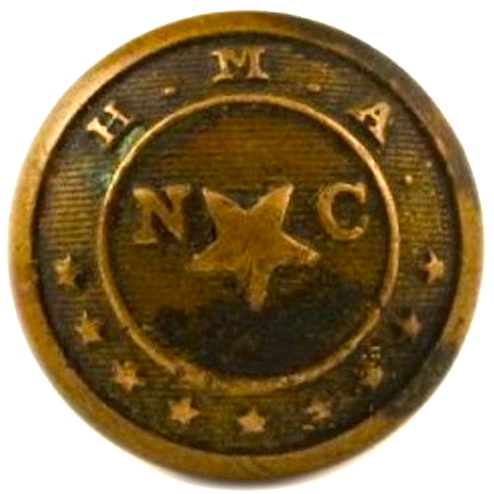
Hillsborough Military Academy, Hillsborough, North
Carolina
1859-1860
The Hillsborough Military Academy opened in 1859, and
modeled their program after the U.S. Military Academy.
Most of the faculty and cadets joined the Confederate
Army at the outbreak of the Civil War. Just before the
fall of Charleston, many of the remaining cadets left to
join General Beauregard; but to the cadet's dismay, many
of the recruiters would not enlist them due to their
impetuous breech of cadet discipline. The remainder of
the Cadet Corps was disbanded shortly before General
Johnston's Army capitulated in 1865. The button's
pattern depicts a large five pointed star in the center
with the prime point oriented downward, with the
initials, "NC" on each side. There is a raised ring
which encircles the inside pattern. The academy's
initials, "H.M.A" is arced in the top legend, and there
are 9 five pointed stars arced in the lower legend. The
high relief pattern is set on a convex lined field with
a plain edge border. Gilt finish, 15mm, 2-Piece Cuff
button.
Albert's Number: SU 150-Bv
Tice's Number: NCS 270-As.1 |
.png)
|
Hillsborough
Military Academy, Hillsborough, North Carolina
1859-1860
This is an ultra rare Hillsborough Military Academy
button. Originally this button was credited to
Henderson's Male Academy, but research shows me this is
Hillsboro. This academy opened in 1859, and modeled
their program after the U.S. Military Academy. Most of
the faculty and cadets joined the Confederate Army at
the outbreak of the Civil War. Just before the fall of
Charleston, many of the remaining cadets left to join
General Beauregard; but to the cadet's dismay, many of
the recruiters would not enlist them due to their
impetuous breech of cadet discipline. The remainder of
the Cadet Corps was disbanded shortly before General
Johnston's Army capitulated in 1865. The button's
pattern depicts a medium size five point star in the
center of a depressed well on a lined field. The star's
prime point is oriented upward. There is a raised ring
with a seven ray sun burst pattern that almost reached
the buttons edge border. The academy's initials, "* H M
A * N C" is in capital letters between the sunburst
points. The high relief pattern is set on a convex
pebbled field with a slightly raised edge border. Gilt
finish, Brass 21mm.
Albert's Number: Unlisted
Tice's Number: NCS |
|
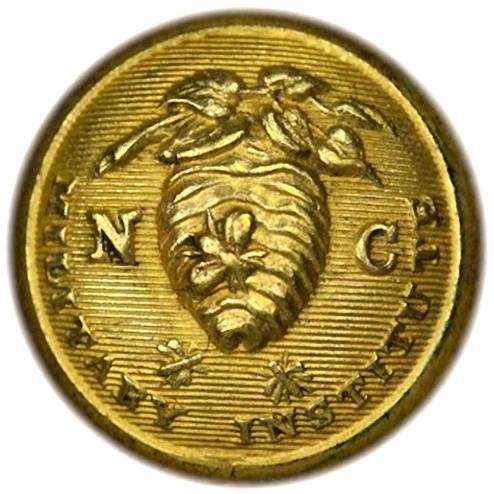
North Carolina Military Institute, Charlotte, North
Carolina
1859-61
The school was established in 1859 due to the efforts of
Daniel H. Hill, who was later a Confederate General in
the Civil War. The school received a charter from the
state legislature, and attracted future Confederate
Generals James Lance, and Charles C. Lee as instructors.
Unfortunately, the coming of the Civil War forced the
doors to close in 1861. The Governor ordered the entire
Corps of Cadets to duty as Drillmasters in Raleigh, and
many served under Hill in the 1st North Carolina. Some
of the cadets from the school manned an artillery piece
in the Civil War's first land battle at Big Bethel,
Virginia in 1861. Scovill made these buttons during the
1850's. The button's pattern depicts a large Hornet's
Nest in the center, with the initials, "NS" on each
side. There is one Hornet on the nest, and two hornets
underneath. The words, "MILITARY INSTITUTE" is written
below. The high relief pattern is set on a convex lined
field with a plain edge border. Gilt finish, 19mm,
2-Piece button.
Albert's Number: SU 272
Tice's Number: NCS 277Am.1 |
|
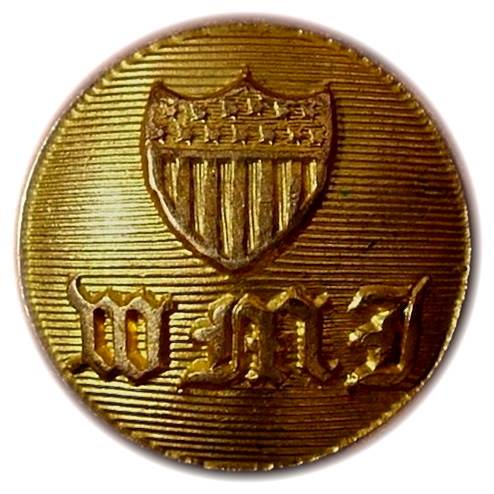
Western Military Institute, Ohio
1850's
This was a small military school that operated in the
1850's. The button's pattern depicts the Old English
initials, "WMI" in the center, with a federal shield
above with 13 five pointed stars. The high relief
pattern is set on a slightly convex lined filed with a
thin edge border. Gilt finish, 20mm, 2-Piece button.
Albert's Number: SU 430
Tice's Number: OHS 210-Am.1 |
|
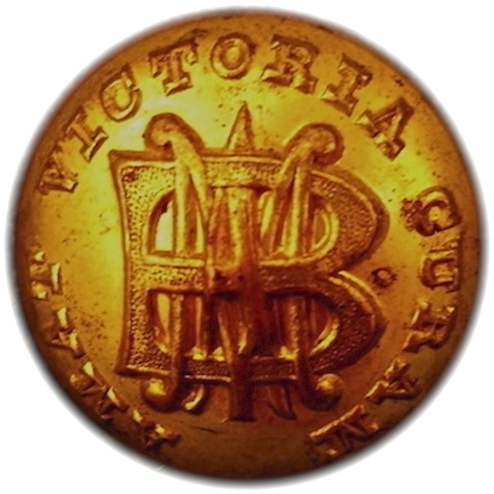
Brooks Military Academy, Cleveland, Ohio
The Brooks Military Academy was a boys college
preparatory school located in Cleveland, Ohio. The
school was relatively short lived and only operated from
1874 to 1891. The school was founded by wealthy
Clevelanders in honor of Frederick Brooks, a respected
rector of St. Paul's Episcopal Church. The school
accepted boys from 7 to 20 years of age. This was the
cadet button, there is an officer-staff 3-Piece button
known.
Albert's Number: SU 38
Tice's Number: Unlisted. |
|
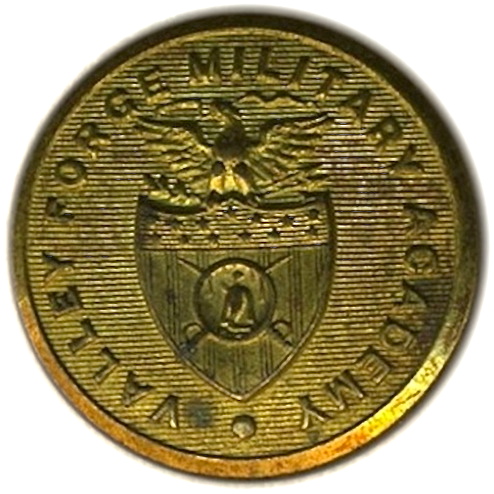
Valley Forge Military Academy, Wayne, Pennsylvania
1930-40's
Valley Forge Military Academy was founded by Lieutenant
General Milton Baker in 1928. Originally General Baker
wanted an American Revolutionary War Motif for the
school. Originally the school's colors were same as the
Continental Army uniform colors: buff and blue. The
cadet rank structure, uniforms, and company types were
molded after those used at the United States Military
Academy. They had a few infantry companies, a cavalry
troop, and even wore the same West Point full dress
grays on parade days. The buildings in the new Wayne
Campus were named after all Revolutionary War leaders.
Valley Forge is an all male preparatory boarding school
grades 7-12; and a coeducational junior college, which
is in strict military tradition. Valley Forge College is
the only private military junior college in the United
States that's entire student body is formed from US or
international military cadets. By the 1940-50's, General
Baker modeled many of the school's drills, customs, and
ceremonies after a British motif. Valley Forge Corps of
Cadets became the only American military organization to
maintain proper British drill and ceremonies. VFMA
currently has a special relationship, and has become
sister institutions with the United Kingdom's Duke of
York's Royal Military School. The button's pattern
depicts a federal shield in the center with two crossed
sabers and a picture of a revolutionary soldier in the
center circle. Standing on top of the shield is a spread
eagle facing right. There are two arrows in it's left
talon, and a laurel stem in it's right. The school's
name, "Valley Forge Military Academy" circles around the
outside edge. The high relief pattern is set on a
slightly convex lined field with a plain border edge.
Albert's Number: SU 402-B (Lined Field).
Tice's Number: Unlisted. |
|
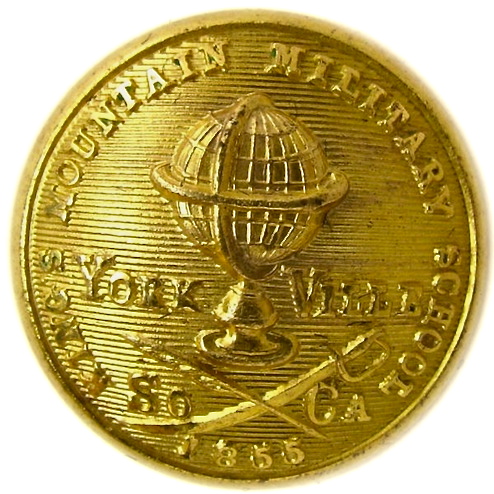
King's Mountain Military Academy, Yorkville, South
Carolina
1855
In 1855 two Citadel graduates, Micah Jenkins and Asbury
Coward established the Kings Mountain Military Academy.
It was recognized as a leading preparatory school
throughout the southeast. When the Civil War broke out,
both men were commissioned as officers into the
Confederate Army. Micah rose in ranks to a Brigadier
General through his gallant actions. Unfortunately, he
was killed later by his own troops (friendly fire)
during the Battle of the Wilderness in Virginia 1864.
Colonel Coward returned to re-open the school, but was
only able to operate it for a few years. Later he went
on to become the President of the Citadel, which was
Charleston's Military School. Kings Mountain opened in
1855, closed during the Civil War, re-opened in 1866,
and closed for good in 1908. The button's pattern
depicts a study globe in the center, with a sword and
quill crossed underneath. The initials, "SO CA" is
within the cross hatch. There is an inscription around
the legend, "KINGS MOUNTAIN MILITARY SCHOOL 1855". The
high relief pattern is set on a convex lined field with
a thin plain edge border. Gilt finish, 20.2mm, 2-Piece
button.
Albert's Number: SU 189
Tice's Number: SCS 294-A.1 |
|
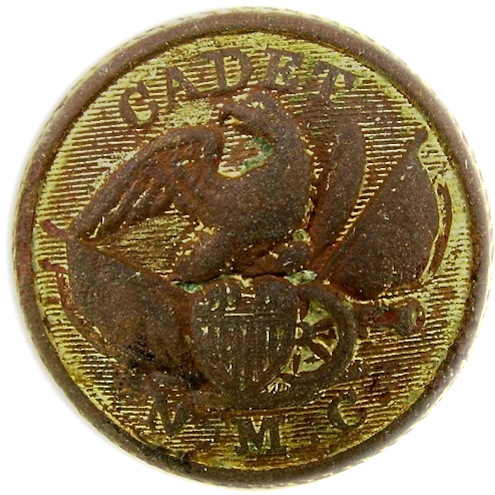
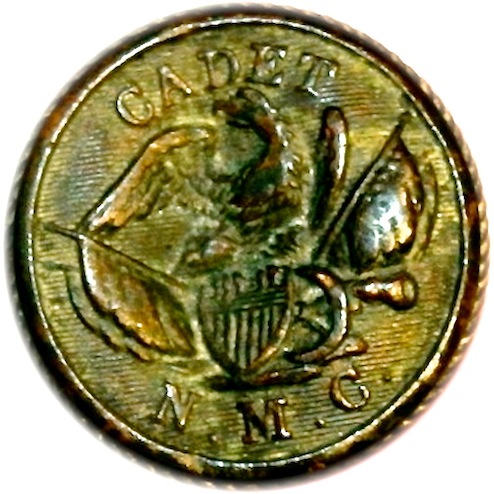
Nashville Military College, Nashville, Tennessee
1855
Kentucky's Western Military Institute integrated with
the military portion of Tennessee school to form
Nashville Military College in 1855. The button's pattern
depicts an eagle with upraised wings standing on a
federal shield facing right. Flanking underneath the
eagle is four draped flags and a cannon. The initials, "N.M.C."
is arced in the bottom legend, and the word, "CADET" is
arced in the legend above. The high relief pattern is
set on a convex lined field with a thin plain edge
border. Scovill made all these buttons during the late
1850's, and all specimens were produced with excellent
quality, and heavy Gilt finishes. 22.7mm, 2-Piece.
Albert's Number: SU 279
Tice's Number: TNS 250-A.1 |
|
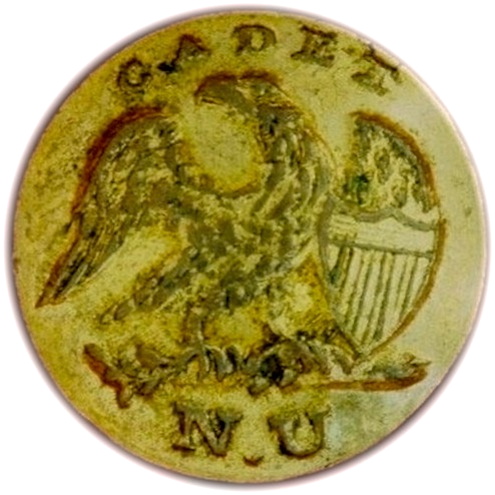
Norwich University or Vermont Military School,
Northfield, Vermont
1835
Norwich University was founded in 1820 by Captain Alden
Partridge, and was the first Northern school after the
US Military Academy to offer a military curriculum. R &
W Robinson made one piece buttons for the school around
1835. Around 1880, Colonel Charles Lewis (class of
1855), offered financial aid to the school; and in
recognition for his help, the college was renamed the
school the, "Lewis College" between 1880-84. After a few
years it re-took it's original name. While temporarily
named, "Lewis College", buttons were also produced by D.
Evans with the initials, L.C. below the eagle. The
button's pattern depicts a standing eagle with raised
wings facing right. Under the eagle's left wing is a
federal shield. The word, "CADET" is arced above, and
the university's initials, "N.U" is below. The high
relief pattern is set on a plain flat field with no edge
border. Gilt finish, 18mm, 1-Piece button.
Albert's Number: SU 287
Tice's Number: VT 250 A.1 |
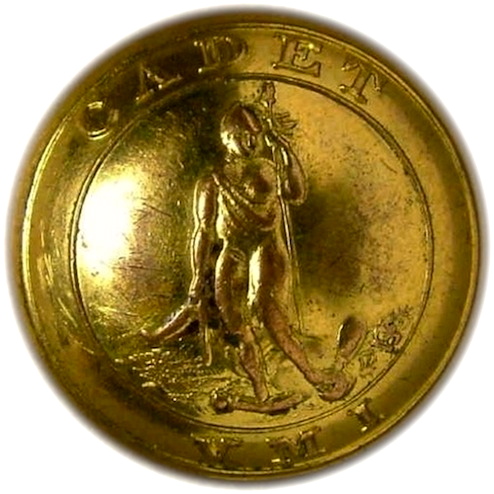
|
Virginia Military Institute in Lexington, Virginia
1840-1864
Virginia Military Institute was established on November
11, 1839, on the site of the Lexington state arsenal.
The first cadets actually relieved the personnel on
duty. The first graduating class in 1842 actually had 16
cadets. The cadet's living conditions were known to be
poor up until 1850, when the cornerstone of the new
barracks was laid. In 1851, Major Thomas "Stonewall"
Jackson became a member of the faculty, and a professor
of Natural and Experimental Philosophy. Cadets were
known to fear Jackson due to his stern views on
discipline, and religion. Soon people were comparing it
to, and called it the West Point of the south. When the
Civil War erupted, the authorities limited the cadets
service to just drilling troops in Richmond, VA. They
feared loosing future generations of qualified officers,
and thought this would be the best place for cadets to
serve. After awhile, military leaders were forced into
calling cadets into active military service 14 times
under the leadership of Stonewall Jackson. By wars end,
V.M.I had turned out 1,780 Confederate Officers for the
Civil War. This was more then any other Military
Institution. The button's pattern depicts the Virginia
Coat of Arms in the center, with the inscription,
"Cadet" above and the school's initials, V.M.I below.
The high relief pattern is set on a plain convex field
with a thin raised edge border. R & W Robinson made
these buttons in the 1840's. Gilt finish, 22.2mm,
2-Piece button.
Albert's Number: SU 407
Tice's Number: VAS 291-A.1 |
|
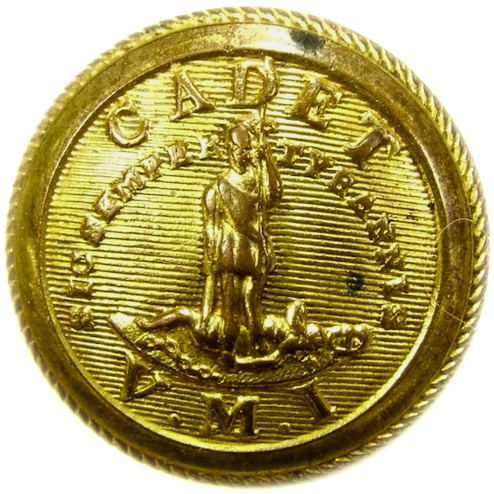
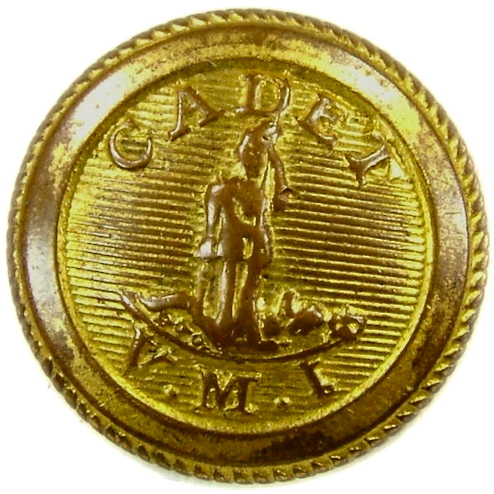
Virginia Military Institute in Lexington, Virginia
1840's-1850's
If you were a V.M.I Cadet, you were most likely a
Confederate Officer in the Civil War, you would have
worn one of these two buttons, or a very similar
variation. The famed Confederate General, "Stonewall
Jackson" very well could have been your instructor. In
1864, Union General Hunter burned the institution to the
ground. It was re-built and re-opened after the Civil
War, and continued it's highly respected traditions and
academics. The button's pattern depicts the Virginia
Coat of Arms in the center, with the Latin inscription,
"Sic Semper Tyrannis" arced around the coat of arms in
the center. The word, "Cadet" above and the school's
initials, "V.M.I" below. The high relief pattern is set
on a convex lined field with a plain border and rope
edge. R & W Robinson made these buttons in the
1840-50's. Gilt finish, 21.21mm, 2-Piece coat button. /
Gilt finish, 13.7mm, 2-Piece cuff button.
Albert's Number: SU 408
Tice's Number: VAS 294-A.1
Cuff Button
Albert's Number: SU 408
Tice's Number: VAS 294-As.1 |
|
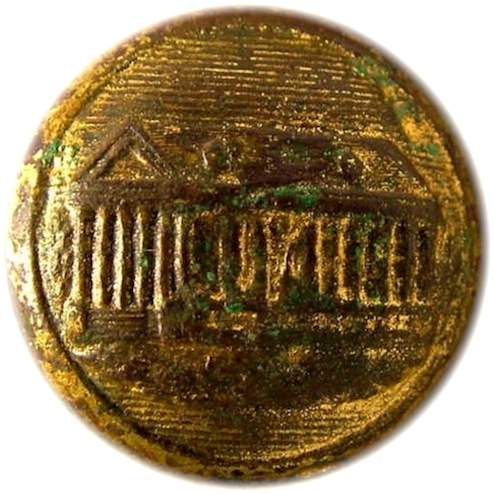
Norfolk Military Academy in Norfolk, Virginia
1840's-1850's
Originally this school was known as Norfolk Academy, and
was one of the finest preparatory schools in Virginia.
In the early 1840's, this impressive building was
constructed under the direction of Thomas Walter who
designed the Capital's Dome. Many Norfolk graduates
served in the Confederate Navy. General Lee's trusted
Adjutant, Walter Taylor attended this school. The
button's pattern depicts a large school building that
was modeled after a Greek Temple in the center. The high
relief pattern is set on a low-convex lined filed with a
plain edge border. Gilt finish, 18mm, 2-Piece button.
Albert's Number: SU 390
Tice's Number: VAS 285-A.1 |
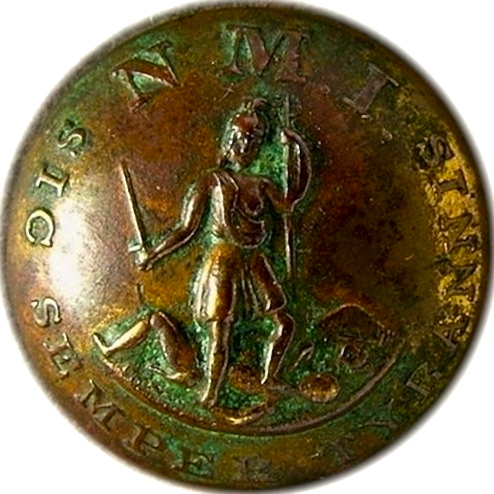
|
Norfolk Male Institute in Norfolk, Virginia
1859
This school was located downtown in Norfolk, and was
probably established a few years before, but we know it
introduced a military program in 1859, and issued Cadet
uniforms. The button's pattern depicts the Virginia Coat
of Arms in the center, the schools initials, "NMI" above
and the states motto below. Gilt finish, 18.8mm, 2-Piece
button.
Albert's Number: SU 280
Tice's Number: VAS 282-A.1 |
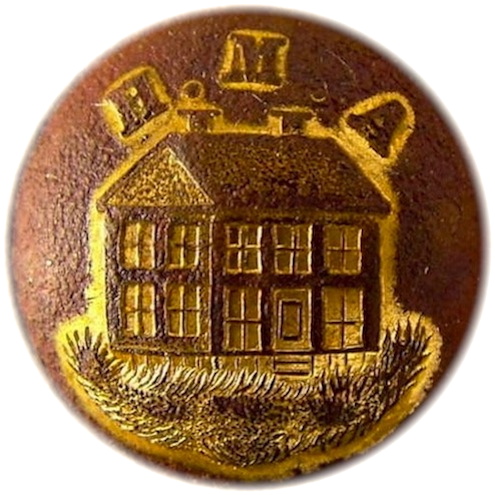
|
Hampton Military Academy in Hampton, Virginia
1852-1861
Originally this was a very small school for cadets, that
operated in one building before the Civil War. Research
indicates the school only operated for ten years before
closing it's doors. Story goes, there was a Federal
strong hold, Fort Monroe just a mile away. and school
authorities thought it prudent to close. Confederate
soldiers came in and burned the building down in 1861 to
prevent Federals from quartering troops or run away
slaves. The button's pattern depicts a large school
building in the center, with the initials, "H.M.A" above
and a grassy field below. The high relief pattern is set
on a plain convex field with no edge border. Gilt
finish, 17.2mm 2-Piece button. Despite the Paris back
mark, research indicates Scovill or Thomas Dale, New
York could have produced these.
Albert's Number: SU 163
Tice's Number: VAS 273-Am.1 |
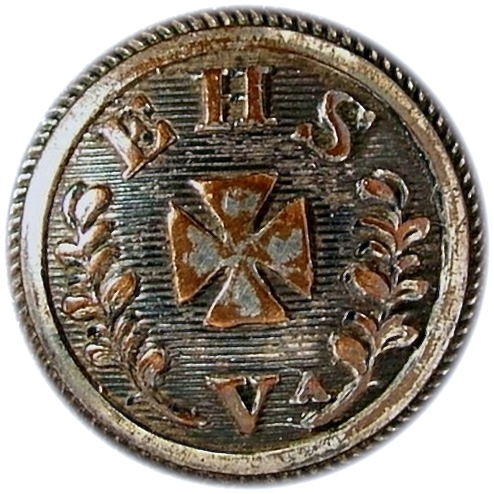
|
Episcopal High School, Alexandrea, Virginia
1839
Episcopal High School was founded on an 80 acre tract of
land just west of the colonial port of Alexandrea in
1839. It was the first high school in Virginia, and was
also known as the, "Howard School" because the location
was a site of an earlier period school. Martha
Washington's eldest granddaughter, "Elizabeth Park
Curtis Law" built a structure around 1805 that serves as
the schools central administration building; called, The
Hoxton House". With the Federal occupation of Alexandria
in 1861, the school was closed, and some 500 students
went to serve in the war. For the next 5 years, the EHS
buildings were used by the union army as a hospital. The
poet Walt Whitman served as a nurse in this hospital.
The school re-opened in 1866, and initiated a more
modern curriculum, and pioneered interscholastic team
sports. EHS enrolled its first female students in 1991,
and the first girls graduated in 1993. The button's
pattern depicts a cross in the center with the schools
initials, "EHS" above, and the state initial, "V a" at
the bottom. Each side of the cross has a laurel stem
around the inside perimeter. The high relief pattern is
set on a convex lined field with a plain border and rope
edge. Silver Plated, 17.3mm, 2-Piece button.
Albert's Number: SU 105
Tice's Number: VAS 270-B.1 |
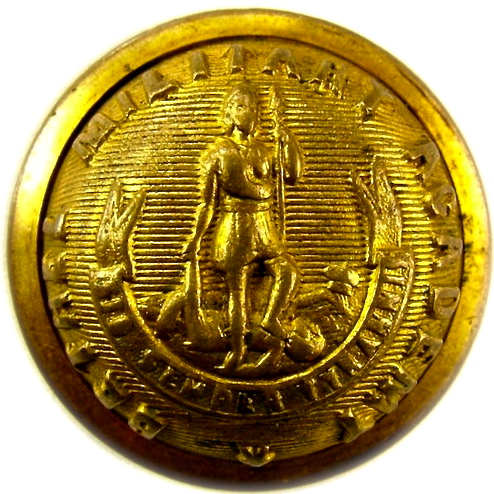
|
Bethel Military Academy, Warrenton, Virginia
1865
This was a small military academy founded after the
Civil War. The button's pattern depicts the Virginia
Coat of Arms with the motto in a banner ribbon
underneath. Around the edge's periphery is the school's
name," Bethel Military Academy". The big relief pattern
is set on a high-convex lined field with plain flat edge
border. Gilt finish, 22.7mm, 3-Piece Officer-Staff
button.
Albert's Number: SU 32
Tice's Number: Unlisted. |
|
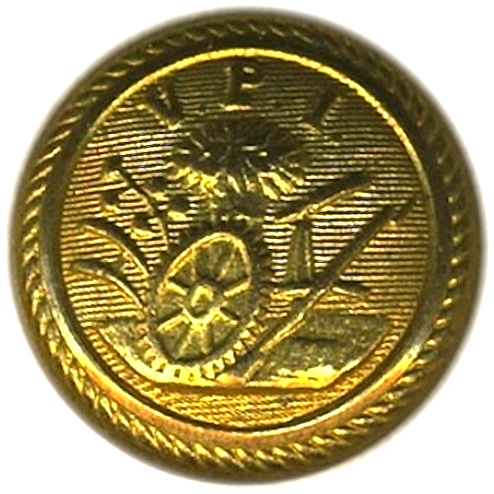
Virginia Poly Technic Institute, Blacksburg, Virginia
1900-20
This Virginia Polytechnic Institute is a public land
grant university that was founded as an agricultural,
and mechanical college. VT has the largest full-time
student population in Virginia, and one of a few
universities in the United States that maintains a Corps
of Cadets. The school is primarily devoted to the
instruction of technical arts, and applied sciences, but
has a strong military program. The button's pattern
depicts several mechanical instruments and items. The
school's initials, V.P.I is above. the high relief
pattern is set on a low convex lined field with a plain
border and rope edge. Gilt finish, 21mm, 2-Piece button.
Albert's Number: SU 411
Tice's Number: Unlisted. |
|
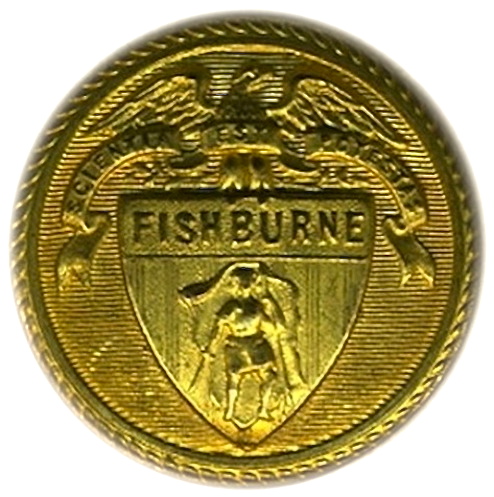
Fishburne Military School, Waynesboro, Virginia
1900-25
James A. Fishburne was a student a protégé of Robert E.
Lee. He originally opened the Waynesboro High School in
1879. The school went through several name changes, and
by 1886, it was known formally as the Fishburne Military
school. The school is listed no the Junior Reserve
Officers Training Corps charter, and has been
continuously rated an Army JROTC Honor Unit since 1924.
The JROTC staff supports military skills other then
close order drill. It has a rifle exhibition drill team,
a Marksmanship team. They take annual trips to VMI, Fort
Pickett, and Fort A.P. Hill to utilize their obstacle
courses and other training facilities. The button's
pattern depicts a large shield with a warrior holding a
short sword and spear. The school's name, "Fishburne" is
located within the top half of the shield. There is a
federal spread-wing eagle standing on top of the shield
facing left. There is also a banner ribbon with the
Latin inscription, "SCIENTIA EST PGYESTAS" within. The
high relief pattern is set on a flat lined field with a
thin raised rope edge border. Gilt finish, 23mm, 2-Piece
button.
Albert's Number: SU 111
Tice's Number: Unlisted. |
|
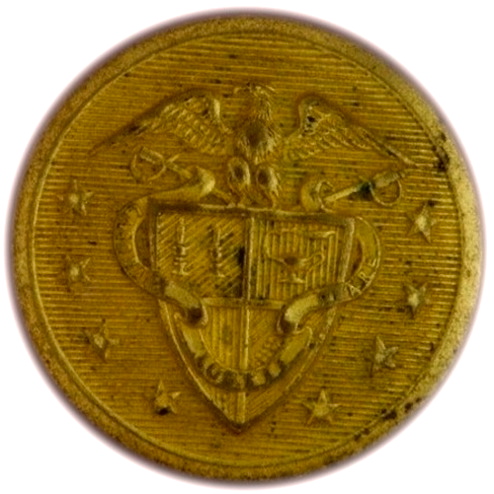
St. John's Military Academy, Delafield, Wisconsin
1884
St John's Military Academy was founded by Rev. Sidney T.
Smythe as a private all male college preparatory and
leadership development school. The school offered a
military style environment that allowed each student to
achieve his full potential. In 1995, St Johns merged
with Northwestern Military and Naval Academy in Lake
Geneva, Wisconsin. The button's pattern depicts a
spread-wing eagle facing right while standing on top of
a large shield with the school's crest within. There are
two swords on each side with a banner scrolling around
with the school's motto within. There are 8 five pointed
stars circling halfway around the bottom periphery. The
high relief pattern is set on a flat lined field with a
plain edge border. Gilt finish, 26mm, 1-Piece button.
Albert's Number: SU 377
Tice's Number: Unlisted. |
GO BACK -
TOP |