|
|
~ Early Navy & Marine Buttons ~
~ 1748 to 1850's ~
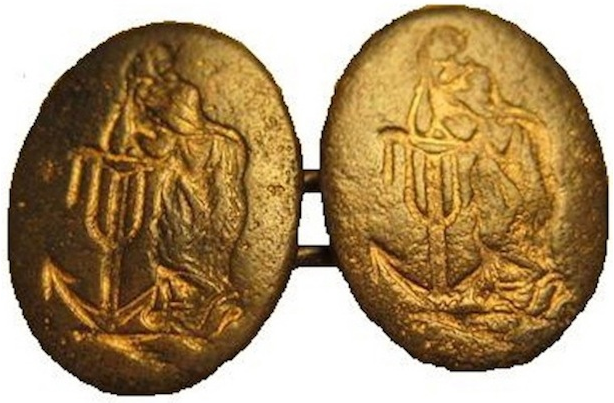
1790 American Liberty Tree of Justice Navy
Cuff
|
~ The Lieutenant's Tudor Rose
Button ~
~ 1748 to 1787 ~
The British Royal Navy was sailing around the world's oceans for
a long time before any kind of official regulations pertaining to
regulation uniforms
and buttons came around.
From 1748 to 1767, all Lieutenants wore flat gilded buttons with a
recessed Tudor Rose on all their undress uniforms. After full dress
was abolished in 1767, this became the standard button on all
Lieutenant's uniforms until 1787-88. Flag officers wore them on
their undress uniforms from 1748-67, and then were wore them on all
their uniforms up until 1795.
Flag
Officers (Various grades of Admirals) distinguished themselves by having a decorative wreath
border around the Tudor Rose. Below is a sample listing of some
variants found in the market. These buttons can be found in many
styles, and these different variations seems endless. Since this
button's pattern is still manufactured to this day, I would
recommend early Royal Navy button collectors seek bone or wood back
Repousse specimens to tightly date their collections.
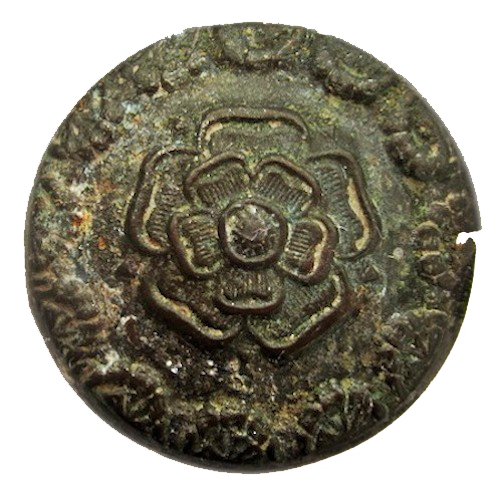 
|
1748-95
ROYAL NAVY FLAG OFFICER'S TUDOR ROSE
Color: A Silvery-Olive Brown with Whitish Gold
Encrustations.
Metal: Slightly Convex, 2-Piece, Raised Design,
Gilt Sheet Copper
Repousse.
Size: 25.11mm. Coat Size
Troiani: Similar
to BNL.h. (This
Specimen is Pictured in the Book)
Variation:
Tudor Rose / Ornate Decorative Wreath
Border.
Present Condition: An Excavated Example, Strong
Repousse, Strong/Exceptional High Relief Pattern.
Robert's Comments: We know from 1748 to 1767, all
Lieutenants wore flat gilt buttons with a Tudor Rose on their undress uniforms.
In 1767, full dress uniforms were no longer used, and
the Tudor Rose buttons became the standard on all
uniforms until November of 1787. In 1788, the Tudor Rose
pattern was replaced for the new Anchor motif. From this
point forward all Captains and Commanders would use this
new Anchor style pattern. Some early Tudor Rose buttons are known to have
either bone or wood backs. These bigger buttons were probably used for their undress
sea coats.
This button's pattern is a rare example of a
Tudor Rose
with a
Ornate Decorative Wreath Border.
The high relief pattern is set on a plain field.
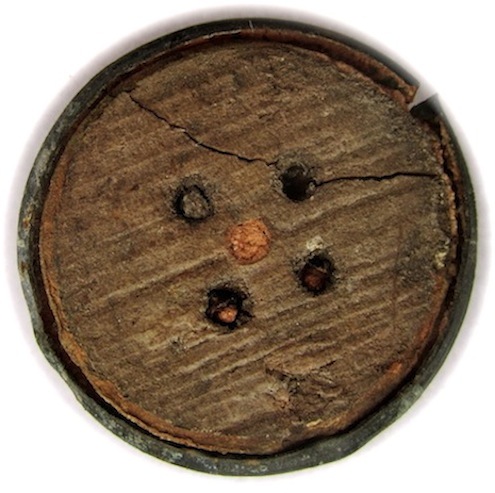
Reverse Button Analysis: This is a 2-piece button
with a wood
back, and uses a cat gut cord for the attachment. The
wood unfortunately has a mild crack, but otherwise is
still intact.
Excavated in the State of New York.~
The RJ Silverstein Collection.
The
Table Below shows how the Pattern was used:
Royal Navy Flag Officer 1748-67 Full Dress
Royal Navy Flag Officers 1767-95 All Uniforms
Each Royal Navy officer who reached flag-rank came
from the Captains’ List. This seniority determined which
officer was next in line for promotion; post-captains
with greater seniority would be promoted before those
officers lower down on the list. The Captains’ List was
all-important:
Some research indicates that in
1757, All Captains wore Tudor Rose buttons on their
Dress Uniforms. They were usually Gilt brass, or Solid
Silver.~
Isabela's notes: A Flag Rank Officer is an honor
bestowed on a senior Navy Captain who is assigned to
lead a squadron of vessels in addition to the command of
their own ship.~ The United States Congress did not
create the title of "flag rank officer" as an actual
rank in the Navy until 1857.~
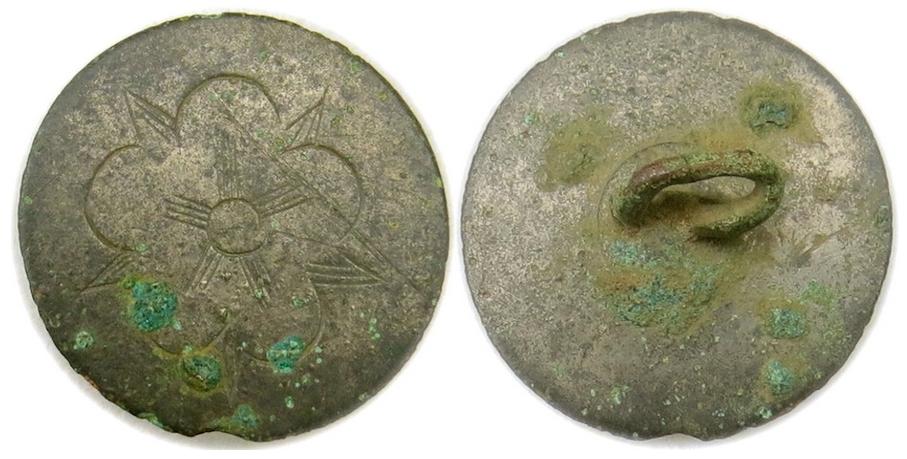
1748-87 ROYAL NAVY LIEUTENANT'S
TUDOR ROSE BUTTON
Color: A Tarnished Silver with Green Encrustations.
Metal: Flat, 1-Piece, Engraved Design, White Metal.
Size: 22.79mm. Coat Size
Troiani: Similar to the BNL Series: Unlisted
Variant.
Variation: Large Engraved Tudor Rose
Present Condition: An Excavated Example, Strong
Planchet Casting, Strong Impressions.
Robert's Comments: This is one of many Tudor Rose variants.
The button's pattern depicts a
Large Engraved Tudor Rose
in the center. The pattern is on a plain flat
field with no raised edge border.
Reverse Button Analysis: This is flat button with a loop shank. The loop is original and intact, but
crushed inward.
Excavated in Massachusetts.
The RJ Silverstein Collection.
Royal Navy Lieutenant's 1748-67 Full Dress to 1767
Royal Navy Lieutenant's 1767-87-88 All Uniforms
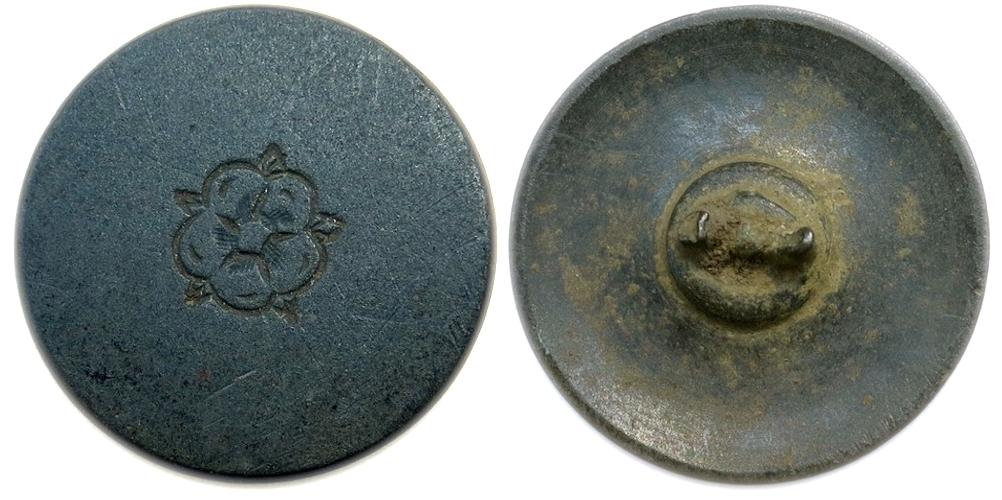
1748-87 ROYAL NAVY LIEUTENANT'S
TUDOR ROSE SEA COAT BUTTON
Color: A Charcoal Silver.
Metal: Flat, 1-Piece, Engraved Design, White Metal.
Size: 26.01mm. Sea Coat Size
Troiani: Similar to the BNL Series: Unlisted
Variant.
Variation: Medium Size Tudor Rose /
Large Field
Present Condition: An Excavated Example, Strong
Planchet Casting, Strong Impression.
Robert's Comments: This was most likely a
Navy officer's Sea Coat button due to it's large size.
The button's pattern depicts a
Medium Size Tudor Rose
in the center of a
Large Field. The pattern is on a plain flat
field with no raised edge border.
Reverse Button Analysis: This is flat button with a loop shank. The
raised boss is still present, but the loop is missing.
Dug
by John on Prince Edwards Island, Canada.
The RJ Silverstein Collection.
Royal Navy Lieutenant's 1748-67 Full Dress to 1767
Royal Navy Lieutenant's 1767-87-88 All Uniforms
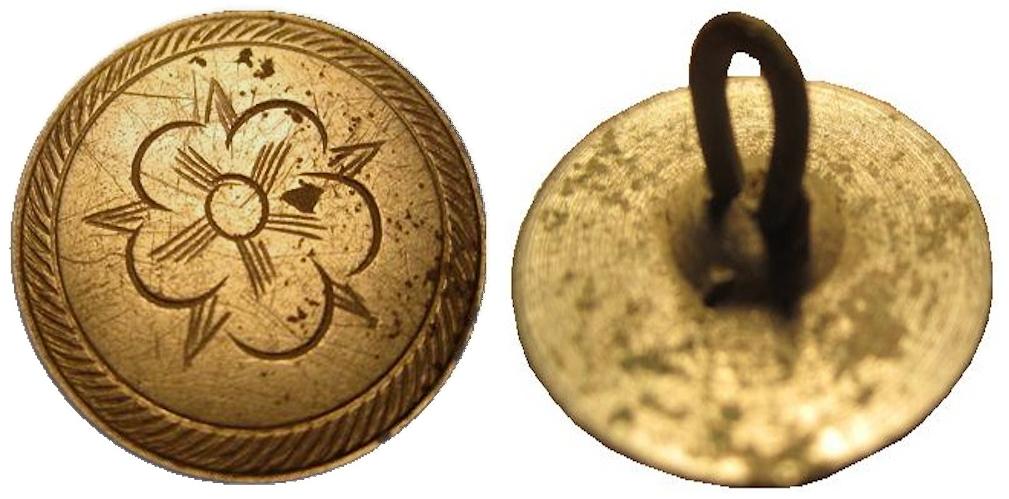
1748-87 ROYAL NAVY LIEUTENANT'S
TUDOR ROSE TOMBAC BUTTON
Color: A White Silver.
Metal: Flat, 1-Piece, Engraved design, White
Tombac.
Size: 23mm. Coat Size
Troiani: Similar to the BNL Series: Unlisted
Variant.
Variation:
Medium Size Engraved
Tudor Rose /
Crude Style Cable
Present Condition: An Excavated Example, Strong
Planchet Casting, Strong Engraving.
Robert's Comments: This is a completely
different kind construction for a Tudor Rose Button.
This button was made of white Tombac. White Tombac is an
alloy of copper, zinc, and arsenic. Tombac was very
popular with the colonist in America because they
resembled silver, but were much more economically
priced. What makes this button unique is in it's
construction. The Tombac was poured with a deeply
embedded wire loop and then lathe turned.
This method is much more time
consuming and labor intensive then your common pewter
poured specimens. The button's pattern depicts a
Medium Size Engraved Tudor Rose
in the center. Circling around the outside edge is a
Crude Style Cable. The pattern is
engraved on a plain flat
field with no raised edge border.
Reverse Button Analysis: This is a flat button
with a loop shank. The loop is original, straight, and
intact.
The Dale Collection.
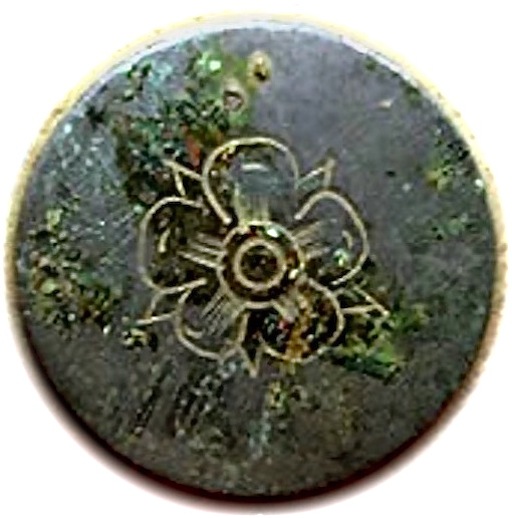 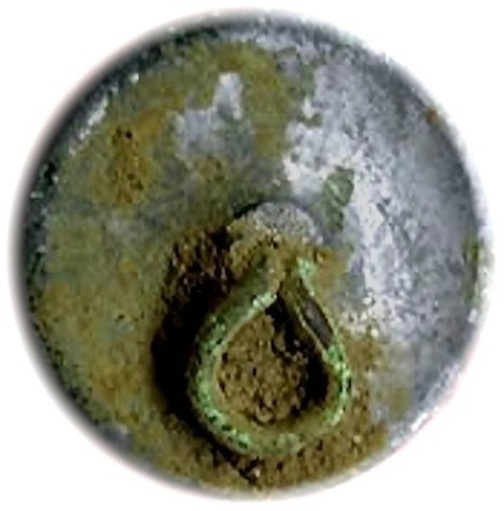
1748-87 ROYAL NAVY LIEUTENANT'S
TUDOR ROSE BUTTON
Color: A Flat Silver with Green & Yellow Encrustations.
Metal: Flat, 1-Piece, Engraved design, White Metal.
Size: 20mm. Coat Size
Troiani: Similar to the BNL Series: Unlisted
Variant.
Variation:
Small Engraved Tudor Rose.
Present Condition: An Excavated Example, Strong
Planchet Casting, Strong Engraving.
Robert's Comments: Here is another variation
of a Lieutenant's Tudor Rose.
The button's pattern depicts a
Small Engraved Tudor Rose
in the center. The pattern is on a plain flat
field with no raised edge border.
Reverse Button Analysis: This is a flat button
with a loop shank. The loop is original and intact, but bent
downward.
The
Table Below shows how the Pattern was used:
Royal Navy Lieutenant's 1748-67 Full Dress to 1767
Royal Navy Lieutenant's 1767-87-88 All Uniforms
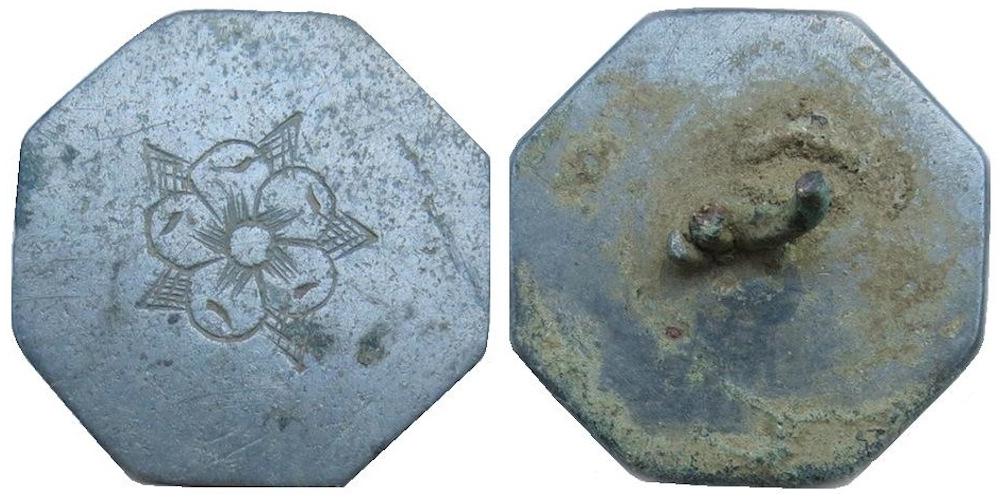
1748-87 ROYAL NAVY LIEUTENANT'S
TUDOR ROSE SEA COAT BUTTON
Color: A Silvery White Tombac Color.
Metal: Flat, Hexagon Shape, 1-Piece, Impressed Design,
White Tombac.
Size: 23.45mm. Sea Coat Size
Troiani: Similar to the BNL Series: Unlisted
Shape Variant.
Variation: Tudor Rose / Hexagonal Shape.
Present Condition: An Excavated Example,
Good/Strong Planchet Casting, Strong Engraved Pattern.
Robert's Comments: The Tudor Rose was the
English symbol for Royal Feuds. From 1748 to 1767, all Lieutenants
wore flat gilt buttons
with a recessed Tudor Rose on all their
undress uniforms.
For their
full dress uniforms
they wore plain domed buttons. This is a bit more lavish
style design that shows exceptional design detail. The
button's pattern depicts a recessed
Tudor Rose
in the center. The edge border is
Hexagonal Shape
with a slightly beveled edge. The engraved pattern is
on a plain flat field. Hexagonal or oval shape
cuff buttons are a bit more
scarce then the commonly found round varieties.
Reverse Button Analysis: The button is a one
piece button with a loop shank. The shank is missing.
Dug
by John on Prince Edwards Island, Mount Stewart, Canada.~
The RJ
Silverstein Collection.
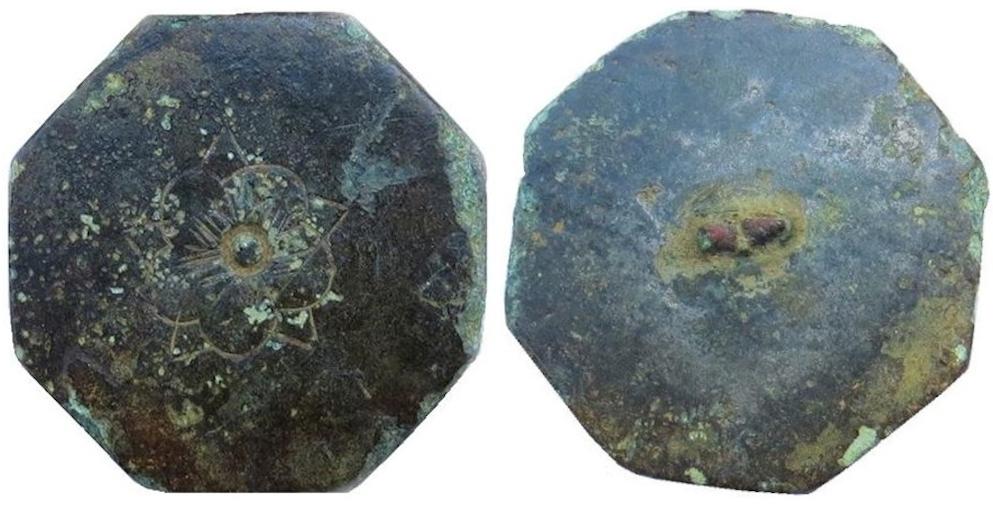
1748-87 ROYAL NAVY LIEUTENANT'S
TUDOR ROSE SEA COAT BUTTON
Color: A Greenish Brown with Green Encrustations.
Metal: Flat, Hexagon Shape, 1-Piece, Impressed Design, Gilt Brass.
Size: 23.32mm. Sea Coat Size
Troiani: Similar to the BNL Series: Unlisted
Shape Variant.
Variation: Tudor Rose / Hexagonal Shape.
Present Condition: An Excavated Example,
Good/Strong Planchet Casting, Strong Engraved Pattern.
Robert's Comments: The Tudor Rose was the
English symbol for Royal Feuds. From 1748 to 1767, all Lieutenants
wore flat gilt buttons
with a recessed Tudor Rose on all their
undress uniforms.
For their
full dress uniforms
they wore plain domed buttons. This is a bit more lavish
style design that shows exceptional design detail. The
button's pattern depicts a recessed
Tudor Rose
in the center. The edge border is
Hexagonal Shape
with a slightly beveled edge. The engraved pattern is
on a plain flat field. Hexagonal or oval shape
cuff buttons are a bit more
scarce then the commonly found round varieties.
Reverse Button Analysis: The button is a one
piece button with a loop shank. The shank is missing.
Dug
by John on Prince Edwards Island, Mount Stewart, Canada.~
The RJ
Silverstein Collection.
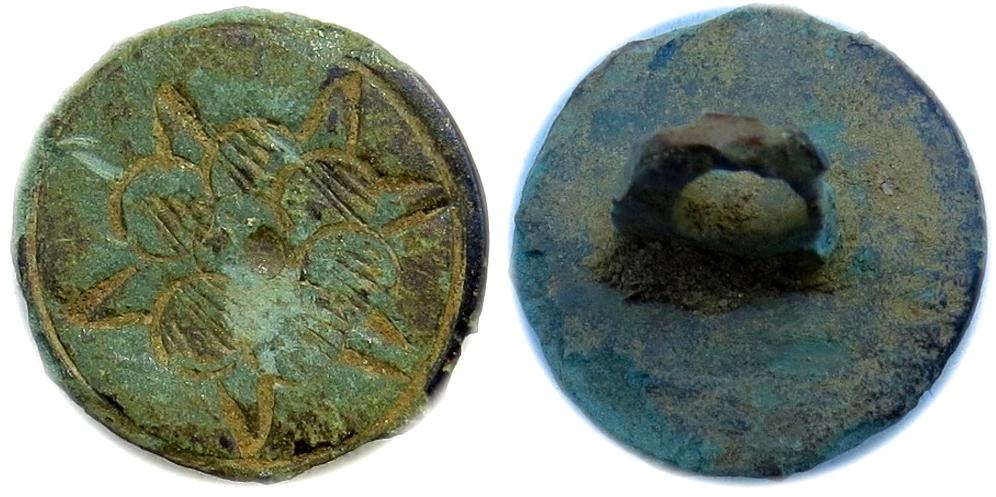
1748-87 ROYAL NAVY LIEUTENANT'S
TUDOR ROSE CUFF BUTTON
Color: A Sea Foam Green with Patches of Brown.
Metal: Flat, 1-Piece, Impressed Design, Gilt Brass.
Size: 16.05mm. Cuff Size
Troiani: Similar to the BNL Series:
Variation: Tudor Rose
Present Condition: An Excavated Example,
Good Planchet Casting, Good Impression.
Robert's Comments: The Tudor Rose was the
English symbol for Royal Feuds. From 1748 to 1767, all Lieutenants
wore flat gilt buttons
with a recessed Tudor Rose on all their
undress uniforms.
For their
full dress uniforms
they wore plain domed buttons. This button would be one
of your common buttons worn by navy officers. The
button's pattern depicts a large recessed
Tudor Rose
in the center. The impressed pattern is on a plain flat
field. Collectors see a large number of these found in
Canada.
Reverse Button Analysis: The button is a one
piece button with a loop shank. The shank is missing.
Dug
in Tracadie on Prince Edwards Island, Canada.~
The RJ
Silverstein Collection.
|
|
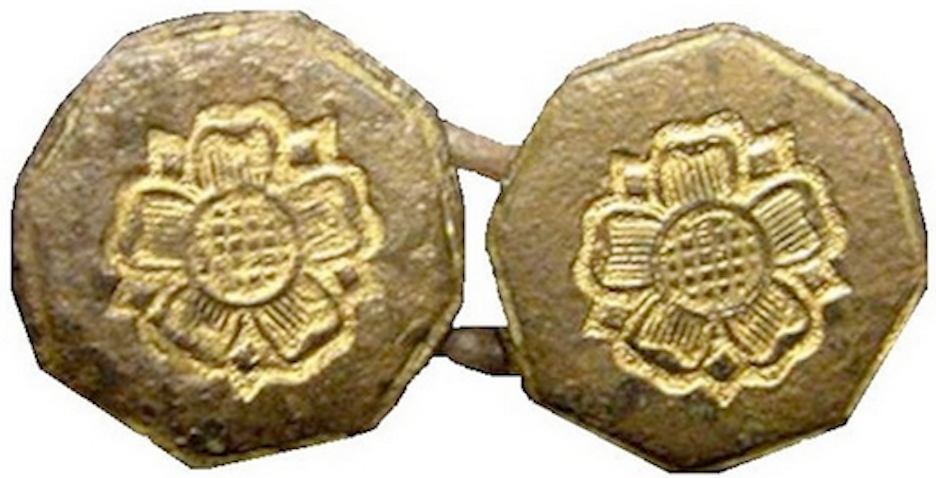
1748-87 ROYAL NAVY LIEUTENANT'S
TUDOR ROSE CUFF
Color: A Golden Brown with Gilt Highlights.
Metal: Flat, Hexagon Shape, 1-Piece, Impressed Design, Gilt Brass.
Size: 15.93mm. Cuff Size
Troiani: Similar to the BNL Series: Unlisted
Shape Variant.
Variation: Tudor Rose / Hexagonal Shape.
Present Condition: An Excavated Example,
Exceptional Planchet Casting, Exceptional Engraved Pattern.
Robert's Comments: The Tudor Rose was the
English symbol for Royal Feuds. From 1748 to 1767, all Lieutenants
wore flat gilt buttons
with a recessed Tudor Rose on all their
undress uniforms.
For their
full dress uniforms
they wore plain domed buttons. This is a bit more lavish
style design that shows exceptional design detail. The
button's pattern depicts a recessed
Tudor Rose
in the center. The edge border is
Hexagonal Shape
with a slightly beveled edge. The engraved pattern is
on a plain flat field. Hexagonal or oval shape
cuff buttons are a bit more
scarce then the commonly found round varieties.
Reverse Button Analysis: The button is a one
piece button with a loop shank. The shank is
original, straight, and intact.
Excavated By J. Baldwin in a camp near St. Augustine, Florida.~
The RJ
Silverstein Collection.
The
Table Below shows how the Pattern was used:
Royal Navy Lieutenant's 1748-67 Full Dress to 1767
Royal Navy Lieutenant's 1767-87-88 All Uniforms

1748-87 ROYAL NAVY LIEUTENANT'S
TUDOR ROSE CUFF
Color: A Flat Silver with A Touch of Green.
Metal: Slightly Convex, 1-Piece, Impressed Design,
Solid Silver.
Size: 15mm. Cuff Size
Troiani: Similar to the BNL Series: Unlisted
Shape Variant.
Variation: Tudor Rose / Hexagonal Shape.
Present Condition: An Excavated Example, Strong
Planchet Casting, Exceptional Engraved Pattern.
Robert's Comments: This is another die
variant of a Hexagonal Shape Tudor Rose button. Since
this is solid silver, it could have been made by a local
jeweler or artisan. The
button's pattern depicts a recessed
Tudor Rose
engraved
in the center. Circling around the button's edge is a
decorative line border to match the
Hexagonal Shape. The impressed pattern is
on a plain flat field. Hexagonal or oval shape
cuff buttons are a bit more
scarce then the commonly found round varieties.
Reverse Button Analysis: The button is slightly
concave with a loop shank. The shank is
original, straight, and intact.
The Dale Collection.
|
~ Royal Navy
Captain & Commander's Buttons Prior to the 1787 Regulation ~
In early
colonial times, only commissioned officers wore uniforms.
By 1748, there were
specifically designed buttons for the various ranks. Originally
Captains and Commanders only wore plain gilded domed buttons until
the regulations of July 30, 1774. The new regulation required all
domed buttons be replaced with flat buttons with an anchor and cable
design impressed into them. This new
regulation was very short lived, and was replaced in
1787, with a raised anchor motif within a recessed oval.
Collector's Note: Understanding the different patterns that were
used is not the same thing as
understanding the slight different variations of a pattern.
|
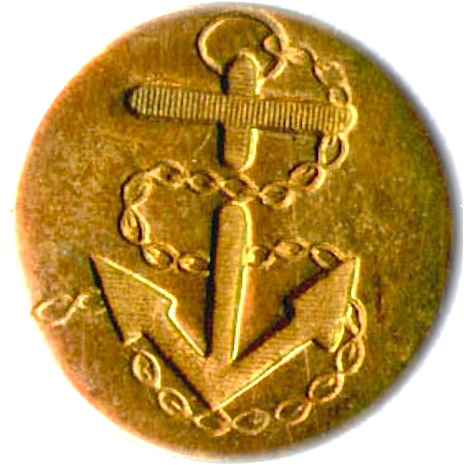
1774-87 ROYAL NAVY CAPTAIN'S BUTTON
1787-1805 Masters & Assistant Masters
1787-1807 RN Surgeons, Pursers, & Warrant Officers
Color: Brass Yellow with An Algae Green border.
Metal: Flat, 1-Piece, Impressed Design, Gilt Brass.
Size: 23.8mm Coat Size
Grains: 56.50
Troiani: Similar
to BNC.l.
Variation:
Fouled Anchor / V-Shaped Crown /
Rounded Ends / Chain Coming off the
Anchor's Top Ring.
Present Condition: A Non Excavated Example,
Exceptional Planchet Casting, Exceptional Impressions.
Robert's Comments: This pattern was
originally used for Captains & commanders, but was
adopted for Masters, RN Surgeons, Pursers, Warrant
Officers and even Mid-Shipmen in 1787-1807. There was
still commerce going on between the colonial states and
English manufacturers, so it would have been normal for
an American garment maker to order these
buttons and use them on Continental Navy Officer's
uniforms. There are a number of variations to this
pattern which depicts a chain link instead of a cable. It is similar to Troiani's
book example, but this
exceptional specimen depicts a rounded stock for the ends instead of
square. This button's
pattern depicts a Fouled
Anchor with a
V-Shaped Crown.
There is a Chain Coming off the
Anchor's Top Ring on the
left hand-side. The chain goes under a straight stock
with Rounded Ends,
and then over and under the shaft. Then goes under the left
fluke, and wraps under the pointed crown, and then goes up under the
right fluke, and off the side of the button. The
anchor's stock has vertical lines and the shaft and
crown have horizontal lines.
The
pattern is stamped into a plain flat round planchet with no
raised edge border.
Reverse Button Analysis: A One Piece Casting for
the Reverse Shank. The shank is original, straight, and
intact.
Stacks Auctions January 2003.~
Harold Cobb/Descendants 1958 to 2003.~
Cobb Purchased this from J.J. Goldberg (B.G. Johnson) in
1961.~
Cobb thought this button was from an officer in the
Connecticut navy during the American Revolutionary War.
It was discovered in January, 1961 on a pair of white
naval breeches that had been owned by Burdette G.
Johnson of St. Louis, Missouri. Johnson had bought the
breeches in Philadelphia years earlier. On the breeches
were 12 small size Eagle and Star buttons GWI 12-B, and
three naval buttons. Eleven of the 12 Eagle & Star
buttons were sold to various collectors. One of the
three naval buttons was sold to Sally Luscomb, and this
one went to Cobb. The breeches, with one Eagle & Star
and the one Naval Officer's Fouled Anchor button ( still
attached), were sold to DeWitt, who exhibited them in
his museum in Hartford, Connecticut.~
After consulting Don Troiani, he explained to me, "there
was no official regulation on the pattern of the button
used for officers in the Continental Navy. They
purchased what ever they wished. An American officer had
the choice of using either American, British, or French
manufactured Anchor buttons. The only regulation is that
they had to be yellow brass ones. The same buttons were
worn on dress and undress clothing. It is the number,
and the arrangement that will vary."
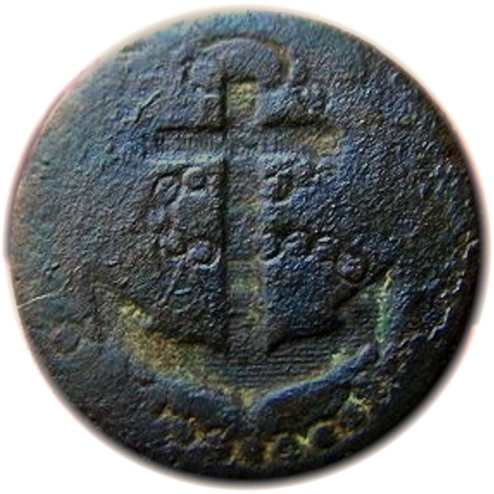
1774-87 ROYAL NAVY CAPTAIN'S BUTTON
1787-1805 Masters & Assistant Masters
1787-1807 RN Surgeons, Pursers, & Warrant Officers
Color: An Ochre of Brown, Greens and Golds.
Metal: Flat, 1-Piece, Impressed Design, Gilt Brass.
Size: 16mm, Cuff Size
Troiani: BNC.l.
Variation:
Fouled Anchor / Barbed Crown /Square
Ends / Chain Coming off the
Anchor's Top Ring.
Present Condition: A Non Excavated Example,
Exceptional Planchet Casting, Exceptional Impressions.
Robert's Comments: This pattern was
originally used for Captains & commanders, but was
adopted for Masters, RN Surgeons, Pursers, Warrant
Officers and even Mid-Shipmen in 1787-1807. There was
still commerce between the colonial states garment maker in
America, so it would have been normal for them to order these
buttons and place them on Continental Navy Officer's
uniforms. There are a number of variations to this
pattern which depicts a chain link instead of a cable. This button's
pattern depicts a Fouled
Anchor with a
Barbed Crown.
There is a Chain Coming off the
Anchor's Top Ring on the
left hand-side. The chain goes under a straight stock
with Square Ends,
and then under the shaft 2x. Then goes under the left
fluke, and wraps under the barbed crown, and then goes up under the
right fluke, and off the side of the button. The
anchor's stock has vertical lines and the shaft and
crown have horizontal lines.
The
pattern is stamped into a plain flat round planchet with no
raised edge border.
Reverse Button Analysis: A One Piece Casting for
the Reverse Shank. The shank is original, straight, and
intact.
The table below shows how a
specific pattern was used over time by different ranks
of Naval Officers:
Capt./Commander 1774 to 1787
RN Master & Mate 1787 to 1807
RN Surgeon 1787 to 1805
RN Purser 1787 to 1807
RN Warrant Officer 1787 to 1860
RN Midshipman 1787 to 1812
RN Volunteer Gr.I 1787 to 1812
*RN is the designation for Royal Navy.~
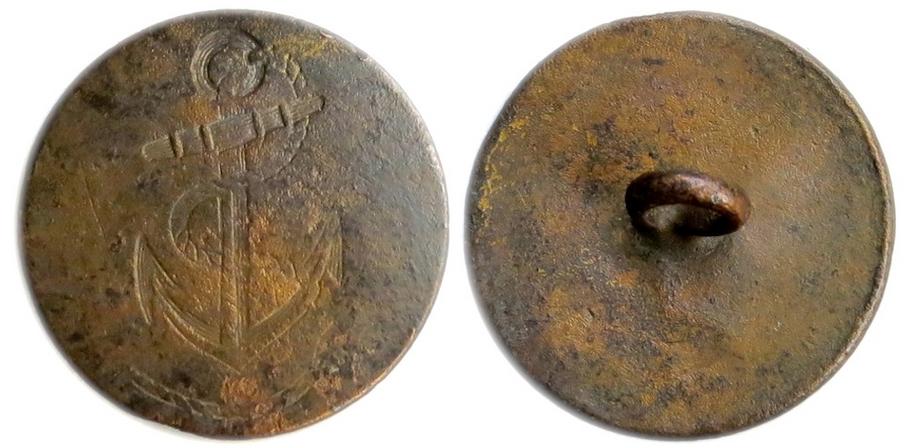
1774-87 A ROYAL NAVY CAPTAIN'S BUTTON OR A
CONTINENTAL NAVY CAPTAIN'S BUTTON
Color: A Golden Brown with Charcoal Verdigris
Spots.
Metal: Flat, 1-Piece, Impressed Design, Copper.
Size: 24.25mm. Large Coat Size
Variation: Fouled Anchor with
Decorative Lines and A Barbed Crown / Upright Top Ring
/ Slanted Stock.
Present Condition: An Excavated Example, Strong
Planchet Casting, Strong Impressions.
Robert's Comments: This is another early
pattern associated with Royal
Navy Officers. This button could have also been used
during the American Revolution by Continental Navy
Officers. The button's pattern depicts a
Fouled Anchor with
Decorative Lines and a Barbed Crown.
The cable comes off the anchor's
Upright
Top Ring
on the left hand-side. The cable goes under a
Slanted Stock with Four Raised Lines,
then over and under a partially lined shaft. The cable
then goes under the left fluke, and then fish hooks
below the crown pointing toward the right.
The
pattern is impressed into a plain flat round planchet,
and has no
raised edge border.
Reverse Button Analysis: This is a flat one-piece
button with a loop shank. The shank is original,
straight, and intact.
The RJ
Silverstein Collection.
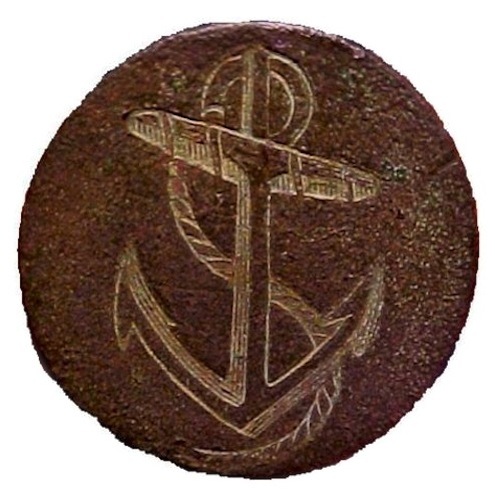
1774-87 ROYAL NAVY OFFICER'S BUTTON
Color: A Rusty Brown with Orange Undertones.
Metal: Flat, 1-Piece, Impressed Design, Gilded
Brass.
Size: 21mm. Coat Size
Variation: Fouled Anchor with
Decorative Lines and A V-Shaped Crown / Relaxed Top Ring
/ Slanted Lined Stock.
Present Condition: An Excavated Example, Strong
Planchet Casting, Strong Impressions.
Robert's Comments: This is another pattern
associated with British Royal
Navy Officers. The button's pattern depicts a
Fouled Anchor with
Decorative Lines and a V-Shaped Crown.
The cable comes off the anchor's
Relaxed Top Ring
on the right hand-side. The cable goes under a
Slanted Lined Stock,
then under the shaft and left fluke, and then fish hooks
below the crown.
The
pattern is impressed into a plain flat round planchet with no
raised edge border.
Reverse Button Analysis: This is a flat one-piece
button with a loop shank.
|
|
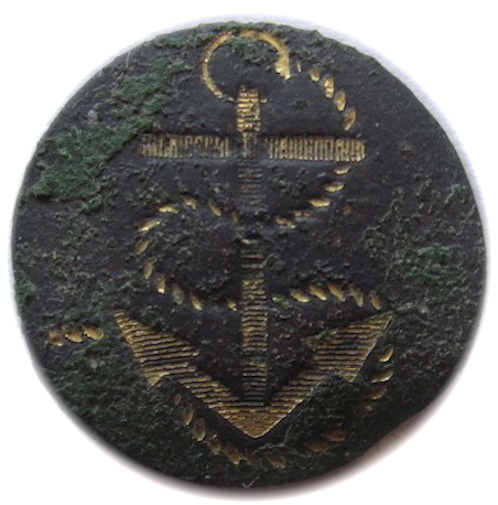
1774-87
ROYAL NAVY CAPTAIN AND
COMMANDER'S BUTTON
Color: A Chocolate Brown with Gold & Green
Encrustations.
Metal: Flat, 1-Piece, Impressed Design, Gilt Brass.
Size: 22mm. Coat Size
Variation: Fouled Anchor with a V-Shaped Crown /
Horizontal Stock.
Present Condition: An Excavated Example, Strong
Planchet Casting, Exceptional Impressions.
Robert's Comments: This was a popular
pattern used by Royal Navy Officers that was made with
slight variations in the pattern. The
button's pattern depicts a
Fouled Anchor with a V-Shaped Crown.
The cable comes off the anchor's top ring on the left
hand-side. The cable goes under a
Horizontal Stock, over and under the shaft,
under then around the left fluke, below the crown, under then
dips behind right
fluke then off the right side.
The
pattern is impressed into a plain flat round planchet with no
raised edge border.
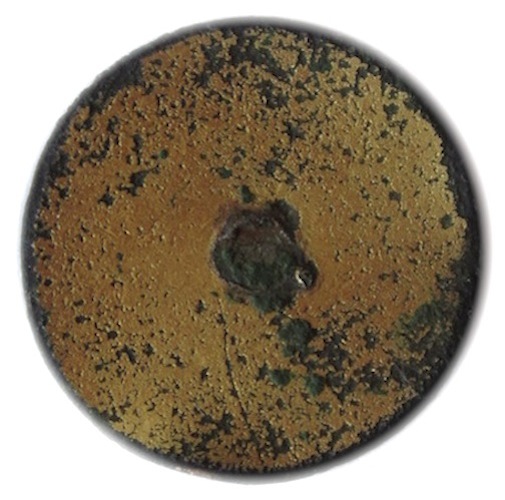
Reverse Button Analysis: This is a one-piece
button with a loop shank. The shank is
unfortunately missing. No back mark.
This was Excavated in Boston Massachusetts.~
The RJ
Silverstein Collection.
|
|
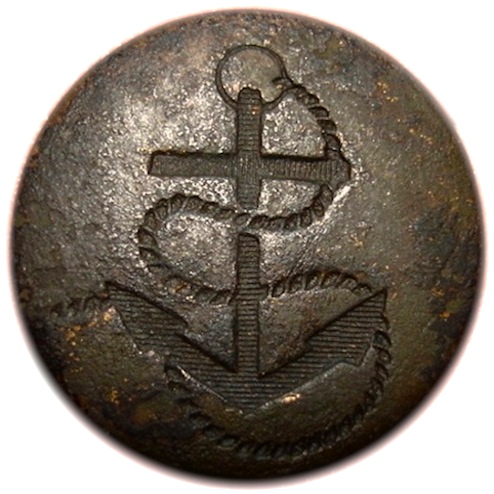
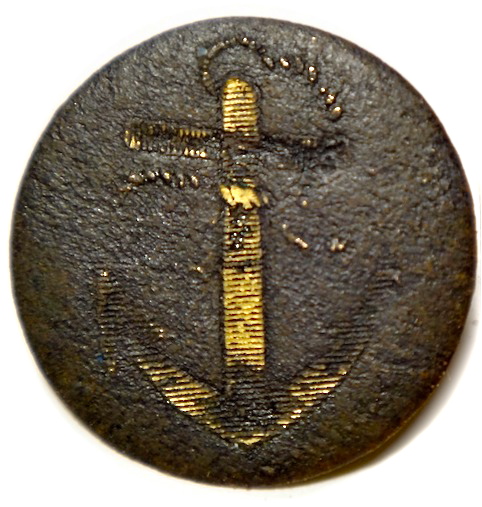
1774-87 ROYAL NAVY CAPTAIN AND COMMANDER'S BUTTON
Color: A Mud Brown.
Metal: Flat, 1-Piece, Impressed Design, Gilt
Brass.
Size: 22mm. Coat Size
Variation: Fouled Anchor with a V-Shaped Crown /
Horizontal Stock.
Present Condition: An Excavated Example, Strong
Planchet Casting, Exceptional Impressions.
Robert's Comments: This is a perfect example
of a die variant that is only slightly different then
the specimen pictured above. Even though there are a
number of variations to this design, most are extremely
close and only differentiate in subtle ways. The
button's pattern depicts a
Fouled Anchor with a V-Shaped Crown.
The cable comes off the anchor's top ring on the left
hand-side. The cable goes under a
Horizontal Stock, over and under the shaft,
under then around the left fluke, below the crown, under then
dips behind right
fluke then off the right side.
The
pattern is stamped into a plain flat round planchet with no
raised edge border.
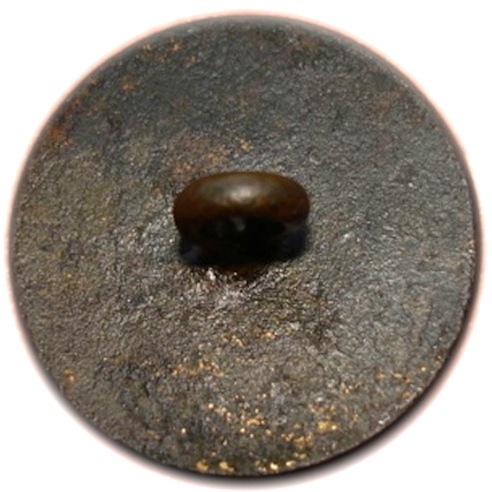
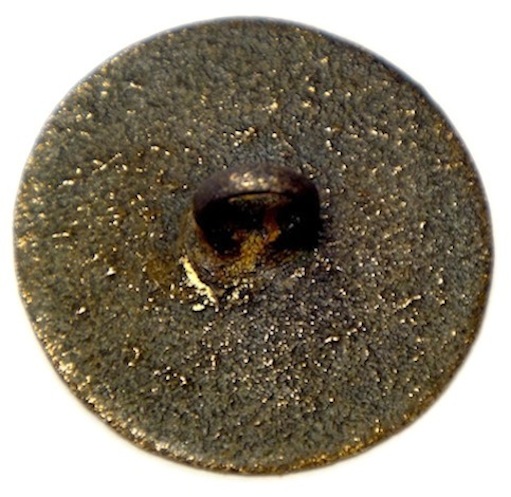
Reverse Button Analysis: This is a one-piece
button with a loop shank. The shank is
original, straight, and intact. No back mark. |
|
1774-87
ROYAL NAVY CAPTAIN AND
COMMANDER'S BUTTON
Color: A Muddy Brown with Gold Design Highlights.
Metal: Flat, 1-Piece, Impressed Design, Gilt Brass.
Size: 22mm. Coat Size
Variation: Upright Anchor with a Barbed Crown /
Slanted Lined Stock
Present Condition: An Excavated Example, Good
Planchet, Good Impressions.
Robert's Comments: This is another pattern
variation that was used by officers in the Royal Navy. The button's
pattern depicts a large
Upright Anchor with a Barbed Crown.
The pattern shows a cable coming off the anchors top
ring on the left hand side. The cable goes under a
Slanted Lined Stock,
and then over and under the shaft, and then under the
left fluke, and then dangles under the barbed crown.
The
pattern is impressed into a plain flat round planchet with no
raised edge border.
Reverse Button Analysis: This is a one-piece
button with a loop shank. The shank is original,
straight, and intact. No back mark.
This was Dug in the State
of Delaware, near a ship landing site.
|
|
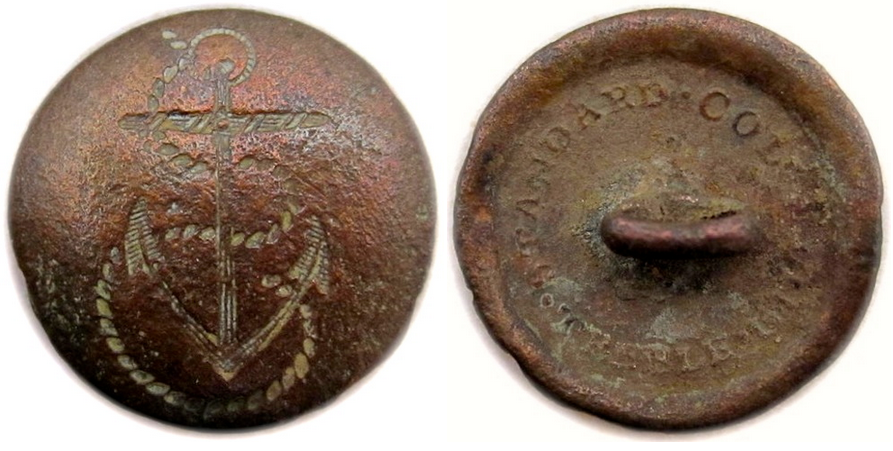
1780's-1815 ROYAL NAVY CAPTAIN AND COMMANDER'S BUTTON
Color: A Soft Brown with Coppery Red Undertones.
Metal: 1-Piece, Domed, Impressed Design, Gilded
Brass.
Size: 19.59mm. Coat Size
Variation:
Upright Fouled Anchor with Decorative Lines / Rope Comes
Through the Anchor's Top Ring.
Present Condition: An Excavated Example, Strong
Planchet Casting, Strong Impressions.
Robert's Comments: This specimen is another
pattern used by Navy Officers in the late 17th and early
19th Century. The button's pattern depicts an
Upright Fouled Anchor with Decorative Lines
within.
In this pattern, the
Rope Comes Through the Anchor's Top Ring
on the right hand-side (This is an usual design). The rope goes under
a straight decorative lined stock, and then under the shaft
2x, then under the right fluke, and fish hooks below the
pointed crown, and then curls up just under the left fluke
pointing toward the shaft.
The
pattern is impressed into a plain flat round planchet with no
raised edge border.
Reverse Button Analysis: This is a one-piece
button with a loop shank in a recessed well. The shank is original,
straight, and intact. TREBLE GILT STANDARD. COLOUR rm.
within a recessed well.
The RJ
Silverstein Collection. |
|
1787
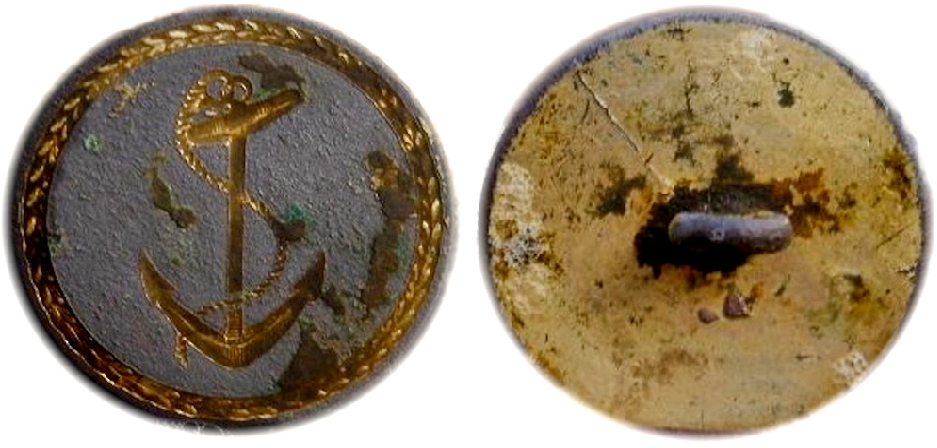
ROYAL NAVY FLAG OFFICER'S BUTTON or EARLIER?
Color: A Ghostly Brown with Gold in the Pattern.
Metal: Flat, 1-Piece, Impressed Design, Gilt Brass.
Size: 20mm. Coat Size
Variation: Upright Anchor with a Skinny Shaft and
Roundish Crown / Slanted Stock / Two Sets of Vertical
Triple Lines / Foliated Wreath.
Present Condition: An Excavated Example, Strong
Planchet Casting, Strong Impressions.
Robert's Comments: This is a tough button for
me to identify. Has the trade marks of an earlier Rev
War Era Button, but the added Wreath is attributed to
the later Royal Navy Flag Officers.. ie Admiral's button
of 1787. Another interesting fact is that this was dug
by a local treasure hunter on the North Shore of
Massachusetts. Meaning this very well could have been
used by an American Officer, or lost by a British
officer in 1812? At this point all speculation. I have a
feeling tail end of Rev War. The button's
pattern depicts a large
Upright Anchor with a Skinny Shaft and Roundish Crown.
The pattern shows a cable coming off the anchors top
ring on the right hand side. The cable goes under a
Slanted Stock,
and then under and over the shaft, and then under the
right fluke, and then dangles below the crown. The
slanted stock has
Two Sets of Vertical Triple Lines,
and the shaft horizontal parallel lines, and crown have
vertical parallel lines. has Circling the button's edge
is a
Foliated Wreath. The
pattern is impressed into a plain flat round planchet with no
raised edge border.
Reverse Button Analysis: This is a one-piece
button with an Alpha shank. The shank is original,
straight, and intact. No back mark.
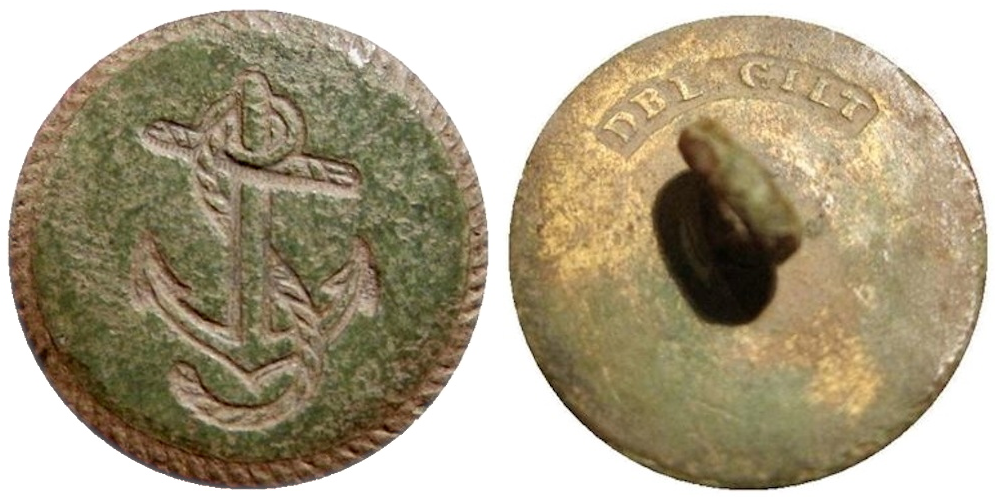
1790-1820's BRITISH MARINES
Color: A Grass Green over A Light Brown.
Metal: Flat,1-Piece, Impressed Design, Double
Gilt
Brass.
Size: 20mm. Coat Size
Variation: Upright Fouled Anchor with A
Barbed Crown / Relaxed Top Ring / Slanted Stock /
Roped Decorative Edge.
Present Condition: An Excavated Example, Strong
Planchet Casting, Strong Impressions.
Robert's Comments: This is a little
more scarce variant found for Royal Marines. The button's pattern depicts an
Upright Fouled Anchor with
A Barbed Crown.
The rope comes off the anchor's
Relaxed Top Ring
on the right hand-side. The rope goes over the
Slanted Stock,
then under the shaft, and then over the left fluke, and
then fish hooks around the crown.
What makes this an unusual die variant is that the
Anchor has an impressed outline leaving the center with a
raised pattern. The pattern is impressed into a plain
flat round planchet with a
Roped Decorative Edge
border.
Reverse Button Analysis: This is a flat one-piece
button with a loop shank. DBL GILT BRASS rm.
Dug in South Carolina, The Low Country.
The Bill Cross Collection.
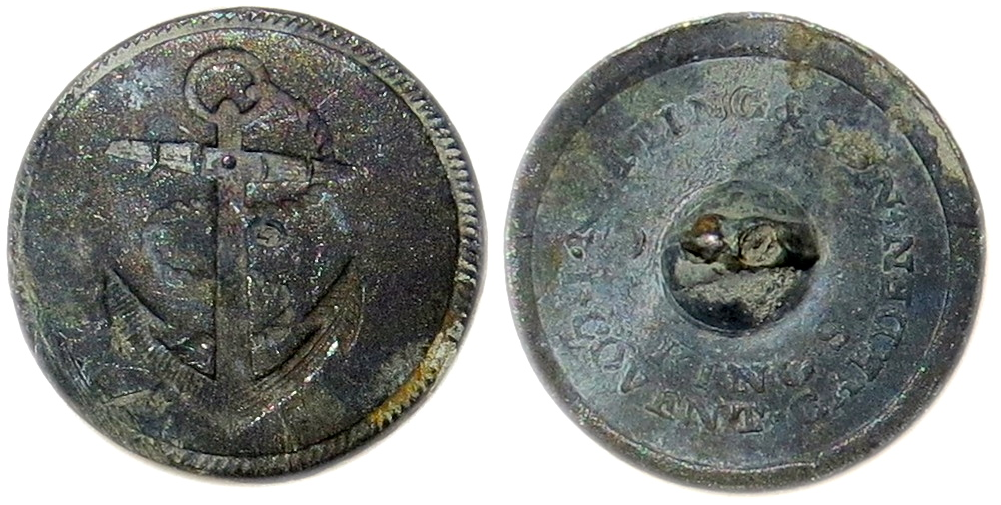
1790-1820's BRITISH MARINES
Color: A White Speckled With A Charcoal Base.
Metal: Flat,1-Piece, Impressed Design, Double
Gilt
Brass.
Size: 22.75mm. Coat Size
Variation: Upright Fouled Anchor with A
Barbed Crown / Slanted Stock / Multi-Directional
Lines /
Roped Decorative Edge.
Present Condition: An Excavated Example, Strong
Planchet Casting, Strong Impressions.
Robert's Comments: This is another die
variant used by the British's Royal Marines.
The button's pattern depicts an
Upright Fouled Anchor with
A Barbed Crown.
The rope comes off the anchor's
top ring
on the left hand-side. The rope goes under a
Slanted Stock
with
Four Lines
and a
Dot,
then under a
Lined Shaft 3x, and then
hangs under the right side of the crown.
The stock has four diagonal lines and a dot. The shaft has vertical lines, and the crown & flukes
have
Multi-Directional Lines
decorated
within.
The
pattern is impressed into a plain flat round planchet
that has a
Roped Decorative Edge
border.
Reverse Button Analysis: This is a flat one-piece
button with a boss and loop shank. NUTTING & SONS. /COVENT.CARDEN./KING'S.St
Dug Around Lake Erie.
The RJ. Silverstein Collection
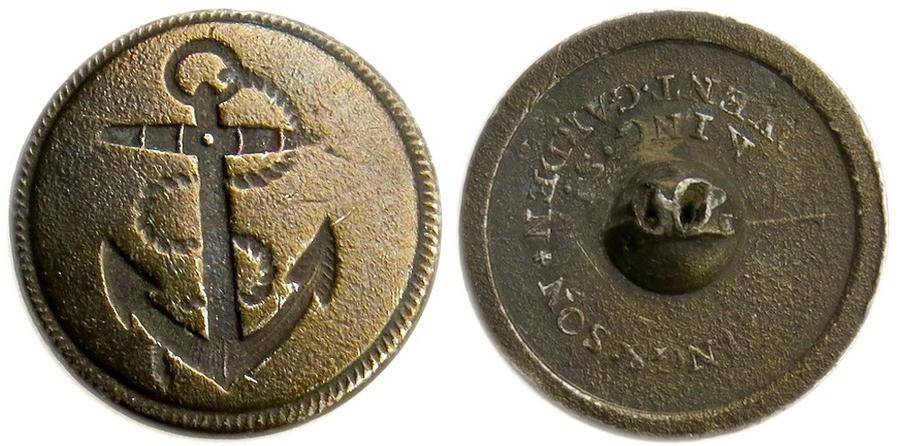
1790-1820's BRITISH MARINES
Color: A Golden Brown.
Metal: Flat,1-Piece, Impressed Design, Double
Gilt
Brass.
Size: 22.62mm. Coat Size
Variation: Upright Fouled Anchor with A
Barbed Crown / Slanted Stock / Multi-Directional
Lines /
Roped Decorative Edge.
Present Condition: An Excavated Example, Strong
Planchet Casting, Strong Impressions.
Robert's Comments: This is most likely
a water
find. This
is the same
pattern as
above, just
a little
clearer. The button's pattern depicts an
Upright Fouled Anchor with
A Barbed Crown.
The rope comes off the anchor's
top ring
on the left hand-side. The rope goes under a
Slanted Stock
with
Four Lines
and a
Dot,
then under a
Lined Shaft 3x, and then
hangs under the right
side of the
crown.
The stock has four diagonal lines and a dot. The shaft has vertical lines, and the crown & flukes
have
Multi-Directional Lines
decorated
within.
The
pattern is impressed into a plain flat round planchet
that has a
Roped Decorative Edge
border.
Reverse Button Analysis: This is a flat one-piece
button with a boss and loop shank. NUTTING & SONS. / COVENT.CARDEN./KING'S.St
Dug Around Lake Ontario.
The RJ. Silverstein Collection
|
~
Early Royal Navy & Continental Navy Cuff Buttons ~
|
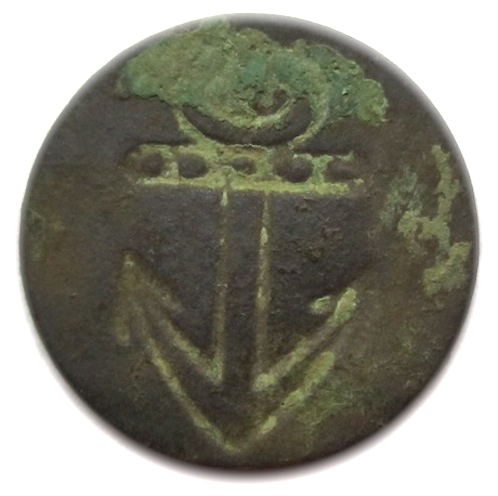
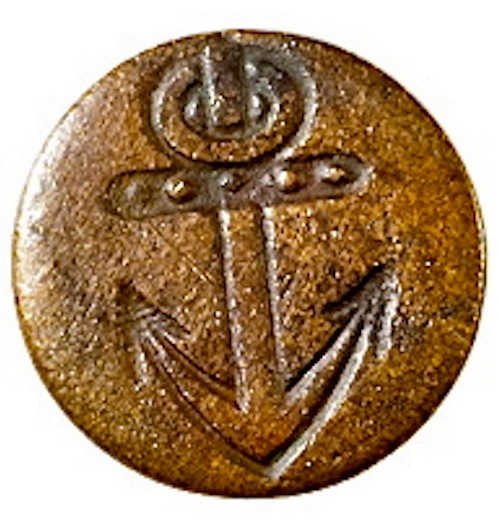
1774-87
ROYAL NAVY CAPTAIN AND
COMMANDER'S CUFF BUTTON
Color: A Golden Brown.
Metal: Flat, 1-Piece, Stamped Design, Brass.
Size: 14mm. Cuff / Vest size
Variation: Upright Anchor with a Relaxed Top Ring
/ Five Raised knobs.
Present Condition: A Non Excavated Example,
Exceptional Planchet Casting, Exceptional Impressions.
Robert's Comments: This appears to be several
die variants known for this cuff. The button's pattern depicts
a crude style
Upright Anchor with a V-Shaped Crown.
The anchor depicts a
Relaxed Top Ring
without an attached cable. The anchor's straight
stock depicts
Five Raised knobs.
There is no cable in this crude pattern. The pattern is
stamped into a plain flat round planchet with no raised edge border.
Popular button for Rev War Collectors.
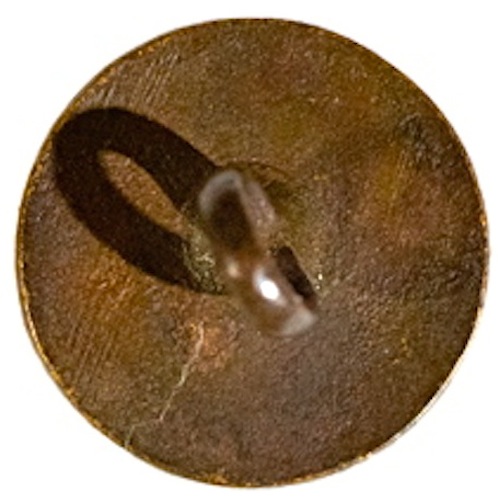
Reverse Button Analysis: This is a one-piece
button with a loop shank. The shank is original,
straight, and intact. No back mark.
|
|
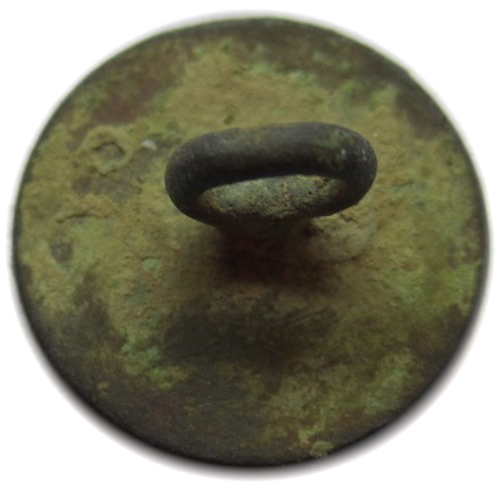
1774-87
ROYAL NAVY CAPTAIN AND
COMMANDERS CUFF BUTTON
Color: A Dark Brown with Florescent Green
Encrustations.
Metal: Flat, 1-Piece Stamped Design, Brass.
Size: 13.54mm. Cuff / Vest Size
Variation: Upright Anchor with a Relaxed Top Ring
/ Five Raised knobs.
Present Condition: An Excavated Example, Good Planchet Casting,
Strong Impressions.
Robert's Comments: This appears to be several
die variants known for this cuff. The button's pattern depicts
a crude style
Upright Anchor with a V-Shaped Crown.
The anchor depicts a
Relaxed Top Ring
without an attached cable. The anchor's straight
stock depicts
Five Raised knobs.
There is no cable in this crude pattern. The pattern is
stamped into a plain flat round planchet with no raised edge border.
Popular button for Rev War Navy
button collectors. This button is usually available in
good condition.
Reverse Button Analysis: This is a one-piece
button with a loop shank. The shank is original,
straight, and intact. No back mark.
This was Excavated in Water at Fort Erie.~
The RJ
Silverstein Collection.
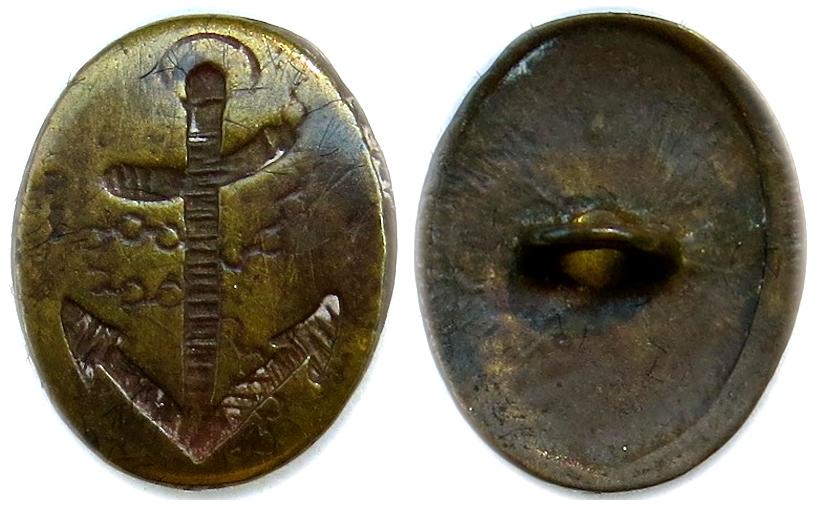
1774-87 ROYAL NAVY CAPTAIN AND COMMANDERS OVAL CUFF
BUTTON
Color: A Brown Bess.
Metal: Oval,
Flat,
1-Piece,
Stamped Design, Brass.
Size: 14.58mm x 11.58mm. (Oval)
Cuff Size
Troiani: Similar
to BNC.q.
Unlisted Variant Shape
Variation:
Fouled Anchor Stamped in the Center / Chain Coming off
the Anchor's Top Ring / Curved Stock /
Present Condition: A Non Excavated Example, Strong
Planchet Casting, Strong Impressions.
Robert's Comments: This is another variation of the
fouled anchor pattern that was used by either the Royal
Navy officers or Continental Navy Officers. Some
undocumented research said this pattern was used by U.S.
Navy Seaman.
This button's
pattern depicts a Fouled
Anchor Stamped in the Center.
There is a Chain Coming off the
Anchor's Top Ring
on the left hand-side. The chain goes under the whole
Curved Stock
with rounded ends,
and then under the shaft 2x, and then falls below the
left fluke. The pattern is impressed into a plain flat
oval planchet with no raised edge border.
Reverse Button Analysis: This is a one-piece button
with a loop shank. The shank is original, straight, and
intact. No back mark.
The RJ
Silverstein Collection.
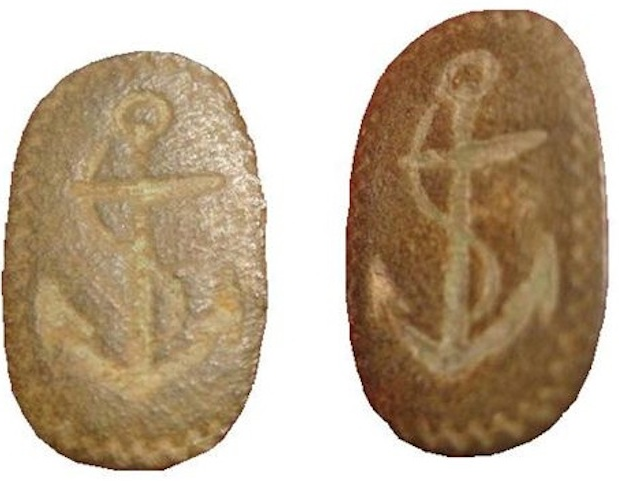
1770-90 ROYAL NAVY CAPTAIN AND
COMMANDERS CUFF BUTTON
Color: A Coppery Brown Shade.
Metal: Flat, Oval, 1-Piece Stamped Design, Gilt Brass.
Size: 16mm x?. Cuff Size
Variation: Upright Fouled Anchor with a Barbed
Crown /
Short Cable /
Disappears Under the Shaft /
Squiggly Line Decorative Border.
Present Condition: An Excavated Example, Good Planchet Casting,
Good Impressions.
Robert's Comments:
This shape button is a bit more
scarce then the usual round cuff examples. The button's
pattern depicts an
Upright Fouled Anchor
with a Barbed Crown.
There is a Short Cable that comes off the anchor's top
ring on the right hand-side. The cable goes under a
straight stock,
and then Disappears
Under the Shaft. The
impressed pattern is set on a plain flat field with a
Squiggly Line Decorative Border.
Reverse Button Analysis: This is a one-piece
button with a loop shank. The shank is original,
straight, and intact. No back mark.
The
Bill Cross Collection.
|
|
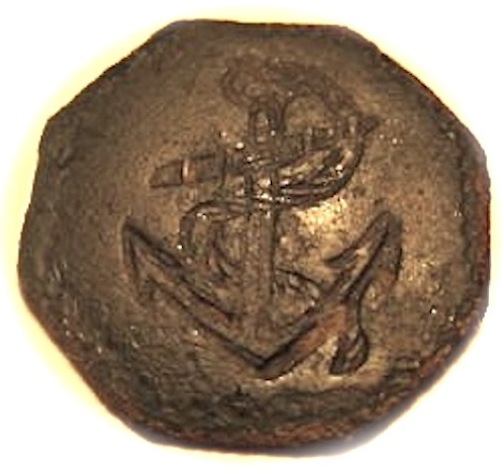
1774-87
BRITISH MARINES OFFICER'S
CUFF BUTTON
Color: A Coppery Brown.
Metal: Flat, 1-Piece, Impressed Design, Gilded
Copper.
Size: 17mm. Cuff Size
Variation: Fouled Upright Anchor with a V-Shaped
Crown / Thick Cable / Straight Lined Stock / Hexagonal
Shape / Decorative Rope Edge.
Present Condition: An Excavated Example, Good
Planchet Casting, Good Impressions.
Robert's Comments: This is another variation of a
fouled anchor and cable pattern that happen to be dug
right here in the northeastern United States. We
previously demonstrated that the
Hexagonal shape was first seen
with the Tudor
Rose pattern. The
button's decorative edge makes me think this pattern was
made for the Marines instead of the Navy. The button's
pattern depicts a
Fouled Upright Anchor with a
V-Shaped Crown.
There is a
Thick Cable
that comes off the anchor's top ring on the left hand
side. The cable goes under a
Straight Lined Stock,
then goes over and under the shaft, and then under the
left fluke, and then dangles below the crown.
The button has a
Hexagonal Shape
with a
Decorative Rope Edge.
The pattern is impressed into the planchet.
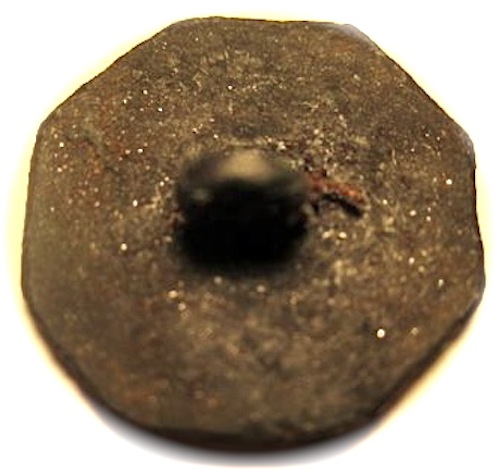
Reverse Button Analysis: This is a One-Piece
Casting for the Reverse Shank. The shank is original,
straight and intact. The surface appears course, and has
a granular texture. |
|
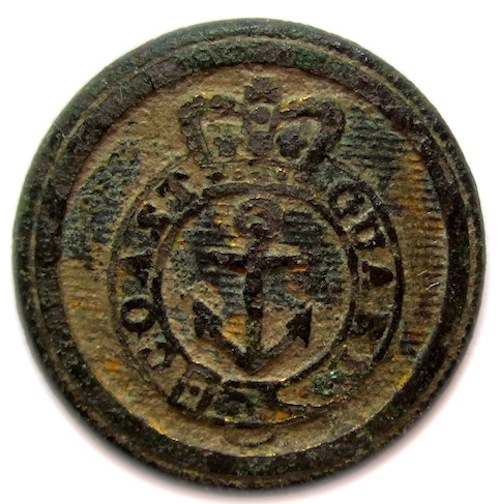
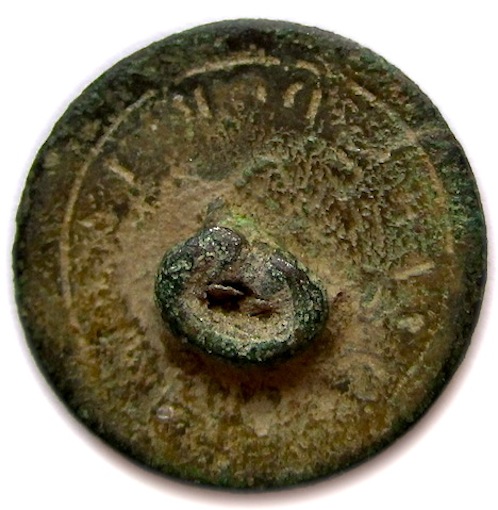
1770-1820 HER MAJESTY'S COAST
GUARD
Color: A Coppery Brown with Beige and Orange
Specs.
Metal: Flat, 1-Piece, Raised Design, Copper.
Size: 18.61mm. Cuff Size
Variation:
Small Upright Anchor /
Royal Garter /
Surmounted by a Crown /
Present Condition: An Excavated Example, Strong
Planchet Casting, Strong High Relief.
Robert's Comments: I found this button very
difficult to accurately date. Several English Royal Navy
Button web sites conflict with the original issue date and use.
Historically speaking, most
Crowns were not added to the
Royal Navy's buttons until the official regulation of
1812; but this is Her
Majesty's Coast Guard, which at the time was under a
completely different jurisdiction then the Royal Navy
Department. After some more historical
research, I found out that Her Majesty's Coast Guard O/Rs
aided the Royal Navy in a "non official capacity"
during the American Revolution. In what capacity, one
could only theorize. If this button's crown pattern
holds to the 1770's issue date, this would be the earliest
use of a Crown motif adapted by any kind of Navy
Button prior to the official regulation of 1812. This
button is one of the better preserved specimens a
collector could find. Most examples are in deteriorated
condition. The button's pattern
depicts a Small Upright
Anchor in the center of a Royal
Garter which is Surmounted by a
Crown. Within the band
of the garter the military designation, "COAST" on the
left, and "GUARD" on the right side. In the top of the
band is the bottom of a large Crown, and in the bottom
of the band is a Buckle The high relief
pattern is set on a lined field with a small beveled
edge border. Being that the pattern is raised instead of
impressed, I would attribute this button to after
1787.
Reverse Button Analysis: This is a one-piece
button with a loop shank. The shank is original,
and intact, but bent over.
Excavated on the coast of Florida.~
The RJ
Silverstein Collection.
|
Royal
Navy's Captain & Commander's Buttons
1787-1800's
|
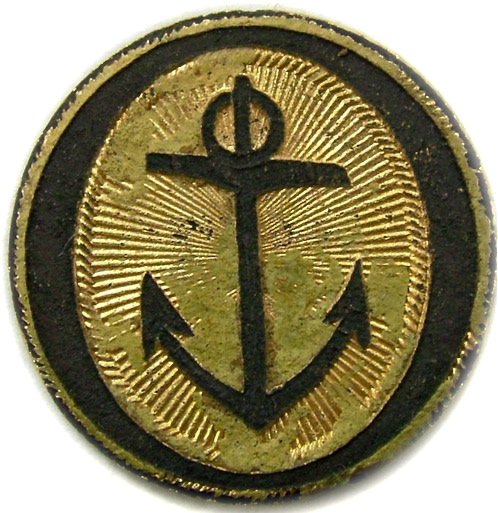
1787-1795 Royal Navy Captain & Commander's Gilt Buttons
In 1787, the Royal Navy changed their regulations from a flat Gilt
button with an impressed anchor pattern to a stylish raised anchor
motif within a recessed oval. The former Captain's pattern of 1774,
was then adopted in 1787, for midshipmen. As for Warrant Officers,
they weren't ordered to wear uniforms prior 1787, so they didn't
have an official button style change prior to then. The common
sailor or seaman was not issued a standard uniform with regulation
buttons, but most crews was provided with a blue jacket that was
trimmed with metal, cloth covered, pressed horn, or leather buttons.
The term Bluejacket was actually used as a common
metaphor to describe British sailors.
Sometimes
at a Captain's whim, the buttons would have a pressed anchor motif
on them, but this was usually rare.
Another important fact worth
mentioning
is that anchor buttons used by the
Royal Navy weren't exclusive, they were used by merchant
seaman as well.
|
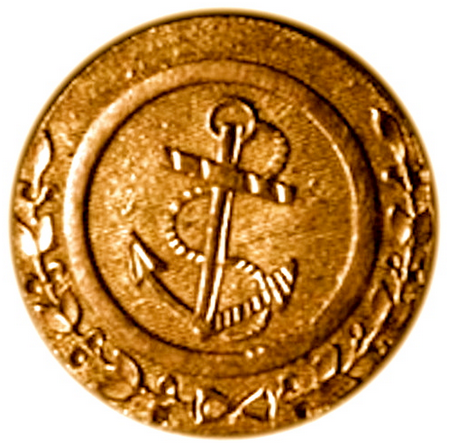
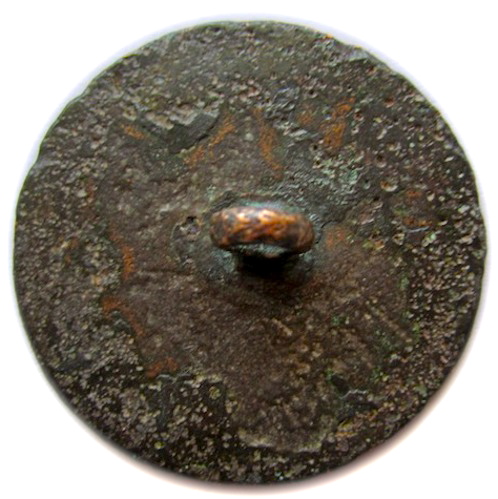
1795-1807 ROYAL NAVY FLAG OFFICER ADMIRAL'S
BUTTON
Color: A Golden Orangey-Brown.
Metal: Flat, 1-Piece, Raised Design, Gilt Brass.
Size: 25mm. Coat Size
Variation:
Fouled Anchor with a Slanted Stock / Barbed
Crown /
Round Inner Ring Picture Frame Border
/Decorative
Wreath.
Present Condition: An Excavated Example, Strong
Planchet Casting, Strong High Relief.
Robert's Comments:
There are three die variants known for this button.
There could possibly be more, but most likely a limited issue with
few made. The differences are noted in the size of the inner ring
and the depiction of the wreath and anchor.
The
buttons pattern depicts a
Fouled Anchor with a Slanted Stock
and a
Barbed Crown.
The stock has four diagonal cut lines, and the cable and
left fluke has several cut lines.
Coming off the anchor's
top ring on the left hand side is a cable. The cable then goes under
the
slanted stock, shaft and
left fluke. The cable then dangles just below the crown
pointing toward the barb. The anchor appears to be set on a lined field
that is within a
raised
Round Inner Ring Picture Frame Border. In a semi-circle 3/4
of the way around the buttons edge is a
Decorative Wreath.
This wreath was used to
distinguish the Flag Officer's rank.
Reverse Button Analysis: This is a one-piece button
with an alpha shank. The shank is original, straight, and
intact. S. Firmin back mark.
*Robert's Notes: RN Flag Officers with a Vertical Stock
within a Wreath Dates to 1807-1812
The family that owns this buttons
states that this came from the coat of Admiral Horatio
Nelson during the battle of the Nile on August 1,1798.
Even though they can offer no substantial proof or
documentation, the S. Firmin back mark of 1771-80
corresponds to Nelsons early career with the Royal Navy.
Nelson became a midshipman aboard the Raisonnable in
March of 1771 and by 1779, Nelson was a Post Captain in
command of the frigate Hinchinbroke. |
|
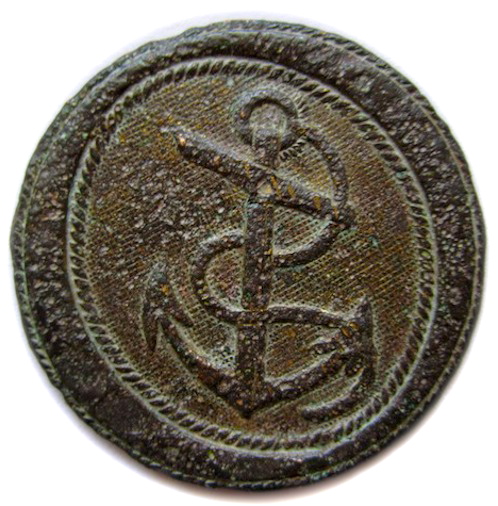
1787-95 ROYAL NAVY CAPTAIN / COMMANDERS & LIEUTENANT'S
SLANTED ANCHOR BUTTON
Color: A Brassy Brown with Gold Undertones.
Metal: Flat, 1-Piece, Raised Design, Gilt Brass.
Size: 29.86mm x 30mm.
Variation: Large Fouled Anchor / Barbed Crown /
Stippled Field / Oval Picture Frame Border / Thin
Decorative Rope Trim.
Present Condition: An Excavated Example, Good
Planchet Casting, Strong High Relief Pattern.
Robert's Comments: The Slanted Anchor pattern
was officially adopted by the Captains & Commanders of
the Royal Navy by 1787. There are a few noted
anchor depiction variations by different manufacturers,
but all are slanted set within a picture frame oval.
This button's pattern depicts a
Large Fouled Anchor
with a
Barbed Crown. There is a
cable coming off the
anchor's top
ring on the left hand-side. The cable goes under a
slanted stock, and then under and over the shaft.
The cable then goes under the left fluke, and ends in a small
fish hook underneath pointing toward the crown. The high relief pattern is set on a
Stippled Field
that is set within an
Oval Picture Frame Border.
There is a
Thin Decorative Rope Trim
on the inside and outside edge of the oval picture frame
border. The high relief pattern is set on a Stippled field,
with a large flat slanted oval border that has a
thin roped edge.
When this pattern was issued, the
Lieutenants would start to use the same pattern as the
captains.
Reverse Button Analysis: This is a one-piece
button with a loop shank. The shank is original,
straight and intact. No back mark.
Excavated on land at Fort Erie.~
The RJ
Silverstein Collection.
|
|
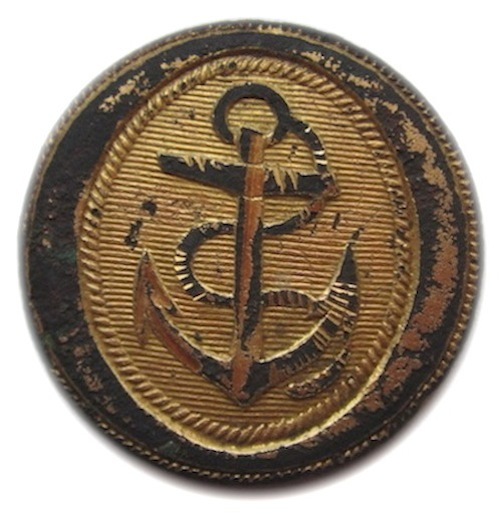
1795-1812 ROYAL NAVY CAPTAIN & COMMANDER'S VERTICAL
UPRIGHT BUTTON
Color: A Golden Brown Mix.
Metal: Flat, 1-Piece, Raised Design, Gilded Brass.
Size: 22.99mm x 23.04mm.
Variation: Large Fouled Upright Anchor /
Barbed Crown /
Lined Field
/ Oval Picture Frame Border / Thin Decorative Rope.
Present Condition: An Excavated Example, Good
Planchet Casting, Strong High Relief Pattern.
Robert's Comments: This Vertical Upright
Anchor pattern quickly replaced the Slanted Anchor
pattern in 1795. We know a number of different
manufacturers made this pattern with sight variations in
the depiction of the anchor. The old pattern was
probably still
used for a short time on their existing uniforms, but this
new pattern would have been on their new uniforms.
The button's pattern depicts a
Large Fouled Upright Anchor
with a
Barbed Crown. There is a
cable coming off the
anchor's top
ring on the left hand-side. The cable goes over a
slightly slanted stock and under the shaft 2x;
then goes under the left fluke and ends in a small
fish hook underneath the the crown. The anchor has crude
cut lines in the stock, cable and left fluke. The shaft
has long vertical lines. The high relief pattern is set on a
Lined Field
that is set within an
Oval Picture Frame Border.
There is a
Thin Decorative Rope Trim
on the inside and outside edge of the oval picture frame
border.
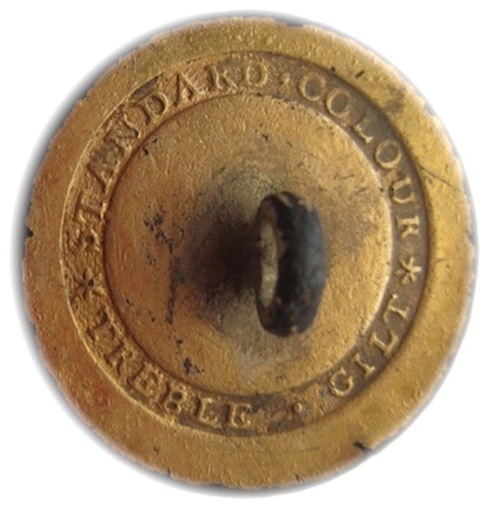
Reverse Button Analysis: This is a one-piece
button with a loop shank. The shank is original,
straight and intact. STANDARD. COLOUR*TREBLE. GILT
Excavated on Land around Fort Erie.~
The RJ
Silverstein Collection. |
|
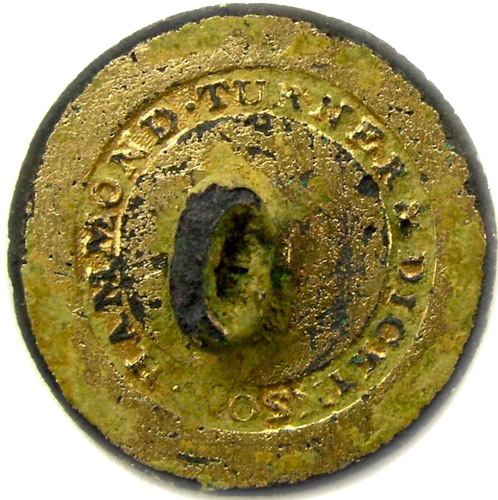
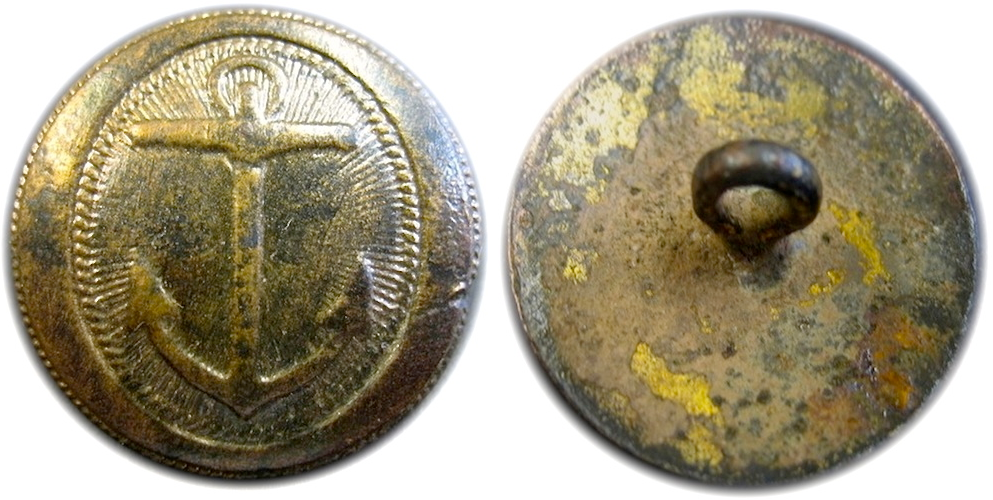
1805-1812 ROYAL NAVY SURGEON
Color: A Yellow Gold Over Charcoal.
Metal: Flat, 1-Piece, Raised Design, Gilt Brass.
Size: 21.89mm. Coat Size
Variation: Rayed Field Behind Anchor.
Albert's: BNH 6
Tice: Back mark PG 154
Variation: Large Slightly
Barbed Anchor with a Relaxed Top Ring / Rayed
Field / Oval Picture Frame Border / Thin Decorative Rope
Trim.
Present Condition: An Excavated Example, Good
Planchet Casting, Strong High Relief Pattern.
Robert's Comments: After this issue, all
Physicians and Surgeons will use the same style pattern
as Captains and Commanders. This stylish rayed pattern
was made by a number of different manufacturers for
about 25 years. There are a few different die variants
known with subtle differences in anchors styles. Albert's lists this on page 90 as a Commissioned
Officers pattern from 1787 to 1795. Tice's back mark
book lists this as 1790 to 1820 on page 154. Three
English Navy Button sites lists this as 1805-12 Royal
Navy Surgeon's button, or an early 1790's Captain's
button. The button's pattern depicts a
Large Slightly
Barbed Anchor with a Relaxed Top Ring. The
anchor is depicted
on a
Rayed Field
that is set within an
Oval Picture Frame Border.
There is a
Thin Decorative Rope Trim
on the inside and outside edge of the picture frame
border.
Reverse Button Analysis: This is a flat one-piece
button with a loop shank. The shank is original,
straight and intact.
TURNER & DICKINSON HAMMOND . rmdc
(HamondTurnerDickenson01)
The RJ
Silverstein Collection.
1805-1812 ROYAL NAVY SURGEON
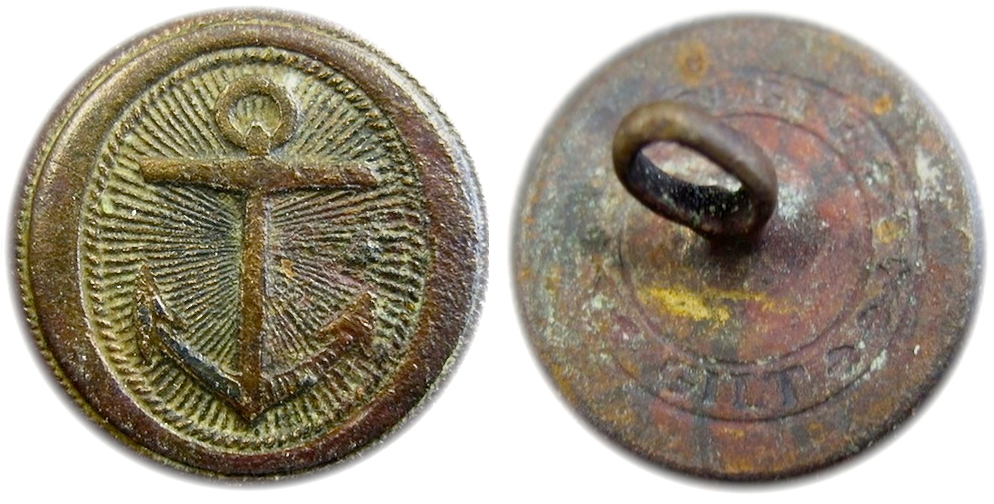
Color: A Golden Azure.
Metal: Slightly Convex, 1-Piece, Raised Design, Gilt Brass.
Size: 23mm. Coat Size
Variation: A Barbed Anchor / Rayed Field /
Thin Decorative Rope Trim / Anchor's Shaft goes Halfway
Through the Top Ring.
Present Condition: An Excavated Example, Strong
Planchet Casting, Strong High Relief Pattern.
Robert's Comments: This stylish rayed pattern
was made by a number manufacturers for about 25 years.
There are a few die variants known that that show a
slight difference in anchor styles. This button's pattern depicts
A Barbed Anchor with a Upright Top Ring.
In this variant, the
Anchor's Shaft goes Halfway Through the Top Ring. The
anchor is depicted
on a
Rayed Field
that is set within an
oval picture frame border.
There is a
Thin Decorative Rope Trim
on the inside and outside edge of the picture frame
border.
Reverse Button Analysis: This is a concave one-piece
button with a loop shank. The shank is original,
straight and intact.
A Water Find near Kingston, Ontario
1795-1805 CAPTAINS & COMMANDERS
CUFF?
1805-1812 ROYAL NAVY SURGEON
Color: A Golden Brown Mix.
Metal: Flat, 1-Piece, Raised Design, Gilt Brass.
Size: 17mm. Cuff Size
Variation: Large Slightly
Barbed Anchor with a Relaxed Top Ring / Rayed
Field / Oval Picture Frame Border / Thin Decorative Rope
Trim.
Present Condition: An Excavated Example, Strong
Planchet Casting, Strong High Relief Pattern.
Robert's Comments: This stylish rayed pattern
was made by a number manufacturers for about 25 years.
There are a few die variants known that that show a
slight difference in anchor styles. This button's pattern depicts
A Barbed Anchor with a Upright Top Ring. The
anchor is depicted
on a
Rayed Field
that is set within an
Oval Picture Frame Border.
There is a
Thin Decorative Rope Trim
on the inside and outside edge of the picture frame
border.
Reverse Button Analysis: This is a one-piece
button with a loop shank. The shank is original,
straight and intact. TREBLE GILT.
A Water Find near Kingston, Ontario
|
|
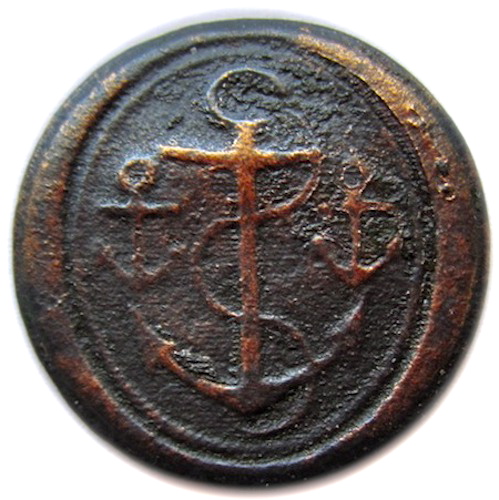
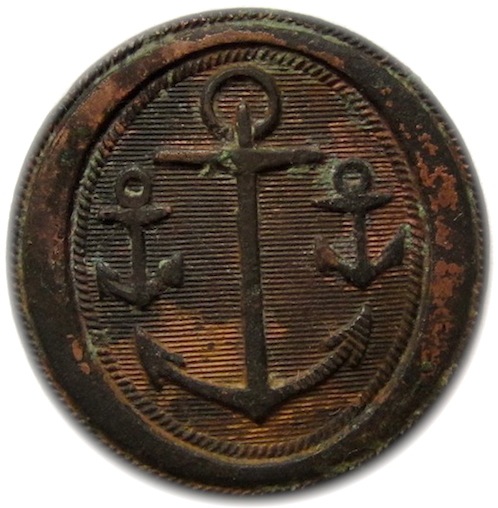
1805-07 ROYAL NAVY MASTER'S
CABLE PATTERN BUTTON
Color: A Two Tone Shoe Polish Brown.
Metal: Flat, 1-Piece, Raised Design, Gilt Brass.
Size: 21.64mm.
Variation: Large Upright Fouled Anchor / Barbed
Crown / Cable Dangling / Small Upright Anchor / Lined
Field / Oval Picture Frame Border
Present Condition: An Excavated Example, Good
Planchet Casting, Good/Strong High Relief Pattern.
Robert's Comments: This is a Royal Navy Masters
button that was briefly used from 1805-07. This short
lived button only had two die variants I know of. The
button's pattern depicts a
Large Upright Fouled Anchor
with a
Barbed Crown.
In this pattern, there is a
Cable Dangling
off the Center anchor's top ring on the left hand-side.
This goes under a horizontal stock and then wraps under
the shaft 2x. The cable then goes under the left fluke,
and ends in a fish hook under the crown's barb. Flanking
each side of the center anchor is a
Small Upright Anchor.
The anchor is depicted
on a
Lined Field
that is set within an
Oval Picture Frame Border.
There is a
Thin Decorative Rope Trim
on the inside and outside edge of the picture frame
border.
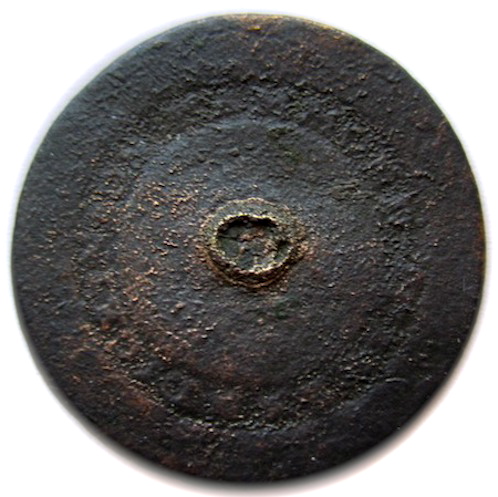
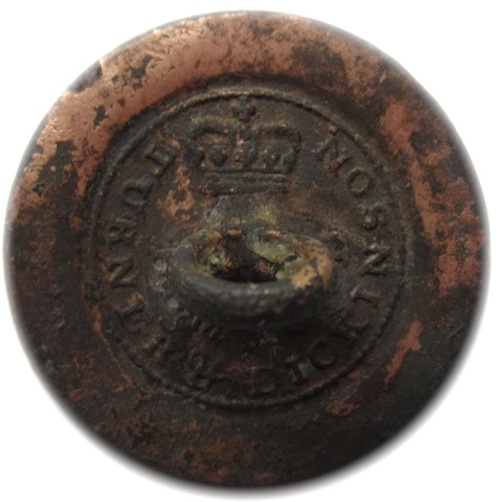
Reverse Button Analysis: This is a one-piece
button with a loop shank. The shank is unfortunately
missing. TURNER & DICKINSON HAMMOND . rmdc
Excavated in the Water at Fort Erie.~
The RJ
Silverstein Collection.
Collectors should note,
this pattern was replaced with a new pattern which
"did not have a Cable coming off the center anchor's top
ring." The 1807-25 pattern was used by the Master,
Assistant Master and also the Royal Navy Vol. GR from
1824-25. |
|
1807-25 ROYAL NAVY MASTER'S
& ASSIST. MASTERS BUTTON
Color: A Two Tone Shoe Polish Brown.
Metal: Flat, 1-Piece, Raised Design, Gilt Brass.
Size: 22.64mm.
Variation: Large Skinny Shaft Upright Anchor /
Barbed Crown / Small Upright Anchor / Lined Field / Oval
Picture Frame Border
Present Condition: An Excavated Example, Good
Planchet Casting, Strong High Relief Pattern.
Robert's Comments:
This pattern quickly replaced the original Master's
button, and was adopted by the Assistant Master, and RN
Vol. GR as well. We also know there were a few die
variants made by several manufacturers. Most patterns
only differentiated by the depiction of the anchors. The
button's pattern depicts a
Large Skinny Shaft Upright Anchor
with a
Barbed Crown.
Flanking each side of the center anchor is a
Small Upright Anchor.
All three anchors depict horizontal stocks. Only the
large center anchor has a lined fluke on the left. The
anchor is depicted
on a
Lined Field
that is set within an
Oval Picture Frame Border.
There is a
Thin Decorative Rope Trim
on the inside and outside edge of the picture frame
border.
Reverse Button Analysis: This is a one-piece
button with a loop shank. The shank is original,
straight, and intact. TURNER & DICKINSON Crown Motif.
The RJ
Silverstein Collection.
.jpg)
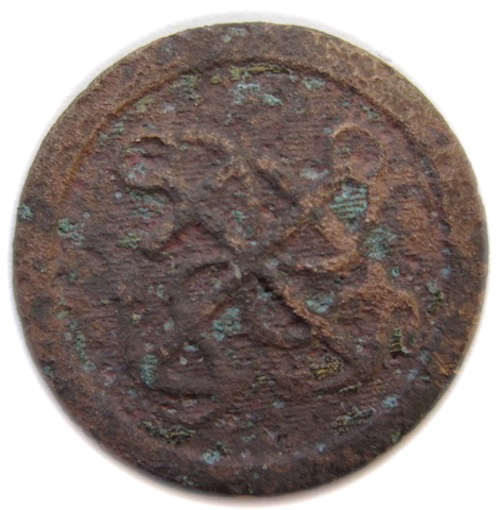
1807-12 ROYAL NAVY PURSER'S
BUTTON
Color: A Gilded Coppery Brown.
Metal: Flat, 1-Piece, Raised Design, Gilt Copper.
Size: 23mm.
Present Condition: An Excavated Example, Strong
Planchet Casting, Strong High Relief Pattern.
Variation: Two Slanted Fouled Anchors / Cross in
the Center / Cable / Raised Round Picture Frame Edge Border.
Robert's Comments: This is one of the harder
patterns to find in good condition. This button's pattern
depicts
Two Slanted Fouled Anchors
that Cross in the Center.
Both anchors depict a
Cable coming off the anchor's top ring
on the right hand-side. Each cable go around their
anchor's stock, and then under the shafts 2x. Both
cables then dangle
below their anchor's left fluke. The high relief pattern is set on a
lined field with a
Raised Round Picture Frame Edge Border.
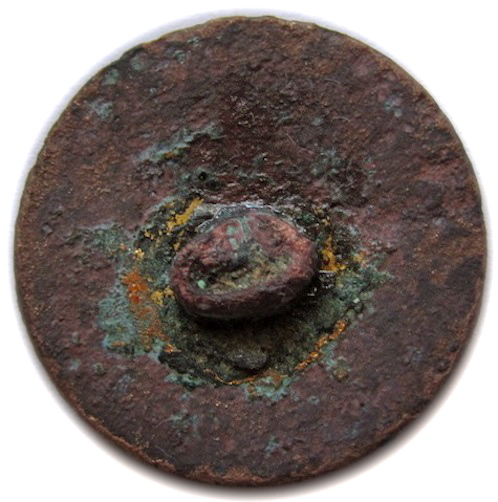
Reverse Button Analysis: This is a one-piece
button with a loop shank. The shank is
unfortunately bent, but is original and intact.
Found by Kingston, Ontario.~
|
|
1807-12 ROYAL NAVY PURSER'S
BUTTON
Color: A Rusty Brown.
Metal: Flat, 1-Piece, Raised Design, Gilt Copper.
Size: 22.05mm.
Rarity: R-5
Present Condition: An Excavated Example, Good
Planchet Casting, Good High Relief Pattern.
Variation: Two Slanted Fouled Anchors / Cross in
the Center / Cable / Raised Round Picture Frame Edge Border.
Robert's Comments: This button's pattern
depicts
Two Slanted Fouled Anchors
that Cross in the Center.
Both anchors depict a
Cable coming off the anchor's top ring
on the right hand-side. Each cable go around their
anchor's stock, and then under the shafts 2x. Both
cables then dangle
below their anchor's left fluke. The high relief pattern is set on a
lined field with a
Raised Round Picture Frame Edge Border.
Reverse Button Analysis: This is a one-piece
button with a loop shank. The shank is
unfortunately bent, but is original and intact.
Excavated in the Water at Fort Erie.~
The RJ
Silverstein Collection.
This pattern was later
replaced in 1812 with a variant that depicted a crown
above the cross-hatch.
|
Continental Navy &
French Marine Buttons
~ 1775-1815 ~
.JPG)
1775-90
Continental Navy or Marines Specimen
When the Continental Navy was
first established in America, there was no official regulations the
officers had to abide by for the buttons they chose to where on
their
uniforms. I would put it simply as, "Officer's Choice".
In colonial times when they ordered their uniforms from the garment
maker of clothier he chose the stylish buttons that would be placed
on the uniforms. Since was was practically non-existent in America,
high quality button choices for garments and uniforms would only be
available from the long established British and French manufactures.
Some of the early Continental Navy & Marine patterns were thought to be
ordered from France. There is some historical
documentation that in 1779, the Continental Navy did order both
plain gilded, and gilded anchor motif buttons from France. Some of
the crude patterns were known to be made by colonial artisans that
were copied from French manufactured patterns. We attribute most of these specimens to be
used by either the Continental Navy or Marines, as opposed to Rhode Island's
French troops and Marines. We also know in the early years it
was common place for a Continental officer to use the
same buttons on their dress, and undress clothing. In
the U.S. reference it was used to characterize the sailors or
Marines who were deployed ashore as an infantry unit. The unofficial
reference must of stuck throughout the years because a bluejacket
manual was officially put out by the United States Navy for it's
personnel.
Here is a little historical information:
The first official regulation of the Marine Committee in
Philadelphia, on September 5, 1776 (Headed by John
Hancock) prescribed for officers (Captains & Lieutenants
uniforms): Blue Cloth.. flat yellow buttons…
Later in the Manuscript papers of John Paul Jones which
is preserved in the Library of Congress, we find the
following original paper, which is endorsed,
"Uniform dress for the navy agreed
to at Boston by the major party of the Captains, March
1777"
- Full Dress for Post Captains - Dark Blue Coats… yellow
flat buttons, with the impression of the rattlesnake and
motto, "Don't Tread On Me" on each of them.
- Dress for Lieutenants - … instead of the rattlesnake,
they wear buttons with the impression of an anchor.
Albert's NA 1
is an incorrect example of a Continental Navy Post
Captain's button, it shows a Georgia Chatham Artillery
Button circa 1800's. As of date, non of these Captain's
dress Rattlesnake Don't Tread on me patterns have been
recovered.~
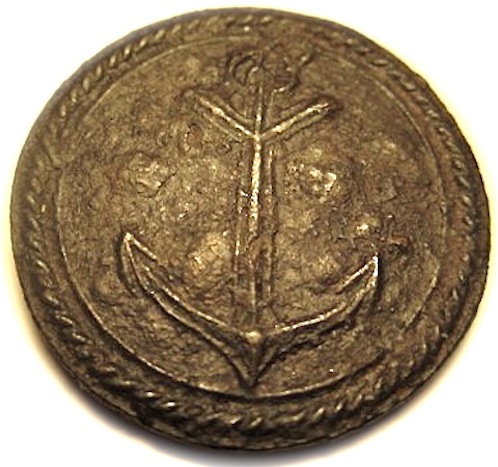 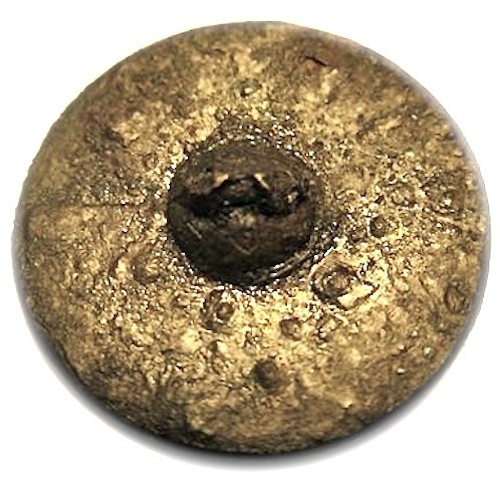
|
1775-90 CONTINENTAL NAVY AND
MARINES
Color: A Dark Pewter Grey.
Metal: 1-Piece, Slightly Convex, Raised Design,
Cast Pewter.
Size: 24mm.
Troiani: Similar
to ACNM.q.
(Example
Pictured in Book)
Variation:
Upright Beveled Anchor with a barbed Crown / Raised Concentric
Ring / Single Decorative Rope Edge Border.
Present Condition: An Excavated Example, Strong
Planchet, Strong High Relief.
Robert's Comments: We know at this time only
commissioned officers wore uniforms in the Navy and
Marines. We also know that most of the buttons used by
the Navy were imported from France, or their style was
copied. Many Navy and Marine buttons ascribed to the
Continental Navy are thought to be actually Rhode Island
Troops. There is no evidence that Anchor buttons can
irrefutably be associated with Marines, but there is
some descriptive historical mentioning's. So for
accuracy, I am going to say the button pictured above
was used by either officers in the Continental Navy or
Marines. The button's pattern depicts an
Upright Beveled Anchor with a
Barbed Crown. Circling
the anchor is a Raised Concentric
Ring. Outside of the
ring is a Single
Decorative Rope Edge Border which
has a beveled
down edge. The high relief pattern is set on a plain
slightly convex field with a beveled edge. Unfortunately, it is impossible to attach any
kind of exact date to the manufacturing of this
style pattern. We can only theorize it was made
anytime from 1775-1790, or even a little earlier.
Reverse Button Analysis: This is a one-piece
button with a boss and a loop shank. The loop shank is
original, but has decayed through on the top middle
portion. The boss portion is still strong. The surface
appears corroded and had a coarse bumpy texture.
This was excavated in Massachusetts.~
The Dale Collection.
*
Since there was no official regulation in the
Continental Navy or Marines on which manufacturer's
pattern an officers had to use, this leaves us uncertain
to patterns start or use dates. In the early years, an
officer purchased and used what ever they wished. |
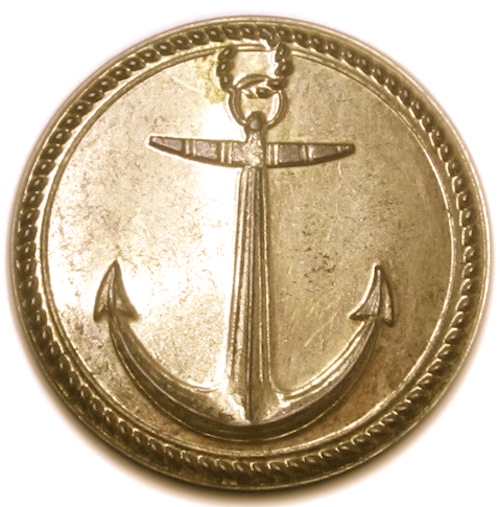 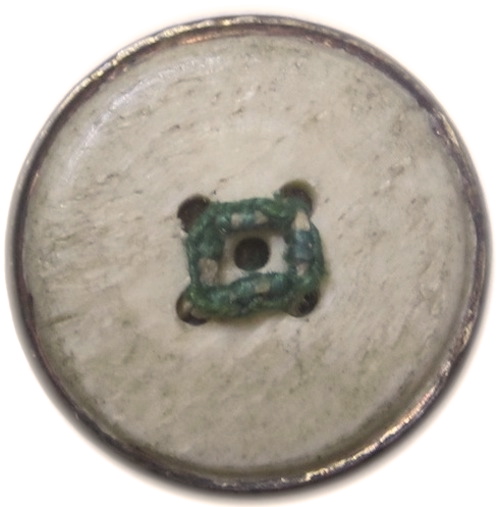
|
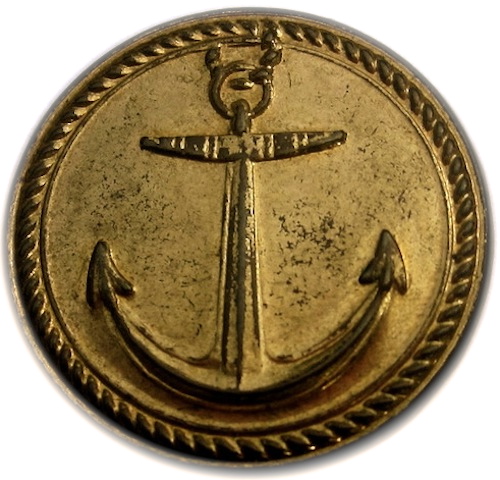
1775-1790's CONTINENTAL NAVY or RHODE ISLAND
TRAIN OF ARTILLERY OFFICERS BUTTON
Color: An
Antiqued Brass.
Metal:
2-Piece, Raised Design, Thin Sheet Brass or Gilt Copper Repousse.
Size: 26.20mm.
Coat Size
Albert's Number: Similar to RI 2-A (Albert's
Un-pictured)
Tice's Number: RI009 AM1
Present Condition: A Non Excavated Example, Exceptional Planchet
casting, Exceptional High Relief Pattern.
Variation: Large Upright Beveled Anchor /
Stock is Straight / Rope Circling Around the Button's
Edge
Robert's Comments: By
comparing similar examples, the pattern most likely
dates back as early as the mid 1770's. The only
thing I know for sure it is French Design. Possibly
first used by the French Colonial Officers, or by
Officers in the Rhode Island Train of Artillery. The
three important
identifying earmarks of this button is the shape of the
Crown, the Single Rope
Border, and lastly the Bone Back Construction. The bone back
gives us the evidence of it being an officer button,
most probably a coat button due to the size. The pattern gives us a date of
"around"
the Revolutionary
War. We do know that for sure similar styles with double
rope borders were used by Continental officers, and
Rhode Island troops. Fallou's
book shows this style was officially adapted by both the
American & French Naval Officers but does not
mention a beginning use date, just mentions it was
definitely in
use by 1790's-1800. Tice notes in his book that this
pattern was in use during colonial times in Rhode Island
for the Train of Artillery in the County of Providence.
He mentions the unit used this pattern when it went on to join the
Continental Army in Boston. The button's pattern depicts a
Large Upright Beveled Anchor
in the
center. The
Stock is Straight
with four sets of double lines. The shaft is narrow at
the stock and then gets increasingly wider toward the
crown. Encircling the anchor is a thinly raised concentric ring.
Just outside of the ring is a
Rope Circling Around the Button's Edge.
The outside edge of the button is slightly beveled with
a thin lip. The anchor's top ring has a rope joining the
circling rope. The high relief pattern is set on a
plain field with a beveled edge. This button was
purchased as a coat and cuff from a family in Rhode Island who's Great 3x
Grandfather served in the Continental Navy. So this is
an example of an American Officer choosing a French
Manufactured button to where on his uniform.
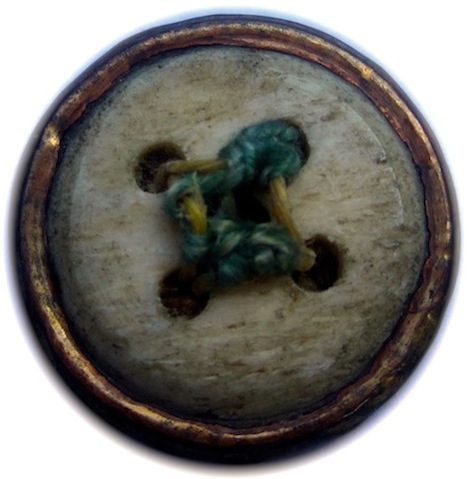
Reverse Button Analysis: This is
2-Piece button with a Bone Back. This would have used cat gut cord for the attachment.
Family Heirloom Provenance Rhode Island.
The RJ
Silverstein Collection.
|
|
1775-1790's CONTINENTAL NAVY or RHODE ISLAND
TRAIN OF ARTILLERY OFFICERS CUFF
Color: A
Marbled Spec Brass Yellow.
Metal:
2-Piece, Raised Design, Thin Sheet Brass or Gilt Copper Repousse.
Size: 18.25mm. Vest / Cuff Size
Albert's Number: Similar to RI 2-Av
Tice's Number: RI009 AM1
Present Condition: A Non Excavated Example, Exceptional Planchet
casting, Exceptional High Relief Pattern.
Variation: Large Upright Beveled Anchor /
Stock is Straight / Rope Circling Around the Button's
Edge
Robert's Comments: By
comparing similar examples, the pattern most likely
dates back as early as the mid 1770's. The only
thing I know for sure it is French Design. Possibly
first used by the French Colonial Officers, or by
Officers in the Rhode Island Train of Artillery. The
three important
identifying earmarks of this button is the shape of the
Crown, the Single Rope
Border, and lastly the Bone Back Construction. The bone back
gives us the evidence of it being an officer button,
most probably a coat button due to the size. The pattern gives us a date of
"around"
the Revolutionary
War. We do know that for sure similar styles with double
rope borders were used by Continental officers, and
Rhode Island troops. Fallou's
book shows this style was officially adapted by both the
American & French Naval Officers but does not
mention a beginning use date, just mentions it was
definitely in
use by 1790's-1800. Tice notes in his book that this
pattern was in use during colonial times in Rhode Island
for the Train of Artillery in the County of Providence.
He mentions the unit used this pattern when it went on to join the
Continental Army in Boston. The button's pattern depicts a
Large Upright Beveled Anchor
in the
center. The
Stock is Straight
with four sets of double lines. The shaft is narrow at
the stock and then gets increasingly wider toward the
crown. Encircling the anchor is a thinly raised concentric ring.
Just outside of the ring is a
Rope Circling Around the Button's Edge.
The outside edge of the button is slightly beveled with
a thin lip. The anchor's top ring has a rope joining the
circling rope. The high relief pattern is set on a
plain field with a beveled edge. This button was
purchased as a coat and cuff from a family in Rhode Island who's Great 3x
Grandfather served in the Continental Navy. So this is
an example of an American Officer choosing a French
Manufactured button to where on his uniform.
Reverse Button Analysis: This is
2-Piece button with a Bone Back. This would have used cat gut cord for the attachment.
Family Heirloom Provenance Rhode Island.
The RJ
Silverstein Collection.
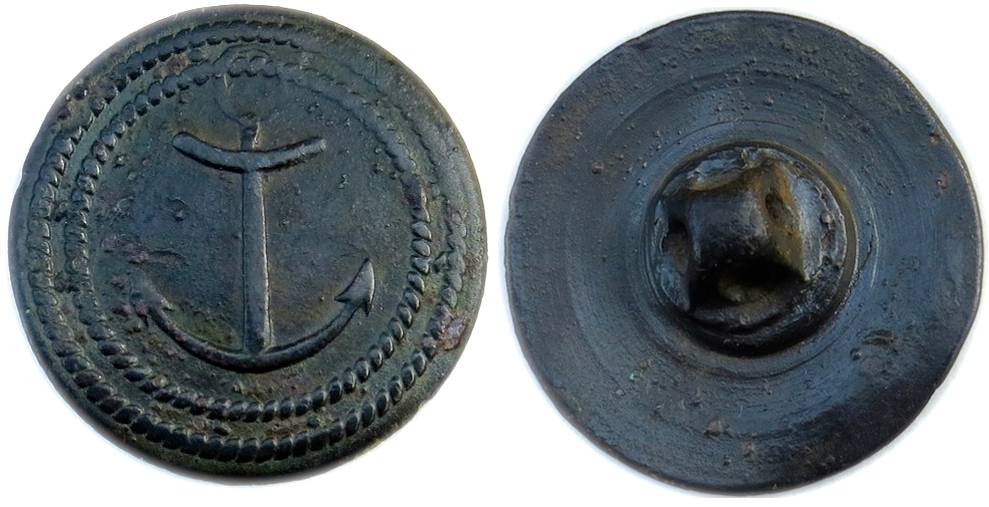
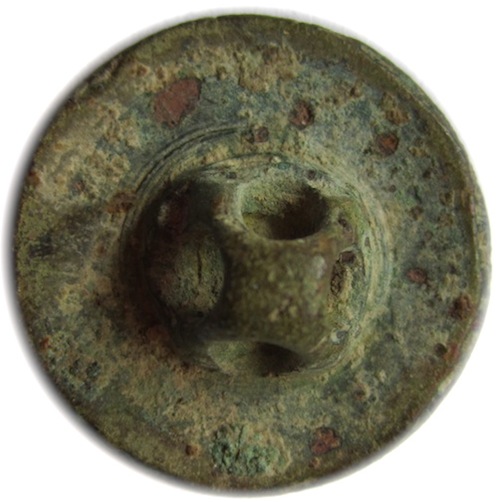
1780's to 1800's FRENCH OR AMERICAN OFFICER'S
COAT BUTTON
Color: Blackened Fish.
Metal: Flat, 1-Piece, Raised Design, White Metal?
Size: 27.66mm. Coat Size
Variation: Large Upright Anchor with a Rounded
Crown / Double Rope Decorative Border / Through the
Anchor's Top Ring /
Rope Bridge.
Present Condition: An Excavated Example, Strong
Planchet Casting, Strong High Relief.
Robert's Comments: This button's pattern
shows a French design, and was most likely manufactured
after the American Revolution somewhere between
1780-1820. We do know this exact pattern with a rounded
crown was manufactured in a Gilt Repousse button with
bone/wood back as early as the late 1770's.
The button's pattern depicts a
Large Upright Anchor with a
Rounded Crown. Circling
the anchor is a Double
Rope Decorative Border.
The inner rope border is
Through the Anchor's Top Ring.
On the compass East / West sides there is a
Rope Bridge
between the inner and outer rope borders. The high
relief pattern is set on a plain flat field.
Reverse Button Analysis: This is a Bird Cage
style shank. The shank is original and intact.
This was excavated in Upstate New York.~
Unconfirmed
The RJ
Silverstein Collection.
|
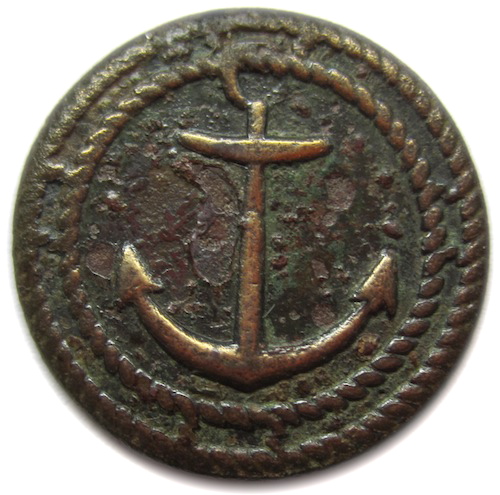
1770's to 1800's FRENCH COLONIAL
TROOPS &
MARINES
Color: A Coppery Brown with Algae Green.
Metal: Flat, 1-Piece, Raised Design, Brass or
Copper.
Size: 17mm. Cuff Size
Variation: Upright Anchor with a Slightly Barbed
Crown / Double Rope Decorative Border / Through the
Anchor's Top Ring /
Present Condition: An Excavated Example, Strong
Planchet Casting, Strong High Relief.
Robert's Comments: This is definitely a
French design, but I am not 100% positive that this would
have ever been used by colonial troops in America. Even
though the anchor is correctly barbed, the stock should
be slightly curved for Rev War Years 1775-83. If this
button was made in America (using a French design), the
pattern would have been impressed, and
the shank would be of a totally
different construction. I see some these buttons with
the birds cage shanks are being mis-labeled and sold as
American Navy or colonial troop buttons out of Rhode
Island, so I am listing this button to illustrate the
difference so people aren't duped. The specimen would
have been the small size
enlisted man's pattern, and most likely belongs to
the late 18th Century. The button's pattern depicts an
Upright Anchor with a Slightly
Barbed Crown. Circling
the anchor is a Double
Rope Decorative Border.
The inner rope border is
Through the Anchor's Top Ring.
On the compass N, E, S, and W there is a Rope Bridge
between the inner and outer rope borders. The high
relief pattern is set on a plain flat field.
Reverse Button Analysis: This is a Bird Cage
style shank. The shank is original and intact.
This was excavated in Canada.~
The RJ
Silverstein Collection.
Isabela's Notes: All French
Colonial Troops wore blue coats while serving in
America. Infantry units used white metal buttons, and
Artillery units used yellow metal buttons, but all
buttons were stamped with an Anchor.~
We know from the mid-18th Century
forward, this anchor pattern has become the standard
when
identifying the French Colonial Troops & Marines of
Rhode Island. At the time, this was the Ministere de la
Marine - the Department of the Navy-. The troupes de la
Marine was a separate little army that originated out of
the French Metropolitan Army.
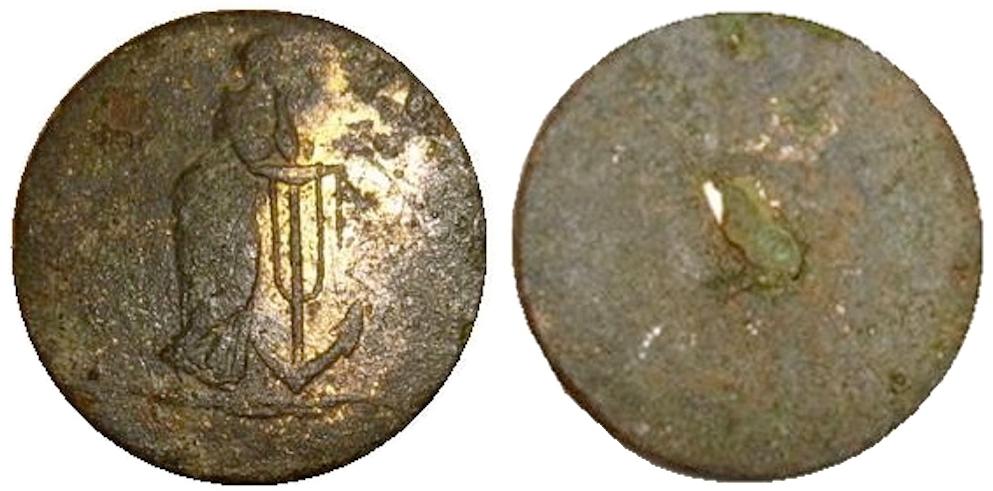
1790's AMERICAN LIBERTY TREE
OF JUSTICE NAVY SEA COAT BUTTON
Color: A
Rusted Metal with Patches of Gilt.
Metal:
Flat, 1-Piece, Impressed Design, Gilt Brass.
Size:
24mm. Sea Coat Size
Variation: Lady Liberty Resting on top of a Large
Upright Anchor / Facing Left / Long Flowing Gown / Liberty Cap on Her
Head.
Present Condition: An Excavated Example,
Strong Planchet Casting. Strong Impressions.
Isabela's Notes:
I was able to date this rare Navy button from other published
memorabilia that carries the same motif. The button's
manufacturing is still questionable though. I believe it is
American made, but could be French. The button's
pattern depicts the
Lady Liberty Resting on top of a Large Upright Anchor
that is
resting on the ground. She is facing left, and her hand appears to be
under her chin as if she was in compilation of an idea
or thought.
She is wearing a
Long Flowing Gown
with possibly a
Liberty Cap/Crown on Her Head.
The pattern is struck on a plain flat round planchet.
Reverse Button Analysis: This is a
one piece casting for the reverse
shank. The Shank is broken off.
|
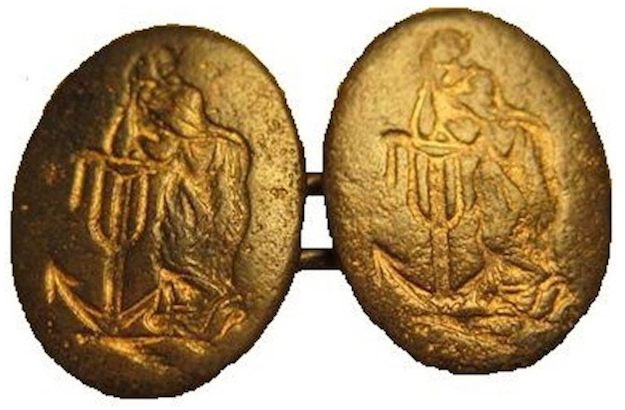
1790's AMERICAN LIBERTY TREE
OF JUSTICE NAVY BUTTON
Color: A
Chestnut Brown Patina.
Metal:
Flat, 1-Piece, Impressed Design, Gilt Brass.
Size:
15mm. Cuff Size
Variation: Lady Liberty Resting on top of a Large
Upright Anchor / Facing Right / Long Flowing Gown / Liberty Cap on Her
Head.
Present Condition: An Excavated Example,
Strong Planchet Casting. Strong Impressions.
Isabela's Notes:
This is a rare Navy cuff button that most likely has
it's origins in Connecticut. I
was able to date this rare Navy button from other published
memorabilia that carries the same motif. The button's
manufacturing is still questionable though. I believe it is
American made, but could be French. The button's
pattern depicts the
Lady Liberty Resting on top of a Large Upright Anchor
that is
resting on the ground. She is
Facing Right,
and her hand appears to be
under her chin as if she was in compilation of an idea
or thought.
She is wearing a
Long Flowing Gown
with possibly a
Liberty Cap/Crown on Her Head. The pattern is impressed in a plain flat oval planchet.
Reverse Button Analysis: This is a
one piece casting for the reverse
shank. The Shank is original, straight, and intact.
The Dale Collection.
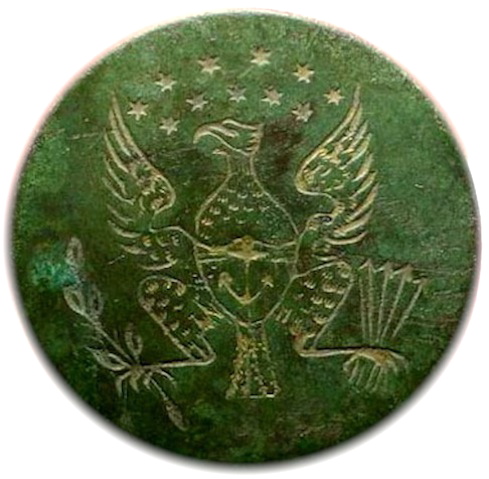 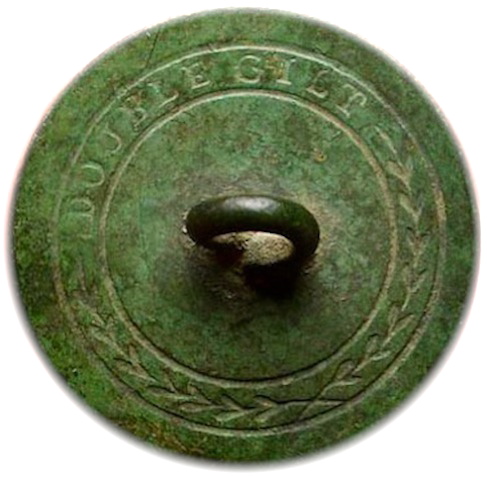
Late 1788-1800 AMERICAN NAVY BUTTON
Color: A Sea Foam Green Patina.
Metal:
Flat, 1-Piece, Impressed Design, Poss. Gilt Brass.
Size: 20mm.
Coat Size
Variation: Modern Style Eagle /
Upraised Wings /
Small Upright Anchor Roundish Crown /
Bundle of Five Arrows /
Long Stem Olive Branch.
Present Condition: An Excavated Example, Excellent Planchet Casting. Strong Impressions.
Isabela's Notes: This is a very unusual early 19th Century American Navy Button, or possibly
just a custom made for a retired military officer.
From the back mark it appears English made, but not 100%
since it is an American design and made so crudely.
Could this have been a Proto-Type? The button's pattern
depicts a
Modern Style Eagle
with
Upraised Wings
looking to the right. On the eagle's chest is a
Small Upright Anchor with A
Roundish Crown. In the
eagle's left talon is a
Bundle of Five Arrows.
In the eagle's right talon is a
Long Stem Olive Branch with Five Petals.
Above the eagle's head is a field of
Eleven Six-Pointed Stars.
The impressed pattern is struck on a plain flat field.
Reverse Button Analysis: This is a One Piece Casting for the Reverse Shank. The Shank is original, straight, and intact.
Excavated in Maryland.~
|
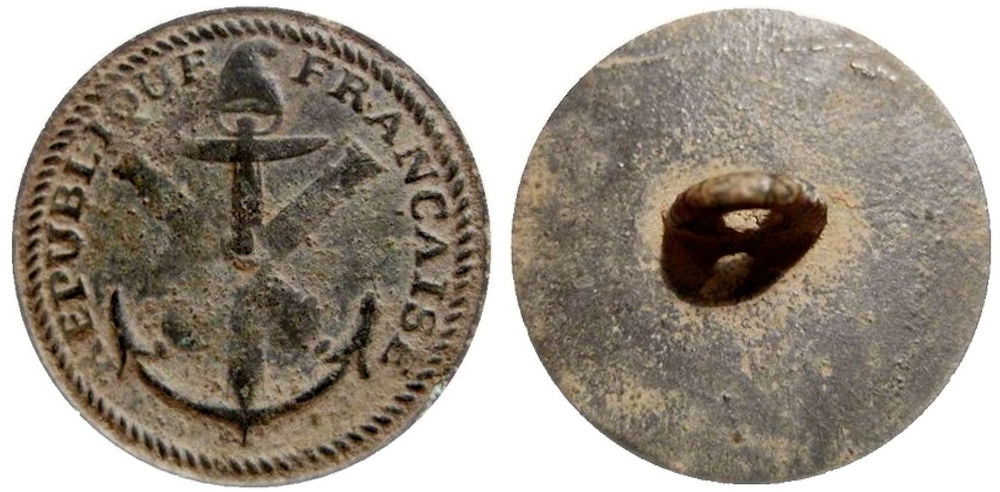
|
1795-1803 French Marine
Artillery
Color: A Rusty Orange-Brown.
Metal: Flat, 1-Piece, Raised Design, Brass.
Size: 24mm. Coat Size
Variation: Cross Cannons / Liberty Night Cap
Present Condition: An Excavated Example,
Good/Strong Planchet, Strong High Relief Pattern.
Robert's Comments: This button was excavated as a
coat and cuff pair in the low country of South Carolina
in 2009. This is a real mystery on how it would have
ended up there. This is one of my favorite French
Republic Marine buttons. The button's pattern depicts a
large fouled anchor with a pointed barb and skinny
stylish flukes. There is a liberty night cap motif
(Liberty Never Rests) rests on top of the anchor's top
ring. The anchor sites in the cross hatch of two crossed
cannons. Encompassing the anchor is France's new
salutation, "Republique Francaise", which is written in
capital letters. The outside edge border has a circling
rope pattern with a thin exterior flat edge lip. The
high relief pattern is set on a plain flat field. This
button's pattern has wonderful symbolism for a fighting
marine unit.
Reverse Button Analysis: This is flat one-piece
button with a loop shank. The shank is broken off, but
part of the boss remains.
Excavated By Bill Cross in
South Carolina 2009.~
The Bill Cross Collection. |
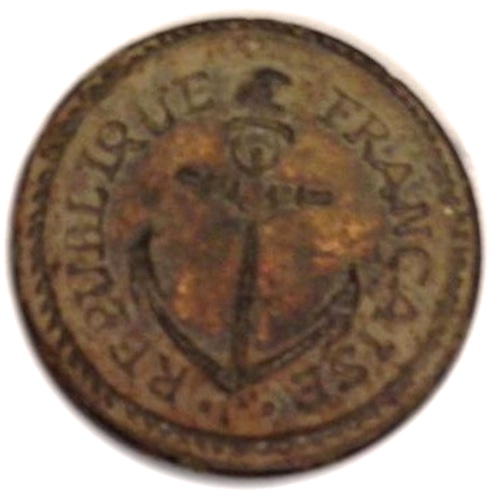 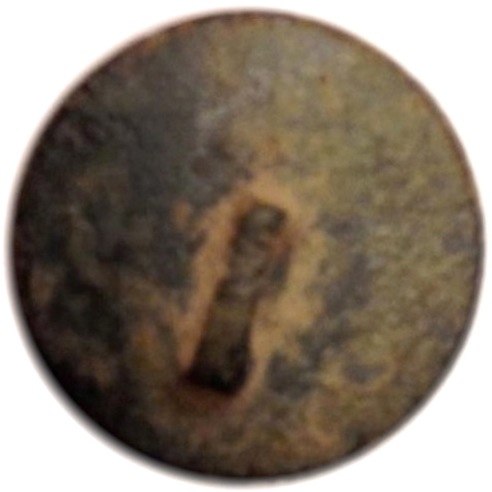
|
1795-1803 French Marine Artillery
Color: A Rusty Orange-Brown.
Metal: Flat, 1-Piece, Raised Design, Brass.
Size: 17mm. Cuff Size
Variation: Cross Cannons / Liberty Night Cap
Present Condition: An Excavated Example,
Good/Strong Planchet, Strong High Relief Pattern.
Robert's Comments: This button was excavated as a
coat and cuff pair in the low country of South Carolina
in 2009. This is a real mystery on how it would have
ended up there. This pattern is one of my favorite
French Republic Navy / Marine buttons. The button's
pattern is slightly different then the coats. It depicts
a foul anchor with a straight stock, and pointed barb on
the crown. There is a liberty night cap motif (Liberty
Never Rests) rests on top of the anchor's top ring.
Encompassing the anchor is France's new salutation, "Republique
Francaise", which is written in capital letters. The
outside edge border has a circling rope pattern with a
thin exterior flat edge lip. The high relief pattern is
set on a plain flat field.
Reverse Button Analysis: This is flat one-piece
button with a loop shank. The shank is intact, but
crushed.
Dug By Bill Cross in South Carolina 2009.~
The Bill Cross Collection.
|
|
~ Early 19th Century American Naval Buttons ~
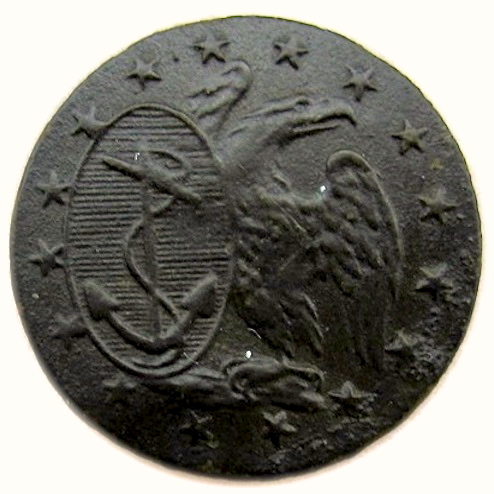
1802-1810 Sixteen Star U.S. Navy
By the early 1800's,
America's Navy was already sailing the
around the world protecting it's citizen's interests for
international commerce. Officer's Copper Repousse
buttons with Bone or Wood backs were being slowly replaced
by a more durable brass button. These new flat
brass one-piece constructed buttons were primarily used
up until the early 1830's,
then a two-piece button started to debut. This new style
button came with a change in construction, and offered
a convex obverse, and a more detailed design using
raised high relief patterns. This new construction prevailed
throughout the manufacturing industry, and lasted into the 20th century.
We do know of some early pioneering two-piece
Navy buttons in the late 1820's,
but it wasn't until the 1830's to 1850's when
the pattern was widely accepted, and used throughout the Navy.
As you will see in the specimens below, several
different American and English manufacturers produced their own
depiction for the eagle & star design; but most of these were short
lived, and then replaced with the newest design.
Robert's Notes: The term,
"Fouled Anchor" is usually applied to the state the
anchor is in or pictured. The term is usually used when
the anchor is hooked on some impediment on the ground,
or has it's cable, rope, or chain wound around the stock
or flukes. |
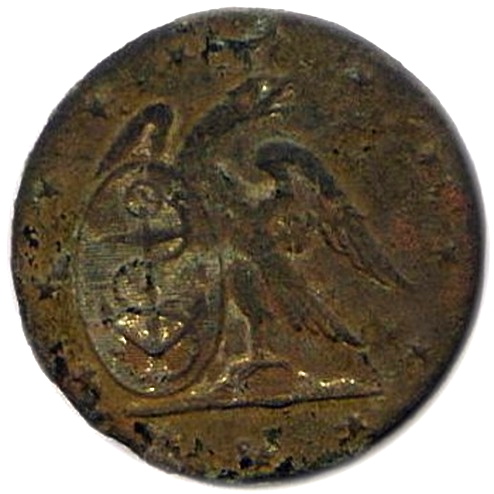
|
1798 to 1810 US Navy Button
Color: An Ochre of Browns and Greens.
Metal: 1-Piece, Raised Design, Gilt Brass.
Size: 23mm. Coat Size
Albert's Number: NA 6-A: RV 35-50
Variation: Large Vertical Oval Shield / Large
Thin Fouled Anchor / Lined Field / Stock is Straight /
Crown is Barbed /13 Five-Pointed
Stars
Present Condition: An Excavated Example, Fair
Planchet Casting, Fair High Relief Pattern.
Isabela's Notes: There are five known die
variants for this pattern in the coat size, and one for
the cuff size.
All depict 13 five-pointed stars, but vary in the
depiction of the eagle, anchor, and shield. This button's pattern depicts a standing eagle with
up-raised wings facing left. There is a
Large
Vertical Oval Shield
that has a
Large Thin Fouled Anchor
on a
Lined Field.
The anchor's
Stock is Straight
and the
Crown is Barbed. The
cable comes off the anchor's top ring on the left
hand-side. The cable goes under the stock, and then loops over the
shaft 2x, and then goes over the left fluke and ends in a
fish hook below the crown. Circling around the eagle on
the button's edge is
13 Five-Pointed Stars. The high relief
pattern is set on a plain flat field.
Reverse Button Analysis: This is a flat one-piece button
with a loop shank. The shank is original, straight, and
intact. CARIN & C / TREBLE GILT rm. |
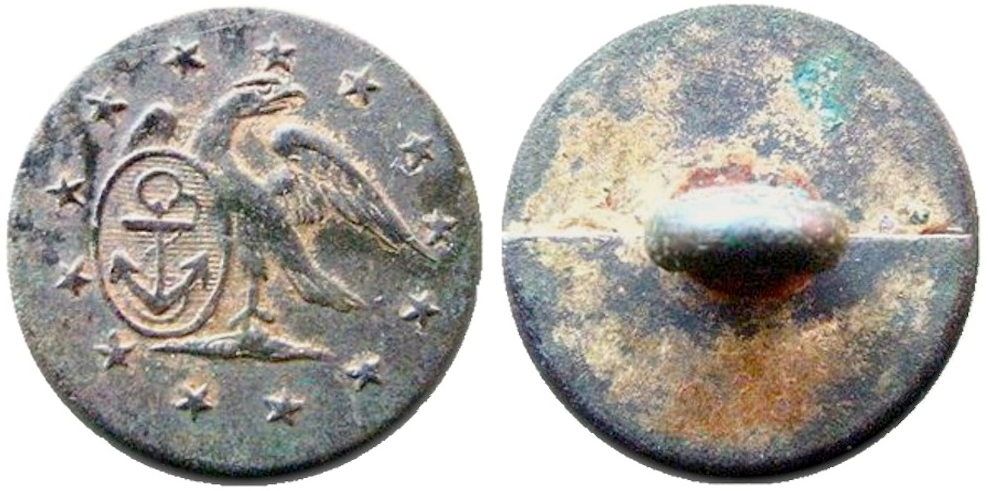
|
1798 to 1810 US Navy Button
Color: Rusty Brown With Hints of Green
Metal: Flat, 1-Piece, Raised Design, Brass.
Size: 15mm. Cuff Size
Albert's Number: NA 6-Bv: Unlisted Size Variant
RV 35-50
Variation: Small Oval Vertical Shield / Shield's
Lined Field / Straight Stock / Barbed Crown / Large Top
Ring / 13
Five-Pointed Stars.
Present Condition: An Excavated Example, Strong
Planchet Casting, Strong High Relief Pattern.
Isabela's Notes: This is the second known die
variant for this pattern. The button's pattern depicts an
eagle with upraised wings standing on a mound facing left.
Covering over the eagle's
right wing is a
Small Oval Vertical Shield
with a raised outline. Depicted on the
Shield's Lined Field
is a
Small Fouled Anchor
with a
Straight Stock
and a slightly
Barbed Crown.
There is a cable coming off the anchor's
Large Top Ring
on the left hand-side. The cable wraps under the
anchor's stock, and then goes under the shaft 2x, and then
wraps under the crown in a fish hook. Circling around
the eagle is
13 Five-Pointed Stars. The high relief
pattern is set on a plain flat field with no raised edge
border. Collector's note at least four variations to the
NA 6 series.
Reverse Button Analysis: This is a flat one-piece
button with a loop shank. The shank is original,
straight, and intact. No back mark, mold line present.
|
 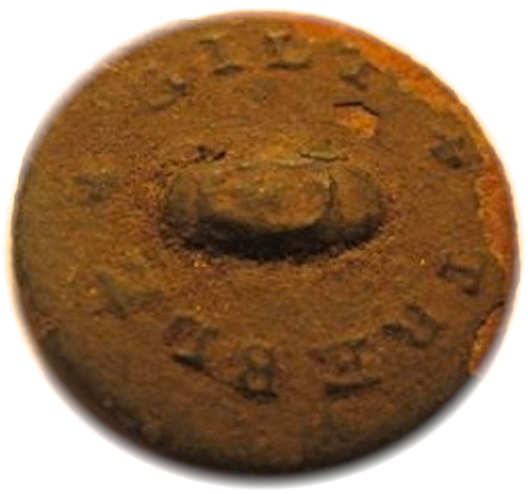
1798 to 1810 US Navy Button
Color: Rusty Orange.
Metal:
1-Piece, Raised Design, Gilt Brass.
Size: 22mm.
Coat Size
Albert's Number: NA
6-C: RV 35-50
Variation: Small Oval Vertical Shield / Shield's
Lined Field / Straight Thick Stock / Larger
V-Shaped Crown / Large Top Ring / 13
Five-Pointed Stars
Present Condition: An
Excavated Example, Fair Planchet Casting, Fair
High Relief Pattern.
Isabela's Notes: This
early Navy button was made by English
manufacturers for Naval Officers. This would be the
third known die variant for this pattern.
In this variation the anchor is depicted with a
V-Shape Crown and the stock is slightly thicker. The button's pattern depicts an
eagle with upraised wings standing on a mound while facing left.
Covering over the eagle's
right wing is a
Small Oval Vertical Shield.
Depicted on the
Shield's Lined Field
is a fouled anchor with a
Straight Thick Stock
and a
Larger V-Shaped Crown.
There is a cable coming off the anchor's
top ring on the left hand-side. The cable wraps under the
anchor's stock, and then goes under the shaft 2x, and then
wraps under the crown in a fish hook. Circling around
the eagle is
13 Five-Pointed Stars.
The high relief pattern is set on a plain flat
field with no raised edge border.
Reverse Button Analysis: This
is a flat one-piece button with a loop shank.
The boss is still present, but the shank is
missing. TREBLE *GILT*
The Dale Collection.
|
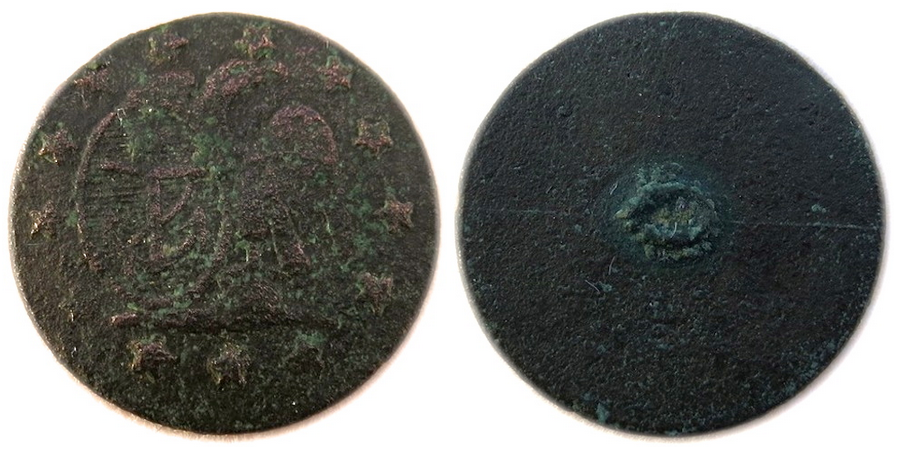
1798 to 1810 US Navy Button
Color: Coppery Brown with Green
Encrustations.
Metal: 1-Piece, Raised Design, Gilt Brass.
Size: 19.39mm. Coat Size
Albert's Number: NA 6-D: RV 50
Variation: Large Oval Shield/ Anchor's
Slanted Stock /13 Five-Pointed Stars
Present Condition: An Excavated Example, Good
Planchet Casting, Good High Relief Pattern.
Isabela's Notes: This is the fourth known
pattern for this button. Early Naval button
collectors who specialize usually favor this variant
because it is the only one that depicts a slanted
stock. Also, this is the only button in the series
in which the rope doesn't loop around the shaft
twice.
The button's pattern depicts an
eagle with upraised wings standing on a mound while facing left.
Covering over the eagle's
right wing is a
Vertical Oval Shield.
Depicted on the
Shield's Lined Field
is a fouled anchor with a
Slanted Stock
and a
Rounded
Crown.
There is a cable coming off the anchor's
top ring on the left hand-side. The cable goes over the
anchor's stock, then under the shaft once, then goes
over right fluke, and then
ends touching the shield's edge below the crown. Circling around
the eagle is
13 Five-Pointed Stars.
The high relief pattern is set on a plain flat field
with no raised edge border. Un-dug specimens are
un-herd of, and dug specimens are rarely offered.
Reverse Button Analysis: This is a flat
one-piece button with a loop shank. The shank is
crushed inward, and decayed.
The RJ Silverstein Collection.
|
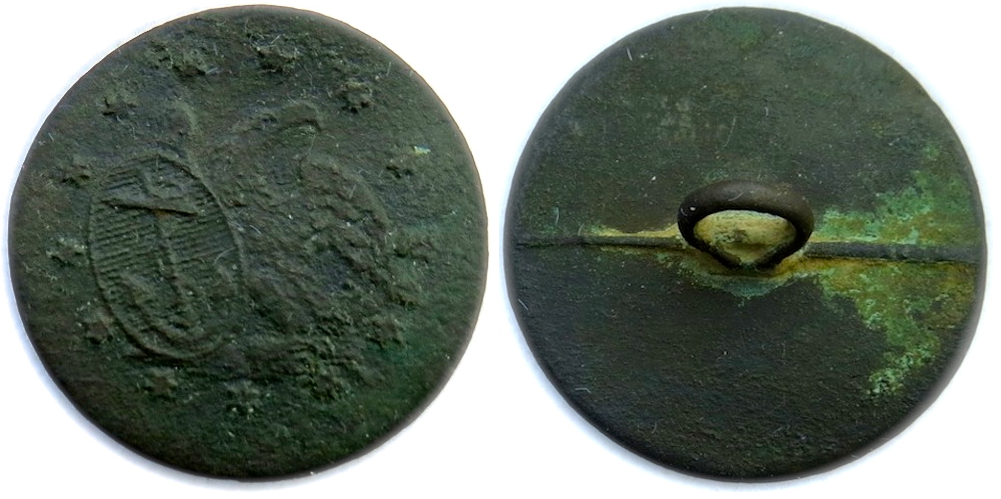
1798 to 1810 US Navy Button
Color: Seaweed Green.
Metal: Flat, 1-Piece, Raised Design, Brass.
Size: 24.31mm. Coat Size
Albert's Number: NA 7-A.1:
RV 50
Variation: Large Slanted Oval Shield /
Thin Fouled Anchor / Anchor's Slanted Stock /
Thin Shaft /Slightly Barbed Crown / 13 Six-Point Stars
Present Condition: An Excavated Example, Good
Planchet Casting, Good High Relief Pattern.
Isabela's Notes: This is another rare
collector's favorite for early American Navy buttons
that depicts 13 stars. This Pattern was made by
Wishart in New York. Buttons could either have a
blank back mark, or show Wishart N. York rm. The button's pattern depicts an
eagle standing on a mound facing left. Covering over
the eagle's right wing is a
Large Slanted Oval Shield.
Depicted on
the shield is a
Large Thin Fouled Anchor
with a
Slightly Barbed Crown
that is set on a lined field. There is a cable
coming off the anchor's top ring on the left
hand-side. The cable wraps under the
Anchor's Slanted
Stock, then over and under
a
Thin Shaft, and then
hangs under the left fluke. Circling around the
eagle is 13 Six-Point Stars. The high relief pattern
is set on a plain flat field with no raised edge
border. Collector's should obtain any specimen
that becomes available. Un dug
examples and specimens with shanks are extremely rare.
Reverse Button Analysis: This is a flat
one-piece button with a loop shank. The shank is
original, straight, and intact. No back mark, mold
line present.
1 of 3 Dug by Muddy Spider on Saint Simons Island,
Georgia in 2009.
The RJ Silverstein Collection.
|
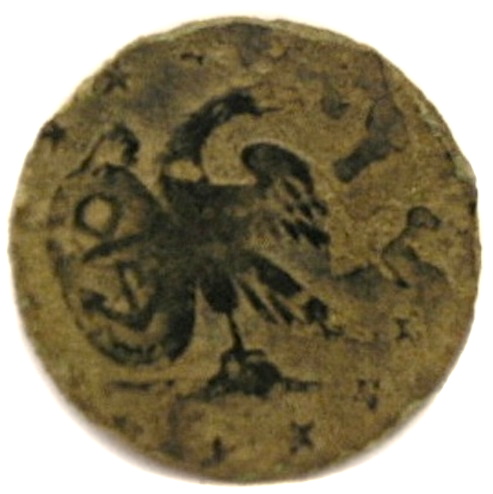 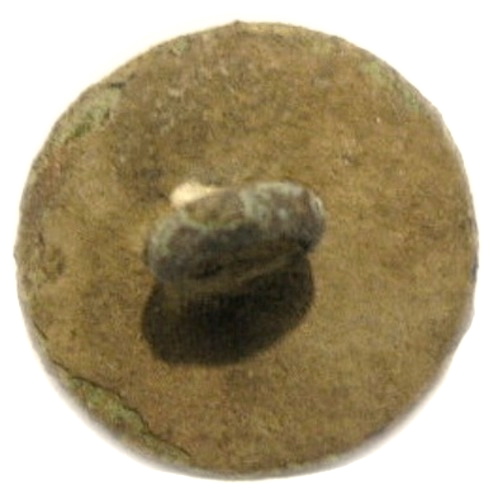
1802 to 1810 US Navy Button
Color: Dusty Brown.
Metal:
1-Piece, Slightly Convex, Raised Design, Pewter.
Size: 25mm.
Coat Size
Albert's Number: Unlisted
Variant - Similar to NA 8.1: RV 35-50
Variation: Slanted Oval
Shield/ 15 Five-Pointed Stars
Present Condition: An
Excavated Example, Fair Planchet Casting,
Fair High Relief Pattern.
Isabela's Notes: This Navy button would
be very similar to Albert's NA 8, but has
minor differences in the Anchor/Rope design.
We know that by 1802, the Navy prescribed a
radical change in the uniforms, and added
two more stars, making it a
15 star arrangement. So
that gives us the earliest date the button
could have been used (previously
ordered buttons only had 13 stars encircling
the eagle). The button's pattern depicts a
standing eagle facing left, with a Slanted Oval
Shield covering
over it's right wing. There is a small
raised anchor design depicted on a plain field. There
is a dangling rope coming off the anchor's
top ring on the right hand-side. The rope
wraps under the Anchor's stock, and then
over and under the shaft, and then ends in a
fish hook below the anchor's crown.
Encircling the eagle is 15
Five-Pointed Stars around
the button's edge. The whole pattern is in
high relief on a plain slightly convex field with no edge
border.
Reverse Button Analysis: This
is a flat one-piece button with a loop
shank. The shank is original, straight, and
intact. No backmark.
|
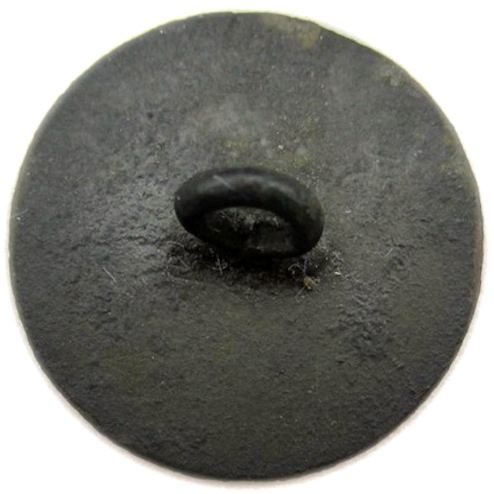
1802 to 1810 US Navy Button
Color: Ocean Green.
Metal:
1-Piece, Raised Design, Brass.
Size: 19.93mm. Coat
Size
Albert's Number: NA
9 RV 40
Variation: Large
Oval Shield / Large Raised Anchor Slanted
Stock / 16 Six-Pointed Stars
Present Condition: An
Excavated Example, Strong Planchet Casting,
Exceptional High Relief Pattern.
Isabela's Notes: This
collector's favorite would be another one of
the earliest patterns ordered, and issued by
the Navy. Most likely used before, and after
the War of 1812. The button's pattern depicts a
standing eagle facing left, with a Large
Oval Shield covering over
it's right wing. There is a
Large Raised
Anchor motif with a Slanted Stock on a lined
field. There is a dangling rope coming off
the anchor's top shaft on the left
hand-side. The rope wraps around the
anchor's stock repeatedly, and then ends in
a fish hook below the anchor's crown.
Encircling the eagle is 16
Six-Pointed Stars on
the button's edge. Even thought this pattern
probably wasn't manufactured after 1810, it
still was most likely used until a new
replacement uniform was ordered with the
newer style buttons.
Reverse Button Analysis: This
is a flat one-piece button with a loop
shank. The shank is original, straight, and
intact. No backmark.
Excavated by J.B.
at Fernadina, Beach Florida.~
The RJ Silverstein Collection.
|
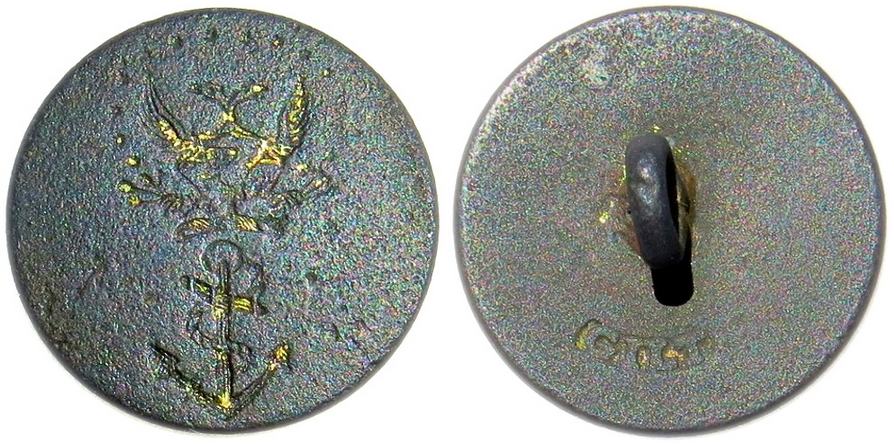
|
1802-1808 South Carolina Navy
Color: A Chocolate Brown With Gold Pattern
Highlights.
Metal: Flat, 1-Piece, Raised Design, Gilt
Brass.
Size: 22.45mm. Coat Size
Albert's: NA 10-B (Page 491) Isabela's RV
200
Variation: Two Headed Spread Eagle / Upright Fouled
Anchor /
Semi Circle of 15
Six-Pointed Asterisk Type Stars
Present Condition: An Excavated Specimen,
Strong Planchet, Strong Impressions.
Robert's Comments: We know in the early
years that South Carolina formed their own Navy to
patrol the
Charleston Harbor. This particular die variant with the two headed
eagle could have been produced as early as the first
variant (the pattern with the single headed eagle
Albert's NA 10-A's)
in
1802. The button's pattern depicts a
Two Headed
Spread-Eagle above an
Upright Fouled Anchor. On the
eagle's chest is a small federal type shield. In the
eagle's left talon is a small bundle of
Three Arrows
Pointing Upwards. In the right talon is a
Small Laurel or Olive Branch.
The anchor's top ring has a rope
or chain coming off the left hand-side, and then goes
under a slanted stock, and then over and under
the shaft, and then hangs over the right fluke.
Surrounding the eagle's is a
Semi Circle of 15
Six-Pointed Asterisk Type Stars.
Since this is a gilt
brass button, I would resume it was intended
for officers. I also don't believe they were produced in any large
quantities, most likely a very limited issue for a small
Navy. To my
knowledge, this is probably the Best Specimen
known to exist. There is also a matching cuff button,
but Ultra Rare with only 4 to5 known to exist.
Reverse Button Analysis: This is flat one-piece
button with a loop shank. The shank is original,
straight, and
intact.
Dug Near Charleston, South Carolina.~
The RJ Silverstein Collection.
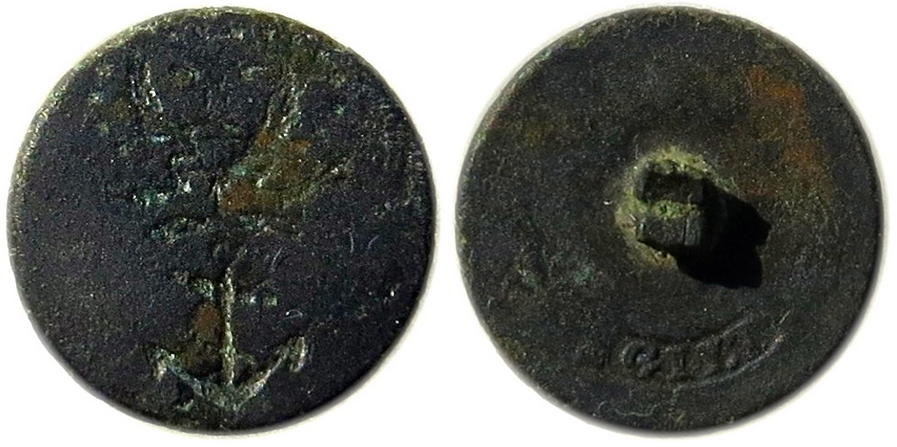
1802-1808 South Carolina Navy
Color: A Deep Brown With Green Speckles.
Metal: Flat, 1-Piece, Raised Design, Gilt
Brass.
Size: 14.56mm. Cuff Size
Albert's: NA 10-Bv (Page 491) Unlisted
Size Variant Isabela's RV
250
Variation: Two Headed Spread Eagle / Upright Fouled
Anchor /
Semi Circle of 15
Six-Pointed Asterisk Type Stars
Present Condition: An Excavated Specimen,
Good/Strong Planchet, Good Impression.
Robert's Comments: We know in the early
years that South Carolina formed their own Navy to
patrol the
Charleston Harbor. This particular die variant with the two headed
eagle could have been produced as early as the first
1802; the same time frame as the pattern with the single headed eagle (Albert's NA
10-A's). The button's pattern depicts a
Two Headed
Spread-Eagle above an
Upright Fouled Anchor. On the
eagle's chest is a small federal type shield. In the
eagle's left talon is a small bundle of
Three Arrows
Pointing Upwards. In the right talon is a
Small Laurel or Olive Branch.
The anchor's top ring has a rope
or chain coming off the left hand-side, and then goes
under a slanted stock, and then over and under
the shaft, and then hangs over the right fluke.
Surrounding the eagle's is a
Semi Circle of 15
Six-Pointed Asterisk Type Stars.
Since this is a gilt
brass button, my belief is that it was intended for
officers. I also believe these would have been made in
half the quantity of the coat issue, most likely a very limited issue. This cuff
is Ultra Rare and I believe only 4 or 5 known specimens exist.
Collectors should seek any specimen available. These
cuff specimens should probably be in a Charleston, S.C.
museum for prosperity.
Reverse Button Analysis: This is flat one-piece
button with a loop shank. The shank is unfortunately
missing.
Dug Near Charleston, South Carolina.~
The RJ Silverstein Collection.
|
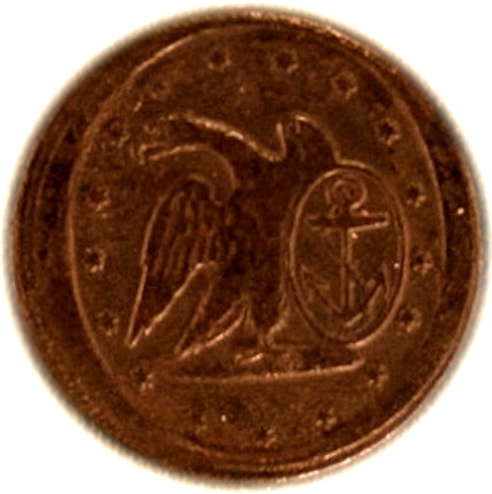 
1810 to 1830's US Navy Button
Color: Tarnished Brown.
Metal:
1-Piece, Raised Design, Gilt Brass.
Size: 23mm.
Coat Size
Albert's Number: Unlisted
Variant / Appears to fall between NA
25-31: RV ?
Variation: Large
Oval Vertical Shield
/ 17 Six-Pointed Stars
Present Condition: An
Excavated Example, Good Planchet Casting,
Good High Relief Pattern.
Isabela's Notes: This Navy
button is
an unknown/unlisted variant that was manufactured in
Boston in the early 19th century. I believe
this unusual pattern falls somewhere between
Albert's missing patterns NA 25-31. The
button's pattern depicts a standing eagle
facing right. Under it's left wing is a
Large Oval Vertical Shield. There is a large
raised anchor motif on the shield's stippled
field. There is a rope coming off the right
hand-side of the anchor's top ring, which
goes over the stock, shaft and fluke, and
ends in a fish hook under the anchor's
crown. Encompassing the eagle, there is 17
six-pointed stars. It is hard to tell
from the poor quality photo, but the high
relief pattern is most likely set on a lined
field with a wide oval border and roped edge. Could
be a transitional type specimen from eagle
resting on a slanted anchor to standing
eagle with shield under it's wing.
Reverse Button Analysis: This
is a one-piece button with a loop shank.
This is a replaced shank, but is straight,
and intact. ????? BOSTON rm.
The William
Leigh Collection.
|
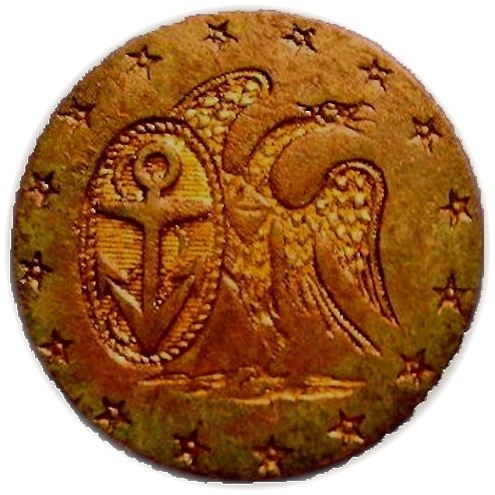
|
1810 to 1830's US Navy Button
Color: A Golden-Brown with Green Undertones.
Metal: Impressed, 1-Piece, Impressed Design, Cast
Brass.
Size: 23mm.
Albert's Number: Similar to NA
32 Series Unlisted Variant - : RV 50
Variation: Large Thick Raised Anchor / Unique
Rope Border/ 16 Five-Pointed Stars
Present Condition: An Excavated Example, Good
Planchet Casting, Strong Impressed Pattern.
Isabela's Notes: This Navy button would be very
similar to Albert's NA 32 series, but minor differences
in the number of stars and eagle's pattern. Albert NA 32
gives examples of 14 & 15 stars, but none 16. So a
specimen might not have been available, or dug during
his time. The button's pattern depicts an old style
eagle standing with a "Goose Neck" facing left. There is
a large oval shield over it's right wing. Within is a
Large Thick Raised Anchor
set on a lined field. There is
a relaxed rope coming off the anchor's top ring on the
right hand-side. The rope wraps under the Anchor's stock
diagonally, and then under the lower shaft and right
fluke and ends in a short fish hook below. As a
decorative border, there is an inside
Unique Rope Border
that encompasses the large anchor. Encircling the eagle is
16 Five-Pointed
Stars
that go around the button's edge. The impressed pattern is
set on a plain flat field with no edge.
Reverse Button Analysis: This is a flat one-piece
button with a loop shank. The shank is original,
straight, and intact. No back mark. |
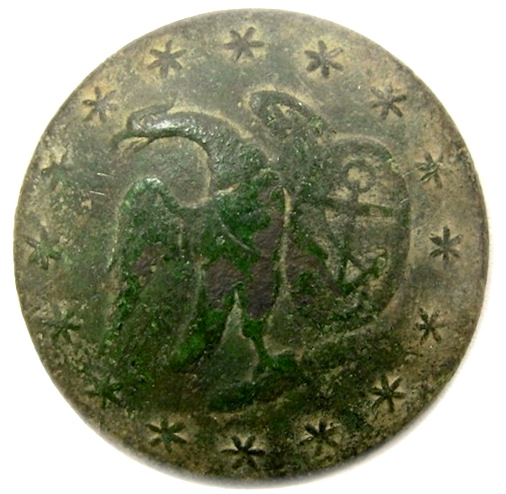 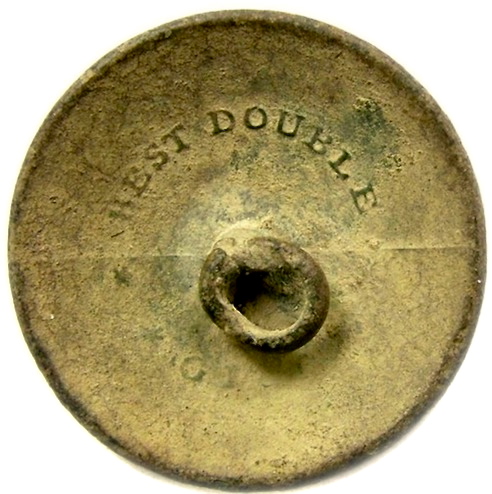
1810 to 1830's US Navy Officer's Button
Color: Seaweed Green with Dusty Brown.
Metal: Slightly
Convex, 1-Piece, Raised Design, Gilt Brass.
Size: 24.7mm.
Coat Size
Albert's Number: NA
36-A: RV 50
Variation: Federal
Shield on Breast/ 16 Six-Pointed
Asterisk Type Stars
Present Condition: An
Excavated Example, Good Planchet Casting,
Good High Relief Pattern.
Isabela's Notes: This is an interesting
series in which the eagle has a patriotic
federal shield on it's breast. Most likely
an English manufactured button. The button's pattern
depicts a standing eagle facing right, with a Federal
Shield on it's Breast.
There is another large oval shield that is
slanted under the eagle's left wing. On the
shield there is a raised anchor motif on a
lined field. There is a rope coming off the
anchor's top ring on the right hand-side,
and goes under the stock, over the shaft,
and then under the left fluke, and ends in a
fish hook under the crown. There are 16
Six Pointed Asterisk Type Stars encircling
the periphery.
The high relief button is set on a plain
slightly convex field with no
distinguishable edge.
Reverse Button Analysis: This
is a one-piece button with a loop shank. The
shank is original and intact, but bent over.
BEST DOUBLE *GILT*
Picture
Courteous of Harry Ridgeway
|
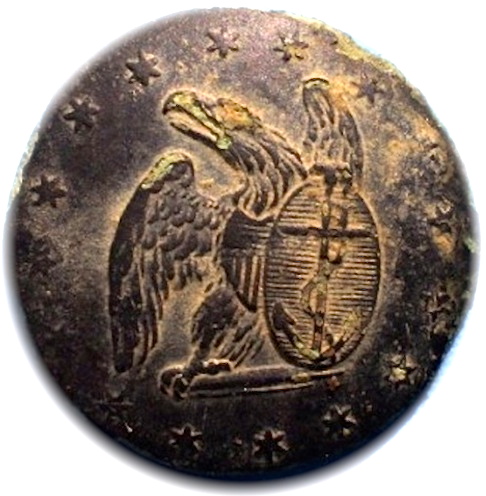 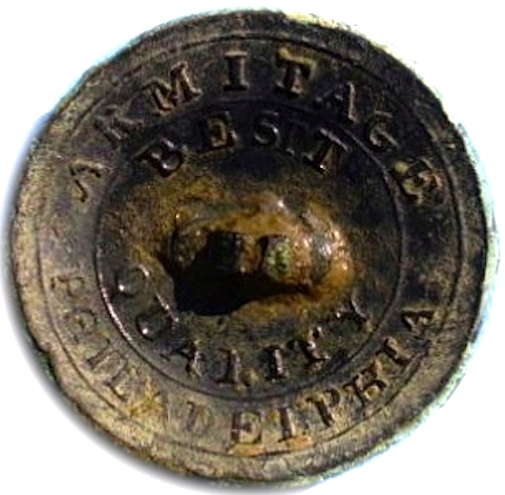
|
1810 to 1820's US Navy Button
Color: Brown with Spots of Orange Oxidation.
Metal:
1-Piece, Slightly Convex Brass.
Size: 21mm.
Coat Size
Variation:
16 Six-Pointed Stars / Elongated Oval Shield
Albert's Number: NA 38:
RV 40
Present Condition: An Excavated Example, Good Planchet Casting, Strong High Relief.
Isabela's Notes: This Navy button's
pattern
depicts a standing eagle facing right, with a federal shield on it's breast.
There is another Elongated
Oval Shield under the
eagle's left wing with a large raised anchor pattern on a lined
field. There is a rope or chain coming off the top ring
of the anchor on the left hand side. Encompassing the
eagle is 16 Raised Six-Pointed
Stars encircling the periphery. George Armitage produced
these buttons in the early 1800's.
The high relief button is set on a plain slightly convex
field with no distinguishable edge. The Best Quality back mark on the reverse dates around 1810.
Reverse Button Analysis:
This is a one-piece button with a loop shank. The original shank is broken off. ARMITAGE PHILADELPHIA/BEST QUALITY 2 rings
Excavated in
Bergen County, NJ.~ |
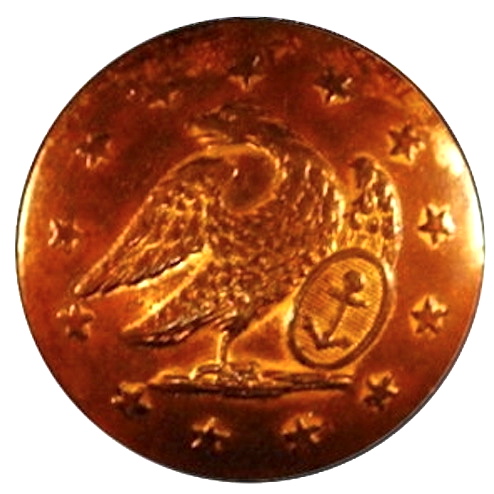 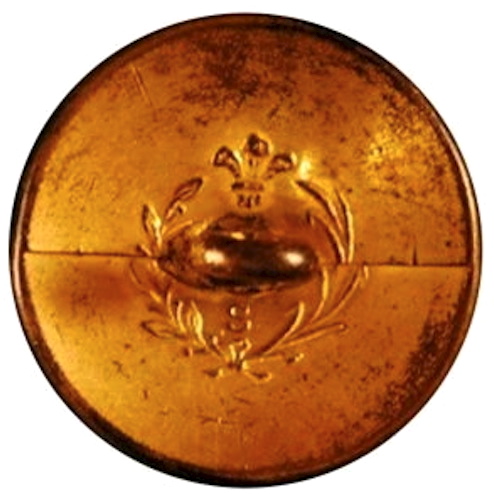
|
1810 to 1830's US Navy Officer's Button
Color: Tarnished Brass.
Metal: 1-Piece, Slightly Convex, Raised Design,
Gilt Brass.
Size: 23mm. Coat Size
Albert's Number: NA 41 RV 15
Variation: Small Slanted Oval Shape Shield / Plain Anchor / 13
Five-Pointed Stars
Present Condition: An Excavated Example, Strong
Planchet Casting, Strong High Relief Pattern.
Isabela's Notes: This is another example of
an early US Navy
pattern. The button's pattern depicts a standing eagle
with upraised wings facing right. In this die variant
there is a
Small Slanted Oval Shape Shield, with
the depiction of a
Plain Anchor
on a lined field. Encompassing the eagle is
13 Five-Pointed Stars
around the button's edge.
The high relief button is set on a plain slightly convex
field with no distinguishable edge.
Reverse Button Analysis: This is a slightly
concave one-piece button with a loop shank. The shank is
original, straight, and intact. THREE FEATHERS /WREATH /
S rm. |
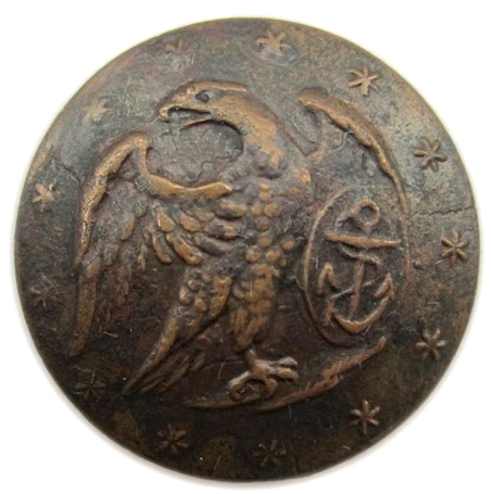 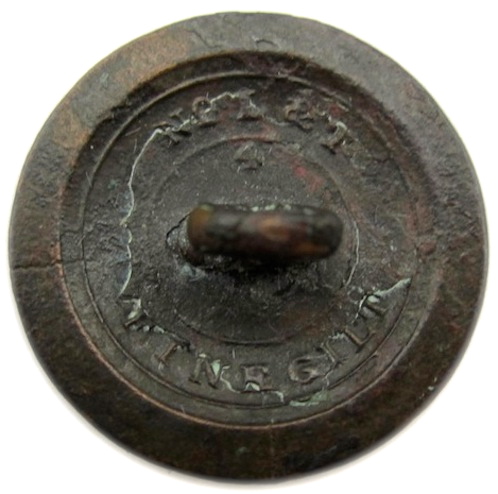
1810 to 1830's US Navy Officer's Button
Color: Light Two Tone Brown.
Metal: Slightly
Convex, 1-Piece, Raised Design, Gilt
Brass.
Size: 22.94mm.
Coat Size
Albert's Number: NA
44-A:
RV 15
Variation: Small Slanted
Raised Shield/ 13 Six-Pointed Asterisk Type
Stars / Outstretched Wing.
Present Condition: An
Excavated Example, Strong Planchet Casting,
Strong High Relief Pattern.
Isabela's Notes: This style Navy
button could
have been manufactured as early as 1810, but
the back mark on this particular specimen
dates to the early 1820's. Lewis & Tomes was
an English maker who operated a partnership
in America from 1819 through the 1830's.
There are three manufacturer die variants
for this particular pattern. This variant
depicts a standing eagle facing right, with a Small Slanted
Raised Shield under
it's Outstretched
Wing.
There is a small raised foul anchor depicted on the
shield's stippled field. There is a rope
coming off the right hand-side of the
anchor's top ring, which goes under the
stock, then over and under the shaft, and
ends below the anchor's crown on the right
hand side. Encompassing the eagle, there
are 13
Six-Pointed Asterisk Type Stars that
circle around the button's edge. The
high relief button is set on a plain
slightly convex field with no
distinguishable edge. Un-dug
specimens for this pattern are extremely
rare, collectors should seek dug ones with a
clear image of the breast feathers.
Reverse Button Analysis: This
is a one-piece button with a loop shank. The
original shank is original, straight, and
intact. No L & T FINE GILT in 2 dm ring.
Dug by J. Baldwin near Fort Conde,
Mobile Alabama.~
The RJ Silverstein Collection.
Robert's
Notes: Edward Lewis was a London England
Manufacturer, and formed a partnership with
Francis Tomes who operated in New York City
in 1819. Tomes then went on and operated
under several various names and made a
variety of military goods throughout the
Civil War.
|
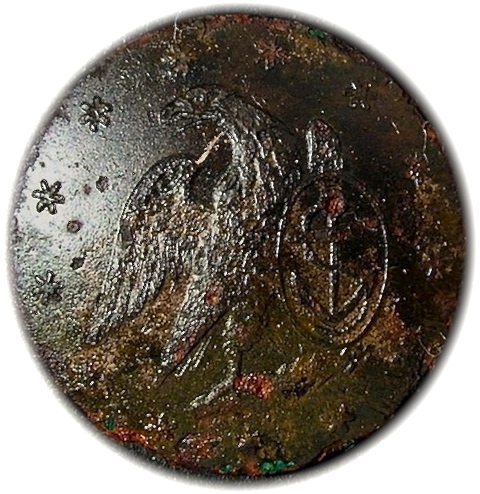 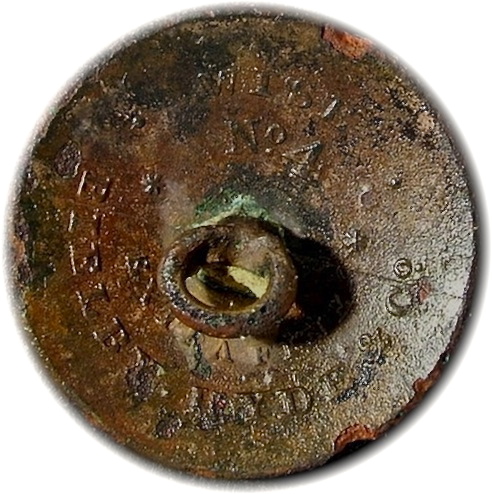
1810-30 US Navy Button
Color: Gold with Sea Weed Green.
Metal: Slightly
Convex, 1-Piece, Raised Design, Gilt
Brass.
Size: 22.4mm.
Coat Size
Albert's Number: NA
44-C: RV 15
Variation: Vertical
Shield /
Close
to the Body
/ 13
Six-Pointed Asterisk Type Stars
Present Condition: An
Excavated Example, Strong Planchet
Casting, Strong High Relief Pattern.
Isabela's Notes: This is another die
variant from an English manufacturer
that was in business from 1818-25. This
button's pattern depicts a standing
eagle facing right that has a more Vertical Oval
Shield over
it's left wing. In this die variant, the
eagle's left wing is small and Close
to the Body.
There is a raised foul anchor motif on
the shield's stippled field. In this
variant, the dangling rope comes of the
anchor's top ring on the right side, and
then goes under the stock, then over the
shaft, then under the fluke and ends in
a fish hook tail halfway under the
anchor's crown. Encompassing the eagle,
there is 13
Six-Pointed Asterisk Type Stars circling
around the edge's periphery. The
high relief pattern is set on a plain
slightly convex field with no
distinguishable edge. Un-dug
specimens are extremely rare, collectors
should seek dug ones with a good portion
of the breast feathers retained.
Reverse Button Analysis: This
is a one-piece button with a loop shank.
The original shank is original and
intact, but slightly bent over. WISE
BIELBY & Co No 4 *EXTRA FINE *
Dug in
Boonsboro, Maryland.~
The Harry Ridgeway Collection.
|
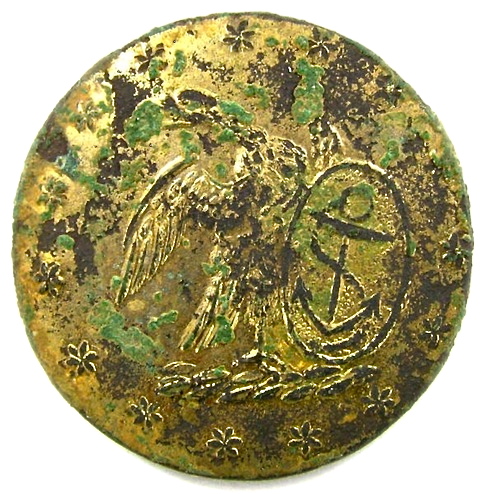 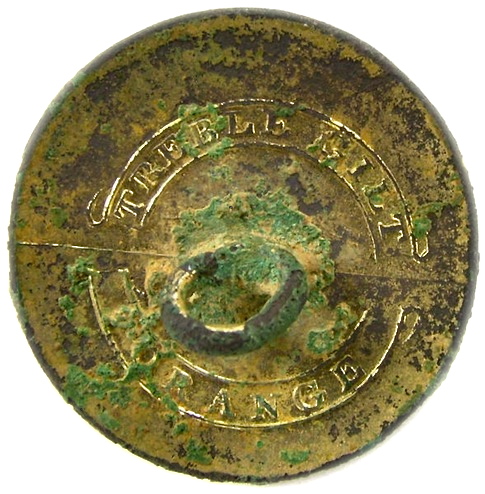
|
1802 to 1830's US Navy Button
Color: A
Golden Brown With Green Encrustations.
Metal: Slightly
Convex, 1-Piece, Raised Design, Gilt Brass.
Size: 23.6mm.
Coat Size
Albert's Number: NA
52 RV
50
Variation: Large Stippled
Shield /
Large
Raised Anchor Motif / 15
Six-Point Asterisk Type Stars.
Present Condition: An Excavated Example, Strong
Planchet Casting, Good/Strong High Relief Pattern.
Isabela's Notes: This gilded brass Navy button
was intended for officers, and produced by an
English manufacturer. This is an unlisted die
variant for Albert's NA 54, but could as well be a
variant for NA 57. The button's pattern depicts a
standing eagle facing right, with a Large
Slightly Slanted Oval Shield under
it's left wing. Within the shield, there is a Large
Raised Anchor Motif
set on a
stippled field. In this variant, the dangling rope comes of
the anchor's top ring on the right side, and then
goes under the stock, then over the shaft, then
under the fluke, and ends in a fish hook tail
halfway under the anchor's crown. Encompassing the
eagle, there are 15
Six-Point Asterisk Type Stars encircling
the eagle around the button's edge. This high relief
pattern is set on a plain convex field. The back mark
indicates 1820's manufacture (Treble 52).
Reverse Button
Analysis: The
is a one-piece button with a loop shank. The shank
is original and intact, but slightly bent. TREBLE
GILT. ORANGE within a 2 rm ribbons.
Dug in Shepherdstown, Virginia by Brian Irving.
Old Courthouse Museum.~
|
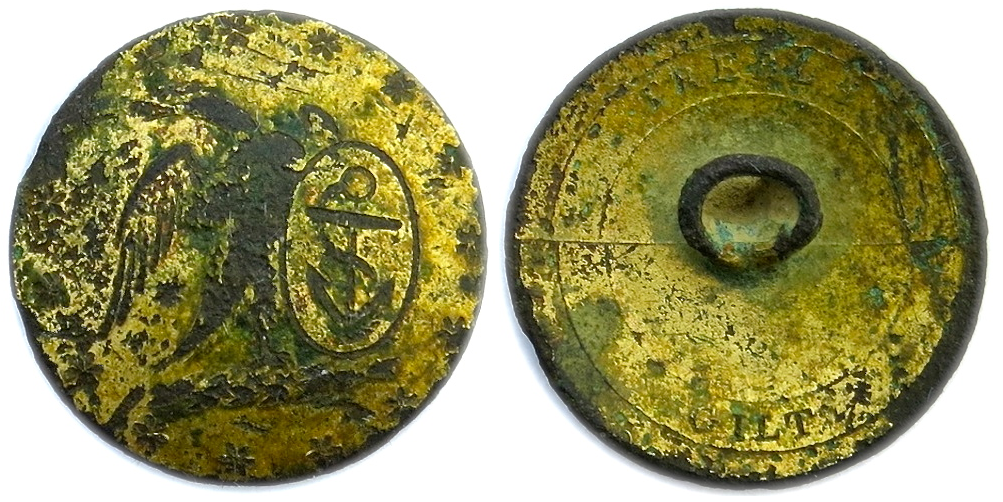
1810 to 1830's US Navy Button
Color: A Golden Brown
Metal: 1-Piece, Slightly Convex, Raised Design,
Gilt Brass.
Size: 23.6mm. Coat Size
Albert's Number: NA 52-Unlisted Back Mark Variant
RV 50
Variation: Large Stippled Shield / Large Raised
Anchor Motif / 15 Six-Point Asterisk Type Stars.
Present Condition: An Excavated Example, Good
Planchet Casting, Good High Relief Pattern.
Isabela's Notes: This is another die variant for
NA 52 that shows a slightly more thicker fluke and
crown. This most likely was intended for officers, and
is also produced by an English manufacturer. The
button's pattern depicts a standing eagle facing right,
with a Large Slightly Slanted Oval Shield over it's left
wing. Within the shield, there is a Large Raised Anchor
Motif that is set on a stippled field. In this variant,
the rope comes of the anchor's top ring on the right
side, and then goes under the stock, and then over the
shaft, and then under the left fluke. The rope and ends
in a fish hook halfway under the anchor's crown.
Circling around the eagle is 15 Six-Point Asterisk Type
Stars. This high relief pattern is set on a slightly
convex plain field. The back mark indicates 1820's
manufacture.
Reverse Button Analysis: The is a one-piece
button with a loop shank. The shank is original and
intact, but bent over. TREBLE GILT in a 2 ring rm
channel.
2 of 3 Dug by Muddy Spider on Saint Simons Island,
Georgia in late 2009.
The RJ Silverstein Collection.
\ |
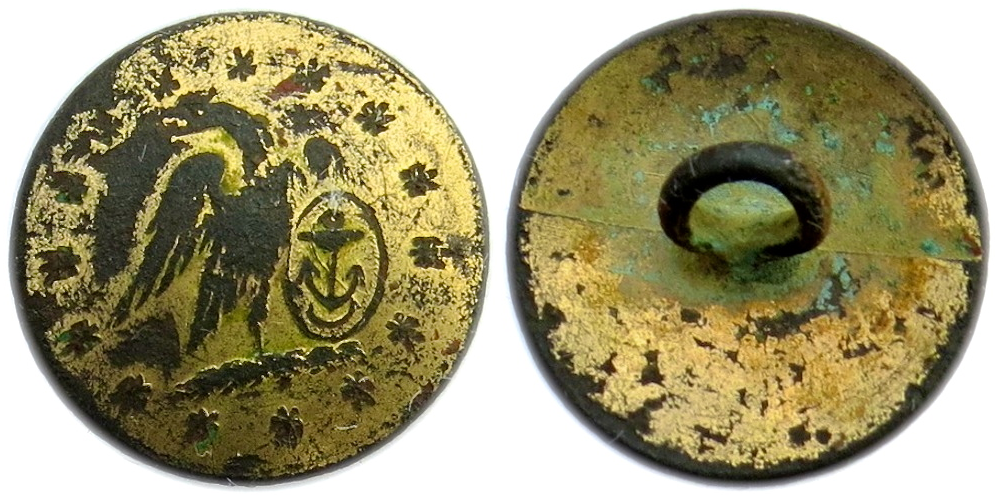
1810 to 1830's US Navy Button
Color: A Pale Yellow Brown
Metal: 1-Piece, Slightly Convex, Raised Design,
Gilt Brass.
Size: 14.84mm. Cuff Size
Albert's Number: Similar to NA 52-Unlisted Size
Variant
RV 100
Variation: Small Shield / Small Raised Anchor
Motif / 15 Six-Point Asterisk Type Stars.
Present Condition: An Excavated Example, Good
Planchet Casting, Good High Relief Pattern.
Isabela's Notes: This is an unlisted size variant
in Albert's book. The pattern and star count match
Albert's NA slightly convex example. This cuff button
was most likely intended for officers. The asterisk type
stars points to English manufacture, but not 100%
certain. The button's pattern depicts a standing eagle
facing right, with a Small Slightly Slanted Oval Shield
over it's left wing. Within the shield, there is a Small
Raised Anchor Motif on a plain field. In this variant,
the rope comes of the anchor's top ring on the right
side, and then goes under the stock, and then over the
shaft, and then under the left fluke. The rope and ends
in a fish hook under the anchor's crown. Circling around
the eagle is 15 Six-Point Asterisk Type Stars. This high
relief pattern is set on a slightly convex plain field.
Reverse Button Analysis: The is a one-piece
button with a loop shank. The shank is original,
straight, and intact. No back mark.
3 of 3 Dug by Muddy Spider on Saint Simons Island,
Georgia in late 2009.
The RJ Silverstein Collection. |
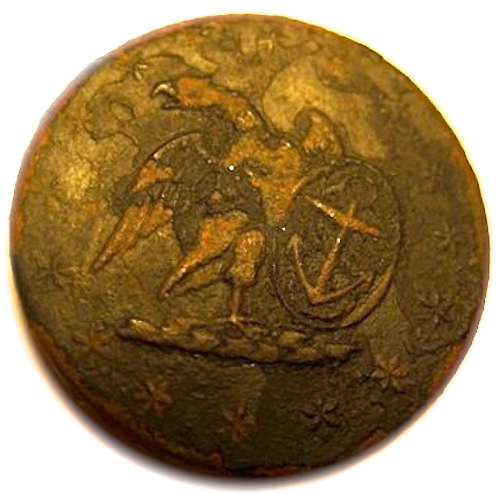 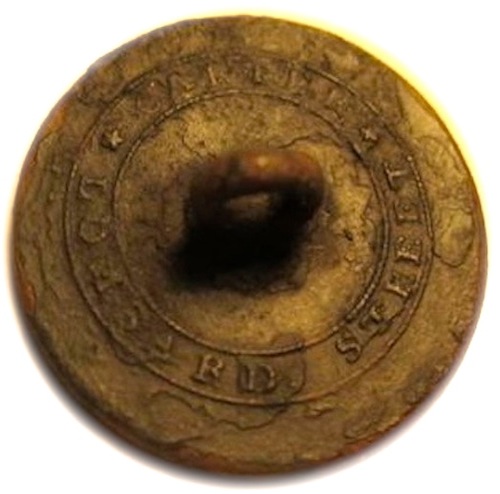
1802 US Navy Button
Color: A Charcoal Silver.
Metal: Slightly
Convex, 1-Piece, Raised Design, Silvered Copper.
Size: 23mm.
Coat Size
Variation:
Slightly Slanted Oval Shield /
16 Asterisk Type Six-Pointed Stars.
Albert's Number: NA 54-A:
RV 25
Present Condition: An Excavated Example, Good
Planchet Casting, Good High Relief Pattern.
Isabela's Notes: This early Navy button was made
by several manufacturers in England and the US. The
button's pattern depicts a standing
Goose Neck Eagle
facing
right, with a Slightly
Slanted Oval Shield under it's left wing. There
is a large fouled anchor motif on the shield that is
set on a stippled field. There is a rope coming off
the anchor's top ring on the right hand-side. This
wraps under the anchor's stock, shaft and fluke, and
then dangles in a long fishhook underneath the
crown. Encircling the eagle is 16
Raised Six-Pointed Asterisk Type Stars around
the periphery. The high relief pattern is set on a
plain slightly convex field. Albert notes this button was produced
in 1802, and most likely was used for 25 years.
Reverse Button Analysis: This is a flat
one-piece button with a loop shank. The shank is
original, straight, and intact. rm CARTER * /LOMARD
STREET * set in a rm channel.
Dug in Connecticut in
the 1990's.
The Dale Collection.
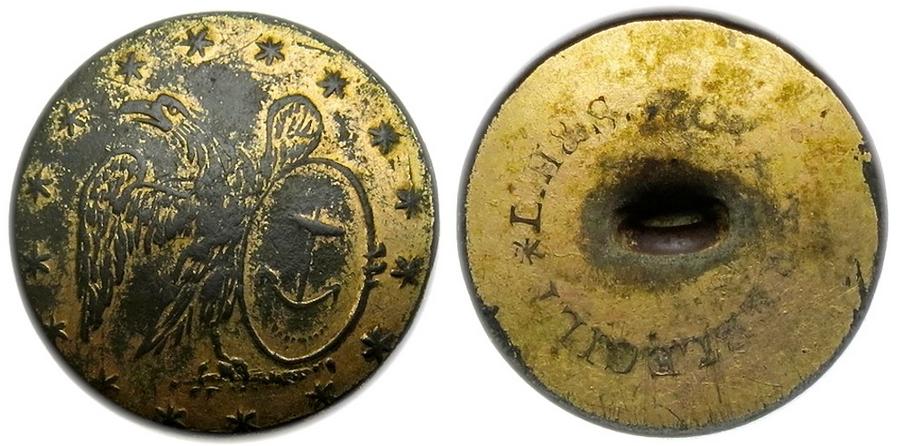
1810 to 1830's US Navy Button
Color: A Golden Brown.
Metal: 1-Piece, Slightly Convex, Raised Design,
Gilt Brass.
Size: 23mm. Coat Size
Albert's Number: NA 57-A RV 25
Variation: Eagle Looking Skyward / Large Slanted
Oval Shield / Short Straight Stock / Round
Crown / Lined Cable.
Present Condition: A Non Excavated Example,
Exceptional Planchet Casting, Exceptional High Relief
Pattern.
Isabela's Notes: There are quite a few die
variants known for this specific pattern that depicts 16
stars. Levenworth, Hayden and Scovill, actually
produced this button between 1811 and 1820. The
pattern
differences are in the eagle's feathers, neck length
& shape,
anchor size, and the cable design. This button's pattern
depicts an
Eagle Looking More Skyward
while standing on a cable. Under
the eagle's left wing is a
Large Slanted Oval Shield
that has a raised outline. Depicted on the shield is a
Medium Size Fouled Anchor
with a
Short Straight Stock,
and a
Round Crown. Coming off the anchor's top ring on the right
hand-side is a
Lined Cable. The
cable goes over the stock, and then under the shaft
and left fluke, and hangs in a fish hook racing
right below the crown. Circling around the button's
edge is 16 Six-Pointed
Stars. The high relief
pattern is set on a plain slightly-convex field. Un-dug
specimens being the true rarity.
Reverse Button Analysis: This is a slightly
concave one-piece button with a loop shank. The
shank is original, straight, and intact. L, H&S.W.Ct.
Treble Gilt.
The RJ Silverstein Collection.
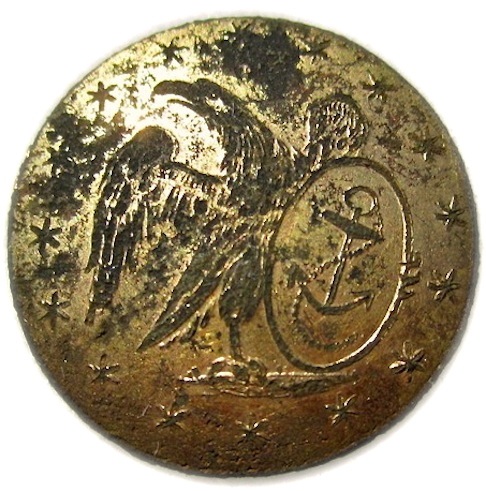 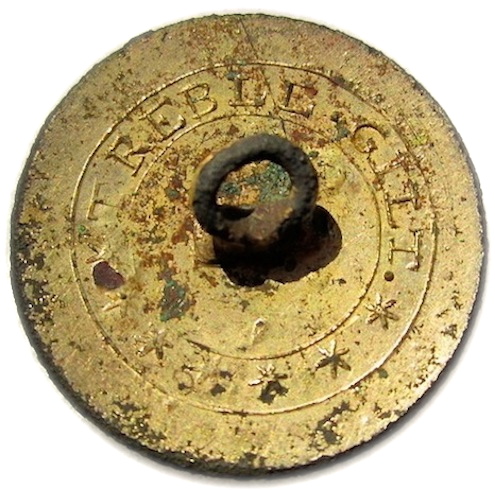
|
1810 to 1830's US Navy Button
Color: A
Golden Charcoal.
Metal: Slightly
Convex, 1-Piece, Raised Design, Gilt Brass.
Size: 23.5mm.
Coat Size
Albert's Number: NA
57-A: Unlisted Back mark Variant RV
25
Variation: Large Slanted
Oval Shield
/ Small Foul Anchor /
16
Six-Pointed Asterisk Type Stars
Present Condition: An Excavated Example, Strong
Planchet Casting, Strong High Relief Pattern.
Isabela's Notes: This is an English
manufacturers variation for (NA 57-A) a Navy
Officer's 16 Star Pattern.
This button's pattern depicts an
Eagle Looking More Skyward
while standing on a cable. Under
the eagle's left wing is a
Large Slanted Oval Shield
that has a raised outline. Depicted on the shield is a
Medium Size Fouled Anchor
with a
Short Straight Stock,
and a
Round Crown. Coming off the anchor's top ring on the right
hand-side is a
Lined Cable. The
cable goes over the stock, and then under the shaft
and left fluke, and hangs in a fish hook racing
right below the crown. Circling around the button's
edge is 16 Six-Pointed
Stars. The high relief
pattern is set on a plain slightly-convex field.
Reverse Button
Analysis: The
is a one-piece button with a loop shank. The shank
is original and intact, but slightly bent. TREBLE
GILT. ******* within a rm channel.
Dug in Cold Harbor,
Virginia 2007.~
The RJ Silverstein Collection.
|
|
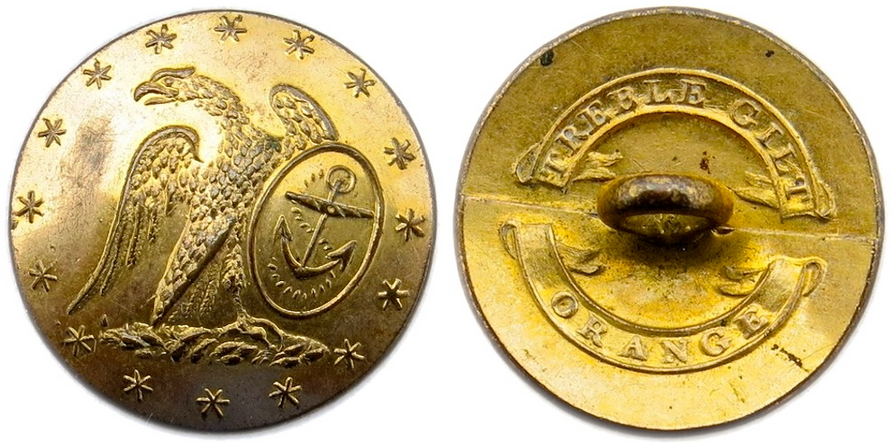
|
1810 to 1830's US Navy Button
Color: Brass Yellow.
Metal: 1-Piece, Slightly Convex, Raised Design,
Gilt Brass.
Size: 23.31mm. Coat Size
Albert's Number: NA 57-B RV 25
Variation: Eagle Facing Right / Large Slanted Oval Shield / Medium
Size Fouled Anchor / Barbed Crown / 16 Six Point
Asterisk Type Stars.
Present Condition: A Non Excavated Example,
Exceptional Planchet Casting, Exceptional High Relief
Pattern.
Isabela's Notes: Since there were several
companies making these buttons, a collector can find
more then one die
variant for this specific pattern: 57-B. The
main differences are in the eagle's feathers, neck
size & length, and the style of the cable depicted. This
die variant has an intricate design in the feather
detail. This button's pattern depicts an
Eagle Facing Right
while standing on a mound. Collectors should note three
distinct inside tail feathers, along with a fuller
looking right wing. Under
the eagle's left wing is a
Large Slanted Oval Shield
with a raised outline. Depicted on the shield is a
Medium Size Fouled Anchor
with a
Slightly Slanted Stock,
and a
Barbed Crown. Coming off the anchor's top ring on the right
hand-side is a lined or dash style cable. The rope goes over
the stock, and then under the shaft and left fluke, and
then
hangs in a fish hook racing right below the crown.
Circling around the button's edge is
16 Six-Pointed Asterisk Type
Stars.
The high relief pattern is set on a plain slightly
convex field. Dug specimens are available with some
frequency.
Reverse Button Analysis: This is a slightly
concave one-piece button with a loop shank. The shank is
original, straight, and intact. TREBLE GILT within a
Ribbon rm / ORANGE within a Ribbon rm.
The RJ Silverstein Collection. |
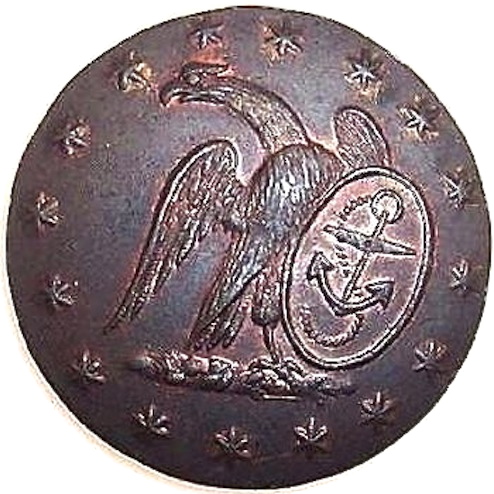
|
1810 to 1830's US Navy Button
Color: Brass Yellow.
Metal: 1-Piece, Slightly Convex, Raised Design,
Gilt Brass.
Size: 23mm. Coat Size
Albert's Number: NA 57-B
RV 15
Variation: Goose Neck Eagle / Three Inside Tail
Feathers / Large Slanted Oval Shield / Small Fouled
Anchor / 16 Six Pointed Stars.
Present Condition: An Excavated Example, Strong
Planchet Casting, Strong High Relief Pattern.
Isabela's Notes: This is another die variant
for NA 57 B 16 Star pattern. This pattern shows a
different feather pattern then the earlier specimen. This button's pattern
depicts a
Goose Neck Eagle
standing on a cable looking to the right. This die
variant shows three distinct tail feathers and lean slim
wings. Covering over the eagle's left wing is a
Large Slanted Oval Shield
that depicts a
Small Fouled Anchor.
The anchor's stock is slightly slanted and the crown is
barbed.
There is a rope that comes off the anchor's top ring on
the right hand-side. The rope goes over the stock and
then under the shaft and left fluke, and hangs in a fish
hook racing right below the crown. Circling around the
button's edge is
16 Six-Pointed Stars. The
high relief pattern is set on a plain convex field.
Reverse Button Analysis: This is a slightly
concave one-piece button with a loop shank. The shank is
original, straight, and intact. TREBLE GILT / ORANGE rm. |
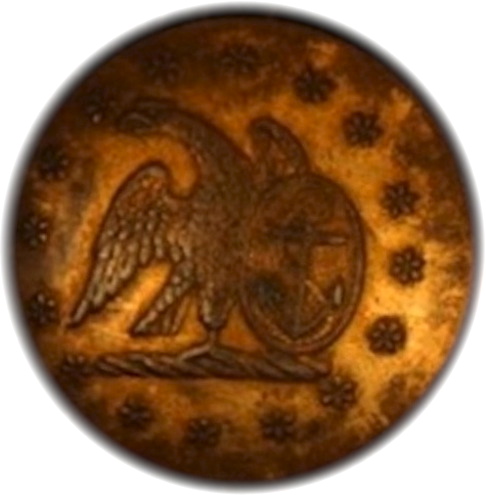 
|
1802 US Navy Button
Color: A Patchy
Golden Brown.
Metal: 1-Piece,
Convex, Raised Design, Gilt Brass.
Size: 23mm.
Coat Size
Variation: Eagle
Standing on a Cable /
Slightly Slanted Oval Shield / Large Fouled
Anchor / 16 Raised Six-Point Flower Type
Stars.
Albert's Number: NA 57: Unlisted variant
RV 25
Present Condition: A Non Excavated Example, Strong Planchet Casting, Strong High Relief.
Isabela's Notes:
This is another die variant in the series. This pattern
depicts a slightly different style eagle. The button's pattern depicts an
Eagle
Standing on a Cable looking
to the right. Under the eagle's
left wing is a very
Slightly Slanted Oval Shield. Depicted
on the
shield is a
Large Fouled Anchor
on a stippled field. The stock of the anchor is straight
and the crown is slightly barbed. There is a rope coming off the anchors top ring on the
right hand-side. This goes under the stock, and then
twists under the shaft, and left fluke. The cable then ends in a long fishhook
passing under the crown and going all the
way up to the right fluke. Circling around the outside
edge is
16 Raised Six-Point Flower Type Stars.
The high relief pattern is set on a plain convex field.
Collectors should note this is the most scarce pattern
out of the NA 57 16 star series.
Reverse Button Analysis:
This is a one-piece button with a loop shank. The shank is original, straight, and intact.
|
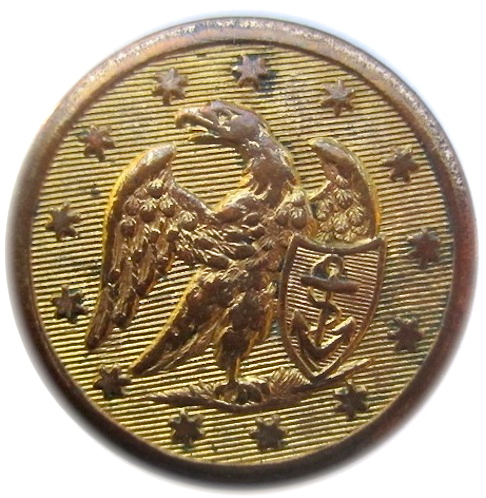 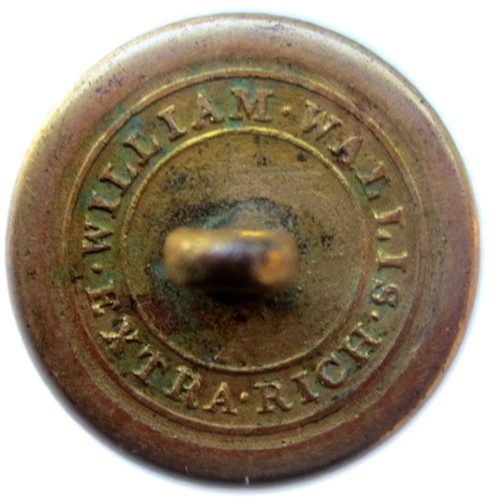
|
1820's United States Navy Officer's Button
Color:
A Tinted Yellow Brass.
Metal:
Flat,1-Piece, Raised Design, Gilt Brass.
Size: 22.83mm.
Coat Size
Variation:
Small Slanted Spade Shaped Shield / Lined Field / Small Raised Anchor
/ Straight Stock / V-Shape Crown /13 Six-Pointed Stars.
Albert's Number: NA 62-E:
RV 20
Present Condition: A Non Excavated Example, Exceptional Planchet Casting, Exceptional High Relief.
Isabela's Notes:
This button was originally intended for Naval Officers. The
button's pattern depicts a standing eagle facing right, with
up-raised wings. Partially covering over the eagle's left wing is a
Small Slanted Spade Shaped Shield.
Depicted on the shield's
Lined Field
is a
Small Fouled Anchor
with a
Straight Stock
and a
V-Shape Crown.
There is a cable coming off the anchor's top ring on the right hand-side, and wraps
under the stock, over and under
the shaft, and then under the right fluke where it
dangles below the crown.
Encircling the eagle is
13 Six-Pointed
Stars. The high relief
pattern is set on a lined filed with a round picture
frame raised edge border.
Reverse Button Analysis: A One-Piece Casting with a loop shank. The shank is original, straight, and intact. .WILLIAM.WALLIS.EXTRA RICH.
The RJ Silverstein Collection. |
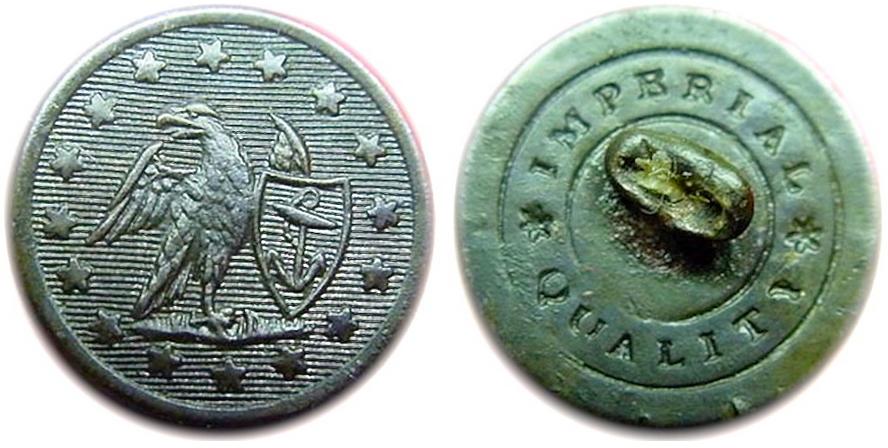
|
1810-30's United States Navy Button
Color: A Greenish-Brown.
Metal: Flat, 1-Piece, Raised Design, Gilt Brass.
Size: 16mm. Cuff Size
Albert's Number: NA 62-Unlisted Variant:
RV 20
Variation: Eagle Facing Right / Vertical Spade
Shape Shield / Small Fouled Anchor / Slanted Stock /
V-Shaped Crown / 13 Six-Pointed Stars.
Present Condition: A Non Excavated Example,
Strong Planchet Casting, Strong High-Relief Pattern.
Isabela's Notes: This popular pattern was
produced by a dozen manufacturers from 1810 to the mid 30's. The
button's pattern depicts a standing
Eagle Facing Right,
with upraised wings. Covering over the eagle's left wing
is a
Vertical Spade Shape
Shield.
Depicted on the lined shield is a
Small Fouled
Anchor
with a
Slanted Stock
and a
V-Shaped Crown. The
cable comes off the anchor's top ring on the
right hand-side, and then goes under the stock and
shaft, and then ends behind/below the anchor's crown.
Circling around the eagle is
13
Six-Pointed Stars.
The high relief pattern is set on a lined filed with a
round picture frame raised edge border.
Reverse Button Analysis: This is a flat one-piece
button with a loop shank. The shank is original, and
intact, but crushed inward. |
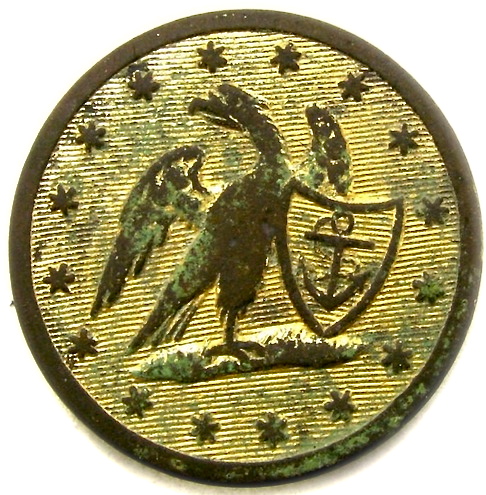 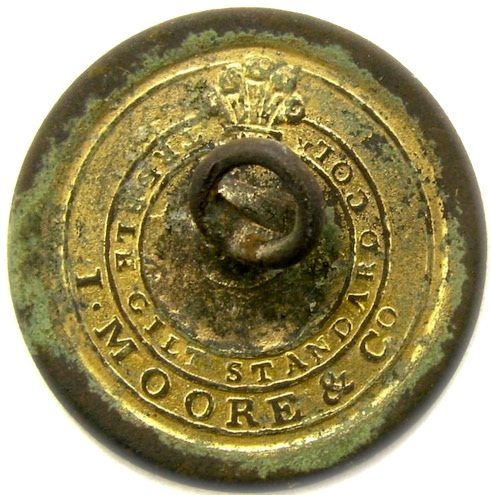
|
1820's United States Navy Button
Color: A Light Gold With Sea foam Green.
Metal:
High Relief, 1-Piece Gilt Brass.
Size: 22.59mm.
Coat Size
Variation:
Small Wide Spade Shaped Shield / Small Fouled Anchor
/Straight
Stock /
Slightly Barbed Crown / 16 Six-Pointed Stars.
Albert's Number: NA 66-A:
RV 15
Present Condition: An Excavated Example, Strong Planchet Casting, Strong High Relief.
Isabela's Notes:
This is an English manufacturers variation of this
commonly found pattern. The button's pattern depicts an
eagle standing on a mound while facing right with raised up-raised wings. Under the
eagle's left wing is a
Small Wide Spade Shaped Shield.
Depicted on the shield is a
Small
Fouled Anchor with a
Straight Stock
and a Slightly Barbed
Crown. There is a
small rope coming off the anchor's top ring on the right
hand-side. The rope goes under the stock and then under
the shaft 2x, then under the right fluke off the edge.
Circling around the eagle is 16
Six-Pointed Asterisk Type Stars. The high relief pattern is set
on a lined filed with a round picture frame raised edge
border.
Reverse Button Analysis: A One-Piece Casting with a loop shank. The shank is original, and intact, but slightly bent upwards. I.MOORE & Co/TREBLE GILT STANDARD COL* Five Plumes Above RM /3 ring rmdc
The RJ Silverstein Collection.
|
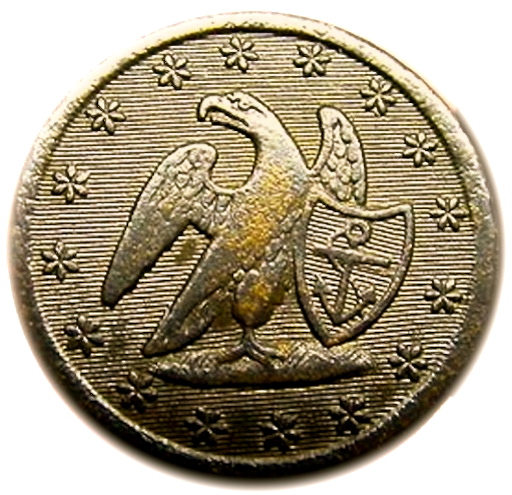 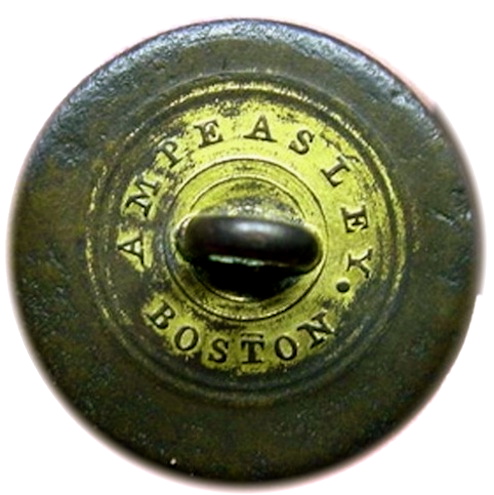
1810-30's United
States Navy Button
Color: A Brass Brown With Gold Highlights.
Metal: Flat,
1-Piece, Raised Design, Gilt Brass.
Size: 23
mm. Coat size
Albert's Number: NA
66-B: RV 12-15
Variation: Small
Spade Shaped Shield /
Small Fouled Anchor
/ Straight Stock / Slightly Barbed Crown / 16
Six-Pointed Asterisk Type Stars.
Present Condition: An
Excavated Example, Exceptional Planchet Casting,
Strong High-Relief Pattern.
Isabela's Notes: This is another die
variant made by A.M. Peasley of Boston. This one has
a different style star depicted.
The button's pattern depicts an eagle standing on a
mound while facing right with raised up-raised wings.
Partially covering over the eagle's left wing is a
Small Wide Spade Shaped Shield.
Depicted on the shield is a
Small
Fouled Anchor with
a Straight Stock
and a Slightly
Barbed Crown. The rope in this variant comes off
the anchor's top ring on the right hand-side, and
then goes over the stock, under the shaft & left fluke, and
ends slightly below the crown. Circling around the
eagle is 16
Six-Pointed Asterisk Type Stars. The high relief pattern is
set on a lined field with a round picture frame
raised border edge.
Reverse Button Analysis: This is a
one-piece button with a loop shank. The shank is
original, straight, and intact. A.M. PEASLEY/BOSTON
rm
The J. Baldwin Collection.
|
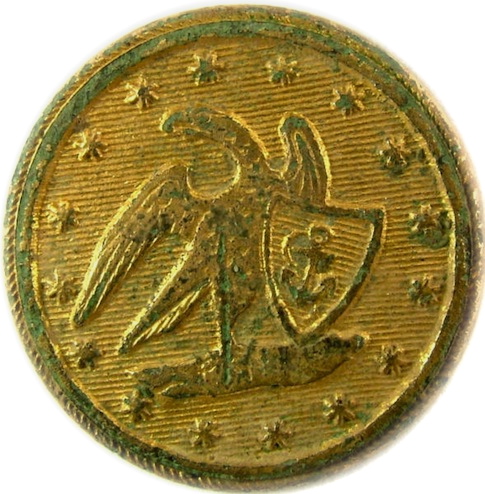 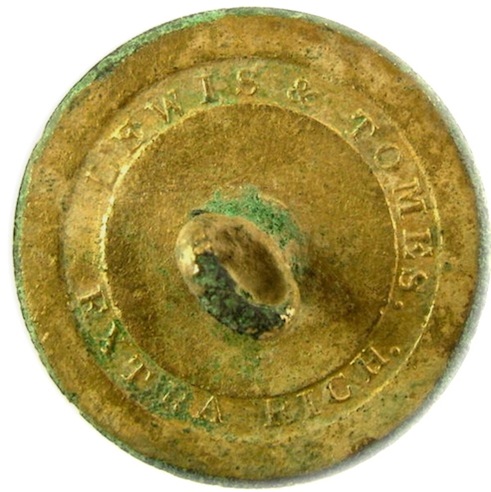
1820-30's United States Navy Button
Color: A Light Gold With Sea foam Green.
Metal: Flat,
1-Piece, Raised Design, Gilded Brass.
Size: 23
mm. Coat Size
Albert's Number: NA
67-A: RV 15
Variation: Eagle
Facing Right /
Slanted Spade Shaped Shield /
Small
Fouled Anchor /
Straight Stock / Barbed Crown
/ Thin Rope Edge.
Present Condition: An
Excavated Example, Strong Planchet Casting,
Strong High Relief Pattern.
Isabela's Notes: This new style
button
is very similar to the previous patterns in the series, but adds a thin
decorative rope to the button's edge. This button's
pattern depicts a standing
Eagle Facing Right,
with raised up-right wings. Partially covering
over the eagle's left wing
is a
Slanted Spade Shaped Shield.
Depicted on the shield is
a
Small Fouled Anchor with
a
Straight Stock
and a
Barbed Crown.
The rope comes off the anchor's top ring on the
right hand-side, and goes over the stock, under
the shaft and fluke, and dangles under the
crown. Circling around the eagle is
16 Six-Pointed Asterisk Type Stars.
The high relief pattern is set on a lined field
with a
flat round picture frame border
and
a
Thin Rope Edge Trim.
The back mark dates this specimen dates from
1820, but the pattern might have come around
earlier. (Lewis Tomes 01).
Reverse Button Analysis: This is a
flat one-piece button with a soldered on loop shank. The shank is
original, straight, and intact.
LEWIS & TOMES EXTRA RICH rm within a channel.
Excavated in
Keedyville, Maryland.~
Picture
Courteous of Harry Ridgeway/ Museum
Collection.
Robert's Notes:
Lewis & Tomes was an English button maker
who operated a partnership in America.
|
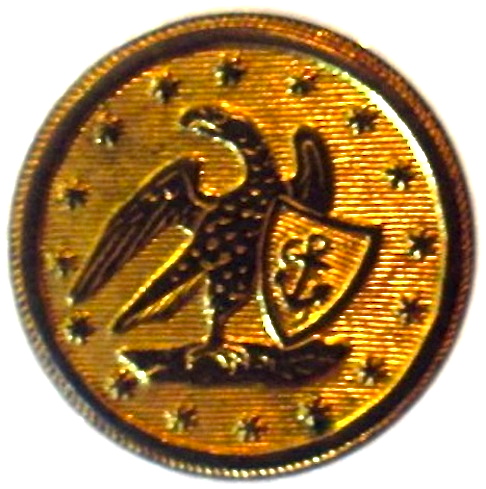 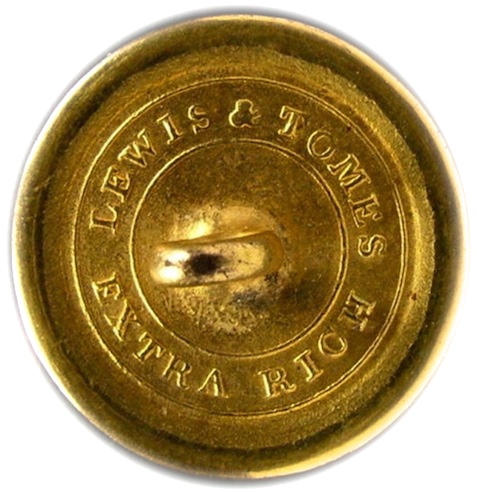
1820-30's United States Navy Button
Color: A
Golden Brass Yellow.
Metal: Flat,
1-Piece, Raised Design, Gilded Brass.
Size: 23
mm. Coat Size
Albert's Number: NA
67-A:
RV 15
Variation: 16
Six-Pointed Stars/Rope Edge.
Present Condition: A
Non Excavated Example, Exceptional Planchet
Casting, Exceptional High Relief Patten.
Isabela's Notes: This
button is another specimen manufactured by
Lewis & Tomes, but with a latter backmark.
This button's pattern depicts a standing
eagle facing right, with raised up-right
wings. Under the left wing is a spade shaped
shield, with a
Small Fouled Anchor depicted
on a lined field. The rope comes off the
anchor's top ring on the right hand-side, and goes
over the stock, under the shaft and fluke, and
dangles under the crown. There
are
16 Six-Pointed Asterisk Type Stars
encircling the eagle on the outside edge.
The high relief pattern is set on a lined field
with a
Thin Raised
Border and Outside Rope Edge.
Reverse Button Analysis: This is
a one-piece button with a loop shank. The
shank is original, straight, and intact.
LEWIS & TOMES EXTRA RICH 2 within a two
ring rm.
|
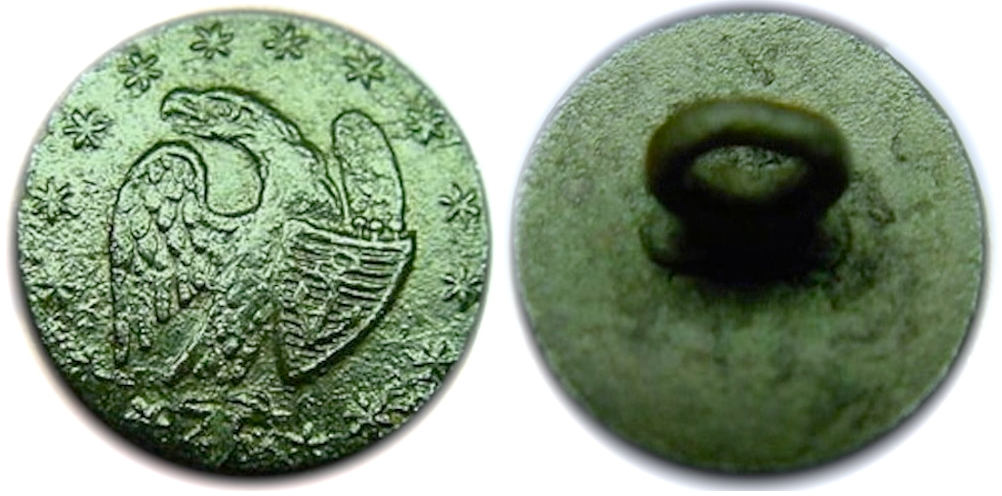
1820-30's United States Navy Button
Color: An Olive
Grey.
Metal: Flat,
1-Piece, Raised Design, Pewter.
Size: 16mm.
Cuff Size
Albert's Number: NA
72-Av:
RV 7
Variation: Slanted
Spade Shaped Shield / Small Foul Anchor / 16
Six-Pointed Asterisk Type Stars.
Present Condition: An
Excavated Example, Strong Planchet Casting,
Strong High Relief Pattern.
Isabela's Notes: The
button's pattern depicts a standing eagle
facing right, with raised up-raised wings.
Under the left wing is a
Slanted Spade Shaped
Shield, with a Small
Fouled Anchor
on a lined field. The rope comes off the
anchor's top ring on the right hand-side,
and goes around the stock, under and over
the shaft, then over the right fluke off the
side. There
are
16
Six-Pointed Asterisk Type Stars
encircling the eagle on the outside
edge. The high relief pattern is set on
a plain flat field with a plain edge..
Reverse Button Analysis: This is
a flat one-piece button with a soldered on loop shank. The
shank is original, straight, and intact.
|
 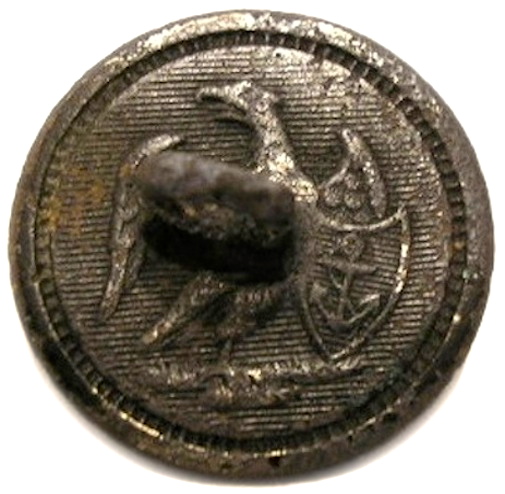
1820-30's United States Navy Style
Reverse Button
Color: An Olive
Grey.
Metal: Flat,
1-Piece, Raised Design, Silvered Copper.
Size: 19
mm. Coat Size
Albert's Number: NA
75-B
RV 05
Variation: Slanted
Spade Shape Shield /
Small Spade Shape Shield
/ Square Notch Border.
Present Condition: An
Excavated Example, Good Planchet Casting,
Strong High Relief Pattern.
Isabela's Notes: This
button is an unusual specimen that has the
device on the back of the button. This style
was very popular during the 1820's with
political buttons as well. There are
two known die variants, one that is a little
bigger with 20 six pointed stars on the
border, and
a smaller example with square notches.
What the style pattern tells me, is that it is
the same style as a Jacksonian Political Reverse Style Button.
This button could have been worn on Breeches, or just
on a shirt's cuff. The button's pattern depicts a
standing eagle facing right, with a Slanted
Spade
Shaped Shield under
it's left wing. Within the shield is a raised anchor
within on a lined field. The anchors
rope comes off the anchor's top ring on the right
hand-side, and goes under the stock, shaft, and left fluke,
then hangs below the crown. The high relief pattern is
on a lined field with a decorative Square
Notch Border.
Reverse Button Analysis: This is
a one-piece button with a loop shank. The
shank is original, straight, and intact.
|
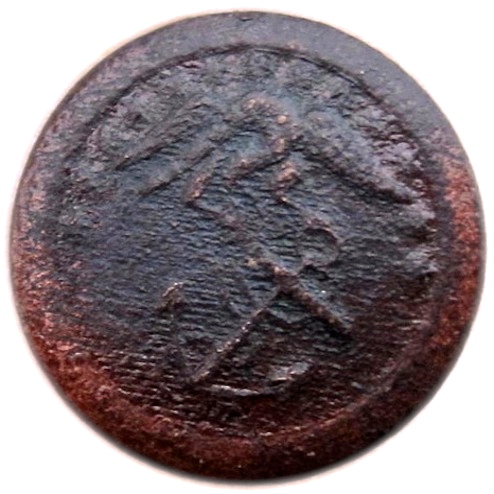 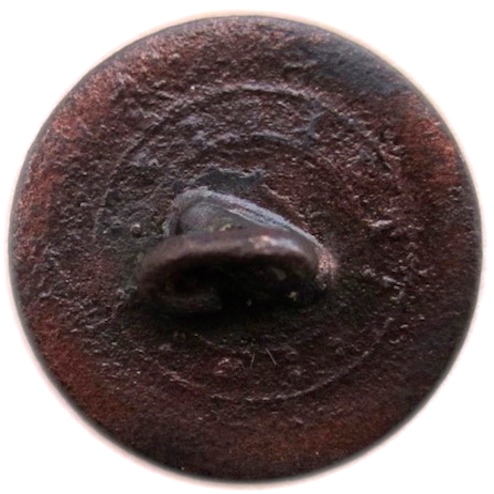
1820's United States Marines
Color: An Ochre of Brown & Shades of
Red.
Metal: Flat, 1-Piece, Raised Design,
Gilt Brass.
Size: 20.69mm. Coat Size
Albert's Number: MC 2:
RV 35
Tice's Number: MC 106
Variation: Flying Spread-Wing
Eagle Facing Down / Large Slanted Fouled
Anchor / 13 Six-Pointed Stars /
Irregularly Lined Field.
Present Condition: An Excavated
Example, Good Planchet Casting, Good High
Relief Pattern.
Isabela's Notes: This button was most
likely made by Robinson during the 1820's.
During the Revolution, Congress authorized
the enlistment of the Marines to serve as
Naval Infantry men. There primary duty was
to keep order aboard American Ships, and to
act as guards at Naval shore installations.
The button's pattern depicts a
Flying Spread-Wing
Eagle Facing Down
with the anchor's rope in
it's beak. Underneath is a
Large Slanted Fouled Anchor.
In the eagle's left talon is the anchor's
top ring. The
slack rope comes off the anchor's top ring
on the left hand-side and goes over and
under the stock, and then through the eagle's beak, and
then under and over the shaft 3x, then over the
right fluke ending under the crown. In the
top legend, there are
13 Six-Pointed Stars
arced above the eagle. The
high relief pattern is set on a
Irregularly
Lined Field, with a wide plain raised
round edge.
These early Marine buttons are usually very
hard to come by, because the Marine Corps didn't have
many men. Tice even noted that by 1851, the Corps
only consisted of 1800 officers and men.
Reverse Button Analysis: This is a
one-piece button with a soldered on wedge shank. The
shank is original, and intact, but twisted
and broken open. GILT *.*.*.*. rm
Dug in Fernandina Florida by
J.B. near Fort Clinch.
The RJ. Silverstein Collection.
|
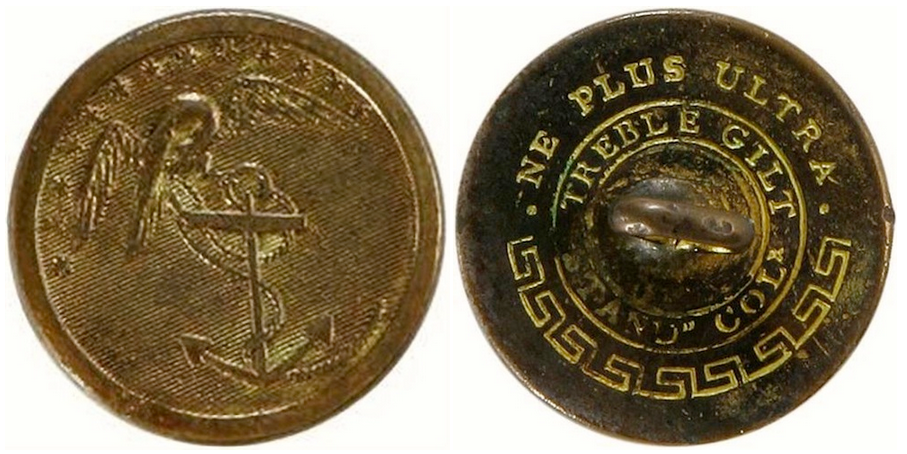
1820's United States Marines
Color: A Golden Brown.
Metal: Flat, 1-Piece, Raised Design,
Gilt Brass.
Size: 23 mm. Coat Size
Albert's Number: MC 3-B: RV 35
Tice's Number: MC
Variation: Flying Spread-Wing Eagle
Facing Down / Large Slanted Fouled Anchor /
13 Six-Pointed Stars / Lined Field.
Present Condition: An Excavated
Example, Good Planchet Casting, Good High
Relief Pattern.
Isabela's Notes: This button was most
likely made by Robinson during the 1820's.
During the Revolution, Congress authorized
the enlistment of the Marines to serve as
Naval Infantry men. There primary duty was
to keep order aboard American Ships, and to
act as guards at Naval shore installations.
The button's pattern depicts a Flying
Spread-Wing Eagle Facing Down with the
anchor's rope in it's beak. Underneath is a
Large Slanted Fouled Anchor. In the eagle's
left talon is the anchor's top ring. The
slack rope comes off the anchor's top ring
on the left hand-side and goes over and
under the stock, and then through the
eagle's beak, and then under and over the
shaft 3x, then over the right fluke ending
under the crown. In the top legend, there
are 13 Six-Pointed Stars arced above the
eagle. The high relief pattern is set on a
Lined Field, with a wide plain raised round
edge. These early Marine buttons are usually
very hard to come by, because the Marine
Corps didn't have many men. Tice even noted
that by 1851, the Corps only consisted of
1800 officers and men.
Reverse Button Analysis: This is a
one-piece button with a soldered on wedge
shank. The shank is original, straight, and
intact. . NE PLUS ULTRA. Decorative pattern
/ TREBLE GILT/ STRAND d COL x
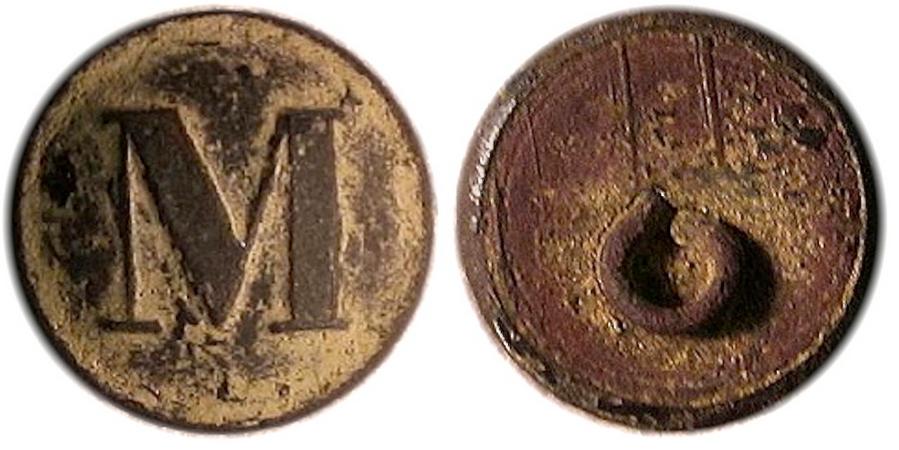
1861-65 United States Marines
Color: A Desert Clay Brown.
Metal: Convex, 2-Piece, Raised Design,
Gilt Brass.
Size: 23 mm. Coat Size
Albert's Number: CS 76: RV
300
Tice's Number: CSM 200
Variation: Stippled Roman M
Present Condition: An Excavated
Example, Strong Planchet Casting, Strong High
Relief Pattern.
Isabela's Notes: On March
16, 1861, the Confederate States envoked an
official Act to Provide for the Organization
of the Navy, and instituted the
establishment of a Corps of Marines.
Unfortunately, the official uniform and
dress code doesn't prescribe any buttons for
the corps of Marines. Several old
collections do have buttons labeled,
"Marines" which indicates buttons were made
for this organization specifically. H T & B
Manchester back mark buttons supplied by the
British to the Confederate Army strongly
point toward Marine issue. There was also
some evidence supplied by the Atlanta
Historical Museum there was another
manufactured button by Horstman and Alien
NY. they had an original uniform which was
owned by a Second Lieutenant Henry Graves.
Research indicates he was in command of 20
Marines that served on the CSS Savannah. The
button's pattern depicts a
Stippled "M"
using Roman font. The high relief letter is
set on a plain convex field with a raised
border edge. This button was the only one
made for the Confederate Marines. Collectors
find this one of the most desirable buttons
to obtain.
Reverse Button Analysis: This is a
2-Piece button with a loop shank. The shank
is original, and intact, but crushed flat.
Dug at Dutch Gap, Virginia.
|
|
|
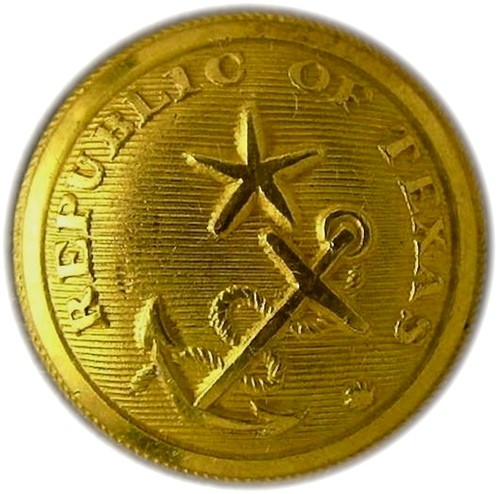 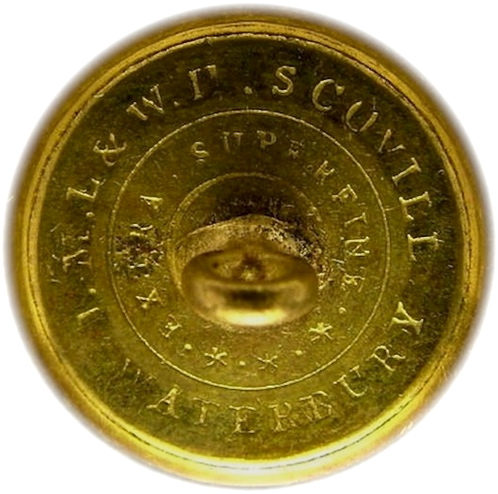
1820's
Republic of Texas Navy
Color: Dripping
Gold!
Metal: Low
Convex, 2-Piece, Raised Design, Gilt
Brass.
Size: 21
mm. Coat Size
Albert's Number: TX
1:
RV 100
Tice's Number : TX 219-A.1
Variation: Five-Pointed
Lone Star /
Large Slanted Raised
Anchor /
Republic of Texas.
Present Condition: A
Non Excavated Example, Exceptional
Planchet Casting, Exceptional High
Relief Pattern.
Isabela's Notes: The
Republic of Texas originally tried to
form it's own country, so naturally they
formed their own Navy to defend
Galveston Bay against the Mexicans. The
button's pattern depicts a
Five-Point Lone Star above a
Large Slanted Raised
Anchor. The rope comes off the anchor's
top ring on the left hand-side, and goes
under the stock, shaft 3x, and then
under the right fluke where it hangs
below.
Republic of Texas
is in large Roman Font letters arced in
the top legend.
The high relief pattern is set on a
lined field with a thin flat border and
pipe rope
edging.
Reverse Button Analysis: This
is a two-piece flat construction with a
soldered on loop shank. The shank is
original, straight, and intact. J.M.L.&
W.H. / SCOVILLS / dm ring WATERBURY.
EXTRA. SUPERFINE *.*.* inner dm ring
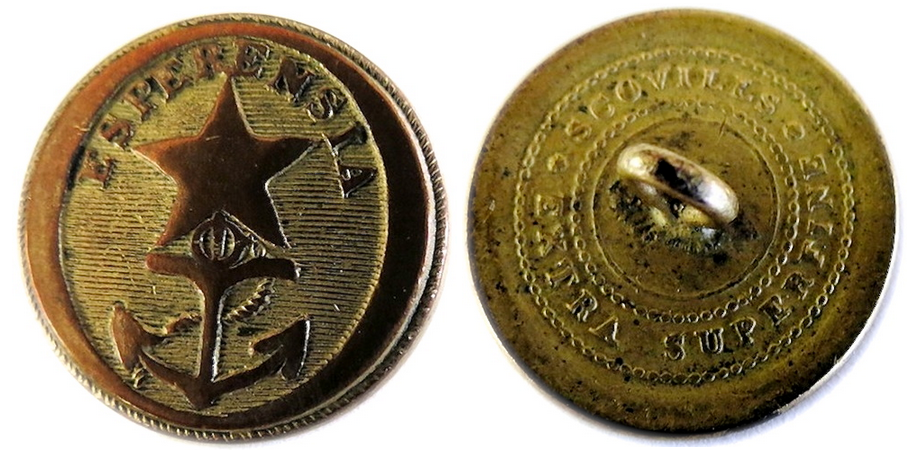
1837 Republic of Texas
Navy
Color: A Coppery Golden Brown.
Metal: Flat, Oval, 1-Piece, Raised
Design, Gilt Brass.
Size: 23mm. Coat Size
Albert's Number: TX
3 RV 100
Tice's Number: TX222
A.1
Variation: Large
Five Point Star Star / Upright Fouled
Anchor / Barbed Crown / Esperensia
/ Oval Picture Frame.
Present Condition: A Non Excavated
Example, Strong Planchet Casting, Strong
High Relief Pattern.
Robert's Comments: This button was
produced by Scovills in 1837. They made
both a coat and matching cuff. The
button's pattern depicts a Large
Five Point Star above
an Upright
Fouled Anchor with
a Barbed
Crown. The
anchor shows the top ring folded over
with a rope coming off the left hand
side. The rope goes under the stock,
shaft, and right fluke, then ends
dangling below the crown. Above the star
is the motto, "ESPERENSIA" in large
capital letters. The high relief pattern
is set on a lined field within an Oval
Picture Frame with
a pipe rope edge. This is a very popular
button for early southern collectors.
Reproductions were cast in silver during
the 1930's.
Reverse Button Analysis: This is a
one-piece button with a soldered on loop
shank. The shank is original, straight,
and intact. * SCOVILLS * / EXTRA
SUPERFINE rm within a 2 ring rope
pattern rm.
|
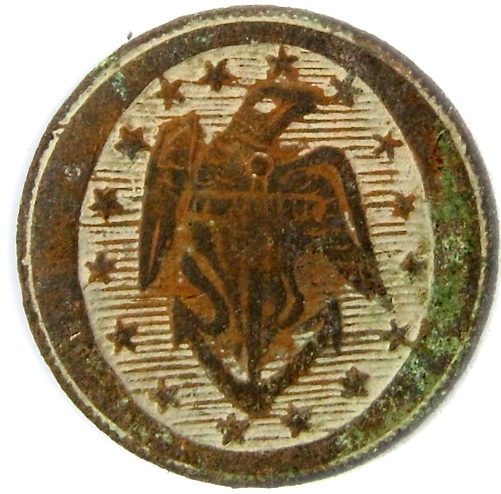 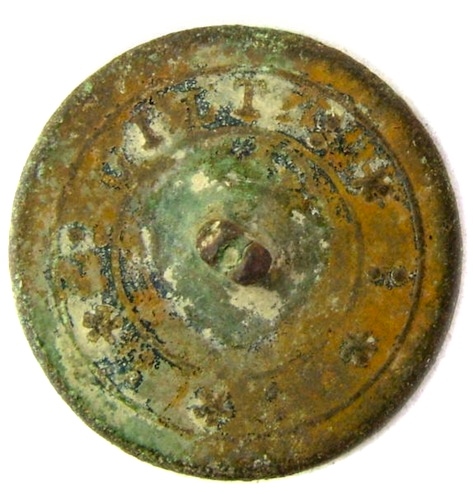
1830's to 1850's US Federal Navy
Officer's Button
Color: White
Wash Rusty Red.
Metal: Flat,
1-Piece, Raised Design, Gilt Brass.
Size: 16mm.
Cuff Size
Albert's Number: NA
81-Bv:
RV 05
Variation: 16
Irregularly Spaced Five-Pointed Stars
/
Plain Wide Oval Border /Irregular Lined Field
Present Condition: A
Non Excavated Example, Exceptional
Planchet Casting, Strong High Relief
Pattern.
Isabela's Notes: This
button was made by an English
manufacturer for Naval Officers in
the 1830's (Gilt 02). The
button's pattern depicts an eagle
standing on the flukes of an upright
anchor facing left. There
are 16
Irregularly Spaced Five-Pointed
Stars
encircling the
eagle around the inside border. This
is followed by a
Plain Wide Oval Border
with an
Outside Pipe Rope Edging.
This high relief pattern is set on an
Irregular
Lined Field. These
earlier specimens do not use an
"inside"
rope border for the pattern. There is also
another cuff variation of this
pattern with 14 stars.
Reverse Button Analysis: This
is a flat one-piece button with a
loop shank. The shank is broken. A
Circle of 8 six-pointed stars with
alternating dots GILT.
Excavated in Harper's Ferry West
Virginia.~
Picture courteous of Harry Ridgeway.
|
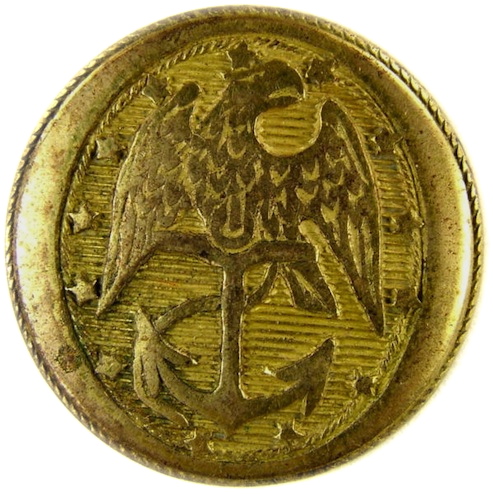 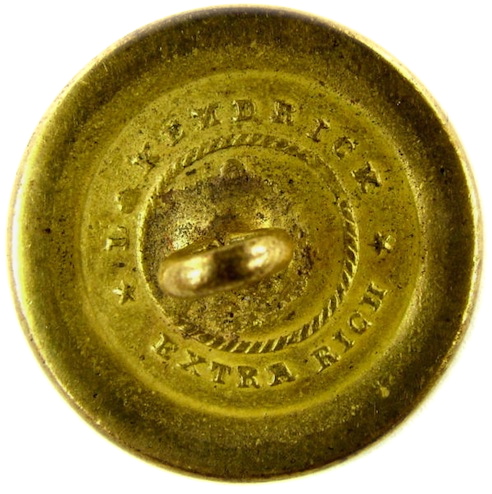
1830's to 1850's US Federal Navy Officer's Button
Color: Brass
Yellow.
Metal: Flat,
1-Piece, Raised Design, Gilt Brass.
Size: 23mm.
Coat Size
Albert's Number: NA
86-A.2:
RV 10
Variation: Rope
Passes Left to Right
/ 13
Raised Five-Pointed Stars /
Thin Rope Edge Border.
Present Condition: A
Non Excavated Example, Exceptional Planchet Casting,
Strong High Relief Pattern.
Isabela's Notes: This
popular Navy Officer's button was made by at least nine
different manufactures, and has two known die variants.
One with the rope passing left to right, and the other
with the rope passing right to left. This style pattern
was known to be manufactured during the late 1820's, but was
prevalent in use from the 1830's to the 50's. The
button's pattern depicts an eagle at rest perched on the stock
of an upright fouled Anchor facing left. The anchor's Rope
Passes from Left to Right under
the stock, and then hangs under the right fluke
almost to the barb on the crown. In this variant, the anchor is a bit
more pronounced, and shows thicker flukes. There are 13
Raised Five-Pointed Stars
encircling the
eagle around the inside border. This is followed by a
Thin Rope Edge Border,
which outlines a wide plain oval border with an outside
pipe rope edge. The high relief inside pattern is set on
a lined field.
Reverse Button Analysis: This is a flat
one-piece button with a loop shank. The shank is
original, straight, and intact. rm * L & KENDRICK
*/EXTRA RICH inside rope ring rm. |
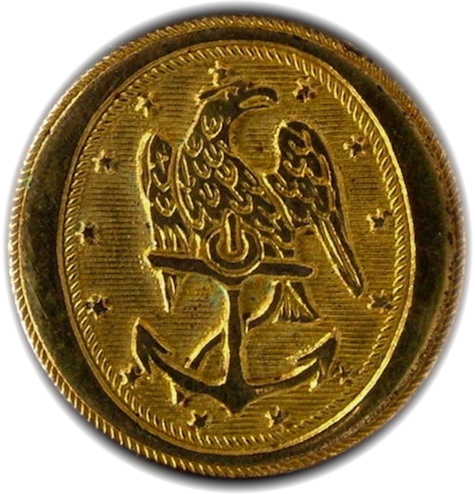 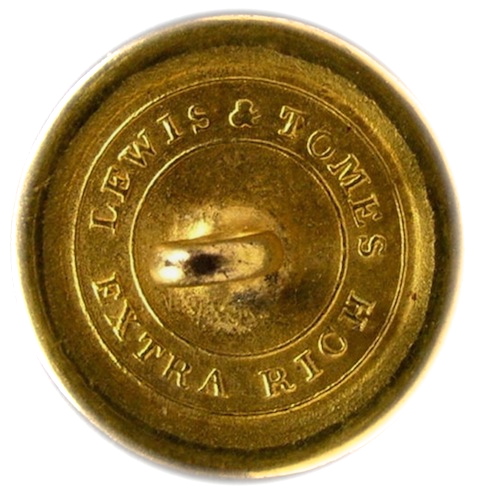
1830's to
1850's US Federal Navy Officer's Button
Color: Brass
Yellow.
Metal: Flat,
1-Piece, Raised Design, Gilt Brass.
Size: 22.6mm.
Coat Size
Albert's Number: NA
86-A.3:
RV 10
Variation: Rope
Passes Left to Right
/
13
Raised Five-Pointed Stars
/
Thin Rope Edge Border.
Present Condition: A
Non Excavated Example, Exceptional Planchet
Casting, Strong High Relief Pattern.
Isabela's Notes: This
die variant was made by Lewis & Tomes for Naval
Officers in the late 1820's or 1830's (Lewis
Tomes 07).
The
button's pattern depicts an eagle at rest perched on the stock
of an upright fouled Anchor facing left. The anchor's Rope
Passes from Left to Right under
the stock, and then hangs under the arm of the right fluke
barely below the crown. In this variant, the anchor is a bit
more pronounced, and shows thicker flukes. There are 13
Raised Five-Pointed Stars
encircling the
eagle around the inside border. This is followed
by a
Thin Rope Edge Border,
which outlines a wide plain oval border with an
outside pipe rope edge. The high relief inside
pattern is set on a lined field.
Reverse Button Analysis: This is a
flat one-piece button with a loop shank. The
shank is original, straight, and intact. LEWIS &
TOMES/ EXTRA RICH rm 2 ring channel.
This style pattern
was known to manufactured in the late 1820's, but
was prevalent from the 1830's to the 50's.
|
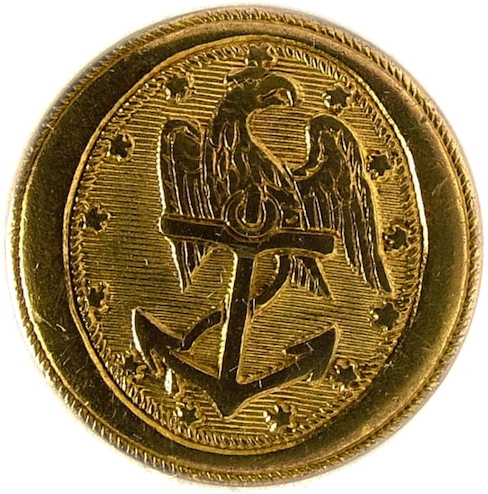 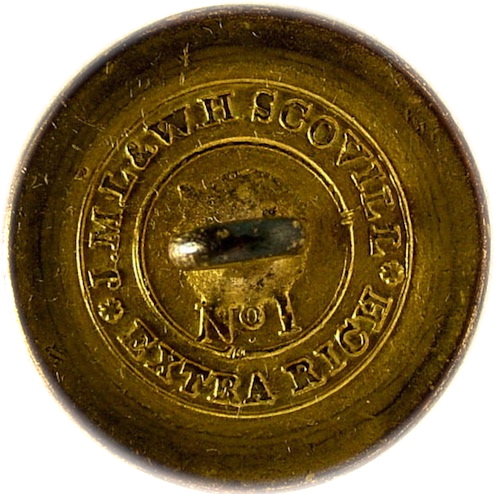
|
1830's to 1850's US Federal Navy Officer's Button
Color: Rich
Gold.
Metal: Flat,
1-Piece, Raised Design, Gilt Brass.
Size: 23mm.
Coat Size
Albert's Number: NA
86-A-Unlisted Backmark Variation:
RV 15
Variation: 13
Five-Pointed Stars / Rope Passes Left to Right
Present Condition: A
Non Excavated Example, Exceptional Planchet Casting,
Strong High Relief Pattern.
Isabela's Notes: This
die variant was made by J.M.L & W.H Scovill (Scovill09)
from 1827 to 1840. The
button's pattern depicts an eagle perched on the stock
of an upright anchor facing left. The anchor's rope
passes from left to right under
the stock and fluke, and ends dangling under the right
fluke. The anchor is a bit more pronounced with a nice
barbed crown and symmetrical flukes. There are 13
raised five-pointed stars encircling
the eagle on the inside border. This is followed by a
thin roped edge, and a wide oval border with an outside
rope edging. The whole inside pattern is set on a lined
field.
Reverse Button Analysis: This is a flat
one-piece button with a loop shank. The shank is
original, straight, and intact. rm *J.M L &W.H SCOVILL
*/EXTRA RICH/No1 set in a rm 2 ring channel. |
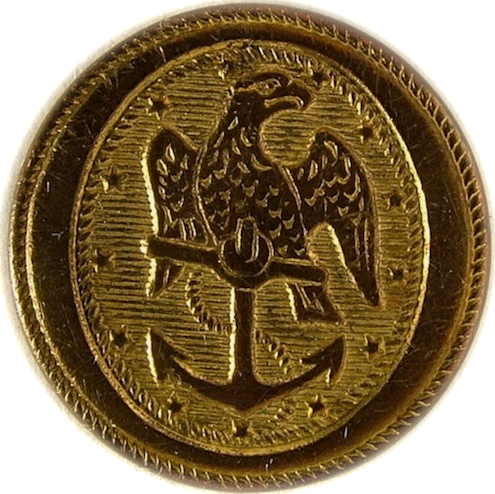 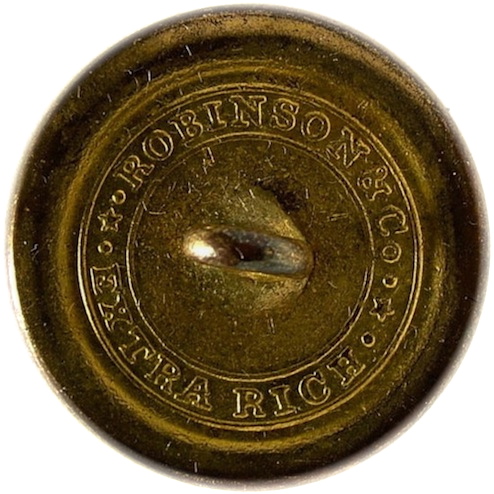
1830's to
1850's US Federal Navy Officer's Button
Color: Aged
Gold.
Metal: Flat,
1-Piece, Raised Design, Gilt Brass.
Size: 16mm.
Cuff Size
Albert's Number: NA
86-Bv:
RV 03
Variation: 13
Five-Pointed Stars / Rope Passes Right to Left
Present Condition: A
Non Excavated Example, Exceptional Planchet Casting,
Exceptional High Relief Pattern.
Isabela's Notes: This
is the only backmark Richard Robinson used for this
alternate die variant where the rope passes right to
left. Robinson did manufacture the original die
variant (Pattern A) with three known backmarks in
the 1820-30's. This particular pattern was made by
Richard Robinson (Robinson R08) in the 1820's. This
alternate pattern is extremely similar to "A",
except for the eagle's feathering, and the
rope passes right to left. The
button's pattern depicts an eagle
at rest, that is perched on an upright anchor's
slanted stock. The eagle is facing left in this
variant. The
anchor's rope
comes from under the right hand side of the stock
and
Passes Right to Left under
the stock, and left fluke. The rope then joins the
inner rope border under the crown. There
are 13
Five-Pointed Stars encircling
the eagle around the inside border. This is followed
by a thin rope edge, which leads into a plain wide oval border with an
outside rope edge. The high relief inside pattern is set
on a lined field.
Reverse Button Analysis: This is a flat
one-piece button with a loop shank. The shank is
original, straight, and intact. rm * . ROBINSON &
Co.*/ EXTRA RICH. rm
This style pattern
was known to manufactured in the late 1820's, but
was prevalent from the 1830's to the 50's.
|
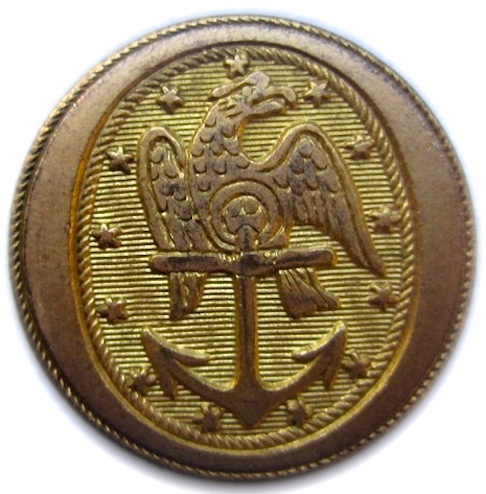 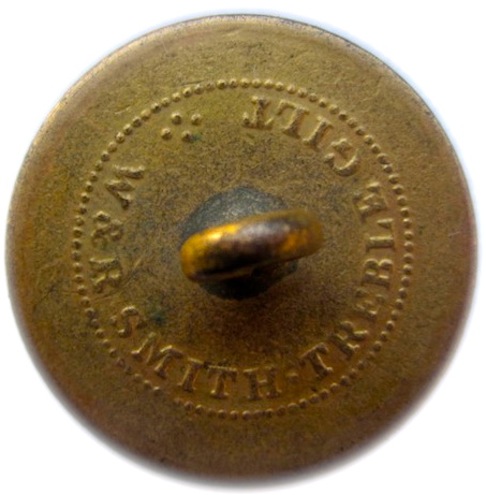
|
1830's Navy Button
Color: A Golden Olive Brown
Metal:
High Relief, 1-Piece Gilded Brass.
Size: 22.46mm.
Coat Size
Albert's Number: NA 87: RV 20
Variation:
Barbed Anchor / 13 Five-Pointed Star /
Pipe Rope Edge.
Present Condition: A Non Excavated Example, Exceptional Planchet Casting, Exceptional High Relief.
Isabela's Notes: This one-piece button
was part of the new transitional style (from an Eagle standing on the
Flukes of an upright Anchor, to an Eagle resting upon the
Stock of an upright Anchor) adapted by the U.S. Navy. This new style pattern was used throughout the 1830's and 40's. Some backmark research indicates this button was produced in the early 1830's.
We also know that W.H. Smith operated from the 1830's to around 1858. (W.H. Smith was an outfitter, and the buttons were manufactured by Scovill).
The button depicts a perched eagle on an
Barbed Anchor facing
left.
There are 13
Five-Pointed Stars encircling
the eagle around the inside border. This is followed
by a thin rope edge, which leads into a plain wide oval border with an
outside
Pipe Rope Edge. The
high relief inside pattern is set
on a lined field.
Reverse Button Analysis: A
one-piece button with a loop shank. The shank is original, straight, and intact. W & H SMITH. TREBLE GILT four dot
The RJ Silverstein Collection. |
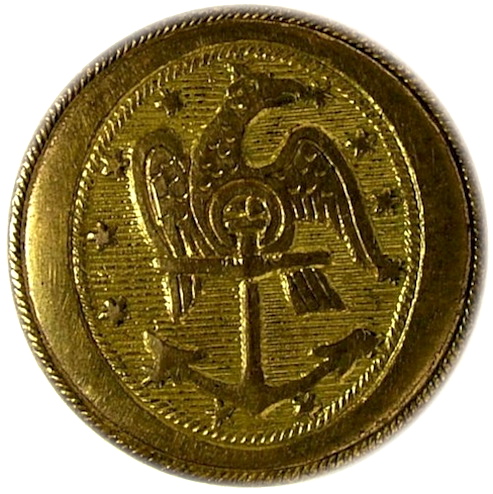 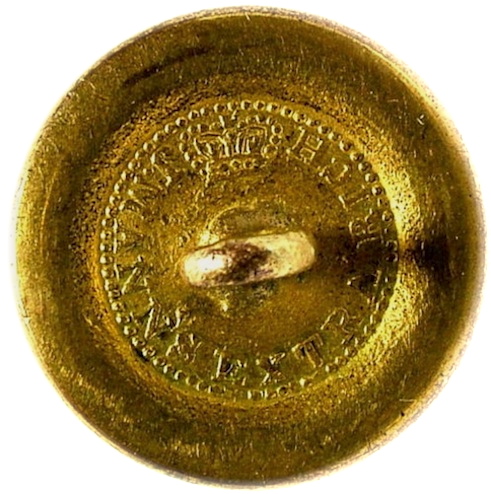
|
1830's to 1850's US Navy Officer's Button
Color: Two
Tone Gold.
Metal: Flat,
1-Piece, Raised Design, Gilt Brass.
Size: 22.7mm.
Coat Size
Albert's Number: NA
87-A.1:
RV 10
Variation: 13
Five-Pointed Stars / Rope Passes Right to Left
Present Condition: A
Non Excavated Example, Exceptional Planchet Casting,
Exceptional High Relief Pattern.
Isabela's Notes: This
button was made by an English manufacturer J. Manns
(Mann02) during the 1820's or 1830's. The
button's pattern depicts the same style and pattern as
NA 86, but thee is no rope coming off the anchor's top
ring. The button's pattern depicts a perched eagle on a
foul anchor stock facing left. There
are 13
five-pointed stars encircling
the eagle around the inside border. This is followed by
a thin roped edge, and a wide oval border with an
outside pipe rope edging. The whole inside pattern is
set on a lined field.
Reverse Button Analysis: This is a flat
one-piece button with a loop shank. The shank is
original, straight, and intact. rm J.MANN'S EXTRA RICH
with a surmounting Crown surrounded by dots. outer
circle of rm dots encircling marker. |
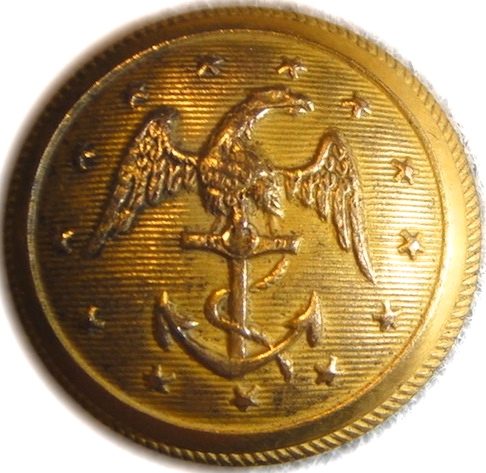 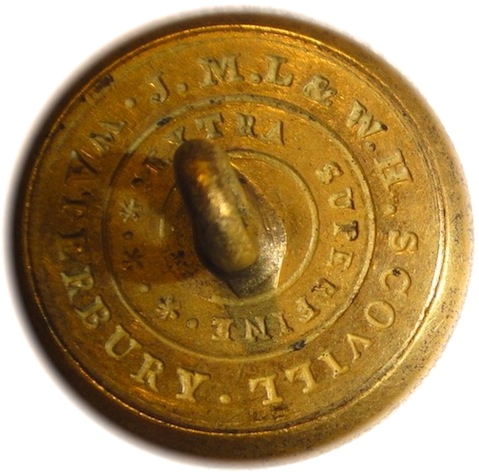
1835-50 United
States Navy Button
Color: Tarnished Brass Yellow.
Metal: 2-Piece, Low-Convex, Raised Design,
Gilded Brass.
Size: 22mm.
Coat Size
Albert's Number: NA
106: RV 5
Tice's Number: NA212A.13
Variation: 13
Five-Pointed Stars.
Present Condition: A
Non Excavated Example, Exceptional Planchet Casting,
Exceptional High Relief Pattern.
Isabela's Notes: There are many manufacturer's
die variants for this popular pattern. The pattern
was manufactured for 15 years, and several companies
had more then one back mark. The button's pattern
depicts an eagle standing on the stock of a raised
anchor. The eagle is facing left with spread wings.
The Anchor's rope dangles off the left hand-side of
the stock and goes under and over the shaft, and
then hangs under the left fluke. There is 13
five-pointed stars that encircle the eagle. The high
relief pattern is set on a lined field with an inner
raised border and an outer roped edge.
Reverse Button Analysis: This
is a two-piece button with a loop shank. The shank
is original, straight, and intact.
|
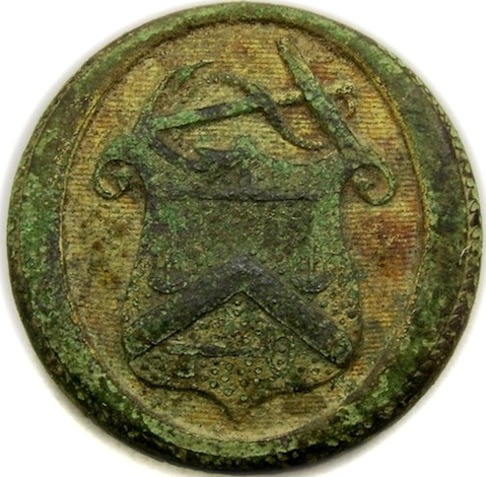 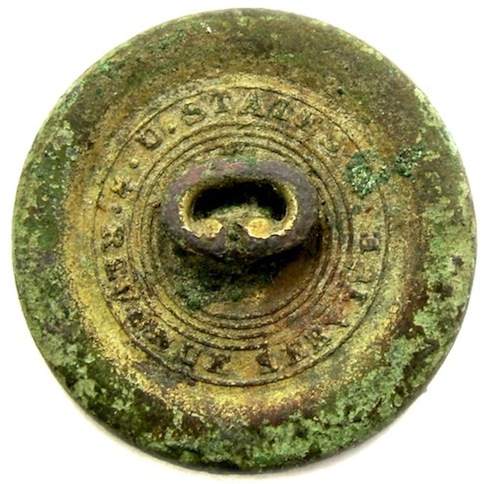
|
1820's to 1830's The Revenue Marines
Color:
A Sea Green with Golden Highlights
Metal:
Flat, 1-Piece, Raised Design, Gilt Brass.
Size: 26 mm.
Coat Size
Variation: Treasury
Shield / Horizontal Fouled Anchor /
Chevron
Pointing Upward with Thirteen Large Five-Point Stars /
Balanced Scales.
Albert's Number: FD 1: RV 25
Isabela's: RV
50
Tice's Number: RM 200B.2
Present Condition: An Excavated Example, Good Planchet Casting, Good Relief
Pattern.
Isabela's Notes: To insure
that the U.S. Treasury
received their payment for import duties, Congress established the Revenue Marines in 1790. Their
primary duty was to prevent smuggling, and ensure the collection of monies owed
from imported goods. When the Civil War began, this service was brought under the Navy Department, and was renamed, The Revenue Cutter Service in 1863. Even though the Revenue Marines didn't officially adopt a
button pattern until 1834,
they still used a mixed federal
branch version of a Treasury Shield and a Horizontal
Navy Fouled Anchor. Even though no regulation existed, this pattern was used as early as the 1820's. After the Civil War, the newly re-named "Revenue Cutter Service"
changed it's buttons to bare the initials, "US". In 1915, the Revenue Cutter Service combined all the services of lifesaving, marines inspection, lighthouse duties, and navigational services into what we call today the modern Coast Guard. The
specimen above is the earliest known pattern to be used
and worn by the Revenue Marine personal. There doesn't appear to be an officer's pattern that differentiates from
regular personal. We know of two die variants. One has
larger stars in the chevron, and one has an V-Shape
anchor stock.
The button's pattern depicts is a large
Treasury Shield
with a surmounting
Horizontal Fouled Anchor.
The anchor's crown is barbed and the stock is slightly
slanted. Within the shield
is a Chevron
Pointing Upward with Thirteen Large Five-Point Stars.
Above the chevron is
a depiction of
Balanced Scales. Under the
chevron is a
Period Type Key on a field of raised
dimples. The high relief pattern is set on a lined
field within a flat oval picture frame border and a pipe
rope trim edge.
Reverse Button Analysis: A
one-piece button with a loop shank. The original shank is bent upward. .*. U.STATES.*.REVENUE SERVICE rm
The
RJ Silverstein Collection. |
|
|
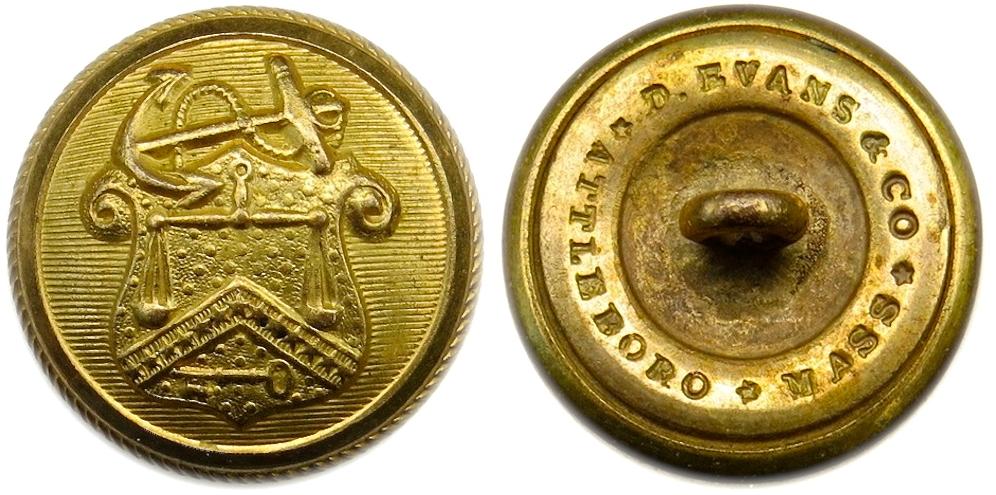
|
1850-63 Revenue Marines
Color: Gold Bar.
Metal:
Slightly Convex, 2-Piece, Raised Design, Gilt
Brass.
Size: 22.95
mm. Coat Size
Albert's Number: FD
4:
RV
5
Tice's Number: RM209A.3
Variation: Treasury
Shield /
Horizontal Fouled Anchor /
Chevron
Pointing Upward with Thirteen Five-Point Stars /
Balanced Scales.
Present Condition: A Non Excavated Example,
Exceptional Planchet Casting, Exceptional High Relief
Pattern.
Isabela's Notes: This button was acquired from items
once owned by Albert G. Browne. He was the supervising
agent for the US Treasury Dept. During the Civil War he
would have worn this button while he was serving along
side of General Sherman during his Georgia campaign.
Albert Browne was also the man credited with the idea of
General Sherman giving President Lincoln the city of
Savannah for Christmas of 1864. The Revenue Marine
Service was established in 1790 under the US Treasury
Dept. insure
against smuggling, and receive monies owed for
import/export duties. This specific button was most
likely a transitional button before changing into the
Revenue Cutter Service in 1863; when it was brought
under the Navy Department. During this time period of
1850-60's several variations of the pattern are noted.
Some later manufactured patterns included 7, 9, or 11
Crosses instead of Stars within the chevron, rope edge
variation, and some bore the US initials on the obverse.
In 1915, the Revenue Cutter Service combined all the
services of lifesaving, marine inspections, lighthouse
duties, and navigational services into what we call
today the modern Coast Guard. The example above is a
pre-civil war button that was worn by Revenue Marine
personal. As noted prior, there doesn't appear to be an
officer's pattern that differentiates from personal. The
button's pattern depicts is a large
Treasury Shield
with a surmounting
Horizontal Fouled Anchor. Within the shield
is a Chevron
Pointing Upward with Thirteen Five-Point Stars.
Above the chevron is
a depiction of
Balanced Scales. Under the
chevron is a
Period Type Key on a field of raised
dimples. The high relief pattern is set on a lined
field within a picture frame border with a plain angled
raised border and rope trim edge.
Reverse Button Analysis: This
is a two-piece button with a loop shank. The shank is
original, straight, and intact. * D. EVANS & CO. * ATTLEBORO
* MASS dm depressed well for shank.
The
RJ Silverstein Collection.
|
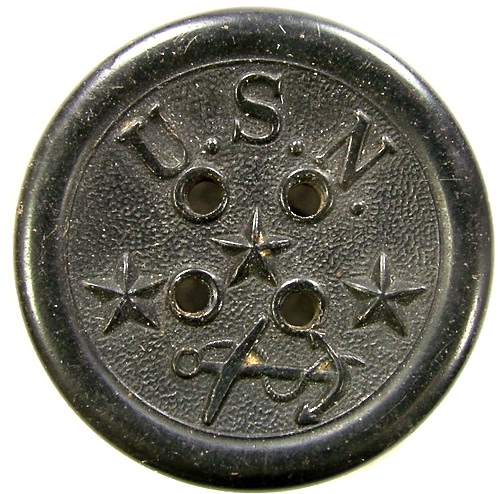 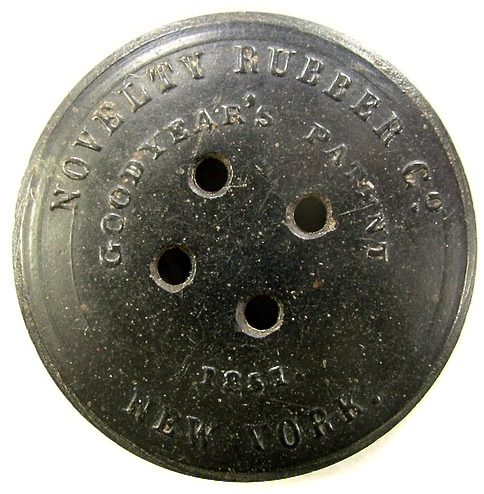
1849-51 United States Navy
Color: A
Dirty Black.
Metal: 1-Piece, Slightly Concave, Raised
Design, Hard Rubber.
Size: 35mm. Coat
Size
Albert's Number: NA
137-A.2: RV 3
Tice's Number: NA 244C.1
Variation: Horizontal
Anchor with A Slanted Stock / Periods Between
Initials / Raised Rim Sew Holes.
Present Condition: A
Non Excavated Example, Strong Planchet Casting,
Strong High Relief Pattern.
Isabela's Notes: This button was intended
for the Navy's enlisted men. There are three
known die variants. One with periods after the
initials, and without periods; and one with a
vertical anchor with periods. The size and slant
on the horizontal anchor specimens also differ.
Lastly, there are some specimens in all three
variants without raised rims around the sew
holes. The button's pattern depicts the
initials, "U.S.N." arced
above with the periods
between the initials.
Underneath, there are three beveled five-pointed
stars stretching from the center to the raised
border. There is a horizontal
raised anchor with a slanted stock on
the bottom.
The rope comes off the anchor's top ring on the
left, and then goes under the stock, under and
over the shaft, then under the fluke, and
finally dangles below the crown. There are four
large sew holes with raised
rims surrounding
the center star. The high relief pattern is set
on a stippled field with a large round border.
Collector's seek double patent date backmarks.
Reverse Button Analysis: This is a
one-piece button with four holes. NOVELTY RUBBER
Co. NEW YORK. / GOODYEAR'S PATENT 1851.
Picture Courteous of Harry Ridgeway.
|
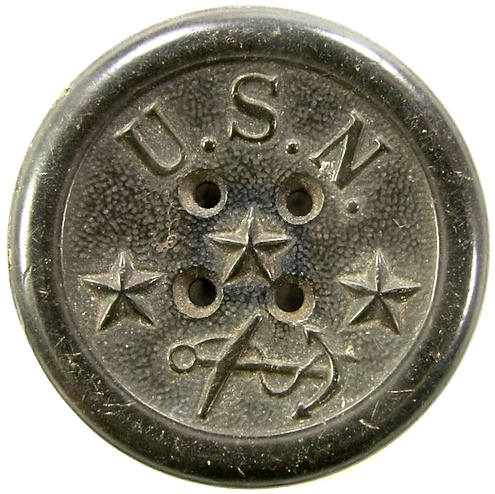 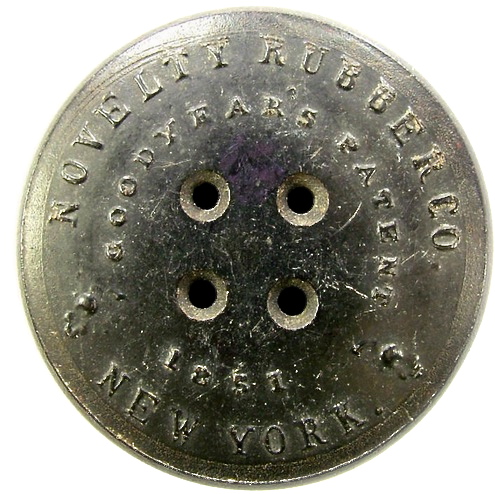
1849-51 United
States Navy
Color: A Dirty Black.
Metal: 1-Piece, Slightly Concave, Raised
Design, Hard Rubber.
Size: 35mm. Coat
Size
Albert's Number: NA
137-A.2: RV 3
Tice's Number: NA 244-B.1
Variation: Horizontal
Anchor with A Slanted Stock / Periods Between
Initials / Without Raised Rim Sew Holes.
Present Condition: A
Non Excavated Example, Strong Planchet Casting,
Strong High Relief Pattern.
Isabela's Notes: This button was intended
for the Navy's enlisted men. There are three
known die variants. One with periods after the
initials, and without periods; and one with a
vertical anchor with periods. The size and slant
on the horizontal anchor specimens also differ.
Lastly, there are some specimens in all three
variants without raised rims around the sew
holes. The button's pattern depicts the
initials, "U.S.N." arced
above with the periods
between the initials.
Underneath, there are three beveled five-pointed
stars stretching from the center to the raised
border. There is a horizontal
raised anchor with a slanted stock on the
bottom.
The rope comes off the anchor's top ring on the
left, and then goes under the stock, under and
over the shaft, then under the fluke, and
finally dangles below the crown. There are four
large sew holes with Without raised
rims surrounding
the center star. The high relief pattern is set
on a stippled field with a large round border.
Collector's seek double patent date backmarks.
Reverse Button Analysis: This is a
one-piece button with four holes. NOVELTY RUBBER
Co. NEW YORK. / GOODYEAR'S PATENT 1851.
Picture Courteous of
Harry Ridgeway.
|
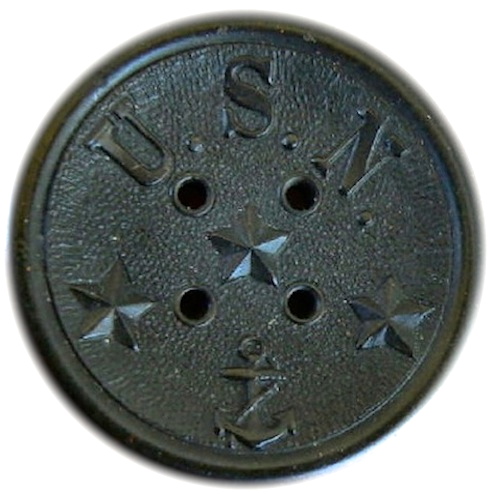 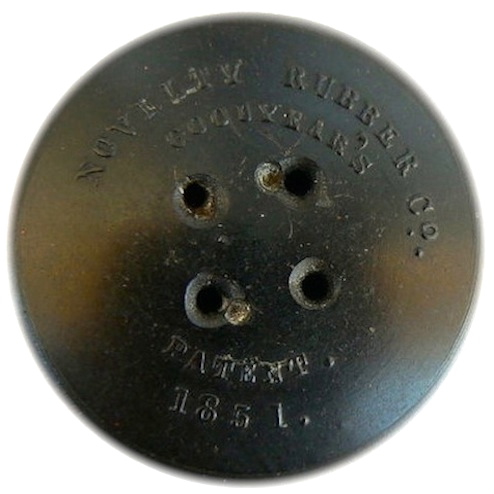
|
1851-65 United States Navy
Color: A Dirty Black.
Metal: 1-Piece, Slightly Concave, Raised Design,
Hard Rubber.
Size: 32mm. Coat Size
Albert's Number: NA 136-A.2: RV 3
Tice's Number: NA 241-A.1
Variation: Small Vertical Anchor / Periods
Between Initials / Raised Rim Sew Holes.
Present Condition: A Non Excavated Example,
Strong Planchet Casting, Strong High Relief Pattern.
Isabela's Notes: The navy purchased many of this
type for it's enlisted men between 1851-65. There are
three known die variants. The button's pattern depicts
the initials, "U.S.N." arced above with the periods
between the initials. Underneath, there are three
beveled five-pointed stars stretching in a chevron V
from the center to the raised border. There is a small
vertical fouled anchor on the bottom. The rope comes off
the anchor's top ring on the left, and then goes under
the stock, then over the shaft, then under the right
fluke, and finally dangles below. There are four large
sew holes with with raised rims surrounding the center
star. The high relief pattern is set on a stippled field
with a large round edge border. Collector's seek double
patent date backmarks.
Reverse Button Analysis: This is a one-piece
button with four holes. NOVELTY RUBBER Co. / GOODYEAR'S
PATENT. / 1851. |
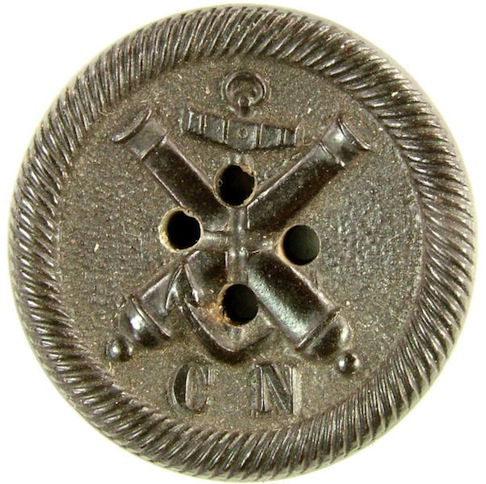 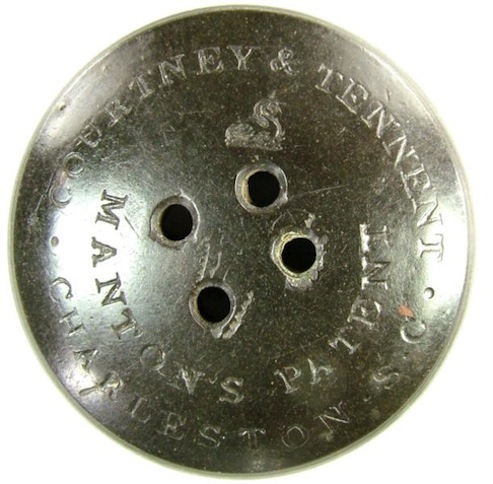
1861-65
Confederate States Navy
Color: A Sandy Grey.
Metal: 1-Piece, Raised Design, Hard Rubber.
Size: 33mm. Coat
Size
Albert's Number: CS
60-A: RV 75
Tice's Number: CSN222A.1
Variation: Vertical
Fluted Anchor with Slanted Stock / Initials, C N
Below
Present Condition: A
Non Excavated Example, Strong Planchet Casting,
Strong High Relief Pattern.
Isabela's Notes: This button was intended for
enlisted men for the ship CSS Texas. Commander
George Terry Sinclair specifically ordered these
buttons from an English manufacturer for the
Confederate Warship CSS Texas. This powerfull ship
was being constructed in the England's Thomson
shipyard, but when the English lost faith in the
American cause, it was seized and sold to another
foreign power. The buttons were never issued and all
were recovered from Sinclair's estate. The button's
pattern depicts a large vertical
fluted anchor with a slanted stock in
the center. Over the anchor is a set of cross
cannons with a notched out cross in the center. This
cross is accompanied by an adjoining sew hole. The
Anchor's right fluke is on top of the right cannon.
The initials
"C N" appear underneath the crown.
The whole high relief pattern is set on a stippled
filed with a cable border.
Reverse Button Analysis: This is a
one-piece button with four holes. COURTNEY & TENNENT./CHARLESTON.S.C./MANTON'S
PATENT dm with a swan above.
|
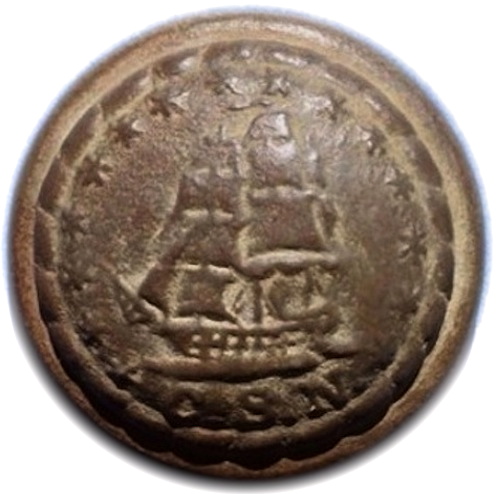 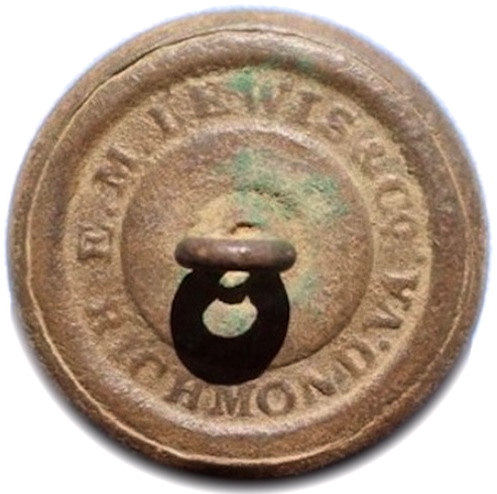
1861-65
Confederate States Navy
Color: Dusty Brown.
Metal: 2-Piece, Convex With Flat Border, Raised
Design, Cast White Metal.
Size: 23mm.
Coat Size
Albert's Number: CS
68-A: RV 150
Tice's Number: CSN270A.1
Variation: Man-of-War
/15 Six Pointed Stars.
Present Condition: An
Excavated Example, Strong Planchet Casting, Strong
High Relief Pattern.
Isabela's Notes: Probably the most attractive
button the south ever manufactured. This button's
pattern depicts a Man-of
War under sail.
The ship is partially surrounded above by an arc of 15
five pointed stars. The
initials, "C S N" lie below the ship. Encircling the
stars is an outer rope decorative border witch leads
to a flat edge. The whole high relief pattern is set
on a plain convex field.
Reverse Button Analysis: This is a
two-piece button with an integral shank. The shank
is original, straight, and intact. E.M.LEWIS & Co/ RICHMOND.VA.
rmdc
|
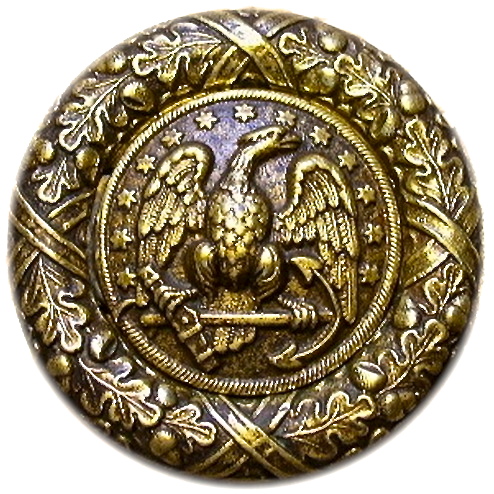
GO BACK -
TOP
|