|
~ State Militia Units ~
Even though the Militia existed in the
colonies before the battle of Lexington & Concord, I think it best to
begin after 1789 when George Washington was elected
President and the new US government formed under the
Constitution. The first use of a semi federal-army was in
1794, when George Washington raised and led
13,000 state militia to quell the Whiskey Rebellion in
Pennsylvania. The experience of unifying and leading a
citizen based state militia system demonstrated to
Washington that our
country in time of war would have a major weakness compared
to other countries who would have a well trained and
disciplined army. The various state militia units were only a loose knit
affiliation of citizens that lacked the necessary military discipline.
Another major problem was the inadequate field training for officers and
engineers. In a letter to General Alexander Hamilton he
writes," The establishment of a military academy upon a
respectable and extensive basis has ever been considered by
me as an object of primary importance to this country; and
while I was in the chair of government, I omitted no proper
opportunity of recommending it to my public speeches, and
otherwise to the attention of the legislature."
Being mindful of the
country lacking a strong unified military army, President Washington repeatedly warned
Congress of these military
short-comings throughout his administration and up until his death in 1799.
Finally, in 1802, the
federal military academy at West Point was established. This
was the answer to the United States problem of relying on a
state based militia system and relying on foreign
mercenaries for protection. In the beginning, there
was a lack of appropriate funds by Congress for it's military
personal. Federal soldiers were given rations and were very
limited on military equipment. On the other hand, state's militia units were more
properly outfitted, and were given very generous private
donations. Unfortunately, money doesn't buy experience,
discipline or training. I would have to personally say they
were ceremonial in nature. Most of these units were run by
egocentrically rich citizens who presumed un-earned ranks of
officers. It wasn't until the war of 1812, when the various state's
militia units were overcome by British regulars that the US
Congress came to realize the real consequences of
Washington's warning about the use of state based citizen
militia units. After the War of 1812, Congress
increased it's military budgets drastically, and from this
point on a Federal Standing Army was deemed better for the
national defense. State's militia units continued service by
maintaining public order, but were primarily used in slave
holding states where there principle duties was to round up
run away slaves. In the years of peace between the War of
1812 and the Civil War, but the state militia's fell into a
"name only" ceremonial-parade marching units at best. They
lacked any real war skills, field training, or anything that
resembled adequate combat training. Local communities
militia had never even drilled together as a larger
regiment. By the time the Civil War came around, the US Army
only consisted of a paltry 16,000 men, and both sides
equally rushed to prepare. Following the Confederate Army
taking Fort Sumter in 1861, President Lincoln called up the
states militia to re-take the Federal seized property and
found that the states militia was far inadequate for the
task.
He writes, "…strength was far short of what the
Congressional Statute provided and required." By the summer
of 1861, military camps started to crop up and circle around
Washington, D.C. They composed of new three year enlistment
of Army Volunteers, and 90 day State Militia Units. The
generals that Lincoln placed in charge of these men were
simple inexperienced civilians who have never handled large
bodies of men, and they lacked military combat training.
There granted positions lacked military discipline, and they
had a less understanding of the importance of discipline for
war.
This is why i choose to honor the Ancient & Honourable
Artillery Button on my home page. It is a prime example of
how an Ancient Militia was a well known fighting unit for
over two hundred years, and then turned ceremonial over
time. By the time the Civil War came around they were only
recognized by their former reputation. ~ We honor those men
who gave of themselves, and appreciate their sacrifices to
have the Liberties and Freedoms we enjoy today as U.S.
Citizens. God Bless America. ~ Robert Silverstein.
Robert's Notes: Most states usually gave their militia free
reign in choosing their buttons and accoutrements for their
uniforms. A lot of Militia Units choose patterns that had
their own state's coat of arms, but the units without the
resources to have their own dies cut, had the option of
asking the garment maker to request manufacturer supplied
"federal type specimens" with motifs similar to those U.S.
Army Buttons issued between 1800 to 1825.
Yes Robert I would have to agree with your assessment of
general service patriotic eagle designs. Remember that local
militia units of this period were loosely organized
following state and federal regulations, but were locally
recruited and financed, they followed the regulations that
they wanted to follow and there would have been lots of
vendors offering supplies, and they pretty much made their
own buying decisions. They bought uniforms from various
garment makers, the garment makers bought buttons, sometimes
specified, sometimes generic, these buttons you asked about
could have been sold to other units and other states. The
star count on most of these early buttons is artistic,
whatever the artist thought would do. If a star count is not
13, it probably is artistic and not symbolic.-
Harry Ridgeway
Robert's Collector's note on Federal
General Service &
State Militia Federal Style Buttons: From my understanding,
the Federal government regulated, and governed the designs
and dimensions for buttons manufactured to be used by the US
Army. Manufacturers were awarded the contracts, and
furnished these Federal specimens. Either two things
happened at this point. 1) After a time, the Federal
Government could have let contracts go in way of new designs
and patterns; or the manufacturers were held under no
restrictions to sell these Federal Style buttons to other
interested parties. In the early 19th Century, there was a
lot of garment makers who would receive contracts by the
various state militia units for uniforms. If a die wasn't
created for a specific unit's button, the garment maker
would supply these Federal Type buttons. Usually, under a
sub-contract they would get these from the original button
manufacturer who produced them under federal contract. As
part of the sub-contract, the garment makers would request
the manufacturer to have their name over stamp the
manufacturers on the reverse.
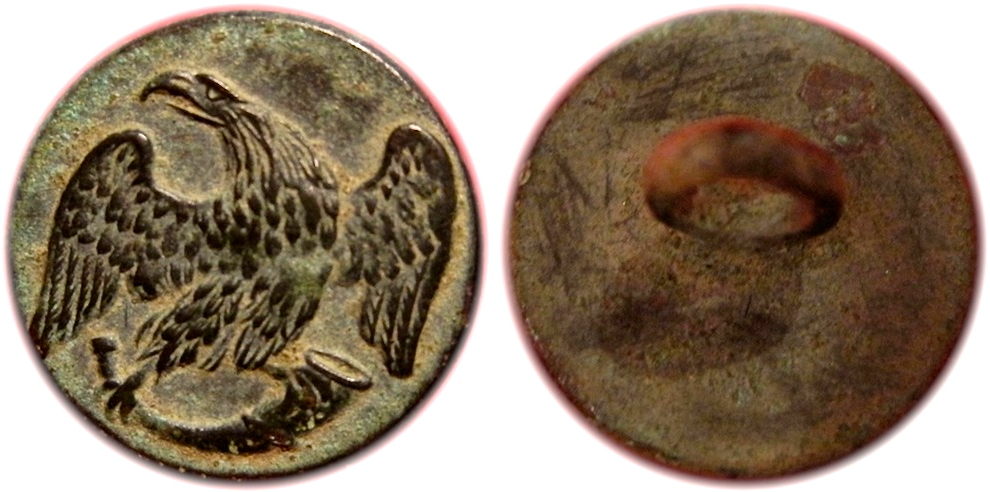
1808-20's Militia Rifles
Color: A Coppery Brown with White Encrustations.
Metal: Flat, 1-Piece, Raised Design, Brass
Size: 14.5mm. Cuff Size
Albert's Number: Unlisted Die Variant: RV 100
Variation: Spread-Wing Eagle facing Right / Hunting Horn
Pointing Toward the Left / Federal Eagle.
Present Condition: An Excavated Example, Good Planchet
Casting, Good High Relief Pattern.
Isabela's Notes: This is an early rifleman button that would
have been supplied by the garment maker when the uniforms
where ordered by state militia units. There appears to be
only one die variant known to date with the hunting horn
facing left. I believe the buttons with a blank back mark
could have been possibly made in South Carolina, before the
war. There are some higher quality similar patterns with
stars in the field and have Double Gilt back marks, but I
believe they were made by an English manufacturer. The
button's pattern depicts a
Spread-Wing Eagle facing Right,
while standing on a
Hunting Horn pointing toward the Left.
The eagle depicted in this pattern is more of a modern style
Federal Eagle. The high relief pattern is set on a plain
flat field with a flat edge.
Reverse Button Analysis: This is a flat one-piece button
with a loop shank. The shank is original, straight, and
intact. No back mark.
Dug in South Carolina.~
The Bill Cross Collection.
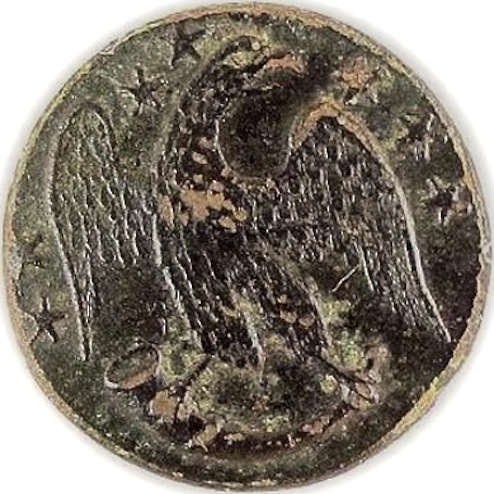
1808-25 Militia Rifles
Color: Silver and Browns.
Metal: Flat, 1-Piece, Raised Design, Gilt Brass?
Size: 18mm. Cuff Size
Albert's Number: Unlisted: RV
100
Variation: Hunting Horn / Seven Stars / Goose Neck.
Present Condition: An Excavated Example, Good Planchet
Casting, Good High Relief Pattern.
Isabela's Notes: This button was most likely used by the
early southern militia rifle units. This button was most
likely made by an English manufacturer, because of the
double gilt back mark. There are two die variants with this
pattern that I know of, but there are possibly more. This
button was most likely ordered by the garment makers to
place on the uniforms for the militia units that placed
orders and wanted a Federal Type. Several buttons with this
pattern have been found in various states like, South
Carolina, Georgia, and even Florida. There are two die
variants I know of, but there could be possibly more. The
only major difference in the two patterns is the eagle
depicted. This button's pattern depicts a droop wing eagle
facing left, while standing on a
Hunting Horn
that is
pointing toward the right. The eagle depicted in this
pattern is more of an old style, with the long thin
Goose
Neck. There are
Seven Stars
surrounding. The high relief
pattern is on a plain flat field with no edge border.
Reverse Button Analysis: This is a flat one-piece button
with a loop shank. The shank is original, straight, and
intact. Double Gilt rm.
William, I received a submission of two early 1-piece 1800's
Militia Rifles buttons today, but having a tough time
swallowing the location of the dig site. Digger claims
Texas, but with my knowledge, I was thinking Georgia,
possibly South Carolina. Can you offer any guidance?
Robert, there is no reference for them....not in Albert's or
Tice's as you have likely discovered (though, you might want
to check the addendum in Albert's to be sure...I don't know
what is in there by heart.
For accuracy sake, I would urge some skepticism with the
Texas find location....make certain of it. Were they LA
finds, I could buy in, but not buying in that there was any
post in Texas as early as these buttons (that said of
course, anything can be found anywhere for a variety of
reasons....just wondering about the accuracy of the report).
With helpful intent, only, Yes. The examples that I have
seen have come primarily from SC, but also a couple from
FL....hence, GA makes sense. Coastal, if you are a betting
man! Be well...off to the Franklin Show, shortly. William
Leigh.
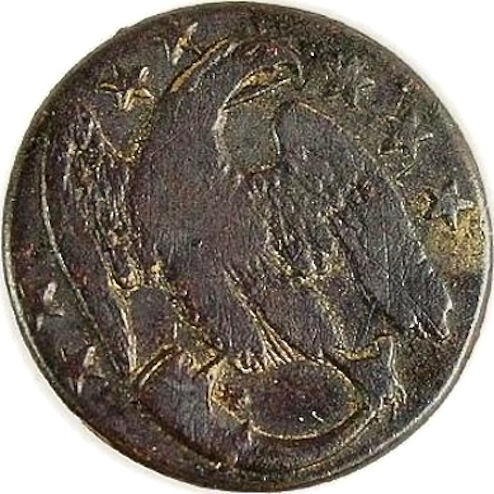
1808-25 Militia Rifles
Color: Silver and Browns.
Metal: Flat, 1-Piece, Raised Design, Gilt Brass?
Size: 17mm. Cuff Size
Albert's Number: Unlisted: RV 100
Variation: Hunting Horn / Seven Stars / Fuller Body.
Present Condition: An Excavated Example, Good Planchet
Casting, Good High Relief Pattern.
Isabela's Notes: This is the second known pattern that was
used by southern militia rifle units. This button was also
most likely made by an English manufacturer. There are two
die variants with this pattern, but there could be possibly
more. This button was most likely ordered by the garment
makers from the manufacturers to place on the uniforms for
the militia units that placed orders, and wanted a Federal
Style Button. Several buttons with this pattern have been
found in various states like, South Carolina, Georgia, and
even Florida. There are two die variants I know of, but
there could be possibly more. The only major difference in
the two patterns is the eagle depicted. The button's pattern
depicts a droop wing eagle facing left, while standing on a
Hunting Horn
pointing toward the right. The eagle depicted
in this pattern is more of a newer style with a
Fuller Body.
There are
Seven Stars
surrounding. The high relief pattern
is on a plain flat field with no edge border.
Reverse Button Analysis: This is a flat one-piece button
with a loop shank. The shank is original, straight, and
intact. Double Gilt rm.
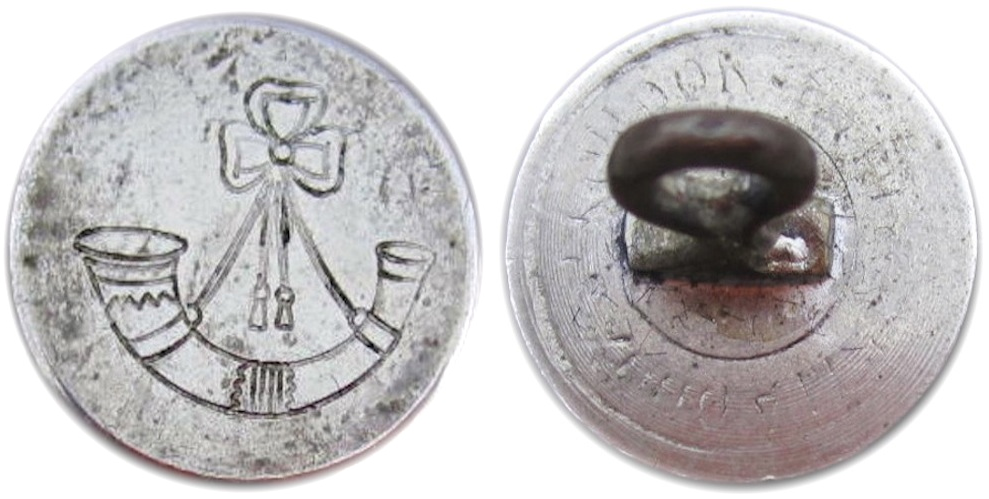
1808-25 Militia Riflemen
Color: An Ochre of Greens, Browns & Yellow.
Metal: Flat, 1-Piece, Engraved Design, Sheffield Silver.
Size: 15mm. Cuff Size
Albert's Number: Unlisted Variant: RV 175
Variation: Hunting Horn / Corded Bow / Two Cord Tassels.
Present Condition: An Excavated Example, Strong Planchet
Casting, Strong Engraved Pattern.
Isabela's Notes: This rare cuff button was manufactured in
England, and most likely made for an officer in the Militia
Rifles. England manufactured several militia rifle patterns
over the next 25 years, so there are few known patterns in
the market, but they are all exceedingly rare. To my
knowledge, several similar patterns have been found in
various southern states, such as, South Carolina, Georgia,
and Florida. The button's pattern depicts a decorative
Hunting Horn
pointing toward the right. The corded sling has
a big
Decorative Bow
ties at the top, with
Two Cord Tassels
hanging below. The engraved design is on a plain flat field
with thing edge border.
Reverse Button Analysis: This is a flat one-piece button
with an Omega style loop shank. The shank is original,
straight, and intact. LONDON
The RJ Silverstein Collection.
* Several English Reproductions were made in a White Metal.
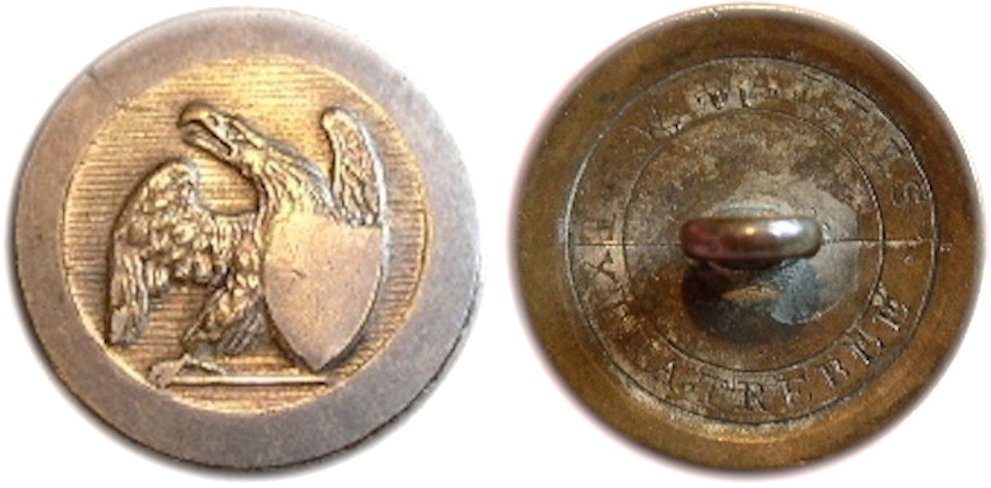
1808-25 Militia Infantry Officer's Button
Color: Silver with Green Encrustations.
Metal: Flat, 1-Piece, Raised Design, Silver Plated Copper.
Size: 20mm. Coat Size
Albert's Number: GI 53R2-F or GI 53R6-F: RV 45
Variation: Head Tilted Up / Round Lined Field / Wide Edge
Border.
Present Condition: An Excavated Example, Good Planchet
Casting, Good High Relief Pattern.
Isabela's Notes: This series was originally manufactured by Armitage, and was intended for Federal Government Infantry
officers. It was manufactured in large quantities, and some
of the stock was boughten by W.Wallace at some point.
Wallace most likely had Armitage over stamp their back mark
with his name on the reverse. Understanding what I have
learned about early button sub-contracts, Wallace most
likely bought Armitage's extra stock so they could supply
these federal type specimens on the uniforms purchased by
state militia units. Just a reasonable conjecture; My
reasoning is the uniforms themselves were Wallace's main
contract. This button's pattern depicts a standing eagle
with upraised wings facing right. In this die variant, the
eagle's Head is Tilted Up, and away from the top of the
wing. Under the eagle's left wing is a large blank unstamped
shield. The high relief pattern is set on a flat Lined
Field, that is within a round picture frame that has an
angled Wide Edge Border.
Reverse Button Analysis: This is a one-piece button with a
loop shank. The shank is original, straight, and intact.
Armitage overstamp> W.WALLACE EXTRA TREBLE dm within 2 ring
dm.
Picture Courteous of Jim
Dews.
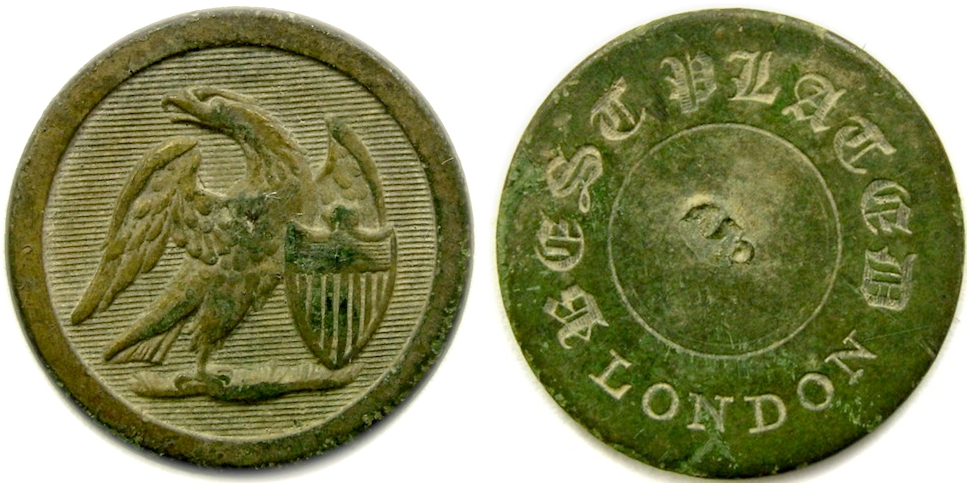
1830-40's State Militia Infantry Units - Federal Style
General Service Button
Color: An Olive Brown With Yellow Undertones.
Metal: Flat, 1-Piece, Raised Design, Silver Plated Copper.
Size: 23mm. Coat Size
Albert's Number: GI 56:
RV 25
Variation: Droop Wing Eagle / Lined Federal Shield.
Present Condition: An Excavated Example, Strong Planchet
Casting, Strong High Relief Pattern.
Isabela's Notes: This English manufactured button
in the 1820-30's, and could have been used by any state's
militia unit in the 1830-40's. This button's pattern depicts
a
Droop Wing Eagle
facing right, while standing upon a grassy mound. Under the
eagle's left wing is a Lined Federal Shield. The
high relief pattern is set on a lined field that is within a round
picture frame flat border. During this
era, most states allowed their militia to have freedom in
choosing their uniforms, accouterments, and buttons. This is
the harder general service button to acquire for collectors.
Shank specimens are a bit more rarer.
Reverse Button Analysis: This is a one-piece button with a
copper loop shank. The shank is missing. BEST PLATED in old english script letters / LONDON dm inner single ring.
The Picture is Courteous of H. Ridgeway.
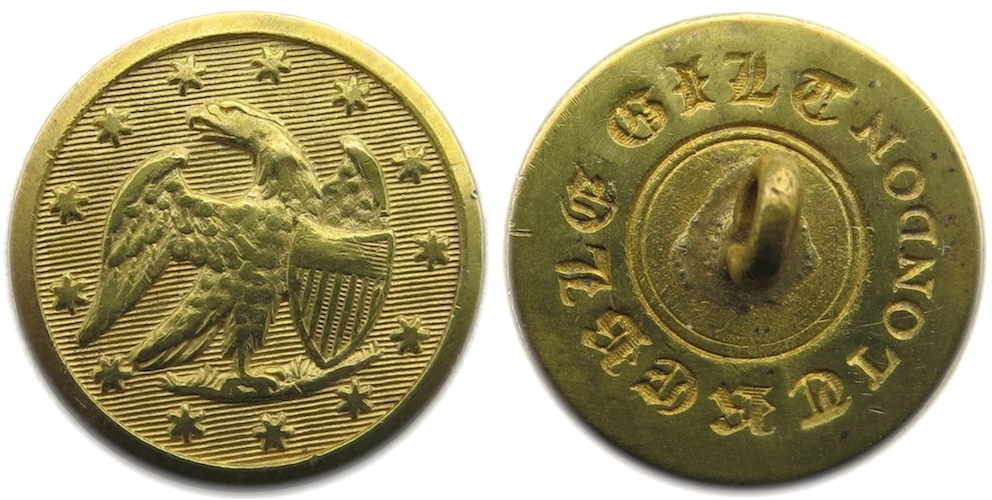
1830-40's State Militia Infantry Units
Color: A Golden Brass.
Metal: Flat, 1-Piece, Raised Design, Gilt Brass.
Size: 21.86mm. Coat Button
Albert's Number: GI 57:
RV 20
Variation: Eagle
with Upraised Wings / Lined Federal Shield / 13 Six-Pointed
Stars.
Present Condition: A Non Excavated Example, Exceptional
Planchet Casting, Exceptional High Relief Pattern.
Isabela's Notes: This is another English manufactured
general service button that was made in the early 1820 and
1830's. This
federal type button would have been supplied by English
manufacturers for the garment makers who received orders for
militia uniforms. Being the button was manufactured in Gilt Brass could
indicate that it was intended for state militia officers. This button's pattern depicts an
Eagle
with Upraised Wings
facing right, while standing upon a
grassy mound. Under the eagle's left wing is a
Lined Federal
Shield.
Circling around the eagle is
13 Six-Pointed Stars. The
high relief pattern is set on a lined field, that is within a round
picture frame with a wide edge border. Collectors seek
the harder to find specimens in which the breast feathers
and shield is not worn flat.
Reverse Button Analysis: This is a flat one-piece button
with a copper loop shank. The shank is original, straight,
and intact. Old English> TREBLE GILT /LONDON 2 inner dm
rings around the shank.
The RJ Silverstein Collection.
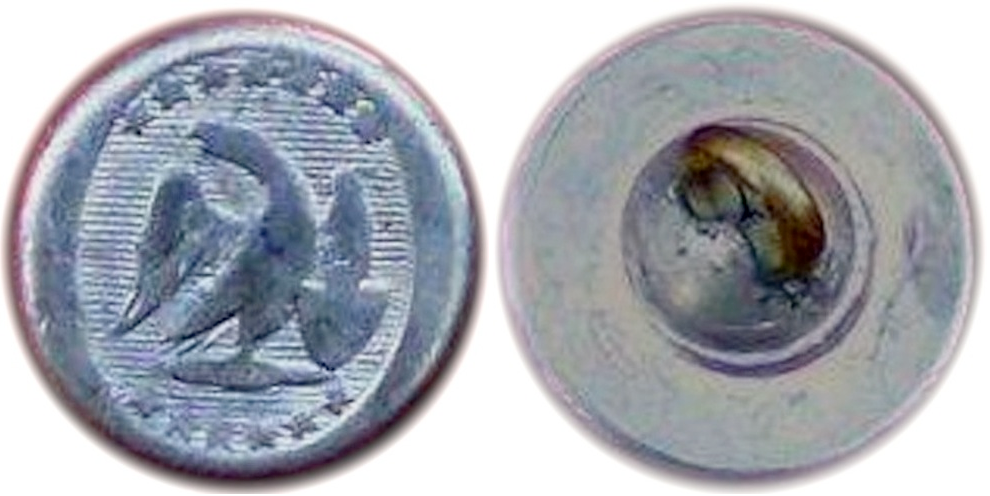
1820-40 Militia Infantry
Color: Bright Cyan Silver.
Metal: Flat, 1-Piece, Raised Design, Pewter.
Size: 13mm. Cuff Size.
Albert's Number: GI 58-Unlisted Size Variant:
RV 20
Variation: Seven Stars Above & Six Stars Below / Small
Shield.
Isabela's Notes:
Reverse Button Analysis: This is a one-piece button with a
brass shank. The shank is original, straight, and intact.
Blank back mark.
Stephen Burgess Collection.
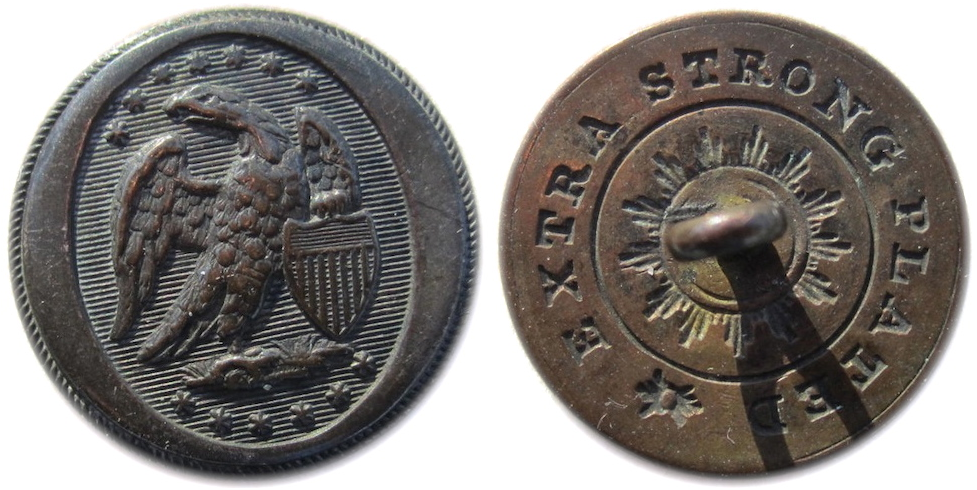
1830-40's State Militia Infantry Units - Federal Style
General Service Button
Color: A Coppery Brown.
Metal: Flat, 1-Piece, Raised Design, Silver Plated Copper.
Size: 22mm. Coat Size
Albert's Number: GI 59-A: RV 10
Variation: Lined Federal Shield / 7 Asterisk Type Six-Pointed
Stars / 6 Asterisk Type Six-Point Stars.
Present Condition: An Excavated Example, Strong Planchet
Casting, Strong High Relief Pattern.
Isabela's Notes: Several manufacturers made this button, and
could have been used by any of the state's militia infantry
units during the 1830-40's. The button's pattern depicts a
Federal Style Eagle
facing right, while standing on a grass mound. Under the
eagle's left wing is a
Lined Federal Shield. Arched above
the eagle is
7 Asterisk Type Six-Pointed Stars, and arched
below is another
6 Asterisk Type Stars.
The button's high relief pattern is set on a lined field
that has a plain flat oval picture frame border with an
outside decorative rope edge. This is a common militia button found in
the market place, but the key is to obtain one with the
breast & wing feathers intact with detail. Uniform suppliers
would have sewn buttons like this onto the garments if a
militia unit didn't specifically order a unit pattern.
Reverse Button Analysis: This is a one-piece flat button
with a wire copper loop shank. The shank is original,
straight, and intact. EXTRA STRONG PLATED dm inner ring/
sunburst pattern around shank
The RJ Silverstein Collection.
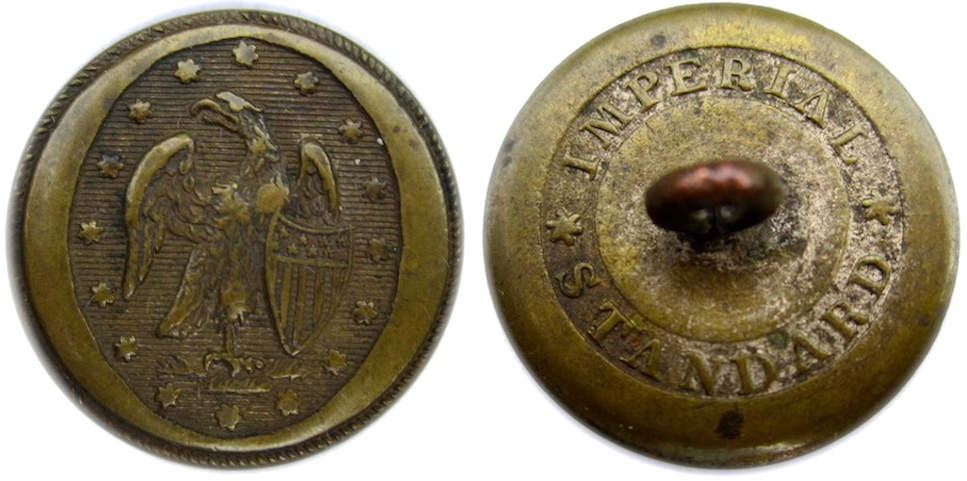
1830-40's Federal Style General Service Button Used By State
Militia Infantry Units
Color: A Tarnished Brass Patina.
Metal: Flat, 1-Piece, Raised Design, Brass.
Size: 22mm. Coat Size
Albert's Number: GI 61-A:
RV 10
Variation: Federal Eagle / Federal Shield with Eight
Stars / Four Stripes / 16 Six Point Stars.
Present Condition: A Non Excavated Example, Exceptional
Planchet Casting, Strong High Relief Pattern.
Isabela's Notes: Even though this back mark dates
early 1830's, this button's pattern could have been used by
any state's militia through the 1840's. This high relief
pattern is set upon a lined oval field with a wide border
and roped edge. The button depicts a
Federal Style Eagle
facing right while standing upon a grass mound. Under the
eagle's left wing is a
Federal shield with Eight Stars
in the top half, and
Four Stripes
in the lower half. Circling around the eagle is
16 Six-Point Stars.
The high relief pattern is set within an oval picture frame
lined field. During this era, most states allowed
their militia to have considerable freedom in choosing their
accouterments and buttons. This is a common militia button found in
the market place, but the key is to obtain one with the
breast & wing feathers intact with detail.
Reverse Button Analysis: This is a one-piece button with a
wire copper shank. The shank is original, straight, and
intact. rm IMPERIAL * STANDARD * set in a depressed channel.
The RJ Silverstein Collection.
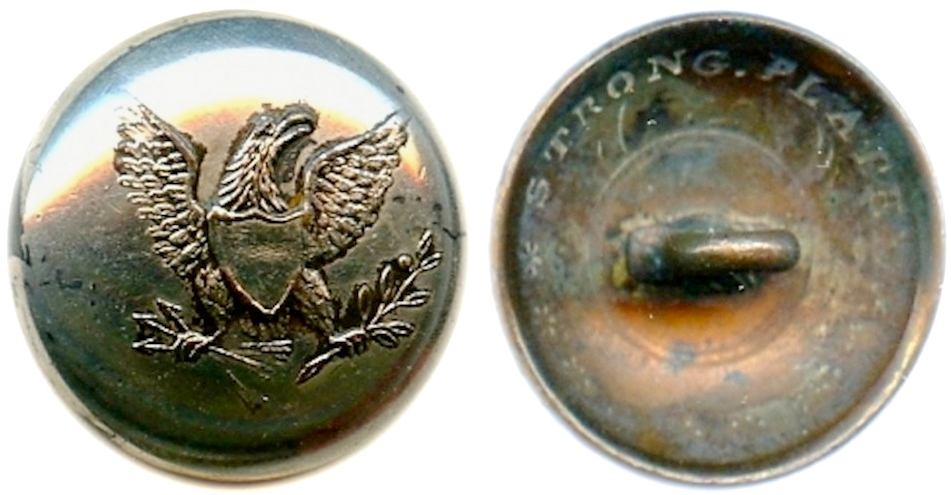
1820's Militia Infantry Officer's Button (General Use)
Color: Tarnished Silver.
Metal: 1-Piece, Convex, Raised Design, Silver Plated Copper.
Size: 22mm. Coat Size
Albert's Number: GI 65: RV 15
Tice's Number: GM135A.1
Variation: Spread Eagle Facing Left / Unmarked Spade
Shape Shield / Long Stem Olive Branch / Three Spread Arrows.
Present Condition: An Excavated Example, Strong Planchet
Casting, Strong High Relief Pattern.
Isabela's Notes: This button was manufactured by A.M Peasley
around 1835 for the state's militia officers. This button's
pattern depicts a
Spread Eagle Facing Left.
There is a slightly slanted
Unmarked
Spade Shape Shield
emblazoned on it's chest. In the eagle's left talon is a
Long Stem Olive Branch
with seven petals and one berry. I the eagle's right talon is a small bundle of
Three Spread Arrows
pointing upward. The high relief pattern is set on a Plain
convex field.
Reverse Button Analysis: This is a concave one-piece button
with a loop shank. The shank is original, straight, and
intact. *****STRONG.PLATED*****
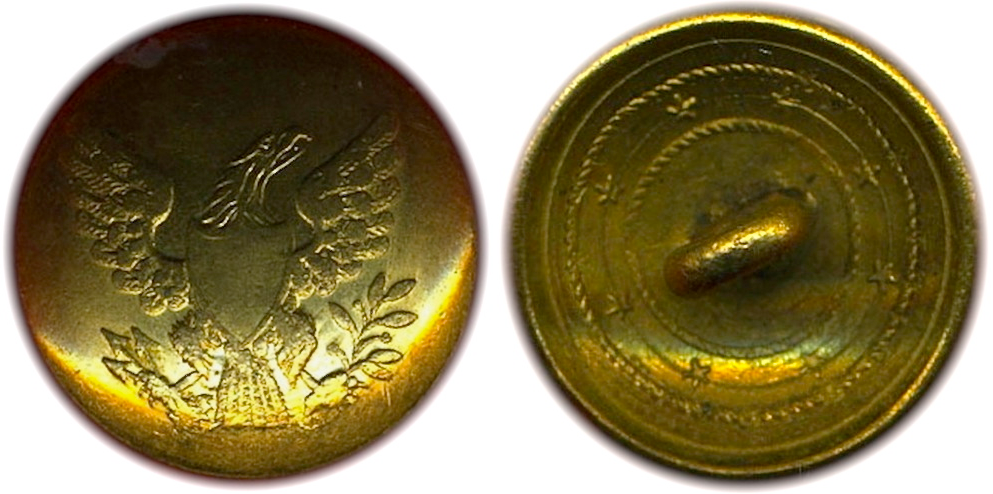
1820's Militia Infantry Officer's Button (General Use)
Color: Darkened Brass.
Metal: 1-Piece, Convex, Raised Design, Gilt Brass.
Size: 20mm. Cot Size
Albert's Number: GI 65-B:
RV 12
Tice's Number: GM135A.1
Variation: Unmarked Shield / Olive Branch with
Six Petals & Three Berries / Long Tail Wide / Three Close
Spaced Arrows.
Present Condition: An Excavated Example, Strong Planchet
Casting, Strong High Relief Pattern.
Isabela's Notes: This button's pattern depicts a spread
eagle with upraised wings facing left. On the eagle's chest
is a large
Un-Marked Shield
with a raised outline border.
This particular die variant depicts the eagle with a
Long Wide Tail. In the eagle's left talon is a short
stem
Olive Branch with
Six Petals and Three Berries. In it's right talon is a small
bundle of
Three Close Spaced Arrows
pointing upward and to the right. The high
relief pattern is set on a plain convex field with no edge
border.
Reverse Button Analysis: This is a concave one-piece button
with a loop shank. The shank is original, straight, and
intact. ******** rm of two rope rings.
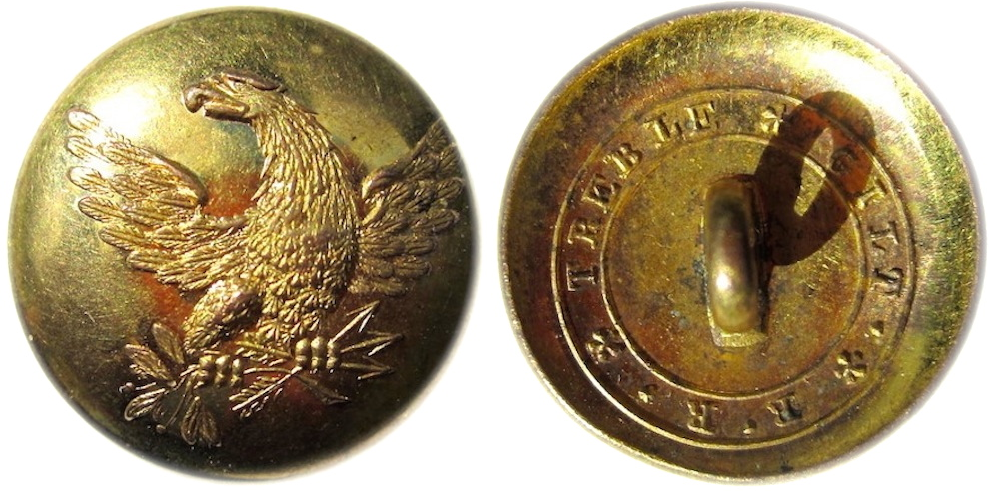
1820's-30's Militia Infantry Units - Federal Style General
Service Button
Color: A Brass Dark Gilt.
Metal: 1-Piece, High Convex, Raised Design, Gilded Brass.
Size: 21mm. Coat Size
Albert's Number: GI 66 A: RV 15
Tice's Number: GM138
Variation: Spread-Wing Eagle / Three Large Arrows /
Olive Branch with Five Petals and Two Berries.
Present Condition: A Non Excavated Example, Exceptional
Planchet Casting, Exceptional High Relief Pattern.
Isabela's Notes: This button's pattern uses the federal
style eagle motif, but without a shield or unit designation.
There are two die variants with this pattern. One produced
in the U.S. by Richard Robinson of Attleborough,
Massachusetts in the 1820's; and the other was of English
manufacture during the 1830's. The button depicts a federal
style
Spread-Wing Eagle
facing right. In it's left talon is a bundle of
Three Large Arrows. In it's right talon is a
short stem
Olive Branch with Five Petals and Two Berries. The raised pattern is set on a
plain convex field with no edge border. This button would have
been available to any state militia unit during the late
1820's to the around 1840. This is a favorite for state
militia button collectors.
Reverse Button Analysis: This is a slightly concave
one-piece button with a copper loop shank. The shank is
original straight, and intact. rm * TREBLE * GILT . * R. R .
within a channel of 2 rm rings.
The RJ Silverstein Collection.
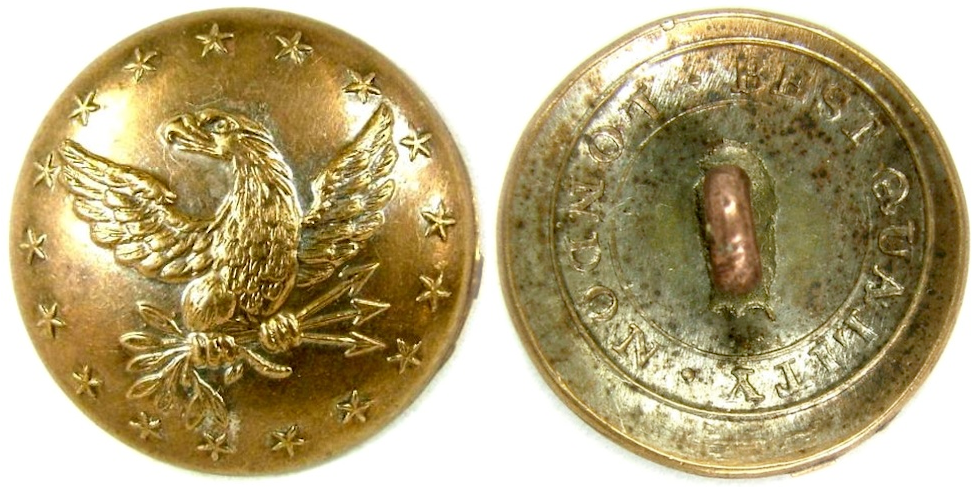
1830-40's State Militia Infantry Units - Federal Style
General Service Button
Color: A Golden Auburn.
Metal: 1-Piece, Low-Convex, Raised Design, Silvered Copper.
Size: 20mm. Coat Size
Albert's Number: GI 67 A: RV 10
Variation: Bundle of
Three Arrows / Short Stem 7 petal Olive Branch / Seventeen Five Pointed Stars / No Shield.
Present Condition: A Non Excavated Example, Exceptional
Planchet Casting, Exceptional High Relief Pattern.
Robert's Notes: This button's pattern uses the same pattern
that Robinson used in the 1820's, but added stars circling
around the eagle on the outer periphery. The button's pattern
depicts a federal style spread-wing eagle facing right.
Clutched in the eagle's left talon is a
Bundle of
Three Arrows
pointing leftward. In it's right claw is a
Short Stem 7 petal Olive Branch.
Circling around the eagle is
17 Five-Pointed Stars. This is an excellent
Specimen of a
"manufactured supplied" federal eagle style button.
This would have been sewn on any state's militia uniform
that didn't have it's own pattern during
the 1830-40's. At this point, I do not believe there
would be a quality difference between the English and
American manufactures; but a side by side comparison does
show the English's die variant to be more fuller in the
olive branch,
and the arrows have thicker shafts. When collectors look for a
specimen, the key is to make sure the breast and wing
feathers aren't worn flat.
Reverse Button Analysis: This is a slightly concave
one-piece button with a copper loop shank. The shank is
original straight, and intact. rm LONDON. BEST QUALITY.
within a channel of 2 rm rings.
The RJ Silverstein Collection.
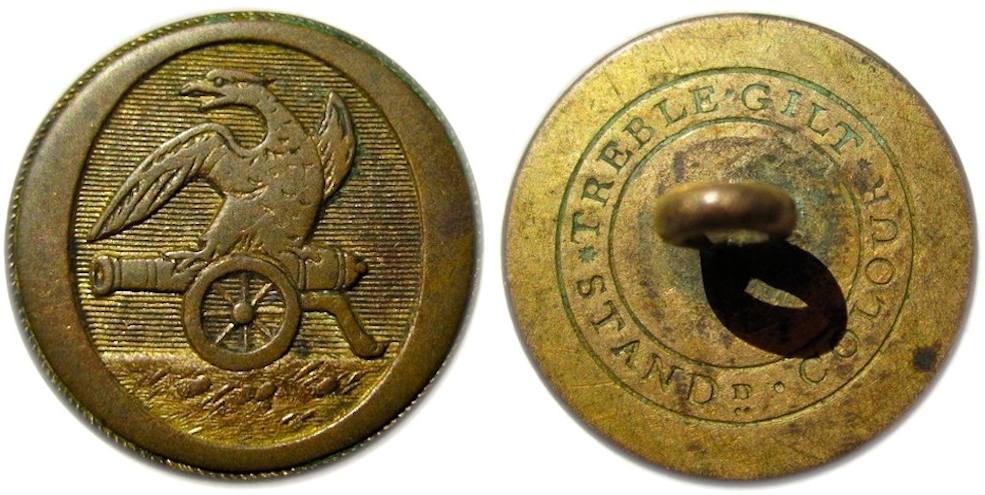
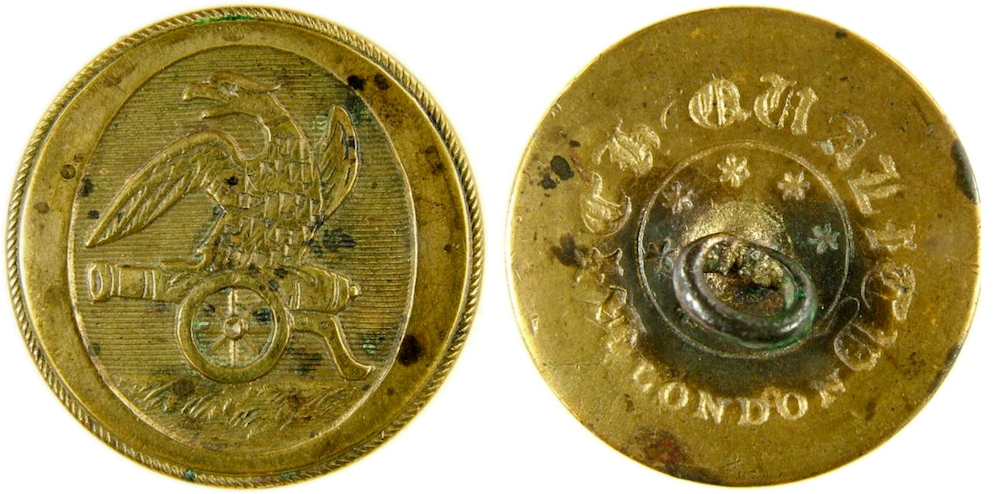
1808-30's Artillery General Use for Federal or State Militia
Units
Color: A Coppery-Brown Gilt.
Metal: Flat, 1-Piece, Raised Design, Gilt Brass.
Size: 23mm. Coat Size
Albert's Number: AY 51-B: Unlisted Variant RV 10
Variation: Ringed Cannon with A Ribbed Breech / Five
Decorative Carriage Bolts / Cannon Sits on a Higher Ground.
Present Condition: A Non Excavated Example, Exceptional
Planchet Casting, Strong High Relief Pattern.
Robert's Notes: This federal style button was
manufactured in England, and could have been used by either
the federal, or state militia artillery units. Albert only
lists two die variants, one with a cannon on higher ground,
the other with a cannon on lower ground. After studying this
series for some time, I found there are several
manufacturers with their own unique variations of the eagle depicted, as well
as the style cannon, and also the placement on the ground.
The button's pattern above depicts a calling eagle with
upraised wings facing right. The eagle is standing on a
Ringed Cannon with a Ribbed Breech. The cannon has a short
carriage which only extends to the back of the wheel. There
are
Five Decorative Carriage Bolts
in this pattern. The
carriage's wheel is round with eight spokes. The
Cannon Sits
on a Higher Ground
in a field of grass. The high relief pattern is set on a
lined field that is within in a wide plain picture frame
border with a rope edge. This pattern was also made in a
smaller size which was used as an officer's epaulette
during the War of 1812.
Reverse Button Analysis: This is a flat one-piece button
with a loop shank. The shank is original and intact, but
slightly bent over. TREBLE GILT * STRANDd.. .COLOUR* within
a CHANNEL OF 2 dm rings.
The RJ Silverstein Collection.
1808-30's Artillery General Use for Federal or State Militia
Units
Color: Black Speckled Yellow Brass.
Metal: Flat, 1-Piece, Raised Design, Gilded Brass.
Size: 23.4mm. Coat Size
Albert's Number: AY 51-B: Unlisted Variant RV 10
Variation: Ringed Cannon / Five Decorative Carriage Bolts /
Cannon Sits on higher ground.
Present Condition: A Non Excavated Example, Exceptional
Planchet Casting, Exceptional High Relief Pattern.
Robert's Notes: This is another die variant that was
manufactured in England in the 1820-30's, and could have
been used by either the federal, or state militia artillery
units. The button's pattern above depicts a calling eagle
with upraised wings facing right. The eagle is standing on a
Ringed Cannon
pointing right. The cannon has a short
carriage which only reaches to the back of the wheel. There
are
Five Decorative Carriage Bolts
in this pattern. The
carriage's wheel is round with eight spokes. The
Cannon Sits
on a Higher Ground
in a field of grass. The high relief pattern is set on a
lined field that is within in a wide plain picture frame
border with a rope edge. The unusual trademark of this die
variant is the depiction of the eagles
breast feathers. They appear to be hand chased afterward.
Reverse Button Analysis: This is a flat one-piece button
with a loop shank. The shank is original and intact, but
slightly bent over. Old English Script lettering dm RICH
QUALITY/LONDON inner dm ring/ 8 asterisk type stars. (Rich03
back mark 1820-30's)
The Picture is Courteous of Harry Ridgeway.
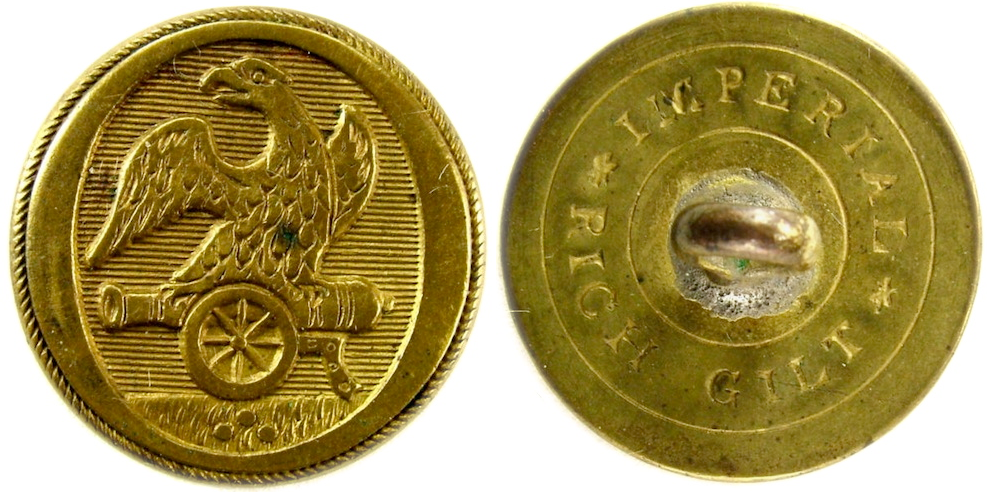
1820-30's Artillery General Use for Federal or State Militia
Units
Color: Aged Gilded Brass.
Metal: Flat, 1-Piece, Raised Design, Gilded Brass.
Size: 20.8mm. Coat Size
Albert's Number: AY 52-A: RV 10
Variation: Ringed Cannon Large Ribbed Breech / Four
Carriage Bolts / Three Small Wide-Spaced Cannon Balls .
Present Condition: A Non Excavated Example, Exceptional
Planchet Casting, Exceptional High Relief Pattern.
Robert's Notes: This series of buttons should
have been included in Albert's AY 51 series as a manufacturer's
pattern variation. These buttons with the cannon balls
underneath were
manufactured in England, and could have been used by either
the federal, or state militia artillery units. In this
series, Albert only lists three earlier manufacturer's back
marks and three die variants, but there seem to be several
manufacturers with their own unique variations. There are
several differences in the style of eagle depicted, to the
characteristics of the cannons and their carriages. Also the
cannon balls size and space can differentiate. The button's
pattern above depicts a calling eagle with upraised wings
facing right. The eagle is standing on a
Ringed Cannon with
a Large Ribbed Breech
pointing right. The cannon has a short
carriage which only reaches to the back of the wheel. There
are
Four Decorative Carriage Bolts
in this pattern. The
carriage's wheel is round with eight spokes. The cannon sits
on a field of grass with
Three Small Wide-Spaced Cannon
Balls
stacked in a pyramidal shape below. The high relief pattern
is set on a lined field that is within in a wide plain oval
picture frame border with a rope edge.
Reverse Button Analysis: This is a flat one-piece button
with a loop shank. The copper shank appears to be replaced.
* IMPERIAL / RICH GILT * within a 2 RING dm. (IMPERIAL03
back mark dates to 1830's).
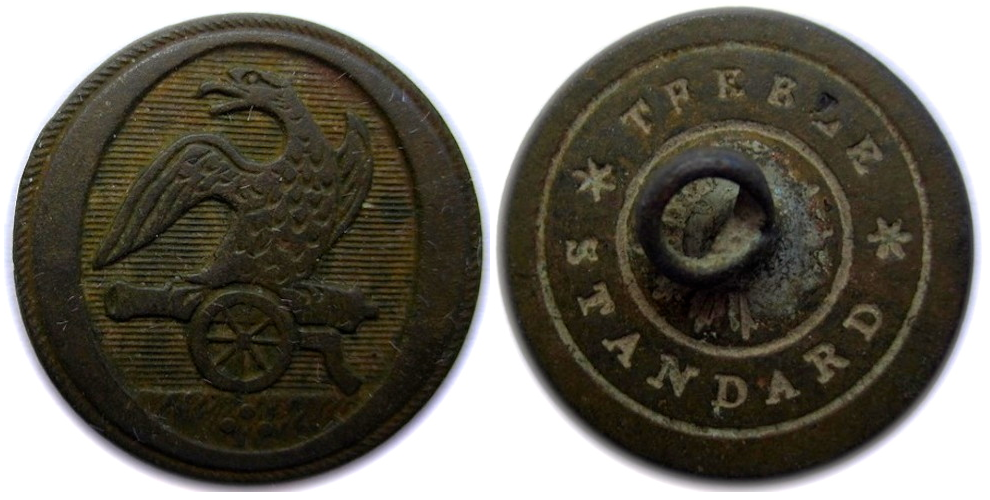
1820-30's Artillery General Use for Federal or State Militia
Units
Color: A Dark Brown With Orangey-Yellow Undertones.
Metal: Flat, 1-Piece, Raised Design, Brass.
Size: 22mm. Coat Size
Albert's Number: AY 52-A: Unlisted Variant RV 10
Variation: Ringed Cannon with A Ribbed Breech / Four
Decorative Carriage Bolts/ Three Small Wide-Spaced Cannon
Balls.
Present Condition: A Non Excavated Example, Exceptional
Planchet Casting, Exceptional High Relief Pattern.
Robert's Notes: This is another pattern variation in the
series. The button's pattern above depicts a calling eagle
with upraised wings facing right. The eagle is standing on a
Ringed Cannon with a Ribbed Breech
pointing right. The
cannon has a short carriage which only reaches to the back
of the wheel. There are
Four Decorative Carriage Bolts
in
this pattern. The carriage's wheel is round with eight
spokes. The cannon sits on a field of grass with
Three Small
Wide-Spaced Cannon Balls
stacked in a pyramidal shape below. The high relief pattern
is set on a lined field that is within in a wide plain oval
picture frame border with a rope edge.
Reverse Button Analysis: This is a flat one-piece button
with a loop shank. The shank is original and intact, but
slightly bent over. TREBLE * STANDARD * within a 2 RING dm.
The RJ Silverstein Collection.
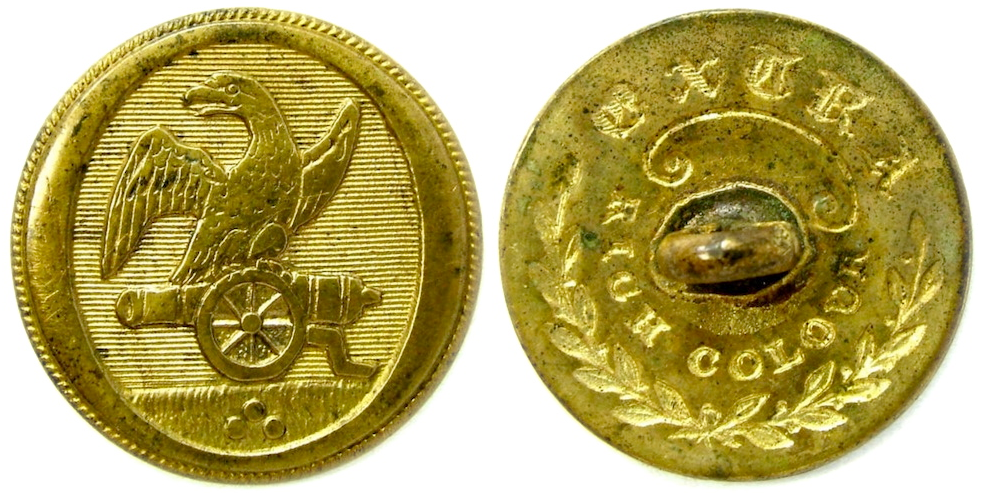
1820-30's Artillery General Use for Federal or State Militia
Units
Color: Yellow Gold.
Metal: Flat, 1-Piece, Raised Design, Gilded Brass.
Size: 21.5mm. Coat Size
Albert's Number: AY 52-B:
RV 10
Variation: Ringed Cannon with a Curved Stock / No Decorative
Carriage Bolts / Three Large Close-Spaced Cannon Balls
Present Condition: A Non Excavated Example, Exceptional
Planchet Casting, Strong High Relief Pattern.
Robert's Notes: This is another die variant that was
manufactured in England during the 1820-30's. As noted
prior, this series of buttons should have been included in
Albert's AY 51 series as just a pattern variation. The
button's pattern depicts a calling eagle with upraised
wings facing right. The eagle is standing on a crude style
Ringed Cannon with a Curved Stock
pointing right. The cannon
has a plain short carriage which only reaches to the back of
the wheel. There are No Decorative Carriage Bolts
in this
basic style pattern. The carriage's wheel is round, and has
eight spokes. The cannon sits on a field of grass with
Three
Large Close-Spaced Cannon Balls
that are stacked in a
pyramidal shape below. The high relief pattern is set on a
lined field that is within in a wide plain oval picture
frame border with a rope edge.
Reverse Button Analysis: This is a flat one-piece button
with a loop shank. The shank is original, straight and
intact. EXTRA -above /WREATH- below / RICH COLOUR graphic
scroll (ExtraR20 back mark dates to 1820-30's).
The Picture is Courteous of Harry Ridgeway.
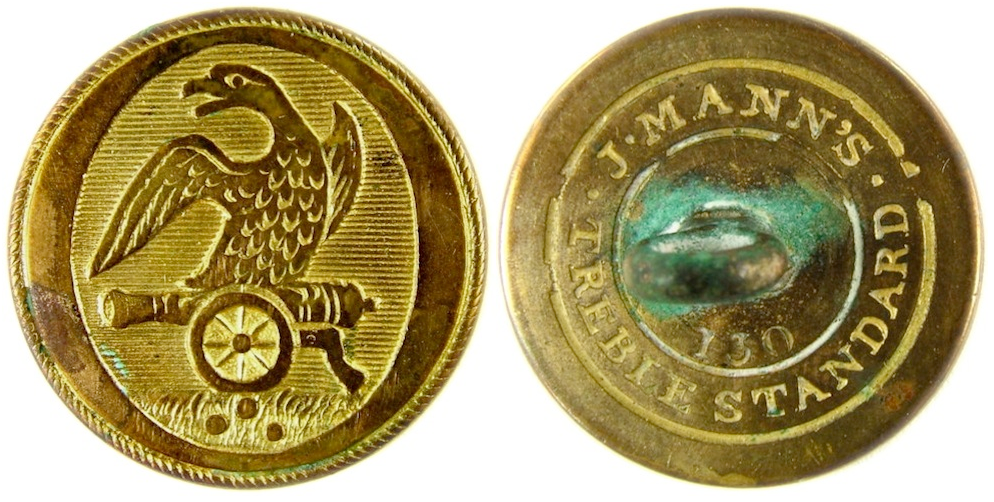
1820-30's Artillery General Use for Federal or State Militia
Units
Color: Yellow Coppery Gold.
Metal: Flat, 1-Piece, Raised Design, Gilded Brass.
Size: 21.2mm. Coat Size
Albert's Number: AY 52-B: Unlisted Variant RV
10
Variation: Ringed Cannon with A Large Breech / One
Decorative Carriage Bolt / Large Skewed Wide-Spaced Cannon
Balls.
Present Condition: A Non Excavated Example, Exceptional
Planchet Casting, Exceptional High Relief Pattern.
Robert's Notes: This federal style button was manufactured
in England during the 1820-30's. The button's pattern above
depicts a calling eagle with upraised wings facing right.
The eagle is standing on a
Ringed Cannon with a Large Breech
pointing right. The cannon has a short carriage which only
reaches to the back of the wheel. There is
One Decorative
Carriage Bolt
on the top. The carriage's wheel is round, and
has eight spokes. The cannon sits on a field of grass with
Three Large Skewed Wide-Spaced Cannon Balls
that are stacked
in a pyramidal shape below. The high relief pattern is set
on a lined field that is within in a wide plain oval picture
frame border with a rope edge.
Reverse Button Analysis: This is a flat one-piece button
with a loop shank. The shank is original, straight and
intact. J.MANN'S.TREBLE STANDARD within a 2 dm channel/130
stamped within inner ring. (Mann04 back mark dates to
1820-30's).
The Picture is Courteous of Harry Ridgeway.
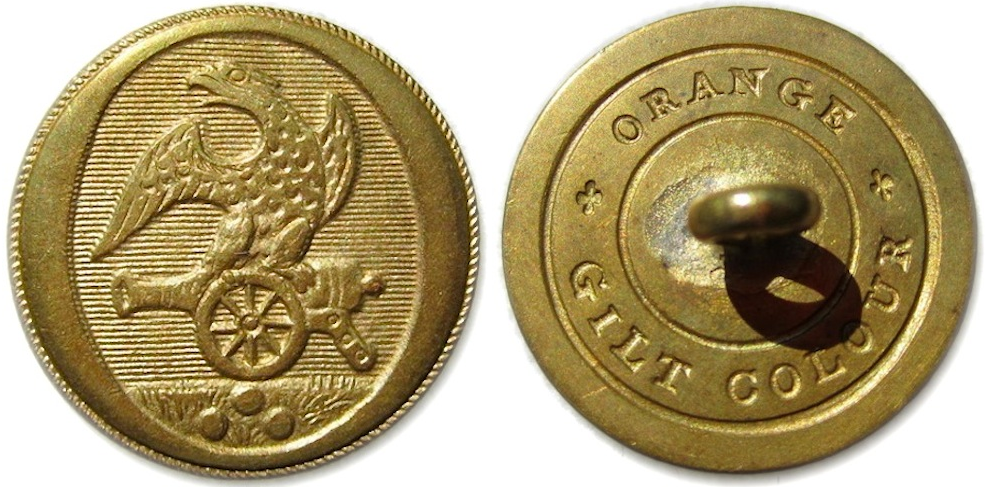
1820-30's Artillery General Use for Federal or State Militia
Units
Color: A Deep Golden Brown.
Metal: Flat, 1-Piece, Raised Design, Gilded Brass.
Size: 23mm. Coat Size
Albert's Number: AY 52-B: Unlisted Variant RV 10
Variation: Small Ringed Cannon with a Large Ribbed Breech /
Three Decorative Carriage Bolts / Three Large Wide-Spaced
Cannon Balls.
Present Condition: A Non Excavated Example, Exceptional
Planchet Casting, Exceptional High Relief Pattern.
Robert's Notes: This is another die variant
manufactured in England in the 1820-30's. The button's
pattern depicts a calling eagle with upraised-wings facing
right. The eagle is standing on a Small Ringed Cannon
with a Large Ribbed Breech. The cannon has a short
carriage which only extends to the back of the wheel. There
is
Three Decorative Carriage Bolts
in this die variant. The carriage's wheel is round with
eight spokes. The cannon sits on a field of grass with
Three Large Wide-Spaced Cannon Balls
stacked in a pyramidal shape below. The high relief pattern
is set on a lined field that is within in a wide plain oval
picture frame border with a rope edge.
Reverse Button Analysis: This is a flat one-piece button
with a loop shank. The shank is original, straight and
intact. ORANGE + GILT COLOUR+ with in a 2 dm ring.
The RJ Silverstein Collection.
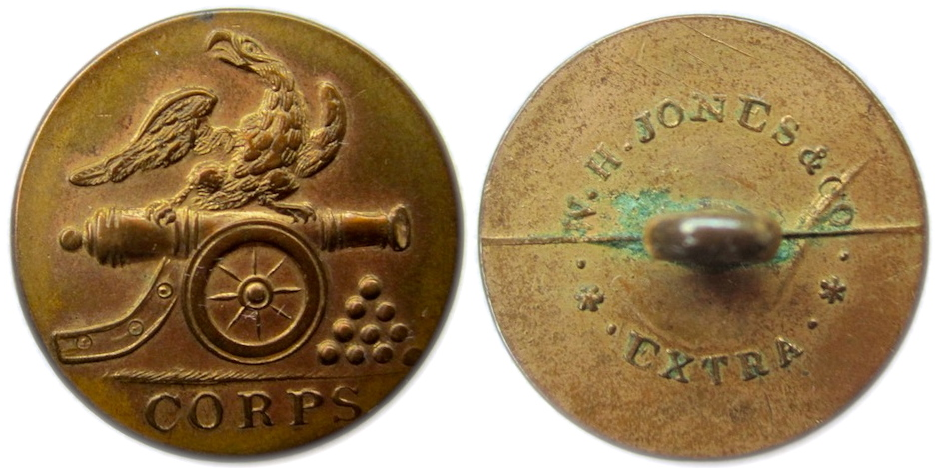
1835-37 Militia Artillery Corps
Color: A Golden Orange.
Metal: Flat, 1-Piece, Raised Design, Gilded Brass.
Size: 22.40mm. Coat Size
Albert's Number: AY 57-A: RV 5
Tice's Number: AM209B.1 / Tice back marks PG 55
Variation: Federal Style Eagle / Ringed Cannon
Pointing Left / Ten Cannon Balls / 3 Decorative Carriage
Bolts / CORPS.
Present Condition: A Non Excavated Example, Exceptional
Planchet Casting, Exceptional High Relief Pattern.
Robert's Notes: This pattern is very similar to the early
Federal Artillery Corps buttons of 1814-21, but is
distinguished by later
back marks. This variation was manufactured specifically for
the state's militia artillery just around the time the
federal government started to use the spread eagle pattern. The
button's pattern depicts a
Federal Style Eagle
facing right while
perched on a
Ringed Cannon Pointing Left.
The cannon's breech is slightly angled inward. The cannon's
carriage goes upward into the cannon slightly behind the
wheel. There are
Three Decorative Carriage Bolts
showing on the carriage. The carriage has a large round eight
spoke wheel that almost reaches the top of the cannon. There are
Ten Cannon Balls
stacked in a pyramidal shape in front of
the carriage's wheel. The military designation,
"CORPS"
is written below in large capital letters. The High relief
pattern is set on a plain flat field with no raised edge
border.
Reverse Button Analysis: This is a flat one-piece button
with a loop shank. The shank is original, straight, and
intact. *.W.H. JONES & CO.*. EXTRA.
The RJ Silverstein Collection.
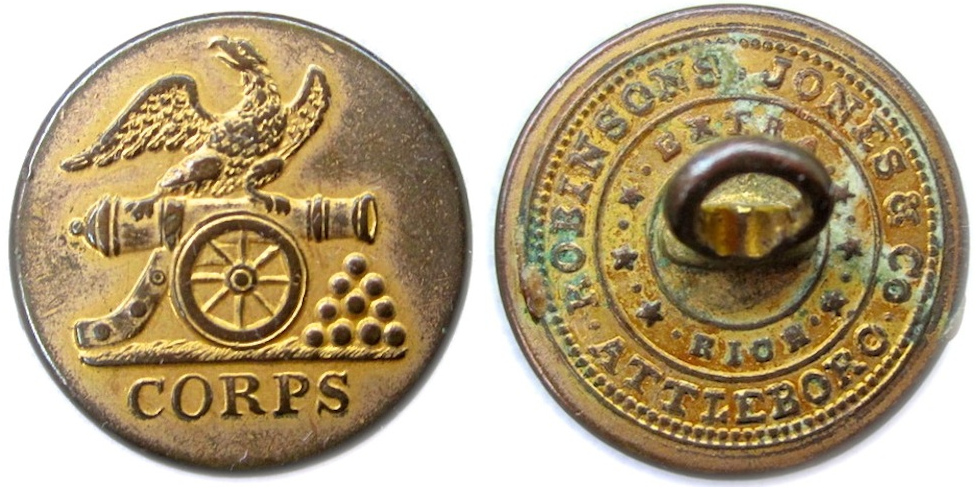
1828-34 Militia Artillery Corps
Color: A Golden Brass-Orange.
Metal: Flat, 1-Piece Gilded Brass.
Size: 21.77mm. Coat Size
Albert's Number: AY 57-B: RV 5
Tice's Number: AM209B.1 / Tice back marks PG 52
Variation: Federal Style Eagle Facing Right / Ribbed
Breech Pointing Leftward / Three Decorative Carriage Bolts /
CORPS.
Present Condition: A Non Excavated Example, Exceptional
Planchet Casting, Exceptional High Relief Pattern.
Robert's Notes: This pattern is very similar to
the earlier W.H. Jone's die
variant, but uses a different style cannon.
This die variant is similar to the
early Federal Artillery Corps pattern, but was manufactured
afterward with
later dated back marks. The pattern depicts a
Federal Style
Eagle Facing Right
while perched on a ringed cannon with a
Ribbed Breech Pointing Leftward. The cannons carriage
angles upward into
the cannon. There are
Three Decorative Carriage Bolts
showing on the carriage. The carriage has a large round eight
spoke wheel that almost reaches the top of the cannon. There
are ten cannon balls stacked in a pyramidal shape in front
of the carriage wheel. The word
"CORPS"
is
written below in large capital letters. The high relief
pattern is set on a plain flat field with no raised edge
border. This button's
pattern could have been made as early as 1828, but Tice
notes 1830's in his back mark book.
Reverse Button Analysis: This is a flat one-piece button
with a loop shank. The shank is original, straight, and
intact. *.W.H. JONES & CO.*. EXTRA.
The RJ Silverstein Collection.
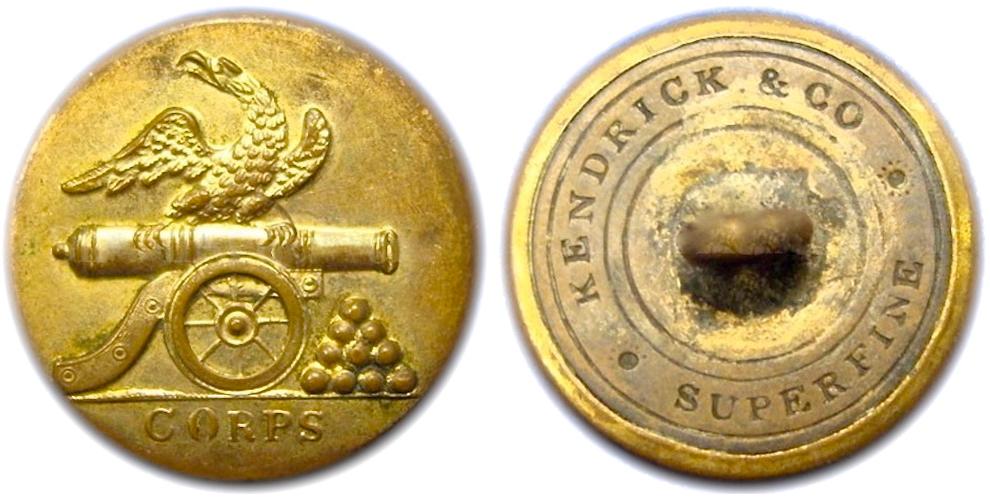
1830's Militia Artillery Corps
Color: A Sunset Golden Brown
Metal: Flat, 2-Piece, Raised Deign, Gilt Brass.
Size: 22.22mm. Coat Size
Albert's Number: AY 58-A
RV 5
Tice's Number: AM 218-A
Variation: Federal Style Eagle Facing Right / Short
Ringed Barrel Cannon Pointing Left / Four Decorative Bolts /
Ten Cannon Balls
Present Condition: An Excavated Example, Good Planchet
Casting, Strong High Relief Pattern.
Robert's Notes: Kendrick manufactured this scarce
specimen in the early 1830's. This is a neat two-piece
construction that was made specifically to mirror a flat
one-piece. The pattern depicts a
Federal Style
Eagle Facing Right
while standing on a
Short Ringed Barrel Cannon Pointing Left. The cannon's carriage
is longer and extends past the cannon's wheel. The carriage has
Four Decorative Bolts.
The carriage's wheel is round with eight spokes. There are
no lug nuts depicted. There
are
Ten Cannon Balls stacked in a pyramidal shape
on the ground in front of the carriage's wheel. The military
designation,
"CORPS"
is
written below in small capital letters. The high relief
pattern is set on a plain flat field with no raised edge
border.
Reverse Button Analysis: This is a flat two-piece
button with a loop shank. The shank is original, straight,
and intact. 0 KENDRICK & CO 0 / SUPERFINE within a channel
of two ring dm.
The RJ Silverstein Collection.
Robert's Notes: Ives & Kendrick operated in Waterville, CT
from 1836-47
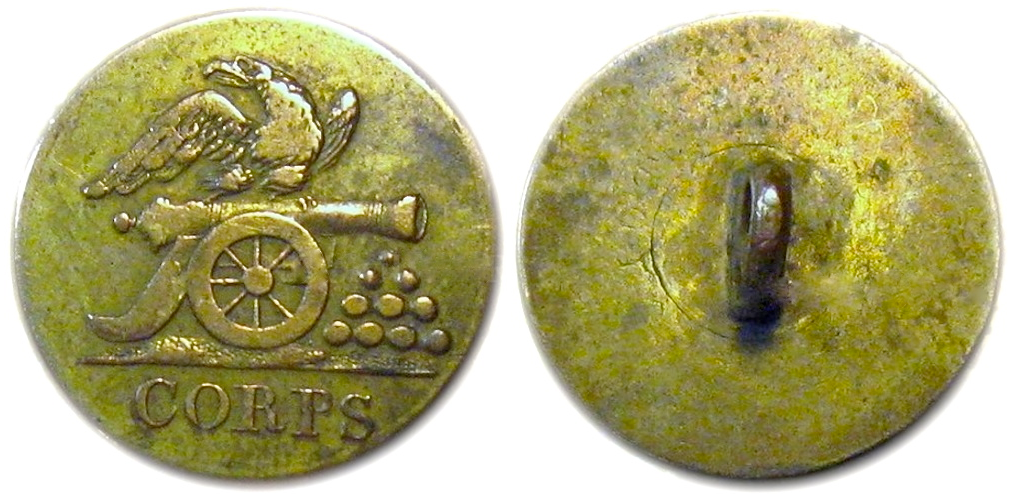
1830's Militia Artillery Corps
Color: Brass Yellow With Brown Undertones.
Metal: Flat, 1-Piece, Raised Design, Gilt Brass.
Size: 22mm. Coat Size
Albert's Number: Similar to AY 58-B,
but Unlisted 1-piece Variant
RV ?
Tice's Number: Similar to AM218 two-piece.
Variation: Federal Style Eagle Facing Right / Crude
Style Large Breech Cannon Pointing Left / Ten Large Cannon
Balls.
Present Condition: An Excavated Example, Good Planchet
Casting, Strong High Relief Pattern.
Robert's Notes: Tice lists this pattern as a two-piece, as
does Albert, but this pattern matches perfectly as a one
piece. So most likely the front dies were carried over. The
button's pattern depicts a
Federal Style
Eagle Facing Right
while perched on a
Crude Style Large Breech Cannon Pointing Left. The cannons carriage
is short and angles upward into
the cannon. This crude depiction doesn't show any decorative carriage bolts. The carriage
shows a round eight
spoke wheel that almost reaches the top of the cannon. There
are
Ten Large Cannon Balls stacked in a pyramidal shape
on the ground under the muzzle. The word
"CORPS"
is
written below in large capital letters. The high relief
pattern is set on a plain flat field with no raised edge
border.
Reverse Button Analysis: This is a flat one-piece button
with a loop shank. The shank is original, straight, and
intact. Blank back mark.
The Picture Courteous of Allen Gaskins.
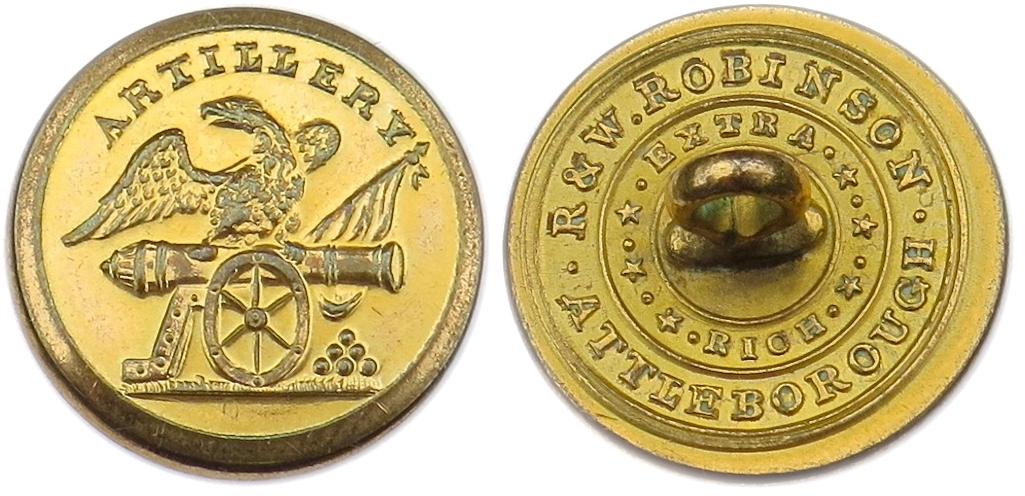
1830-40's Militia Artillery
Color: A Golden Mirror Brass.
Metal: Flat, 1-Piece, Raised Design, Gilded Brass
Size: 21.55mm. Coat Size
Albert's Number: AY 59- Unlisted back mark Variant: RV 10
Tice's Number: AM212 A - Unlisted Back mark
Variation: Federal Style Eagle Facing Right / Draped
Flag with a Small Top Tassel / 5 Decorate Carriage Bolts /
Artillery.
Present Condition: A Non Excavated Example, Exceptional
Planchet Casting, Exceptional High Relief Pattern.
Robert's Notes: This early pattern was made by Robinson in
the late 1820's and in the early 1830's. The button's pattern depicts a
Federal Style Eagle Facing Right, while standing on a ringed
cannon with a medium size breech pointing left. There is a
Draped
Flag with a Small Top Tassel
on the left behind the cannon's
barrel. The cannon's carriage extends to the wheel's axel, and
has
Five Decorate Carriage Bolts.
The carriage's wheel is oval and depicts six spokes and lug
nuts. The military unit designation,
"ARTILLERY"
is
written in an arc at the top in capital letters. There are six
cannon balls tightly stacked on the ground in a pyramidal shape
underneath the draped flag. The high relief pattern is set
on a plain flat field with a thin raised edge border. This
appears to be the only only state militia Artillery pattern without
the words CORPS or REGt. below.
Reverse Button Analysis: This is a flat one-piece button
with a loop shank. The shank is original, straight, and
intact. R & W. ROBINSON./ATTLEBOROUGH/.*.*.*RICH.*.*.*EXTRA
double outside rm ring, 2 inner rm rings.
The Robert J Silverstein Collection.
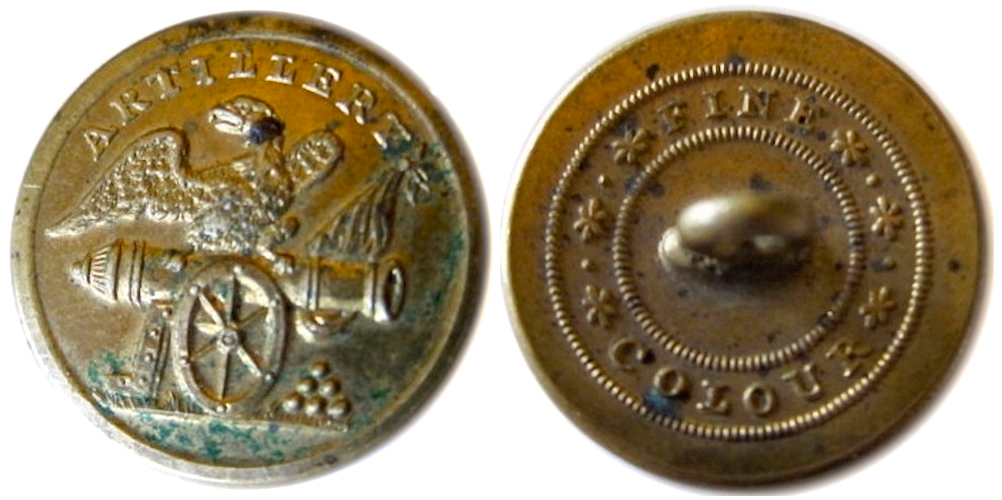
1830's Militia Artillery
Color: A Tarnished Brown with Green Encrustations.
Metal: Flat, 1-Piece, Raised Design, Brass
Size: 22mm. Coat Size
Albert's Number: AY 59- Unlisted English Back mark Variant: RV 05
Tice's Number: AM212 A - Unlisted English Back mark
Variation: Federal Style Eagle / Large Angled Breech
/ Draped Flag / Extends to the Back of the Wheel /
Present Condition: A Non Excavated Example, Exceptional
Planchet Casting, Exceptional High Relief Pattern.
Robert's Notes: This is the English version of R
W Robinson's militia artillery pattern. From the back mark, this
appears to be manufactured in the early 1830's. There only
appears to be a slight depiction in the cannon's barrel and
extension of the carriage. The button's pattern depicts a
Federal Style Eagle Facing Right, while standing on a ringed
cannon with a
Large Angled Breech
pointing left. There is a
Draped
Flag with a Small Top Tassel
on the left behind the cannon's
barrel. The cannon's carriage only
Extends to the Back of the Wheel,
and depicts
Five Decorative Carriage Bolts.
The carriage's wheel is oval and depicts six spokes and lug
nuts. The military unit designation,
"ARTILLERY"
is
in an arc at the top in capital letters. There are six
cannon balls tightly stacked on the ground in a pyramidal
shape under the cannon's barrel. The high relief pattern is
set on a plain flat field with a thin raised edge border.
Reverse Button Analysis: This is a flat one-piece button
with a loop shank. The shank is original, straight, and
intact.
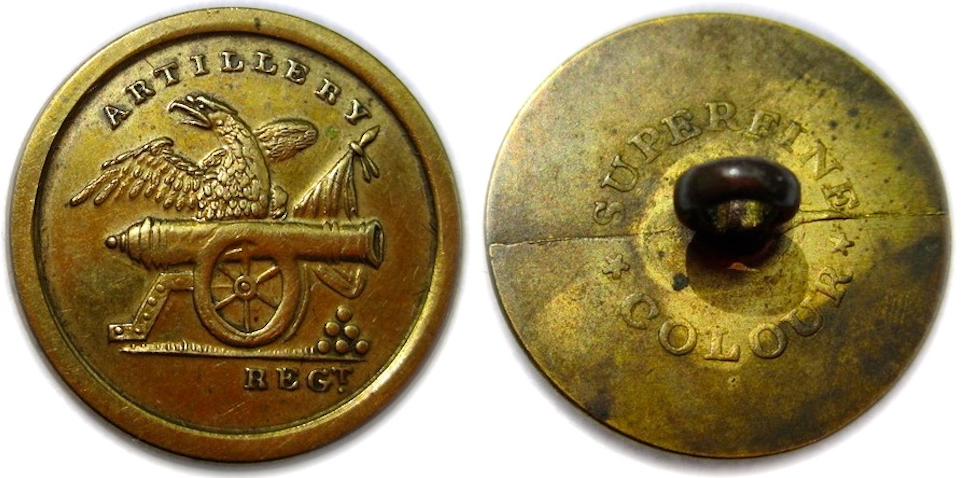
1820-30's Militia Artillery Regiment
Color: A Deep Golden Brass.
Metal: Flat, 1-Piece, Raised Design, Gilt Brass.
Size: 22.42mm. Coat Size
Albert's Number: AY 60-B Unlisted Back mark: RV 5
Tice's Number: AM 215-B. Unlisted Back mark
Variation: Eagle with Upraised Wings / Ringed Breech
/ Draped Flag Small Top Tassel / Wheel is Oval and has Six
Spokes.
Present Condition: A Non Excavated Example, Exceptional
Planchet Casting, Exceptional High Relief Pattern.
Isabela's Notes: This Artillery Regt. was made by
the British in the 1820's to early 30's. Regt. designations
are a little bit more scarcer then the Artillery Corps
buttons commonly found. The button's pattern depicts an Eagle
with Upraised Wings Facing Right.
The eagle is standing on a ringed
cannon with a slightly larger
Ringed Breech
that is pointing toward the left. On the left, there is a
Draped
Flag with a Small Top Tassel. The cannon's carriage
is short and
only
Extends to the Back of the Wheel.
The carriage depicts
six small decorative carriage bolts.
The carriage's
Wheel is Oval and has Six Spokes. The
militia's unit designation,
"ARTILLERY"
is
in an arc at the top of the button in small capital letters. There are
Six
Cannon Balls
in a pyramidal shape
stacked on the ground under the cannon's barrel. The high relief pattern is set on
a plain flat field with a thick raised edge border. This would be a good example of
how the British used an earlier American manufacturer's pattern as a
template.
Reverse Button Analysis: This is a flat one-piece button
with a loop shank. The shank is original, straight, and
intact. British Manufacture. * SUPERFINE COLOUR*
The RJ Silverstein Collection.
Connecticut's Militia Units
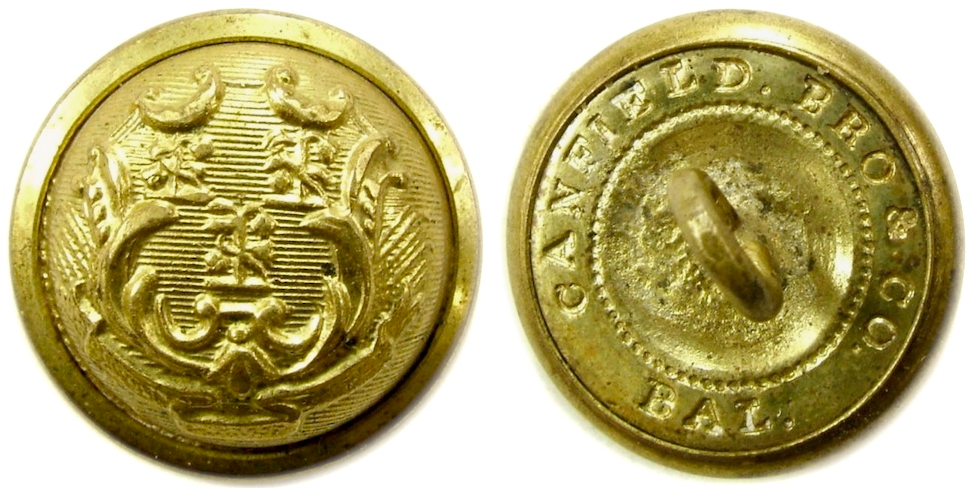
1845-60 Connecticut Militia Officer's Staff Button
Color: A Deep Gold.
Metal: 3-Piece, High Convex, Raised Design, Gilded Brass.
Size: 15mm. Cuff Size
Albert's Number: CT12: RV 5-10
Tice's Number: CT200AS.1
Variation: Connecticut's Coat of Arms / Three Grape
Vines / Decorative Ribbon Below.
Present Condition: A Non Excavated Example, Exceptional
Planchet Casting, Exceptional High Relief Pattern.
Isabela's Notes: This staff button was commonly used by
officers in Connecticut regiments during the Civil War.
Scovill first produced this pattern in 1845, then stopped in
1860. The button's pattern depicts
Connecticut's Coat of Arms
with
Three Grape Vines
evenly spaced in the center of a decorative flowing scroll
pattern. Below is a
Decorative Ribbon Below.
The high relief pattern is set on a high convex lined field
with a plain over lapping edge border.
Reverse Button Analysis: This is a three-piece button with a
loop shank. The shank is original, straight, and intact. CANFIELD.BRO&CO. BAL. inner ring dm
The Picture is Courteous of H. Ridgeway.
Florida's Militia Units
Florida is a peninsula state in the southeastern region of
the United States. It is bordered between the Gulf of
Mexico, and the Atlantic Ocean. To it's northern borders is
the states of Alabama and Georgia. Florida was given it's name by the Spaniard Juan Ponce
De Leon in 1513. The name means,
Feast of Flowers. Saint
Augustine established the first permanent European
settlement in 1565. In 1821, Spain reached an
agreement and transferred ownership to the United States.
This transfer of ownership was immediately followed by the Seminole Indian War.
This battle didn't end well for the native American Indians
and they were relocated by the US Army to Oklahoma. In
1845, Florida was admitted to the Union as the 27th state,
and adopted a seal showing a map of the state. Florida's
militia used buttons bearing the territorial seal consisting
of an
Eagle with Down Swept Wings. In the eagle's left talon
is a laurel branch, and in it's right claw is a small bundle
of three arrows. The eagle is situated above cacti, and
there are 13 six-pointed stars arched above encircling the
eagle. In 1861, Florida was the third state to secede from
the union and join the
Confederacy.
They produced no buttons during the Civil War.~
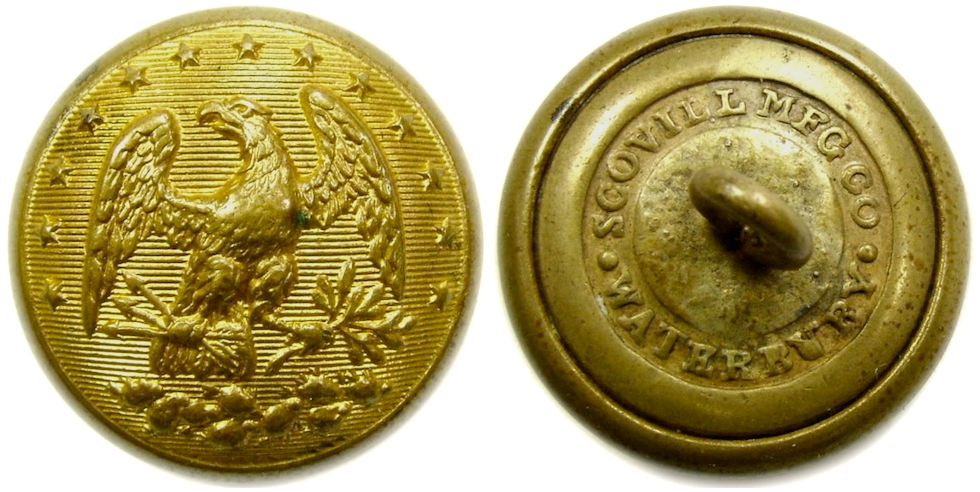
1840-50's Florida's State Militia
Color: A Deep Gold.
Metal: 2-Piece, Convex, Raised Design, Gilt Brass.
Size: 20mm. Coat Size
Albert's Number: FL1: RV 50
Tice's Number: FL200A.4
Variation: Eagle with Down-Swept Wings Facing Right / 13 Five-Pointed Stars
/ Cacti Underneath.
Present Condition: A Non Excavated Example, Exceptional
Planchet Casting, Exceptional High Relief Pattern.
Isabela's Notes: This early 2-piece button uses the
unofficial Florida territorial seal on a lined field. The
button depicts an
Eagle with Down-Swept Wings Facing Right.
In the eagles left talon is an olive branch, and in it's
right is a
bundle of three arrows. There are
13
Five-Pointed Stars arched 3/4 away around the eagle, and
a
Cacti Underneath.
The high relief pattern is set on a convex lined field with
a plain narrow edge border. Collectors should this is the
most common Florida pre-1865 uniform button to find on the
market. Scovills made these buttons for about 20 years, from
1840 to 1860. Collectors usually prize there specimens and
they usually command a premium. Tice does note that the small size
examples are rarer.
Reverse Button Analysis: This is a two-piece button with a
loop shank. The shank is original, straight, and intact. .SCOVILL
MFG CO.WATERBURY. rm within a channel.
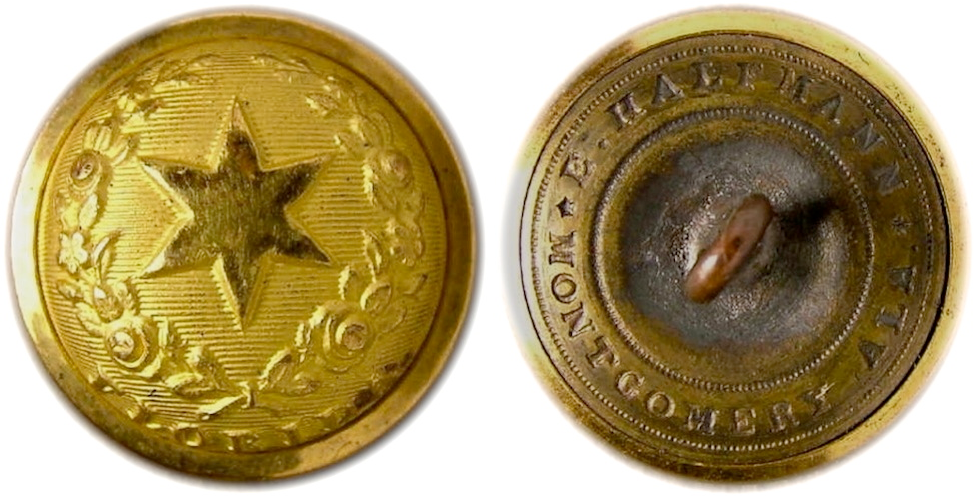
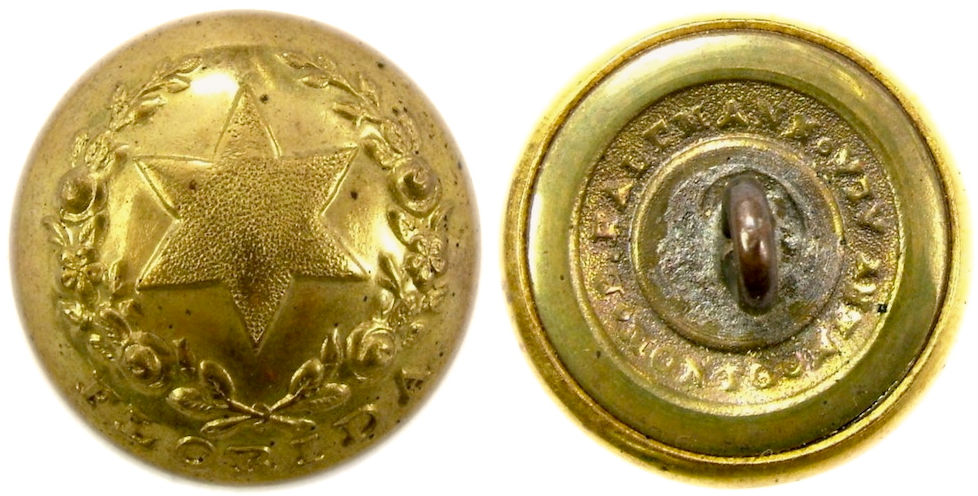
1860's Florida's State Militia
Color: Florida Gold.
Metal: 3-Piece, Low-Convex, Raised Design, Gilded Brass.
Size: 22.3mm. Coat Size
Albert's Number: FL2: RV 150
Tice's Number: FL205A.1
Variation: Raised Six-Pointed Star/ Cherokee Rose
Wreath / Florida.
Present Condition: A Non Excavated Example, Exceptional
Planchet Casting, Exceptional High Relief Pattern.
Isabela's Notes: In 1860, the legislature asked
the Governor to find a
new suitable pattern for the state's militia buttons. He chose the Cherokee Rose
design. Before the Civil War, the Florida Militia was mostly posted around the
Panhandle region. This area was an
extension of the Gulf Coast economic power region of Mobile
Alabama and New Orleans. The button's pattern depicts a
Raised Six-Pointed Star
in the center of a
Cherokee Rose
Wreath.
The states name, "FLORIDA" is
in roman font capital letters below. The
whole pattern is set on a low convex lined field with a
false 3-piece rim. Scovill made these around 1860,
for a military contractor Ethlebert. Halfmann of Montgomery Alabama. There are only a few
specimens known which makes this
button not only a true rarity, but a costly one for southern
state button collectors.
Reverse Button Analysis: This is a three-piece button with a
loop shank. The shank is original, straight, and intact. E. HALFMANN/ * MONTGOMERY ALA. * dm between two rings of dots.
1860's Florida's State Militia
Color: A Spotted Gold.
Metal: 2-Piece, High Convex, Raised Design, Gilt Brass.
Size: 20.6mm. Coat Size
Albert's Number: FL3: RV 150
Tice's Number: FL210A.1
Variation: Six-Pointed Star / Cherokee Rose Wreath / No Edge Border.
Present Condition: A Non Excavated Example, Exceptional
Planchet Casting, Exceptional High Relief Pattern.
Isabela's Notes: This button was also produced by
Scovills around 1860 for Ethlebert Halfmann. Unlike the
officer's die variant, this pattern was made without the 3-piece border
to distinguish the enlisted men. The button's
pattern depicts a raised
Six-Pointed Star
with a
Pebbled
Surface.
The star is situated in the center of a decorative
Cherokee Rose Wreath. The state's
name, "FLORIDA" is written below in large
Roman font capital letters.
The pattern is set on a plain convex field with no edge rim.
As with the officer's die variant, this is rare and costly
for southern state button colectors.
Reverse Button Analysis: This is a two-piece button with a
loop shank. The shank is intact, but professionally
re-soldered. E.HALFMANN/ .MONTGOMERY ALA. rmdc on a stippled
field.
Georgia's Militia Units
Georgia is located in the southeastern part of the United States.
It is
bordered by Florida in the south, South Carolina & Atlantic
Ocean in the East. To the west is Alabama, and it's northern
borders brinks upon North Carolina and Tennessee. Georgia
was the last of the original 13 colonies to be established
in 1732. It was named after King George II, who charted the
region to James Oglethorpe who established a settlement in
Savannah in 1733. Originally it was created to be a buffer
between the British colonies to the north, and the Spanish
territory of Florida in the
south. Between 1770-1840, settlers from Virginia and the
Carolinas began to colonize the interior of the state and
force the Creek and Cherokee Indians out of their lands. In
1861, Georgia joined the Confederacy, and was the 5th state
to secede from the union. In 1799, the Georgia legislature
adopted a State Seal, or
Coat of Arms
depicting
Three
Classical Pillars supporting an Arch bearing the word, "Constitution". The design symbolizes the three branches of
government;
Legislative, Judicial, and Executive
supporting
the ratified
Constitution. Wrapped within the pillars is a
banner inscribed with the words,
"Wisdom, Justice, and
Moderation". On the side of one of the pillars is a
Minuteman with a Drawn Sword
symbolizing the defense of the
constitution by state military forces.
There are a large number of manufacturers and die variants for
Georgia buttons, which makes these buttons great for collectors.
1830-50's Republican Blues, Savannah Georgia
Color: A Two-Tone Silver.
Metal: 2-piece, Low-Convex, Raised Design, Silver Plated
Copper.
Size: 21mm. Coat Size
Albert's Number: GA23: RV 50
Tice's Number: GA261B.1
Variation: American Spread Eagle Facing Right / Short
Stout Neck / Federal Lined Shield / Republican Blues.
Present Condition: An Excavated Example, Strong Planchet
Casting, Strong High Relief Pattern.
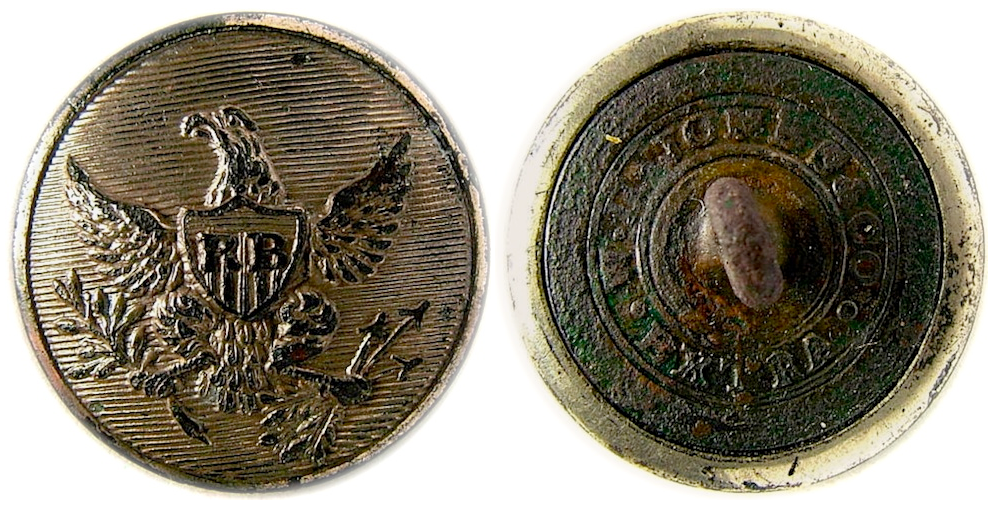
Isabela's Notes: There are four known die
variants for this pattern. One facing right with a long
neck, one facing right with a short stout neck. One facing
left looking toward the three o'clock position, and one
looking left toward the one o'clock position. Various
Northern manufacturers made this button from 1830's through
the 1850's. All are known to be silver plated. This particular back mark dates in-between
1835-40. The button's pattern uses the same early 1821-40
Federal Infantry & Artillery pattern of an
American Spread Eagle Facing Right.
This die variant depicts an eagle with a
Short Stout Neck. In the eagle's right
talon is an olive branch, and in it's right talon is a
bundle of three arrows. On the eagle's chest is a
Federal Lined Shield
with the initials, "R B" for
Republican Blues. The
high relief pattern is set on a low-convex lined field with
a slightly raised thin edge. The Savannah Blues
formed in 1808 by socially prominent men. This would be your
typical example of how a militia unit turned from a
military objective of protection to a ceremonial parade
military organization as the years went by. During the Civil War, the Blues
served within the 1st Volunteer Georgia Infantry. Most
specimens known are excavated.
Reverse Button Analysis: This is a two-piece button with a
loop shank. The shank is original, straight, and intact. rmdc .W.H. JONES &CO. EXTRA within depressed channel.
Excavated by Rocky Sommers in Savannah Georgia.~
The R. Sommers Collection.
1840's Irish Jasper Greens, Savannah Georgia
Color: A Golden Green.
Metal: 2-Piece, Low-Convex, Raised Design, Gilt Brass.
Size: 22mm. Coat Size
Albert's Number: GA18A.1: RV 50
Tice's Number: GA256B.1
Variation: Spread Wing Eagle Facing Right / Large
Decorative Harp / Irish Jasper Greens.
Present Condition: An Excavated Example, Good Planchet
Casting, Good/Strong High Relief Pattern.
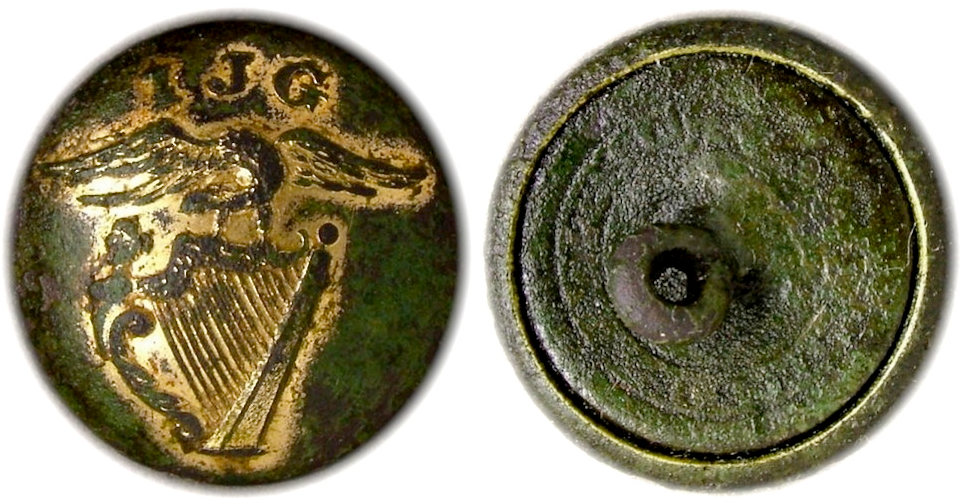
Isabela's Notes: This button was made by three
manufacturers with only a slight change in the depiction of
the Harp and Eagle. This button depicts a
Spread Wing Eagle Facing Right,
while perched on top of a
Large Decorative Harp.
The initials for
Irish Jasper Greens, "I J G"
is arched
above. The pattern is set upon a plain low-convex field eith
no raised edge border. The
Irish Jasper Greens was formed in Savannah Georgia in 1842,
and designated Company A, 1st Volunteer Regiment of Georgia.
The company's name was taken from William Jasper who was an
American Revolutionary War Hero born in South Carolina.
During the battle of Fort Sullivan, Jasper replaced the
fort's fallen flag while under heavy fire from a British
Naval squadron. All the members of this company are citizens
of Savannah, and Irish. Most of these examples have been dug
in the costal areas of Georgia and South Carolina. Silver plated non-excavated examples are
extremely rare.
Reverse Button Analysis: This is a two-piece button with a
loop shank. The shank is original, and intact, but slightly
bent. BENEDICT & BURNHAM on a ribbon with an eagle.
Excavated in Savannah Georgia.~
The Picture is Courteous of H. Ridgeway.
1856-61 Georgia Militia
Color: A Golden Brown.
Metal: 2-Piece, Convex, Raised Design, Gilt Brass.
Size: 24mm. Coat Size
Albert's Number: GA1A.2: RV 10
Tice's Number: GA200A.4
Variation: Georgia State Coat of Arms / Period After
the Word Constitution / Wisdom, Justice, and Moderation
Present Condition: An Excavated Example, Strong Planchet
Casting, Good/Strong High Relief Pattern.
Isabela's Notes: There seems to be a little bit of
conjecture on dating this button. Some button enthusiasts
say it goes back to the early 1840's, and Tice inaccurately
labeled it 1850's in his book. Whichever, we know it use
dates prior to the Civil War. There appears to be two
variants noted for this early button pattern. One with a
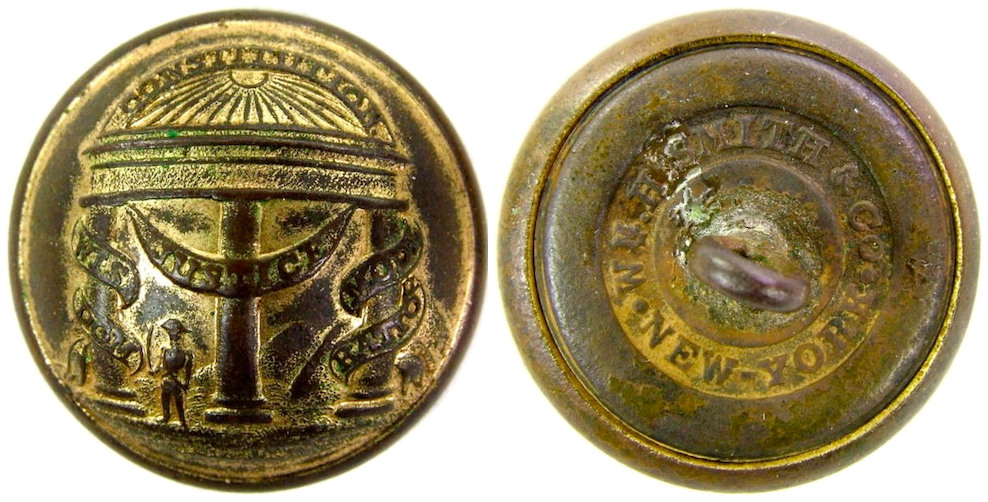
period after the word Constitution, and without a period. This button's pattern depicts
the
Georgia State Coat of Arms
which is Three Classical
Pillars supporting an Arch bearing the word Constitution
above.
In this variant there is a
Period After the Word Constitution.
The pattern symbolizes the judicial, legislative, and
executive departments of government in support of the
constitution. There is a free flowing ribbon around each of the pillars that
are inscribed, "Wisdom, Justice, and
Moderation. This
high relief pattern is set on a plain convex field with a
thin edge border. This has always been a southern
confederate button collectors favorite. Manufacturer
signature back marks are much scarcer then blank locals.
Reverse Button Analysis: This is a two-piece button with a
loop shank. The shank is original, straight, and intact. rmdc .WmH.SMITH&CO. NEW-YORK within a stippled depressed
channel. This back mark seems to date to 1840's according to
Tice. Some back marks appear to have a raised area around the
shank, this most likely is not a die variant, but caused
during assembly. Some other examples of this back mark have a
weak dash between New and York, this most likely is caused
by either grime or die fatigue.
Possible excavated in Virginia, but unconfirmed.~
The RJ Silverstein Collection.
Georgia's Artillery Units
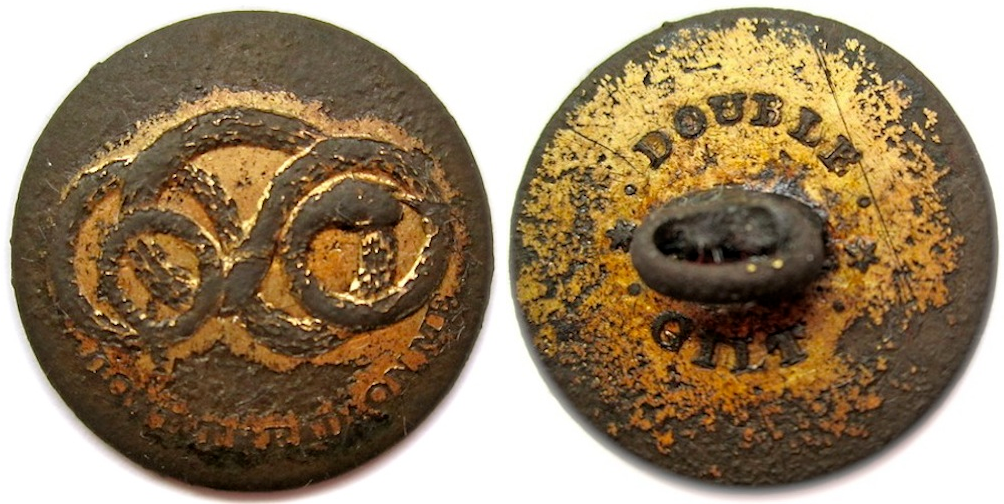
1810-20's Georgia Chatham Artillery
Color: An Ochre Pigment of Brown Shades with Golden
Highlights.
Metal: Flat, 1-Piece, Raised Design, Double Gilt Brass.
Size: 21mm. Coat Size
Albert's Number: NA 1-Incorrectly Identified as
Continental Navy
Tice's Number: GA110 A.2
Variation: Large Coiled Hissing Snake / Don't Tread
On Me / Head Points Toward Three O'clock.
Present Condition: An Excavated Example, Strong Planchet
Casting, Strong High Relief Pattern.
Isabela's Notes: There appears to be three known
die variants for this button. The notable difference is
where the snakes head is depicted. One the snakes body near
the head touches the coil, and the head points toward three
o'clock. In the second, The snakes body near the head does
not touch the coil, and the head points to 2:30. In the
third, the snakes body near the head touches the body, and
the head points toward the two o'clock position. The first
variant with the double gilt back mark is the rarest or the
three, and un-dug specimens in any variation are extremely
rare. This button's pattern depicts a
Large Coiled Hissing Snake
above the motto,
"DON'T TREAD ON ME"
. The motto appears to be in large Roman Font Capital
letters. This variant depicts the snakes body near the head
touching the coil, and the
Head Points Toward Three O'clock.
The high relief pattern is set on a plain flat field with no
raised edge border. This artillery company traces it roots back
to the 1st battalion, 118 field artillery, which organized
on April 18, 1751. This was originally formed as a Georgia
Militia unit in the district of Savannah. It consisted of
four independent volunteer companies, three of foot, and one
of horse. In 1778, the British military planners decided to
embark on a southern strategy to conquer all the rebellious
colonies with the support of their loyalist supporters in
the southern states. Their first step was to gain control of
the southern ports of Savannah Georgia, and Charleston,
South Carolina. In December, the British took
Savannah as an easy conquest. There was only moderate resistance from the in-effective
Georgia Militia, and Continental Army defenses. With
survivors from this encounter, the Georgia militia disbanded
for almost two years, and then reformed and joined the
Continental Army using the common pewter enlisted man's
U.S.A. pattern buttons. Officially, they were re-designated
as the Chatham Artillery in 1786 under Captain Edward Lloyd.
There first documented duty was the funeral honors of
Revolutionary War General Nathanael Greene in June of 1786.
This company was also instrumental for George Washington in
the Oconee Wars of 1789 to 1793. In 1792 George Washington
showed his appreciation for their gallant services, and
presented them with 2 cannons. One of which was captured at
Yorktown, and the other was from France. This button has
become a real collector's favorites, and usually demands a
premium.
Reverse Button Analysis: This is a one-piece button
with a loop shank, The shank is original, but very slightly bent.
There is the rare "Double Gilt" raised back mark
with two Six Pointed Stars with Four Dots in-between in high
relief.
Excavated in around Savannah Georgia.~
The RJ Silverstein Collection.
Robert's Notes: This button has been mistakenly identified
by A. Albert (NA 1), and others as the first Continental
Navy Dress Uniform Button. Records of that button show the
pattern to be impressed, not in High Relief as the example
above. Also, the Navy buttons with the Rattlesnake Don't
Tread On Me have never been recovered to date. Even though
the Chatham Artillery Militia unit (AKA Georgia Militia
Savannah District) dates back to fighting in
Revolutionary War, the back mark on the button example above
most likely dates anywhere from 25 to 50 years after.~
Massachusetts's Militia Units
The official name of the state is, "The Commonwealth of
Massachusetts", or is simply referred to as, "The
Commonwealth". The early colonists took the name
Massachusetts from the Algonquian Indian term,
"Near the
Great Hill", or "By the Blue Hills". Massachusetts is
located in the
New England region of the northeastern United States, and
lies on the coast of the Atlantic Ocean. It is bordered by Rhode Island
and Connecticut to the south, New York to the west, and
Vermont and New Hampshire to the north. Massachusetts was
originally formed from three distinct settlements.
Plymouth near Cape Cod, Gloucester on Cape Ann, and Mass.
Bay Colony around Boston. The first English settlers were
known as Pilgrims, and they came to Plymouth, Massachusetts
in 1620. They developed friendly relations with the native
Wampanoag Indians, and this became the second successful
permanent English colony in North America after Jamestown.
In 1630, the Puritans soon followed and established the
Massachusetts Bay colony. This is what we know in present day as
Boston. Unlike the Plymouth Colony, the Bay colony was
founded under a Royal Charter by the Puritans. They were seeking
religious freedom from the Church of England. In 1691, both
the colonies (& Maine) were united into the Province of
Massachusetts Bay. The new
governor of the Province, Sir William Phips, is the one in
which the Salem Witch
Trials took place. This resulted in a number of men and
women being hanged or burned.
In the late 18th Century, Boston became known as the
"Cradle of Liberty"
because of the agitation of it's colonists that led to the
American Revolution, and the independence of United States
from Great Britain.
Later on in the Federal Period around 1780, John
Adams who was known as,
"The Atlas of Independence"
wrote Massachusetts's original Constitution.
This was the first state
to have a Constitution that declared the universal rights
for it's citizens.
Also in 1780, Nathan Cushing designed the
Massachusetts's Coat of Arms. This depicts a standing
Native American Indian
holding a Bow in his left hand, and an Arrow in his right.
There is a five-pointed North Star over his right shoulder
which represents the dependent territory of Maine. The
Commonwealth's Latin motto,
"Ense Petit Placidam sub
Libertate Quietem",
means
"This Hand the Rule of Tyrants to oppose, Seeks with the
sword fair freedom's soft repose".
This prompted the adoption of a Sword and Arm as the
unofficial crest.
Most of the Massachusetts Militia buttons depict either the
Arm & Sword, or the Standing Indian. The
earliest known use of a military button depicting an Arm and Sword
would be Henry Jackson's independent Boston Militia in
1776. By the early part of the 19th Century, Massachusetts
operated with a large number of undisciplined militia units
who were ceremonial in nature. It wasn't until 1840, the
state started to re-organize all these rouge companies in
order to create a more disciplined volunteer system. By
1851, they had integrated most of the independent companies
into regiments and battalions. The companies who wouldn't
join and opposed the new reorganization soon disbanded.
Robert's Notes: In 1820, Maine separated from The
Commonwealth of Massachusetts, began it's own statehood, and
entered into the union as the 23rd state. This branch off
from Massachusetts was a direct result of
the Missouri Compromise. This legislation dictated
that slave and free states be admitted to the union in an
equal number. Maine accompanied Missouri, and both were admitted together.
By the Civil War, Maine had it's own distinct Militia entity
from Massachusetts.
.png)
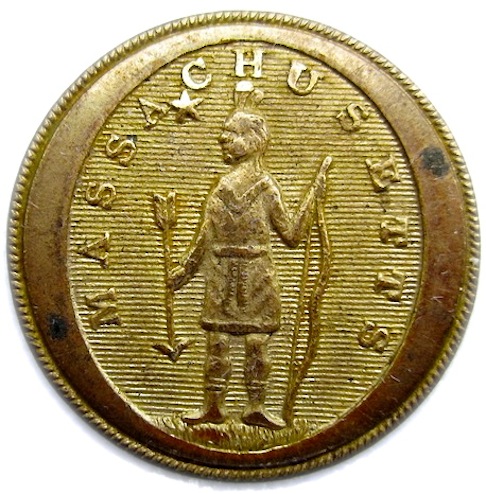
1812-30's Massachusetts State Militia General Use
Color: A Golden Center With A Light Coppery Brown Border.
Metal: Flat, 1-Piece, Raised Design, Gilt Brass.
Size: 25mm. Coat Size
Albert's Number: MS 19-A:
RV 10
Tice's Number: MSO 36A Unlisted Back Mark
Variation: Native American Indian Standing on A
Grassy Mound / Large Hunting Bow / Downward Pointing Arrow
Present Condition: A Non Excavated Example, Exceptional
Planchet Casting, Exceptional High Relief Pattern.
Isabela's Notes: This pattern has always been a collector's favorite
among both button and coin collectors. It was
produced by British manufacturers all throughout the first
quarter of the 19th century. The button's pattern depicts a
Native American Indian Standing on a Grassy Mound.
He is leaning on a
Large Hunting Bow in his Left Hand, and
holding a
Downward Pointing Arrow
in his right. Over the Indian's right shoulder is the symbolic
Five-Point North
Star
which represents the
dependent territory of Maine. Arched in a semi-circle around the
Indian is the states name, "MASSACHUSETTS"
in large Roman font capital letters. The high relief pattern is set
on a lined field, that is within a plain oval picture frame border with
an outer
rope edging. When this button becomes available, collectors should seek
specimens that clearly show the
Indian's belt and depict the shirt's V neck lines clearly.
Reverse Button Analysis: This is a one-piece button with a
loop shank. The shank is original, straight, and intact. dm
IMPERIAL+ ORANGE GILT+ within 2 dm rings.
The RJ Silverstein Collection.
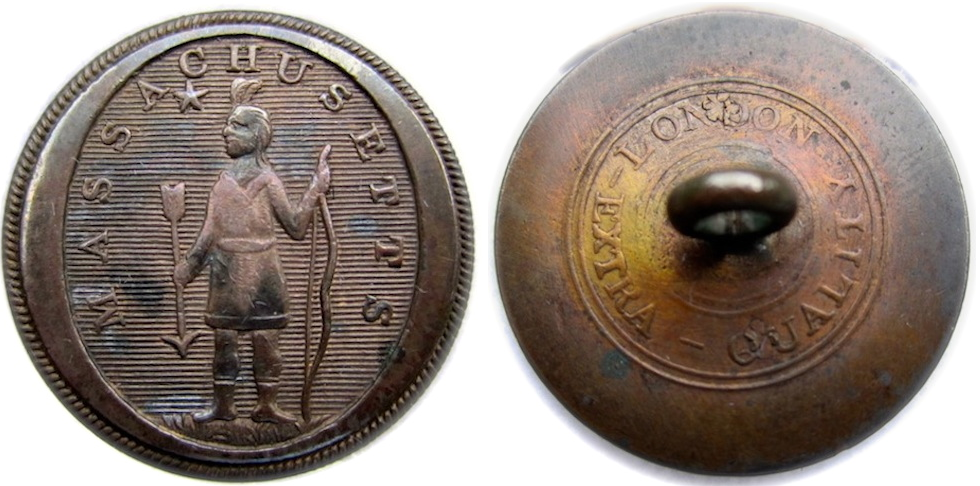
1812-30's Massachusetts State Militia General Use
Color: A Coppery Brown.
Metal: Flat, 1-Piece, Raised Design, Brass.
Size: 25mm. Coat Size
Albert's Number: MS 19-A: RV 6-10
Tice's Number: MSO 36A.2
Variation: Native American Indian Standing on A
Grassy Mound / Large Hunting Bow / Downward Pointing Arrow
Present Condition: A Non Excavated Example, Exceptional
Planchet Casting, Exceptional High Relief Pattern.
Isabela's Notes: This is the same British
manufacturer's obverse pattern, just a different back mark.
The button's pattern depicts a
Native American Indian Standing on a Grassy Mound.
He is leaning on a
Large Hunting Bow in his Left Hand, and
holding a
Downward Pointing Arrow
in his right. Over the Indian's right shoulder is the symbolic
Five-Point North
Star
which represents the
dependent territory of Maine. Arched in a semi-circle around the
Indian is the states name, "MASSACHUSETTS"
in large Roman font capital letters. The high relief pattern is set
on a lined field, that is within an oval picture frame border with
an outer
rope edging. When this button becomes available, collectors should seek
specimens that clearly show the
Indian's belt and depict the shirt's V neck lines clearly.
Reverse Button Analysis: This is a one-piece button with a
loop shank. The shank is original, straight, and intact. rm
LONDON- EXTRA-QUALITY within a set of 2 double Rm rings.
The RJ Silverstein Collection.
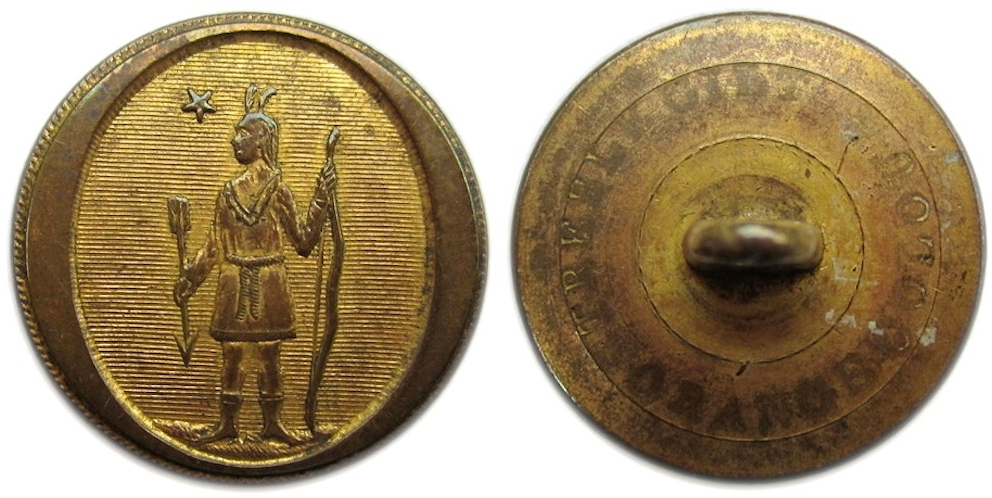
1815-25 Massachusetts State Militia General Use
Color: A Golden Brass Yellow Patina.
Metal: Flat, 1-Piece, Raised Design, Gilt Brass.
Size: 24mm. Coat Size
Albert's Number: MS 22: RV 10
Tice's Number: MS102-A/B
Variation: Native American Indian / Large Hunting Bow
/ Downward Pointing Arrow / Five Point North Star.
Present Condition: A Non Excavated Example, Exceptional
Planchet Casting, Exceptional High Relief Pattern.
Isabela's Notes: This specific pattern was made
by both the British & American Manufacturers between
1815-25 . The button's pattern depicts a
Native American Indian Standing on a Grassy Mound.
He is leaning on a
Large Hunting Bow in his Left Hand, and
holding a
Downward Pointing Arrow
in his right. Over the Indian's right shoulder is a
Five-Point North
Star Pointing Downward.
This star is to symbolically represent the dependent
territory of Maine. The high relief pattern is set on a
lined field, that is within an oval picture frame border with
an outer
rope edging. This button is a little more scarce then it's
counterpart with the states name in the legend. A clearly
defined belt and tunic should be a strong consideration in
pricing.
Reverse Button Analysis: This is a one-piece button with a
loop shank. The shank is original, straight, and intact.
This button is a strike over from surplus early
official/diplomatic buttons. TREBLE GILT ORANGE COLOUR
within 2 dm rings.
The RJ Silverstein Collection.
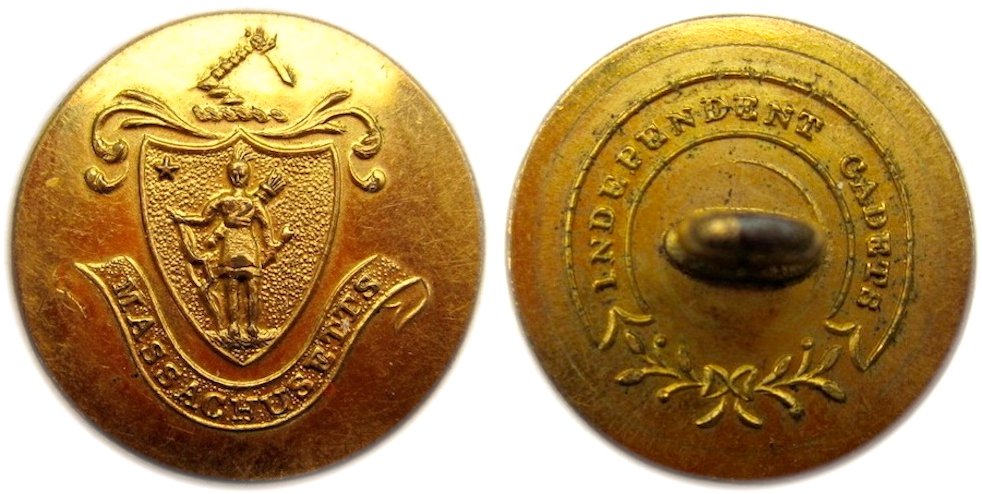
1830's-65 Massachusetts State Militia
Color: Antique Brass with An Orange Glow.
Metal: Flat, 1-Piece, Raised Design, Gilded Brass.
Size: 22mm. Coat Size
Albert's Number: MS 26:
RV 5
Tice's Number: MS200A.1
Variation: Native American Indian / Pebbled Field /
Quiver of Arrows / North Star / Bent Arm / Downward Pointing
Saber.
Present Condition:
A Non Excavated Example, Exceptional Planchet Casting,
Strong High Relief Pattern.
Isabela's Notes: This was the first Massachusetts button in
the 1830's to depict the entire Commonwealth Coat of Arms.
The button was also re-manufactured throughout the Civil
War. The
button's pattern depicts a
Native American Indian
standing on a grassy mound. The Indian is depicted on a
Pebbled Field
that is within a recessed shield that has a raised outline
border. The Indian is leaning on a large bow with his right hand, and
holding a downward pointing arrow in his
left. Over the Indian's left shoulder is a
Quiver of Arrows.
In the upper right hand corner of the shield is the symbolic
North Star
which represents the dependent territory of
Maine. Directly above the shield is a mantle depicted by some graphic swirly lines.
Above that is the
Bent Arm Holding a
Downward Pointing Saber. Below the shield is a
"U" shaped banner
ribbon that has the states name, "MASSACHUSETTS"
in capital letters on a pebbled field. The high relief
pattern is set against a plain flat field with
no raised edge border.
Reverse Button Analysis: This is a flat one-piece button with a
loop shank. The shank is original, straight, and intact.
above is a rm INDEPENDENT CORPS within a ribbon. Below is a
rm wreath & Bow design.
The Robert J. Silverstein Collection.
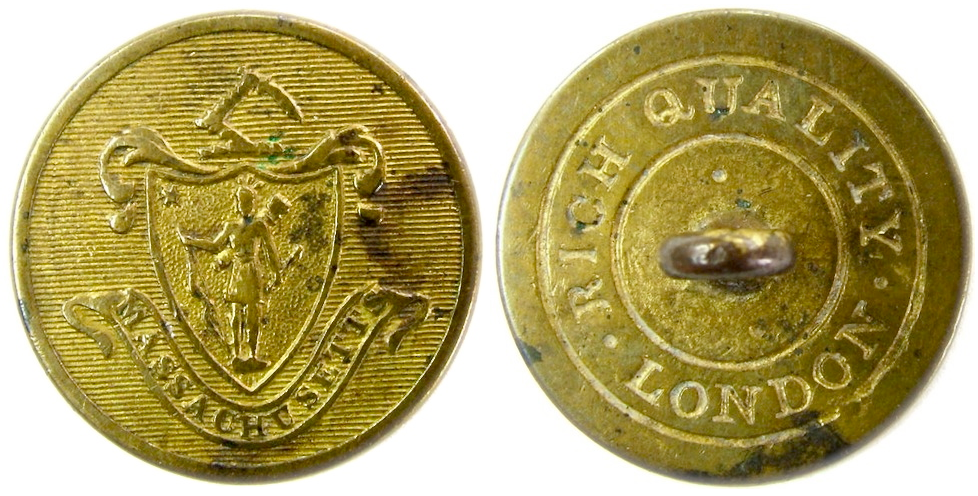
1820's Massachusetts State Militia
Color: A Brass Yellow With Green Undertones.
Metal: Flat, 1-Piece, Raised Design, Gilded Brass.
Size: 23mm. Coat Size
Albert's Number: MS 27:
RV 5
Tice's Number: MS110C.2
Variation: Pebbled Field / Slanted Bow / Quiver of
Arrows / North Star / Saber Appears like a Short Knife.
Present Condition:
A Non Excavated Example, Exceptional Planchet Casting,
Strong High Relief Pattern.
Isabela's Notes: These buttons were manufactured
in Great Britain during the 1820's. There appears to be at
least three die variants. The main differences are in the
depiction of the length of the saber, and its spacing to the
top of the mantling. The
button's pattern depicts a
Native American Indian
standing on a very small mound. The Indian is depicted on a
Pebbled Field
that is within a shield with a raised outline. The Indian is
leaning on a large
Slanted Bow
with his right hand, and holding a
Downward Pointing Arrow
in his
left. Over the Indian's left shoulder is a
Quiver of Arrows.
In the upper right hand corner of the shield is the symbolic
North Star
which represents the dependent territory of
Maine. Directly above the shield is a mantle depicted by some graphic swirly lines.
Above that is the
bent arm holding a downward pointing saber.
In this variant, the
Saber Appears like a Short Knife. Below the shield is a
"U" shaped banner
ribbon that has the states name, "MASSACHUSETTS"
in capital letters. The high relief pattern is set on a
lined field with a thin raised edge border.
Reverse Button Analysis: This is a one-piece button with a
loop shank. The shank is original, straight, and intact. rm
LONDON. RICH .QUALITY within a set of 2 double dm rings.
The Robert J. Silverstein Collection.
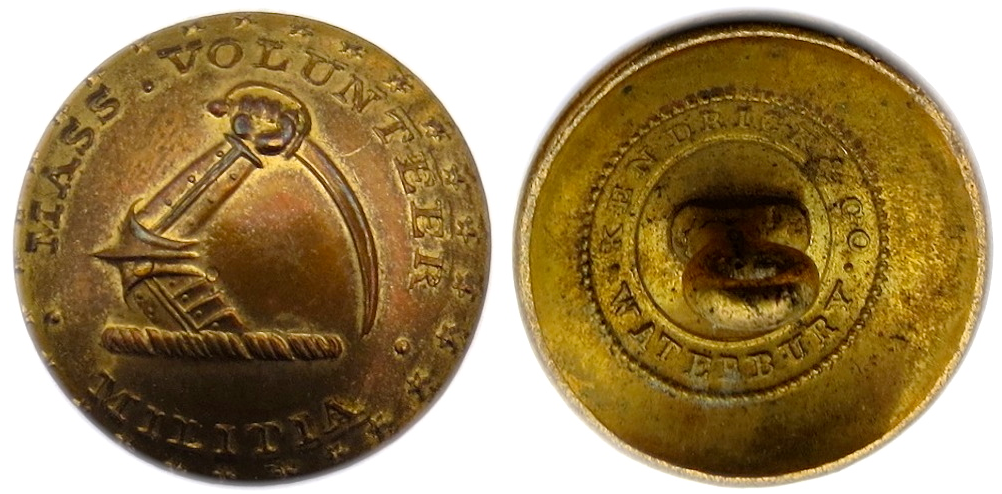
1830's Massachusetts State Militia
Color: A Coppery Brown Golden Areas.
Metal: 1-Piece, Slightly Convex, Raised Design, Gilded
Brass.
Size: 20.08mm. Coat Size
Albert's Number: MS 33:
RV 8
Tice's Number: MS204A.1
Variation: Bent Arm Clothed in a Military Style
Button Shirt / Long Downward Pointing Saber / 26 Five
Pointed Stars.
Present Condition: A Non Excavated Example, Exceptional
Planchet Casting, Exceptional High Relief Pattern.
Isabela's Notes: This is one of
the last Massachusetts one-piece military buttons made
during the
1830's. The same front dies were later used for the production of
two-piece buttons. There are two die variants known for this
one piece button. One with a long sword, and the other with
a short sword. The button's pattern depicts a large
Bent Arm Clothed in a Military Style Button Shirt
holding a
Long
Downward Pointing Saber.
In a semi-circle above is the states abbreviation, "MASS."
with the designation," VOLUNTEER". In the legend below is
the military designation, "MILITIA" in capital
letters. Circling around the button's edge is
26 Five Pointed Stars.
The high relief pattern is set on a plain convex field with
no raised edge border. There is another die variant
with a shorter sword.
Reverse Button Analysis: This is a slightly concave one-piece button with a
loop shank. The shank is original, straight, and intact.
.KENDRICK & CO./WATERBURY rm with an inner contiguous ring
and outer ring of dots.
The Robert J. Silverstein Collection.
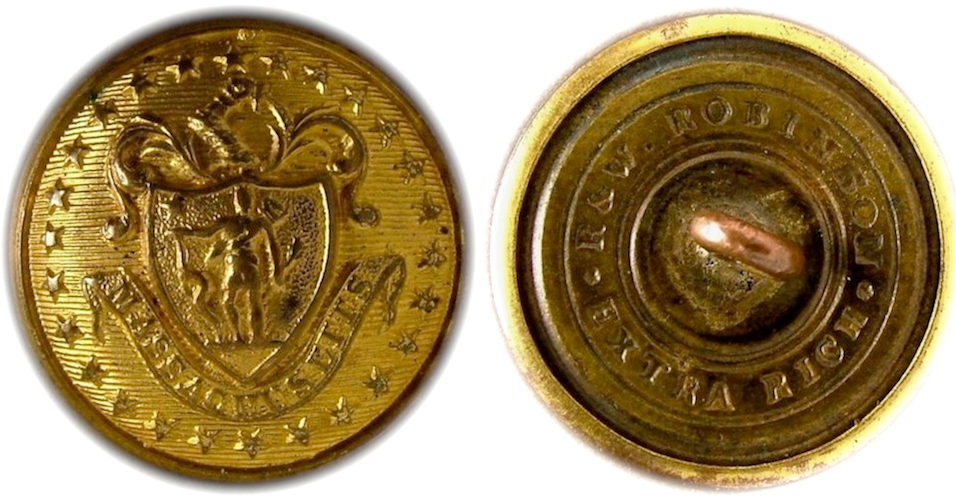
1840's Massachusetts State Militia
Color: A Tarnished Gold.
Metal: 2-Piece, Low-Convex, Raised Design, Gilded Brass.
Size: 23mm. Coat Size
Albert's Number: MS 30: RV 1
Tice's Number: MS202B.2
Variation: Native American Indian / Pebbled Shield /
Hunting Bow / Decorative Mantle / Short Saber / 26 Five
Point Stars.
Present Condition: A Non Excavated Example, Exceptional
Planchet Casting, Strong High Relief Pattern.
Isabela's Notes: Originally Colonel Winchester
made for the Independent Corps of Cadets when he was
visiting Paris, when he returned he presented them to the
corps. By October 4, 1844 the pattern was officially
adopted. There are four known die variants that became
general use button for all Massachusetts troops. The
differences mainly lie in the depiction of the sword, stars,
and shield. The button depicts the Commonwealth Arms of a
small
Native American Indian
standing within a
Pebbled Shield.
In his right hand he is leaning on a
Hunting Bow.
In his left hand he is holding an arrow pointing downward.
Over his left shoulder is a quiver of arrows. There is a North Star in the upper corner of
the shield which represents the dependent territory of
Maine. Above the shield is a
Decorative Mantle
with a bent arm holding a
Short Saber
in the middle. Below
the shield is a banner ribbon with the states name,
"MASSACHUSETTS" in all capital letters on a
pebbled field. Circling around the border is
26 Five Point Stars.
In this die variant, the stars are rotated 180 degrees with
the point upward. The pattern is set against a lined field
with a thin flat border ring encircling the edge.
Reverse Button Analysis: This is a two-piece button with a
loop shank. The shank is original, straight, and intact. dm
R&W. ROBINSON. EXTRA RICH. within a set of double inner dm
rings, and one outer dm ring.
The Picture is Courteous of H. Ridgeway.
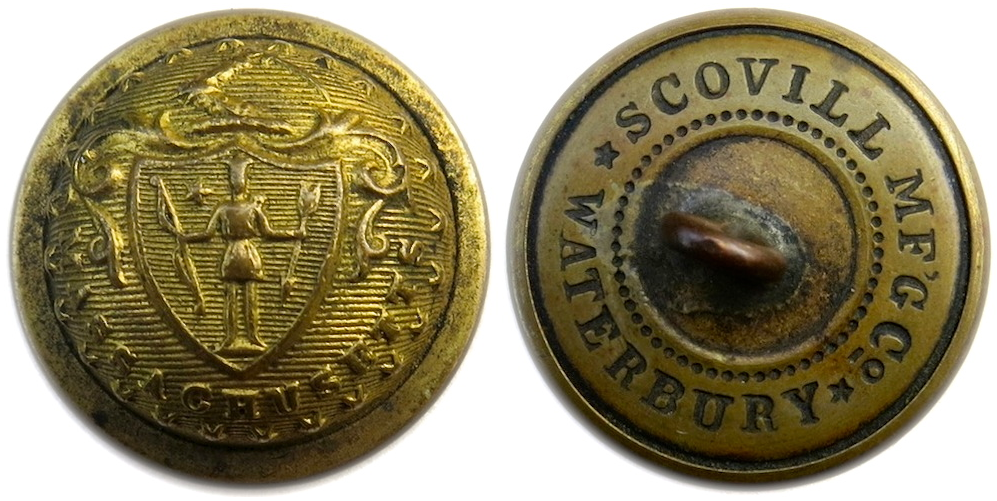
1865-90's Massachusetts State Militia
Color: Antique Brass.
Metal: 3-Piece, High Convex, Raised Design, Gilt Brass.
Size: 23mm. Coat Size
Albert's Number: MS 28: RV 1
Tice's Number: MS201 Unlisted Back mark.
Variation: Native American Indian / Lined Shield /
Small Hunting Bow / Large Arrow / Short Saber / 24 Five
Point Stars.
Present Condition: A Non Excavated Example, Exceptional
Planchet Casting, Strong High Relief Pattern.
Isabela's Notes: Robinson & Evans made most of
these after the Civil War, but there are some manufactured
prior to 1865. Civil War collectors should be careful noting
back marks. There are two known die variants. One with the
star over the Indians left shoulder, and one with it over
his right. The button depicts the
Commonwealth Arms of a small
Native American Indian
standing within a
Lined
Shield.
In his right hand he is holding on a
Small
Hunting Bow.
In his left hand he is holding a
Large Arrow
pointing downward. Over his left shoulder is a small quiver
of arrows. There is a North Star on the right hand side
between the Indian's head and hunting bow. This represents
the dependent territory of Maine. Above the shield is a
decorative mantle
with a bent arm holding a
Long
Saber
in the middle. In this die variant, the sword in the crest
is longer the other variants. Below
the shield is with the states name,
"MASSACHUSETTS" in all capital letters. Circling
around the border is
24 Five Point Stars.
In this die variant, the stars are rotated 180 degrees with
the point upward. The pattern is set against a lined convex
field with a thin flat false border ring encircling the
edge.
Reverse Button Analysis: This is a two-piece button
with a loop shank. The shank is original, straight, and
intact.
The RJ. Silverstein Collection.
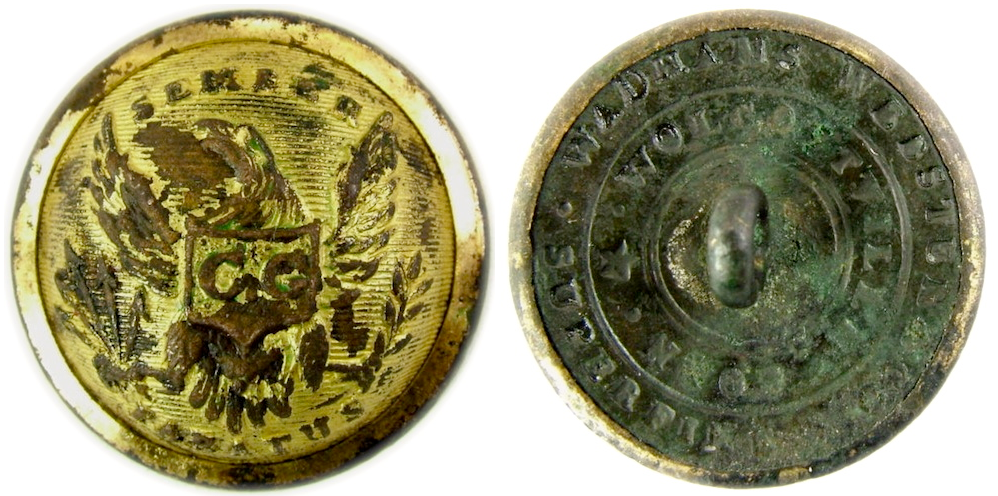
1838-46 Boston City Guards Officer's Staff Button
Color: Golden Yellow With Brown Patches.
Metal: 3-Piece, Low-Convex, Raised Design, Gilt Brass.
Size: 22.5mm. Coat Button
Albert's Number: MS 56:
RV 8
Tice's Number: MS230A.1
Variation: Eagle with Upraised Wings / Bundle of Five
Arrows / Olive Branch with Seven Petals / CG / Semper /
Paratus.
Present Condition: An Excavated Example, Strong Planchet
Casting, Strong High Relief Pattern.
Isabela's Notes: In September of 1821, this unit organized
as the "Boston City Greys," but was soon renamed Guards.
They later became Company E of the 1st Light Infantry
Regiment. They were nicknamed, "Tiger First". Windhams,
Webster & Co made these buttons in Torrington, CT between
1838-46. This appears to be the only manufacture for this
specific pattern, hence the only pattern known. The button's pattern depicts an
Eagle with Upraised Wings
facing right. In it's right talon is a
Bundle of Five Arrows, and in it's left talon is a
short stem
Olive Branch with Seven Petals.
On the eagle's chest is an outlined shield with the
initials,
"CG"
for City Guard. In an arc above the eagles head
is the Latin word, "SEMPER" and arched in the bottom legend
is the word, "PARATUS," which means, Always Ready. The
high relief
pattern is set on a low-convex lined field. Collectors like
this button because there are three different design types
to collect.
Reverse Button Analysis: This is a three-piece button with a
loop shank. The shank is original, straight, and intact. WINDHAMS WEBSTER & CO/. SUPERFINE . WOLCOTTEVILLE CONN.*. dm
middle solid ring, and two inner solid rings
The Old Court House Civil War Museum Collection.
The Picture is Courteous of H. Ridgeway.
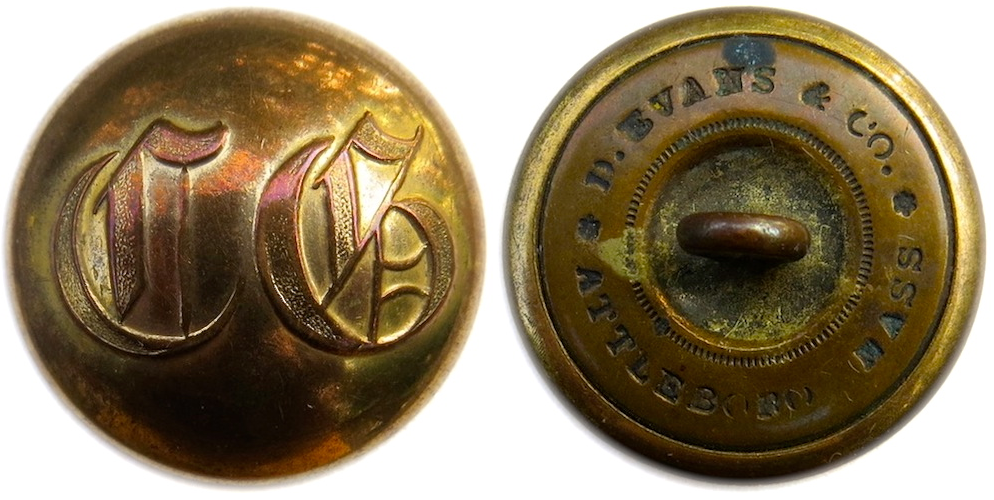
1845-59 Boston City Guards
Color: A Golden Reddish-Brown.
Metal: 2-Piece, Convex, Raised Design, Brass.
Size: 22.94mm. Coat Button
Albert's Number: MS 57:
RV 5
Tice's Number: MS232A.2
Variation: C G in Old English / Raised Outline /
Pebbled Field
Present Condition: An Excavated Example, Strong Planchet
Casting, Strong High Relief Pattern.
Isabela's Notes: This new style button replaced
the City Guards Semper Paratus eagle button in 1846. The
button's pattern depicts the City Guards initials,
"C G" in Old English.
The initials have a
Raised Outline
with a
Pebbled Field.
The high relief pattern is set on a plain convex field with
no raised edge border. There appears to be at least four
manufacturers that produced the same style pattern. Robinson
being the most common, and Draper and Sandland a it more
scarcer.
Reverse Button Analysis: This is a two-piece button with a
loop shank. The shank is original, straight, and intact.
*D.EVANS & CO./*ATTLEBORO MASS inner line dm surrounding a
shank well.
The RJ. Silverstein Collection.
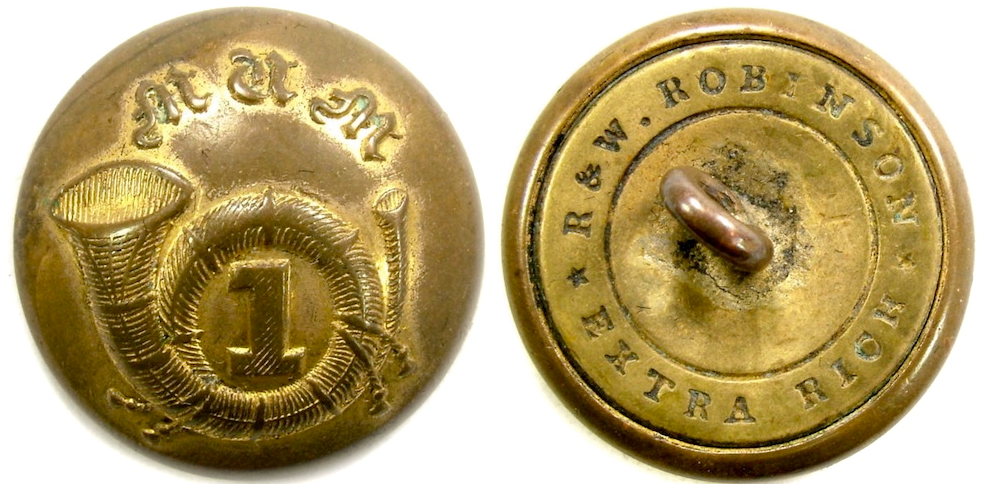
1854 Massachusetts
Volunteer Militia, 1st Regiment Infantry.
Color: Antique Brown With Gold Highlights.
Metal: 2-Piece, Convex, Raised Design, Gilt Brass.
Size: 23.18mm. Coat Size
Albert's Number: MS41: RV
5
Tice's Number: MS214 A.1
Variation: False Embroidered
Hunting Horn / Four Tassels / Lined Number 1 / MVM in Old English
Capital Letters.
Present Condition: A Non Excavated Example, Strong
Casting, Strong High Relief Pattern.
Isabela's Notes: A very popular state infantry button among
collectors. The button's pattern depicts a
False Embroidered
Hunting Horn
with
Four Tassels.
Inside the loop of the horn is a big
Lined Number, "1"
to distinguish the regiment. Above the hunting horn is the abbreviation for Massachusetts
Volunteer Militia,
"MVM" in Old English Capital Letters.
The high relief pattern is set on a plain convex field with
no raised edge border. State authorities formed the
volunteer regiment from existing companies that were still
around from the "old" 1st & 2nd regiment. During the Civil
War, the 1st & 2nd Regiments were organized into the 42nd
Massachusetts Volunteer Infantry Regiment which saw
distinguished service.
Reverse Button Analysis: This is a two-Piece button with a
loop shank. There is a slight push, but straight, original,
and intact. * R&W. ROBINSON/ EXTRA RICH* single inner ring
dm.
The RJ Silverstein Collection.
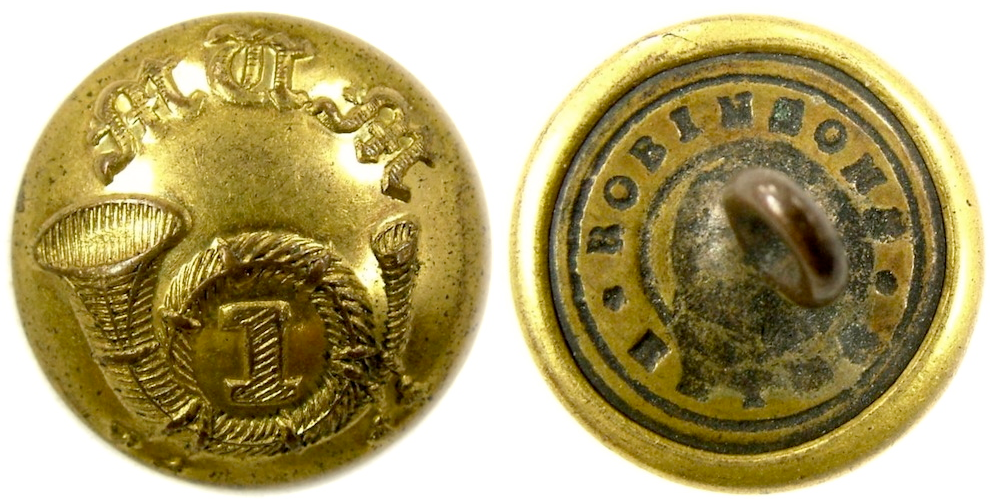
1854 Massachusetts
Volunteer Militia, 1st Regiment Infantry.
Color: Brass Yellow With Brown Speckles.
Metal: 2-Piece, Convex, Raised Design, Gilded Brass.
Size: 15.10 mm. Cuff Size
Albert's Number: MS41: RV 10
Tice's Number: MS214 As.1
Variation: False Embroidered
Hunting Horn / Four Tassels / Lined Number 1 / MVM in Old English
Capital Letters.
Present Condition: A Non Excavated Example, Strong Casting,
Exceptional High Relief Pattern.
Isabela's Notes: A very popular state infantry button among
collectors. The button's pattern depicts a
False Embroidered
Hunting Horn
with
Four Tassels.
Inside the loop of the horn is a big
Lined Number, "1"
to distinguish the regiment. Above the hunting horn is the abbreviation for Massachusetts
Volunteer Militia,
"MVM" in Old English Capital Letters.
The high relief pattern is set on a plain convex field with
no raised edge border. State authorities formed the
volunteer regiment from existing companies that were still
around from the "old" 1st & 2nd regiment. During the Civil
War, the 1st & 2nd Regiments were organized into the 42nd
Massachusetts Volunteer Infantry Regiment which saw
distinguished service.
Reverse Button Analysis: This is a two-Piece button with a
loop shank. There is a slight push, but straight, original,
and intact. * R&W. ROBINSON/ EXTRA RICH* single inner ring
dm.
The RJ Silverstein Collection.
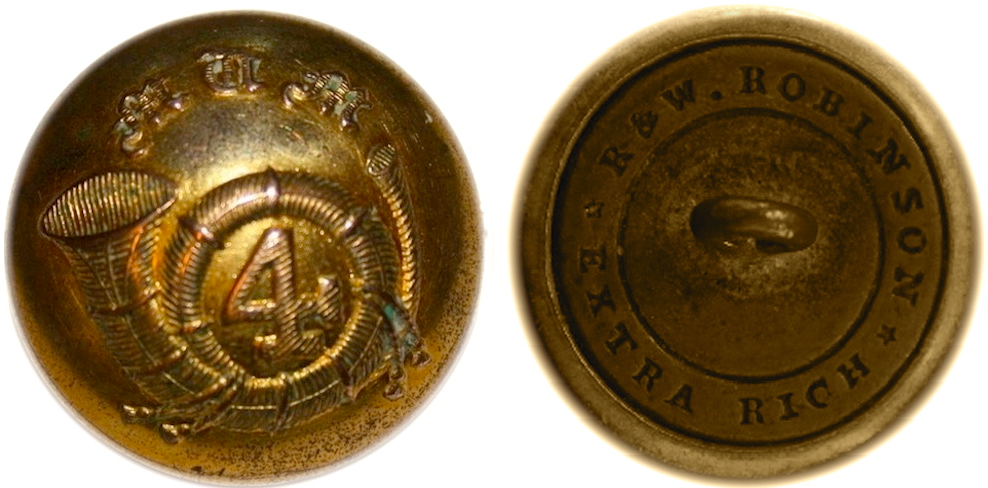
1855 Massachusetts
Volunteer Militia, 4th Regiment Infantry.
Color: A Polished Brassy-Brown.
Metal: 2-Piece, Convex, Raised Design, Gilded Brass.
Size: 23mm. Coat Size
Albert's Number: MS42:
RV 10
Tice's Number: MS216 A.1
Variation: False Embroidered
Hunting Horn / Four Tassels / Lined Number 1 / MVM in Old English
Capital Letters.
Present Condition: A Non Excavated Example, Strong
Casting, Strong High Relief Pattern.
Isabela's Notes: D. Evans made these handsome mis-backed
buttons around 1855. The unit originated out of the old 2nd
light infantry regiment of southeastern Massachusetts in
1855. The button's pattern depicts a
False Embroidered
Hunting Horn
with
Four Tassels.
Inside the loop of the horn is a big
Lined Number, "4"
to distinguish the regiment. Above the hunting horn is the abbreviation for Massachusetts
Volunteer Militia,
"MVM" in Old English Capital Letters.
The high relief pattern is set on a plain convex field with
no raised edge border. During the Civil War,
authorities mustered this regiment into service for three
months in 1861 and nine months in 1862 &1863. This button is
much scarcer then the 1st regiment. Collectors should base
there cost according to the detail remaining in the
embroidered hunting horn.
Reverse Button Analysis: This is a Two-Piece button with a
loop shank. The shank is straight, original, and intact.
R&W. ROBINSON* EXTRA RICH* single dm ring.
Massachusetts Artillery Units
Robert's Research Notes: Each cannon would be manned by two
gunners, six soldiers, and four officers of the artillery.
The right gunner was to prime the piece and load it with
powder, while the left gunner would fetch the powder from
the magazine, and keep ready to fire the cannon at the
officer's command. Three soldiers stood on each side of the
cannon, to ram and sponge the cannon, and hold the ladle.
The second soldier on the left was charged with providing 50
rounds.
Colonial artillery crew during the American Revolutionary
War - contemporaries of the 1771Encyclopædia Britannica.
Prior to loading, the cannon would be well cleaned with a
sponge to remove all sparks, filth, and dirt. The powder was
added, followed by a wad of paper or hay, and the ball was
thrown in. After ramming, the cannon would be aimed with the
elevation set using a quadrant and a plummet. At 45 degrees
the ball had the utmost range – about ten times the gun's
level range. Any angle above the horizontal line was called
random-shot. The officer of artillery had to ensure the
cannon was diligently served. Water was available to dip the
sponges in and cool the pieces every ten or twelve rounds.
In the late 1770s it was said that a 24-pounder could fire
90 to 100 shots a day in Summer, or 60 to 75 in Winter.
However, French artillery officers managed to have a cannon
fire 150 shots daily during siege. A 16 or 12 pounder would
fire a little more, because they were more easily served.
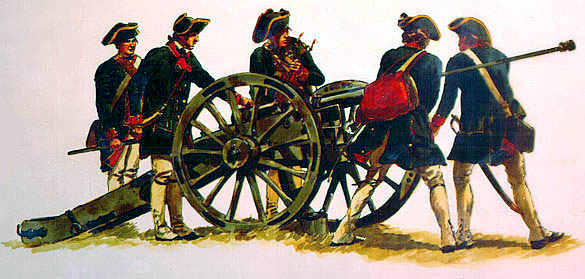
Source: Wikipedia
Colonial artillery crew during the American Revolutionary
War - Contemporaries of the 1771 Encyclopedia Britannica.
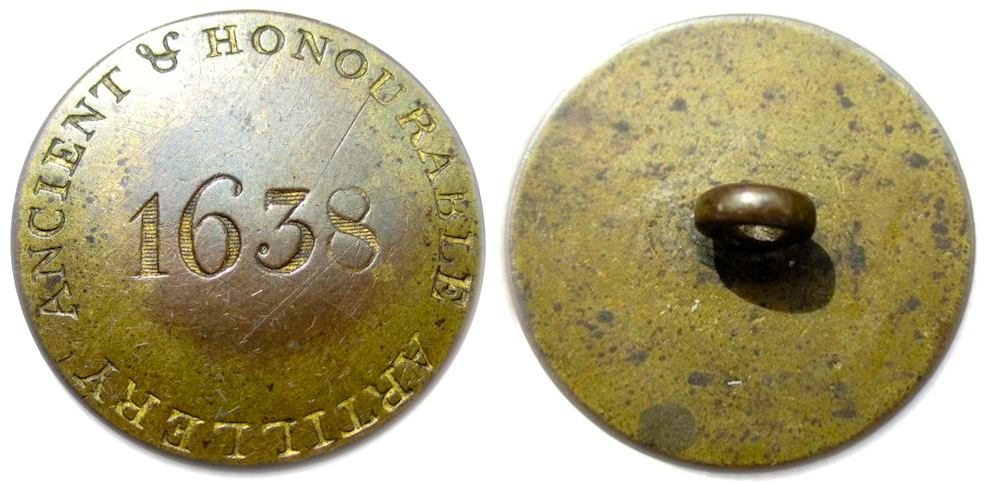
1799-1810 Massachusetts Ancient & Honourable Artillery 1638
Color: A Golden Brown With A Softer Light Brown
Center.
Metal: Flat, 1-Piece, Impressed Design, Gilt Brass.
Size: 25.09mm. Coat Size
Albert's Number: MS45: RV 45? Isabela's:
RV 75
Tice's Number: MSO40A.1
Variation: Charter Year 1638 / Ancient & Honourable
Artillery /
Present Condition: A Non Excavated Example, Exceptional
Planchet Casting, Exceptional Impression.
Robert's Notes: The Ancient & Honourable Artillery unit acquired
it's first named button in 1799-1800. The button's
pattern depicts the companies
Charter Year, "1638"
in the center. The company's name and designation,
"ANCIENT & HONOURABLE ARTILLERY"
is in capital letters circling around the buttons edge. The word "HONOURABLE"
is spelled the British way, so obviously they had a grammar problem
with more then just the word colour..lol or they just
spelled it to honor their British heritage with the formal
spelling of the time. The impressed pattern is on a plain
flat field with no raised edge border. This company was
originally founded in 1637, by Robert Keyane. All 24
original members were officers in the Massachusetts Militia.
Some of these 24 officers were originally from the Ancient &
Artillery Company in London before they sailed to the new
world. (Obviously they were leading dead
end-lives in London with no hopes of military career
advancement). During the early colonial times, this company
served as a school for training Militia. Many cadets went on
to fight with distinction on the Champlain frontier and also
in Canada. During the American Revolution, some members were
at the Boston Tea Party, and some served in the Continental
Army. After the Revolution, some members helped suppress
Shay's Rebellion in the Berkshire Mountains in
Massachusetts. The company turned into a ceremonial
organization in the mid 1800's, and did
"NOT" function as a fighting unit during the Civil War!
The different style buttons that followed after the first
two original patterns were mostly ceremonial in nature. There must have been a few floating around
that Albert new about for such a low RV rating, because I
have only come across this one during my whole life of
collecting…. and my dear friend William L. made me pay
dearly. I recommend that if any specimen that comes to
market consider the opportunity of buying it with extreme
prejudice.
Reverse Button Analysis: Flat one-piece button. The shank is
original, straight, and intact. No back mark.
The RJ. Silverstein Collection.
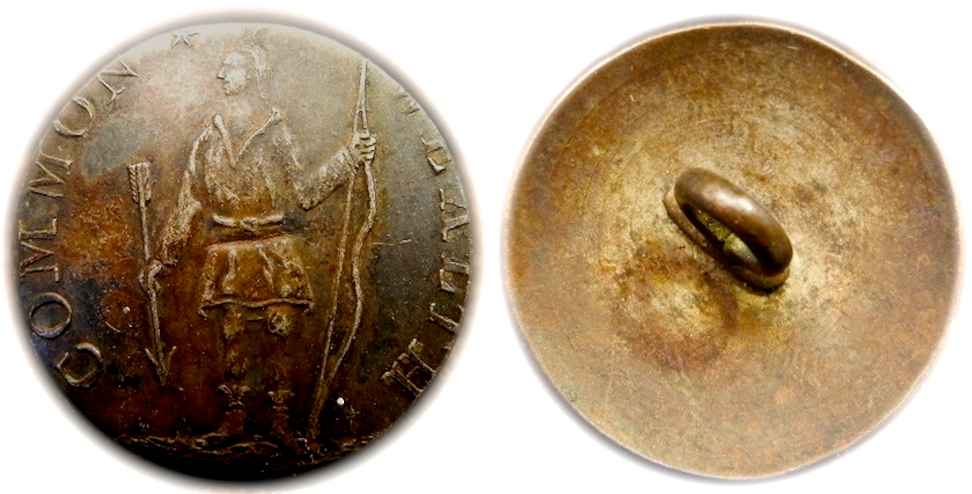
1810 Massachusetts Ancient & Honourable Artillery 1638
Color: A Golden Brown With Some Purple & Blue.
Metal: Low Convex 1-Piece Plated.
Size: 25mm.
Albert's Number: MS46: RV 40
Tice's Number: MSO42A.1
Variation: 5 Point Star.
Present Condition: A Non Excavated Example, Exceptional
Planchet Casting, Strong High Relief Pattern.
Robert's Notes: This popular pattern button was made both in
Gilt and Silver Plated Copper around 1810. The high relief
pattern depicts a standing indian facing right, while
holding a bow in his left hand, and an arrow in his right.
There is a raised five pointed star over his right shoulder.
(There is another variant with a 6 pointed star). The
inscription COMMON WEALTH circles the button's outside
periphery. The Ancient & Honourable Artillery unit turned
into a ceremonial organization during the mid 1800's, and
did "NOT" function as a fighting unit during the Civil War.
The different style buttons that followed after the first
two original patterns were mostly ceremonial in nature. The
Ancient & Honourable Artillery unit acquired it's first
named button in 1799-1800.
Reverse Button Analysis: Slightly concave one-piece button.
The shank is original, straight, and intact. No back mark.
The RJ Silverstein Collection.
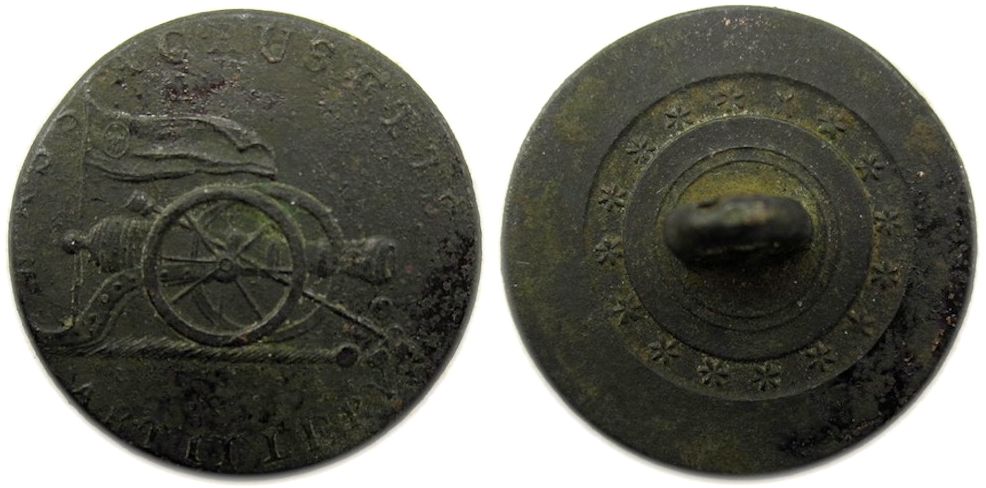
1800-1825 Massachusetts Militia Artillery Unit
Color: A Forest Green with Brown Undertones.
Metal: Flat, 1-Piece Brass.
Size: 25mm.
Albert's Number: MS 18: RV 40
Tice's Number: MSO 34
Present Condition: An Excavated Example, Strong Planchet
Casting, Strong High Relief Pattern.
Robert's Notes: Massachusetts purchased these buttons from
American manufacturers in Boston during the early 1800's.
The button's pattern depicts a an old style cannon in the
center pointing left. The cannon's carriage extends to the
wheel axel, and shows five carriage bolts. On the right hand
side behind the cannon is a raised flag with a motif of a
small standing indian within a circle. There is a pile of
cannon balls stacked with a gaming sponge in front of the
cannon. The state's name, " MASSACHUSETTS" is in an arc
along the top legend, and the word, "ARTILLERY" is written
below in a semicircle. There appears to have been a number
of manufacturers that produced this pattern in the US and
England. Collectors usually seek A.M PEASLEY. Recently there
was a 6-8 found in New Boston New Hampshire.
Reverse Button Analysis: This is a flat one-piece button
with a loop shank. The shank is original, straight and
intact. Sixteen raised asterisk type stars encircle in a
depressed channel (A.M. PEASLY BOSTON'S back mark). 2 rm
small rings within.
Excavated in New Boston, New Hampshire (1 of 2 found
together).
The RJ Silverstein Collection.
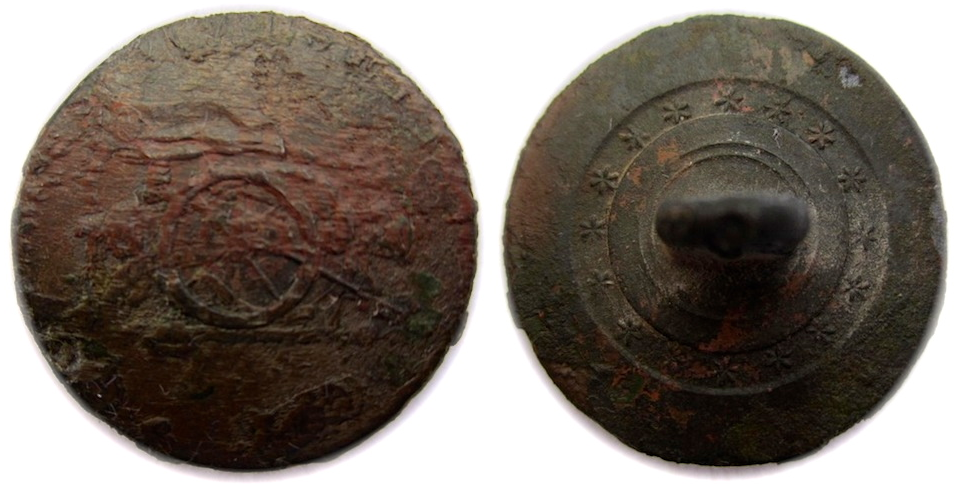
1800-1825 Massachusetts Militia Artillery Unit
Color: A Deep Brown with Clay Red Highlights.
Metal: Flat, 1-Piece Brass.
Size: 23mm.
Albert's Number: MS 18: RV 40
Tice's Number: MSO 34
Present Condition: An Excavated Example, Fair Planchet
Casting, Poor High Relief Pattern.
Robert's Notes: Massachusetts purchased these buttons from
American manufacturers in Boston during the early 1800's.
The button's pattern depicts a an old style cannon in the
center pointing left. The cannon's carriage extends to the
wheel axel, and shows five carriage bolts. On the right hand
side behind the cannon is a raised flag with a motif of a
small standing indian within a circle. There is a pile of
cannon balls stacked with a gaming sponge in front of the
cannon. The state's name, " MASSACHUSETTS" is in an arc
along the top legend, and the word, "ARTILLERY" is written
below in a semicircle. There appears to have been a number
of manufacturers that produced this pattern in the US and
England. Collectors usually seek A.M PEASLEY. Recently there
was a 6-8 found in New Boston New Hampshire.
Reverse Button Analysis: This is a flat one-piece button
with a loop shank. The shank is original, straight and
intact. Sixteen raised asterisk type stars encircle in a
depressed channel (A.M. PEASLY BOSTON'S back mark). 2 rm
small rings within.
Excavated in New Boston, New Hampshire (2 of 2 found
together).
The RJ Silverstein Collection.
Maine Infantry Militia
Maine is both the most northern, and eastern state in the
United States. The Atlantic Ocean lies on it's eastern
border, with the state of New Hampshire to the West, and
Canadian provinces of Quebec and New Brunswick to the north.
Some historians believe that it's name comes from the
mariner Jargon, who would differentiate the "mainland" from
the myriad of islands off the Atlantic Coast. The first
European settlement was in 1604, by Pierre Dugua on Saint
Croix Island. Then two Jesuit missions were established by
the French some 10-12 years later. The first English
settlement was established by the Plymouth Company in 1607,
but unfortunately due to the rugged climate, and the
constant conflicts with the local natives, the English
Popham Colony was short lived. A number of colonies
eventually sprung up along the coast line in the 1620's, but
most of them were also short lived due to the same
underlining reasons. The few sparsely populated settlements
that did survive in that rugged region accepted control by
the Massachusetts Bay Colony. In the beginning, the
Massachusetts's "Puritan" social and ethical convictions
were welcomed by Maine colonists, and by 1652 it was a way
of life for people. Then for the next hundred and fifty
years, Massachusetts and Maine were as one in embodiment
under the "Commonwealth of Massachusetts". Maine had a
scarce population, and relied upon Massachusetts's Militia
for help if need be. Then a combination of events in the
early 1800's caused Maine to look toward secession from the
Commonwealth. First was a long standing disagreements over
land speculations and settlements in 1807. This caused the
first attempt for Maine to secede from Massachusetts by
vote, but it failed. Then it wasn't until the War of 1812,
when it came to a head once more. Massachusetts's
Pro-British merchants opposed the war, and it's militia
refused to defend Maine against the British invaders. By
1819, Massachusetts agreed for Maine to secede if voters
called for it. They won the vote, and finally seceded from
the Commonwealth of Massachusetts in 1820. Later that year,
Maine was admitted to the "Union" as the 23rd state under
the Missouri Compromise. Also in 1820, the State of Maine
Legislature convened, and immediately adopted their own
State of Arms. This design shows a shield emblazoned with a
stately White Pine with a Moose below. A husbandman is
resting on a scythe representing agriculture is on one side
of the shield, and the other side has a seaman leaning on an
anchor. A crest above contains the North Star which was
taken from the Massachusetts's seal. Maine's motto,
"Diringo" which means, "I Direct" is symbolic of Maine
helping mariners find there way alludes to the North Star.
By the early 1820-30's, Maine began to organize more of
their own volunteer militia companies. Even with the War of
1812 ending a short time ago, these new volunteers
unfortunately had little or no military field experience. By
1851, they undergone a reorganization to a uniformed
volunteer militia. Still mostly ceremonial at this point,
but growing in numbers. By 1861, there were thirty five
Volunteer companies in three military divisions. With the
onset of the Civil War, Maine was able raise 15 regiments of
infantry, a cavalry regiment, and five light artillery
batteries. Early Maine Militia buttons only used Maine's
State of Arms "North Star" symbol as their button main
pattern. Not the complete State of Arms symbol. Several
variations of the North Stars emerged, some with lines, some
with beveled edges, some with ropes, and some florals
within. These were all one-piece buttons in various metals.
In 1856, the Legislature changed the militia's North Star
pattern to the complete Maine State of Arms symbol, which
includes the North Star. Scovill produced the first examples
in 1857, and by 1861 they were a standard for all Maine
troops.
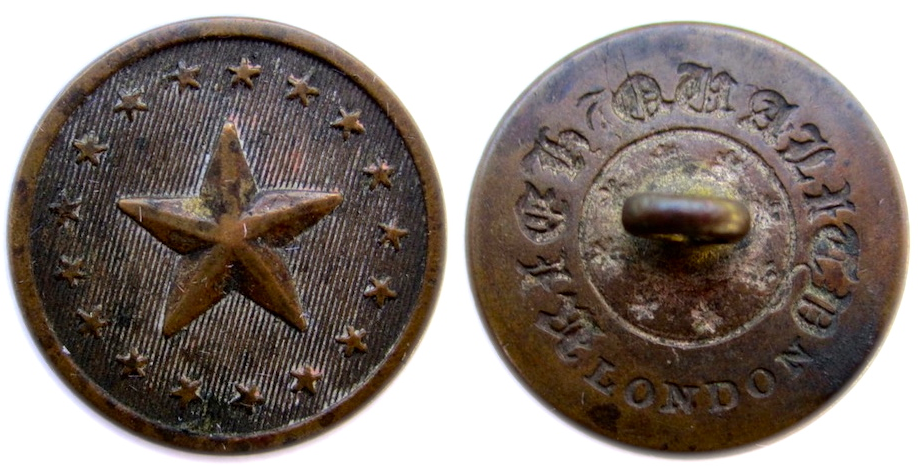
1820-30's Maine Militia
Color: A Mixed Chocolate.
Metal: Flat, 1-Piece, Raised Design, Brass.
Size: 21mm.
Albert's Number: ME 4-A: RV 4
Tice's Number: ME 100A.2 Variation
Variation: 11mm Beveled Star.
Present Condition: An Excavated Example, Exceptional
Casting, Exceptional High Relief Pattern.
Isabela's Notes: Depending on the manufacturer, there is 18
known variations of this pattern used by Maine's Militia.
The reason for the wide spread amount of variants might be
because they outfitters applied them onto headgear as well
as coats. Maine took the symbol of the North Star from the
Massachusetts's Militia Coat of Arms when they broke away
and became independent. This button's pattern depicts a
large raised beveled five-pointed star in the center of a
lined field. This is encircled by a ring of 17 small 5
pointed stars. There is a small thin raised edge border.
Great button for collectors because of the wide number of
pattern variations, and available specimens.
Reverse Button Analysis: This is a one-piece button with a
loop shank. The shank is original straight, and intact.
LONDON RICH QUALITD dm ring/inner ring of 8 five pointed
stars.
The RJ Silverstein Collection.
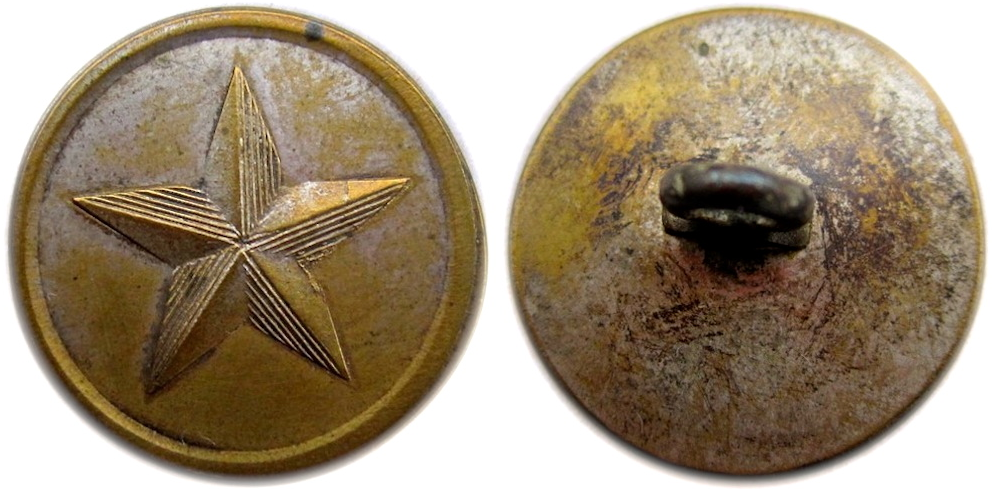
1820-23 Maine Militia
Color: A Mustard Green.
Metal: Flat, 1-Piece, Raised Design, Silver Wash Copper.
Size: 23.17mm.
Albert's Number: ME 4-C: RV 8
Tice's Number: ME 100F.5 Variation
Variation: 5 Point Star with Alternating Lines.
Present Condition: An Excavated Example, Exceptional
Casting, Exceptional High Relief Pattern.
Isabela's Notes: There is a lot of die variants for just
this specific pattern, some even have a rope border. Maine
took the symbol of the North Star from the Massachusetts's
Militia Coat of Arms when they broke away and became
independent. This button's pattern depicts a large raised
beveled five-pointed star on a flat plain field. The star's
arms have alternating lines to a flat side. There is a small
thin raised edge border, but the right hand side extra
thickness for easier thumb buttoning. Collectors should seek
this scarce die variant with any back mark. This pattern is
great button for collectors because of the wide number of
patterns and sub-variations, and available specimens.
Reverse Button Analysis: This is a one-piece button with a
loop shank. The shank is original straight, and intact. No
back mark.
Maine was admitted to the Union in 1820, Aaron Peasley out
of Boston made this button for three years, from 1820-23.
The RJ Silverstein Collection.
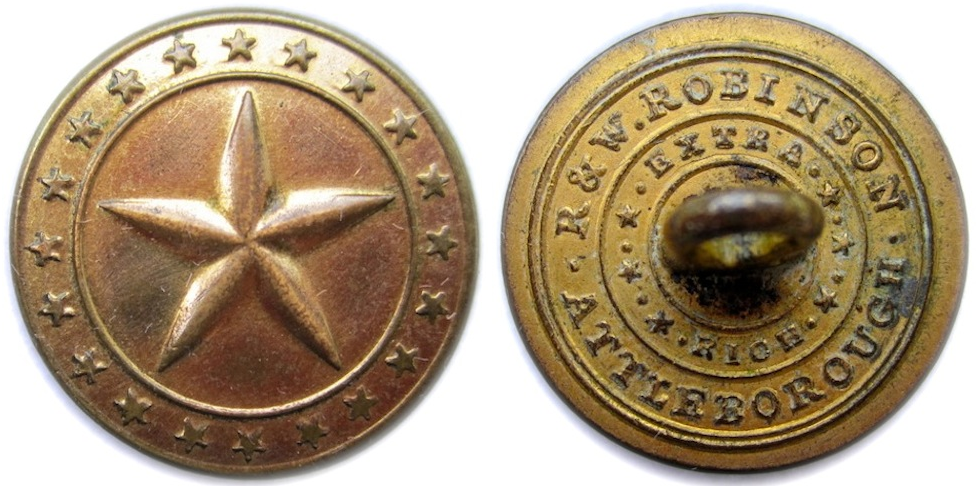
1830's Maine Militia
Color: A Mixed Chocolate.
Metal: Flat, 1-Piece, Raised Design, Gilt Brass.
Size: 21mm.
Albert's Number: ME4E: RV 6
Tice's Number: ME 100E.3 Variation
Variation: 11mm Beveled Star.
Present Condition: An Excavated Example, Exceptional
Casting, Exceptional High Relief Pattern.
Isabela's Notes: Depending on the manufacturer, there is 18
known variations of this pattern used by Maine's Militia.
The reason for the wide spread amount of variants might be
because they outfitters applied them onto headgear as well
as coats. Maine took the symbol of the North Star from the
Massachusetts's Militia Coat of Arms when they broke away
and became independent. This button's pattern depicts a
large raised beveled five-pointed star within a raised
concentric ring. Outside of the ring is 20 five pointed
stars circling around the buttons perimeter. There is a
small thin raised outside edge border to give a channel look
for the stars. This is a great button for collectors because
of the wide number of pattern variations, and available
specimens.
Reverse Button Analysis: This is a one-piece button with a
loop shank. The shank is original straight, and intact. R &
W ROBINSON. ATTLEBOROUGH./RICH.*.*EXTRA.*.*.* Outside double
rm ring with two other inner rings.
The RJ Silverstein Collection.
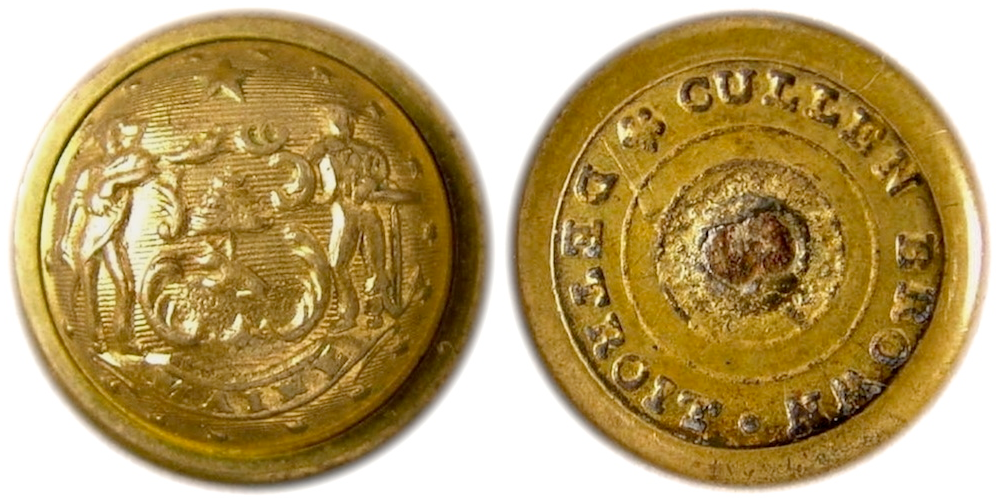
1846-60 Maine Militia Officer's Button
Color: A Golden Brass Yellow.
Metal: 3-Piece, High Convex, Raised Design, Brass.
Size: 14.7mm. Hat or sleeve size
Albert's Number: ME 1: RV 5
Tice's Number: ME200As.2
Variation: Star with Raised Center.
Present Condition: An Excavated Example, Exceptional
Casting, Exceptional High Relief Pattern.
Isabela's Notes: This would be the earliest known
manufacturer's pattern.
Reverse Button Analysis: This is a three-piece button with a
loop shank. The shank is missing. * CULLEN BROWN/DETROIT. 2
inner dm rings.
The Picture is Courteous of H. Ridgeway.
Missouri Infantry Militia
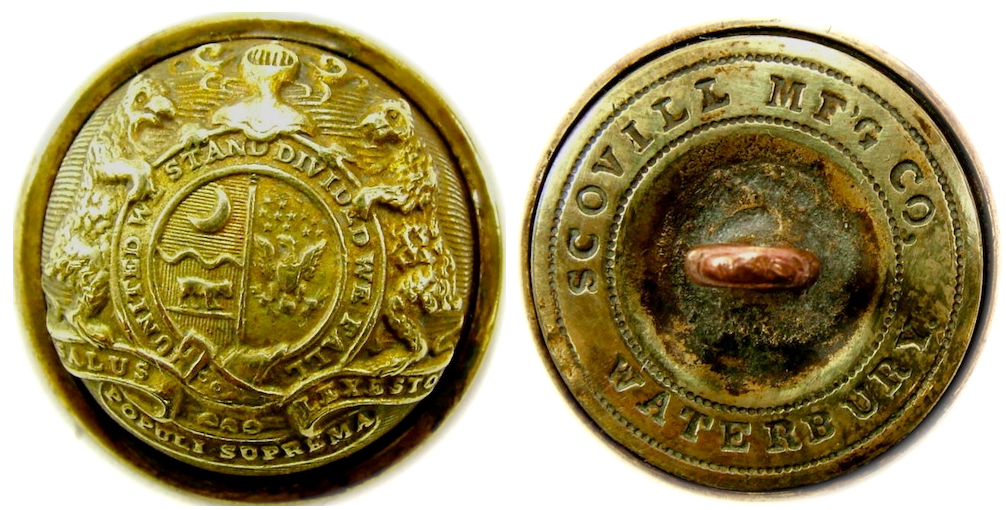
1860 Missouri's Militia Infantry Officer's Button
Color: Whitewash Gold.
Metal: 3-Piece, High Convex, Raised Design, Brass.
Size: 22.3mm.
Albert's Number: MO 1-A: RV 10
Tice's Number: MO200A.1
Variation: 12 Stars above Eagle / Helmet Has 6 Bars / Wavy
Line Under Crescent.
Present Condition: A Non Excavated Example, Exceptional
Planchet Casting, Exceptional High Relief Pattern.
Isabela's Notes: The back mark indicates that this button was
manufactured by Scovills in the early 1860's, but used the
original die variant. This button was intended for the
Missouri Militia officers who generally sided with the
North, but were known to serve both sides. The button's
pattern depicts the Missouri State Seal of a split shield
symbolizing that the State and Federal government have
separate functions, but are united as one. Within the shield
is an eagle on one side with 12 five-pointed stars above.
The other side has a crescent moon on a horizontal lined
field with a wavy line underneath. Beneath the wavy line is
a walking bear on a vertical lined field. Encircling the
design is the motto in raised capital letters, UNITED WE
STAND DIVIDED WE FALL. Surmounting the top of the shield is
a helmet with Six bars. Flanking each side of the shield is
two large standing Grizzly Bears. Underneath in the legend
is a scroll with the Latin saying, "Salus Populi supema Lex
Esto", which means, "Let the good of the people be the
supreme law". The whole raised pattern is set upon a high
convex lined field with a 3-piece false rim. This particular
die variant was used prior to 1860, and then was
re-introduced with a later back mark for the Civil War years.
Reverse Button Analysis: This is a three-piece button with a
loop shank. The shank is original, straight, and intact.
SCOVILL MF'G CO, / WATERBURY small depressed letters within
2 rings of dots.
The Picture is Courteous of H. Ridgeway.
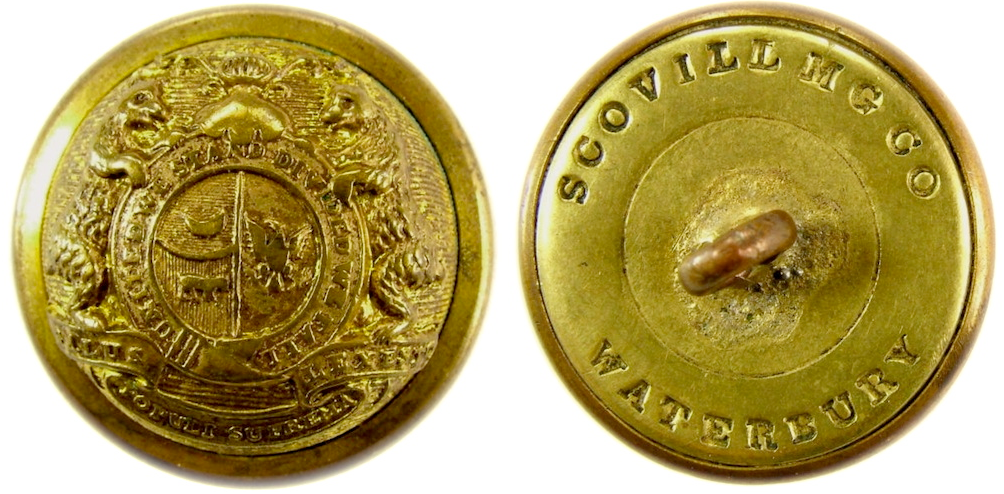
1850 Missouri's Militia Infantry Officer's Button
Color: Antique Gold.
Metal: 3-Piece, High Convex, Raised Design, Brass.
Size: 22.3mm.
Albert's Number: MO 2: RV 10
Tice's Number: MO205A.1/ Tice PG 71 back marks.
Variation: No Stars above Eagle / Divider Under Crescent is
an Arc.
Present Condition: A Non Excavated Example, Exceptional
Planchet Casting, Exceptional High Relief Pattern.
Isabela's Notes: The back mark indicates that this button was
manufactured by Scovills in the early 1850's. Intended for
Missouri Militia officers who generally sided with the
North, but were known to serve both sides during the Civil
War. This early button's pattern depicts the Missouri State
Seal of a split shield which symbolizes the State and
Federal government are separate in their duties, but are
united as one. In this variant, the one side of the shield
has a spread eagle on a plain field with no stars above. The
other side has a crescent moon on a horizontal lined field
with an arc divider underneath. Beneath the divider is a
smaller bear on a vertical lined field. Encircling the
design is the motto in raised capital letters, UNITED WE
STAND DIVIDED WE FALL. Surmounting the top of the shield is
a helmet with Six bars. Flanking each side of the shield is
two large standing Grizzly Bears. Underneath in the legend
is a scroll with the Latin saying, "Salus Populi supema Lex
Esto", which means, "Let the good of the people be the
supreme law". The whole raised pattern is set upon a high
convex lined field with a 3-piece false rim.
Reverse Button Analysis: This is a three-piece button with a
loop shank. The shank is original, straight, and intact.
SCOVILL MG CO/WATERBURY dm.
New Hampshire Infantry Units
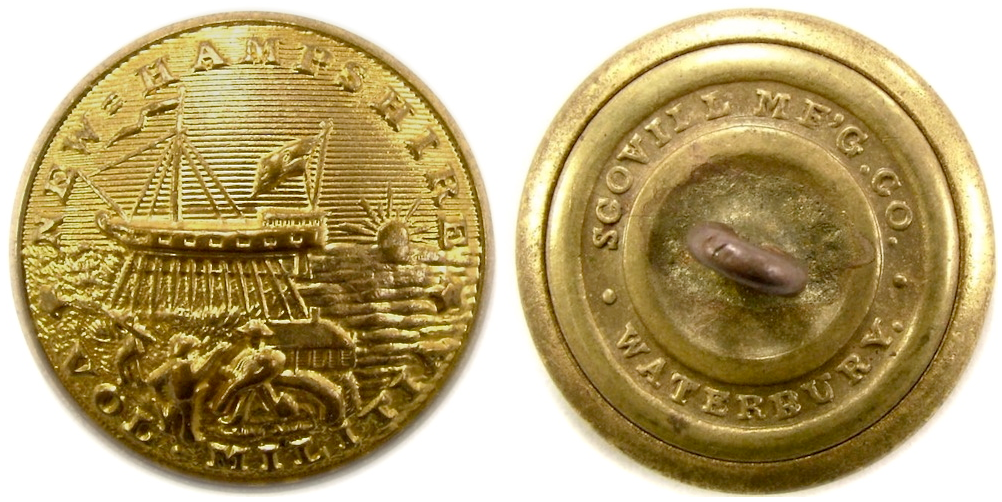
1850's New Hampshire Militia Infantry Unit
Color: Crisp Brass With Light Golden Brown Undertones.
Metal: Convex, 2-Piece, Raised Design, Gilt Brass.
Size: 23mm.
Albert's Number: NH 6: RV 5
Tice's Number: NH 200 A.2
Variation: New=Hampshire / Double Hyphen / Slanting Foremast
Touches E / Sun Short Radiating Lines.
Present Condition: A Non Excavated Example, Exceptional
Planchet Casting, Strong High Relief Pattern.
Robert's Notes: Even though manufactured earlier, this
button was the standard Civil War button for New Hampshire
Infantry units. This was first used in 1855, by the
Battalion of Amoskeag of Manchester, N.H. Since most large
manufacturers produced this pattern, there appears to be
more then 5 or 6 variations for the coat size, and several
different ones in the cuff size. There are quite a few
differences depicted for the State of Arms. Anything from
the use of a hyphen, to the building depicted, the size of
the sun, the angle and position of the boat's foremast, and
the position of the flag. This button's pattern depicts New
Hampshire's State of Arms on a lined field. Arced in the
legend above, is the states name, "NEW=HAMPSHIRE" in all
capital letters, and this die variant uses a Double Hyphen.
The boat's Slanting Foremast Touches the Tip of the,"E" in
the word NEW. The boat's flag is shown at half mast gently
blowing. There is a small Sun, with Short Radiating Lines.
In the legend below is the abbreviation for volunteer,"VOL."
which is followed by an abbreviated dot, and then the word,
"MILITIA". The high relief pattern is set on a convex lined
field with a thin edge border. This is a strong collector's
favorite because of all the variations.
Reverse Button Analysis: This is a 2-Piece button with a
loop shank. . SCOVILL MF'G. CO. /. WATERBURY. rmdc on a
stippled background. (ScovillM250)
The RJ Silverstein Collection.
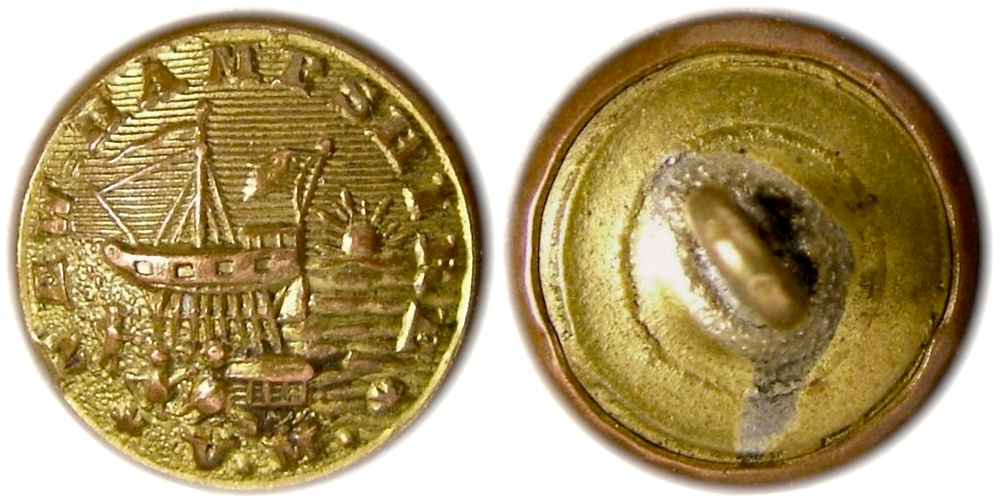
1850's New Hampshire Militia Infantry Unit
Color: Crisp Brass With Light Golden Brown Undertones.
Metal: Convex, 2-Piece, Raised Design, Copper.
Size: 14mm.
Albert's Number: NH 6: RV 5
Tice's Number: NH 200 AS.3
Variation: New=Hampshire / Double Hyphen / VM for Volunteer
Militia / Slanting Foremast Points toward the hyphen / Sun
Short Radiating Lines.
Present Condition: A Non Excavated Example, Exceptional
Planchet Casting, Strong High Relief Pattern.
Robert's Notes: This button was probably made by Steele and
Johnson in 1860's. This button's pattern is a crude
depiction of New Hampshire's State of Arms on a copper face.
Circling around the upper half of the legend is the states
name, "NEW=HAMPSHIRE" in all capital letters; and uses a
Double Hyphen in-between the words. Circling around the
lower legend, is the initials, "V.M.", for Volunteer
Militia. Separating the states name, and bottom legend's
inscription is Two Five Pointed Stars. There is a small boat
floating on gentle waters, and the Slanting Foremast is
pointing toward the, "Hyphen" in-between the states name. In
this die variant, the main mast is in the ship's center, and
the boat's flag is gently blowing in the wind. This die
variant shows a very Small Cabin Type Building, with three
individuals outside. There is a small sun, with short
radiating lines. The high relief pattern is set on a convex
field with a thin edge border. These cuff buttons are a nice
variation to the coat examples.
Reverse Button Analysis: This is a 2-Piece button with a
loop shank. Blank back mark (BlankNorth 04) dm inner ring.
Picture Courteous of Harry Ridgeway.
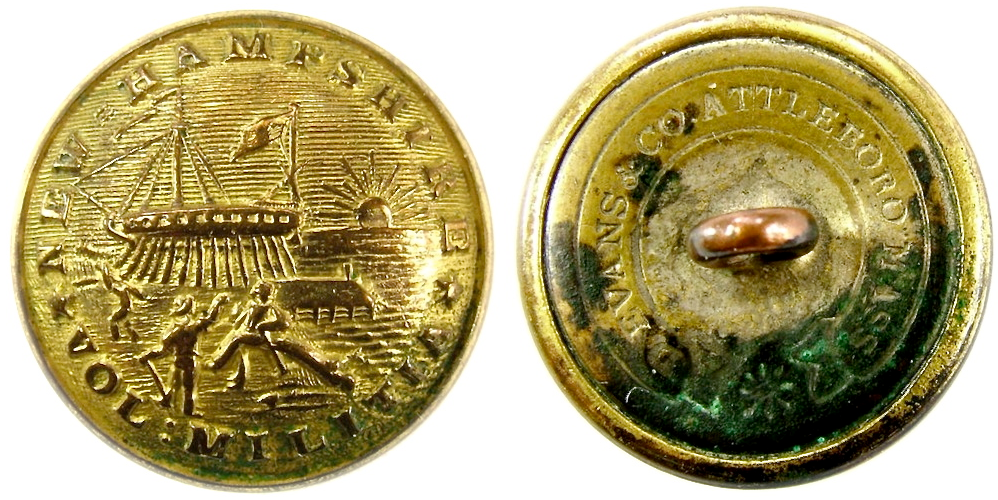
1855-60's New Hampshire Militia Infantry Unit
Color: Golden Brass With Green Encrustations.
Metal: Convex, 2-Piece, Raised Design, Gilt Brass.
Size: 23mm.
Albert's Number: NH 6: RV 5
Tice's Number: NH 200 C.1
Variation: Double Hyphen / Vol: is Followed By Colon / Two
Five Pointed Stars / Slanting Foremast is Found Between the
E & W / Flat Roof that Resembles a Wharf.
Present Condition: An Excavated Example, Strong Planchet
Casting, Strong / Exceptional High Relief Pattern.
Robert's Notes: Even though manufactured prior to the Civil
War, this button was the standard for New Hampshire Infantry
units. This was first used in 1855, by the Battalion of
Amoskeag of Manchester, N.H. Since most large manufacturers
produced this pattern, there appears to be more then 5 or 6
variations for the coat size, and several different ones in
the cuff size. There are quite a few differences depicted
for the State of Arms. Anything from the use of a hyphen, to
the building depicted, the size of the sun, the angle and
position of the boat's foremast, and the position of the
flag. This button's pattern depicts New Hampshire's State of
Arms on a lined field. Arced in the legend above is the
states name, "NEW=HAMPSHIRE" in all capital letters, and
uses a Double Hyphen in-between the words. In the lower
legend, the abbreviation for volunteer, "VOL:" is followed
Colon, and then the word, "MILITIA". Separating the states
name, and bottom legend's inscription is Two Five Pointed
Stars. The boat in this variant is floating on calm waters,
and the Slanting Foremast is found between the,"E" and the,
"W" in the word NEW. In this variant, the boat's flag is
blowing gently in the wind. The building in this die variant
has a Flat Roof that Resembles a Wharf. There is a small
sun, with short radiating lines. The high relief pattern is
set on a convex field with a thin edge border. This is a
strong collector's favorite because of all the variations.
Reverse Button Analysis: This is a 2-Piece button with a
loop shank. D.EVANS & CO ATTLEBORO. MASS dm in ribbon
reading clockwise, flower at bottom (Evans07)
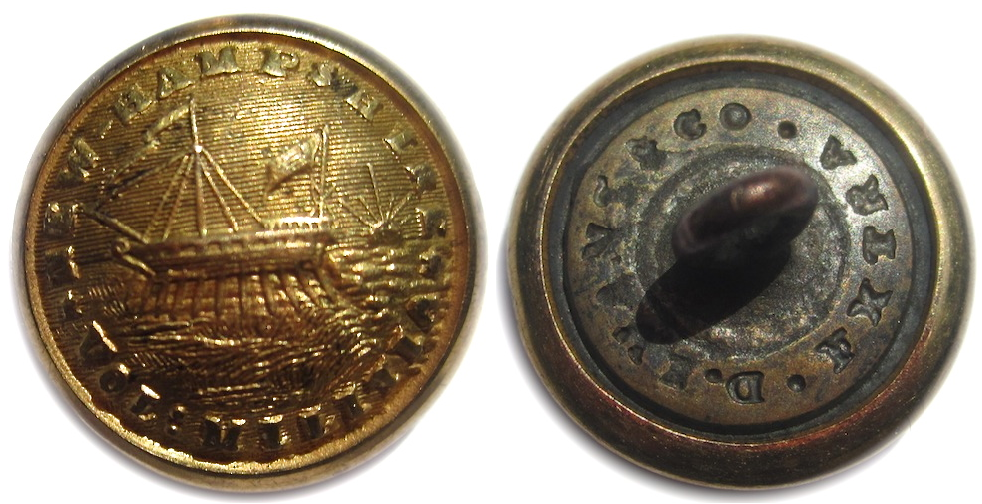
1850's New Hampshire Militia Infantry Unit
Color:
Metal: High Convex, 2-Piece, Raised Design, Gilt Brass.
Size: 15mm.
Albert's Number: Similar to NH 6: Unlisted back mark Variant
RV 25
Tice's Number: NH 200 UNCL-C.1
Variation: Single Hyphen / Vol: is Followed By Colon / Two
Five Pointed Stars / Slanting Foremast is Found Between the
E & W / Flat Roof that Resembles a Wharf.
Present Condition: An Excavated Example, Strong Planchet
Casting, Strong / Exceptional High Relief Pattern.
Robert's Notes: This would be the hardest Die Variant to
find for a collector. Unlike other specimens, there are no
people in the foreground or building. Circling around the
upper half of the legend is the states name, "NEW-HAMPSHIRE"
in all capital letters. This variant only uses a Single
Hyphen in-between the words. Circling around the lower
legend is the abbreviation for volunteer,"VOL:" which is
followed Colon, and then the word, "MILITIA". Separating the
states name, and bottom legend's inscription is Two Five
Pointed Stars. The boat is shown on calm waters, and the
Slanting Foremast is touching the, "E" in the word NEW. The
main is toward the center of the boat, and the flag is
hanging downward lightly blowing. There is a small sun, with
short & long radiating lines. The high relief pattern is set
on a convex field with a thin edge border.
Reverse Button Analysis: This is a 2-Piece button with a
loop shank. D.EVANS & CO
The RJ Silverstein Collection.
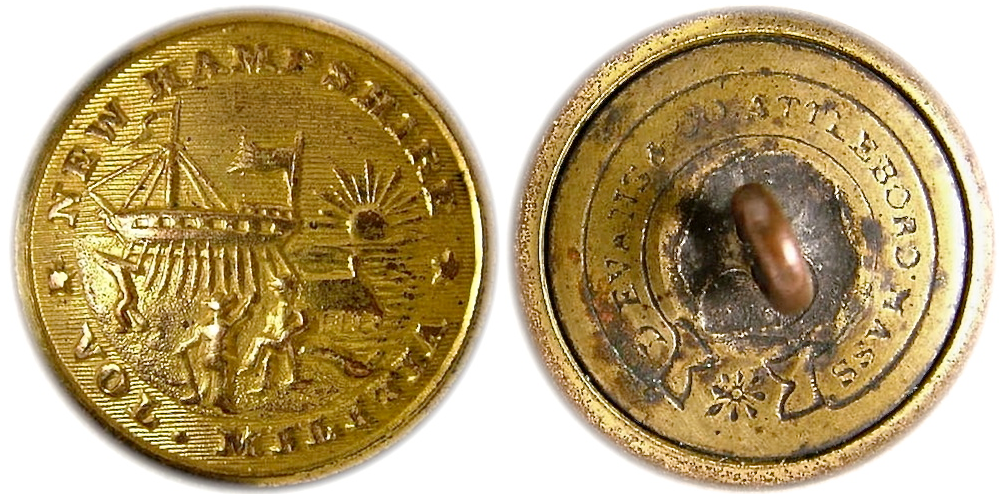
1855-60's New Hampshire Militia Infantry Unit
Color: Golden Brass With Brown Highlights.
Metal: Convex, 2-Piece, Raised Design, Gilt Brass.
Size: 23mm.
Albert's Number: NH 6: RV 5
Tice's Number: NH 200 D.1
Variation: Raised Center Field / Wide Lined Border / Two
Five Pointed Stars / Slanting Foremast is Found Between the
N & E / Flat Roof Resembles a Wharf.
Present Condition: An Excavated Example, Strong Planchet
Casting, Strong High Relief Pattern.
Robert's Notes: This button's pattern is on a slightly
Raised Center Field, that is partially stippled and lined.
The button uses a Wide Lined Border for the legend
inscription. Arced halfway around the upper portion of the
legend is the states name, "NEW HAMPSHIRE" in all capital
letters. (This die variant does not use a hyphen). Circling
the lower half of the legend, the abbreviation for
volunteer,"VOL." which is followed by a dot, and then the
word, "MILITIA". Separating the states name, and bottom
legend's inscription is Two Five Pointed Stars. The boat
depicted is floating on calm waters, and the Slanting
Foremast is found between the,"N" and the, "E"in the word
NEW. The boat's flag is blowing in the wind. The building in
this die variant shows a Flat Roof that Resembles a Wharf.
There is a small sun, with medium radiating lines. The high
relief pattern is set on a convex field with a thin edge
border. This is a strong collector's favorite because of all
the known die variants.
Reverse Button Analysis: This is a 2-Piece button with a
loop shank. D.EVANS & CO ATTLEBORO. MASS dm in ribbon
reading clockwise, flower at bottom (Evans07)
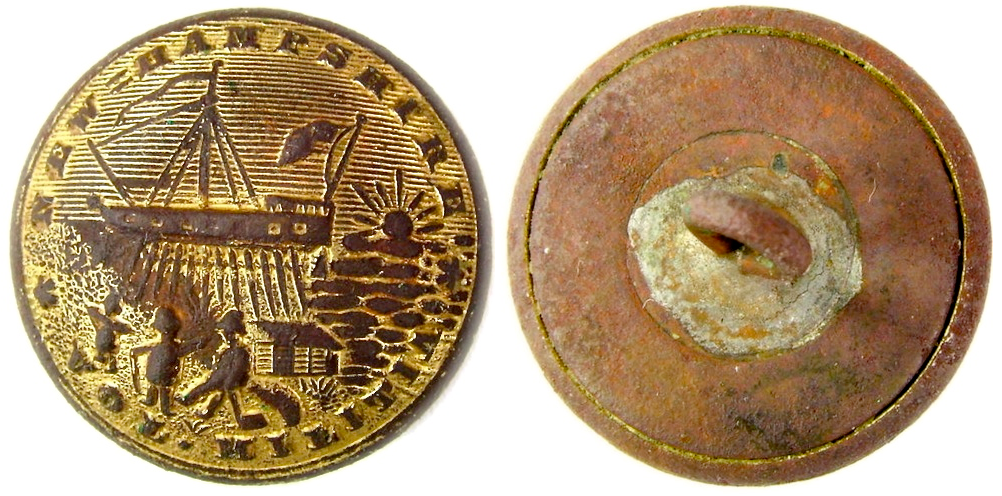
1860's New Hampshire Militia Infantry Unit
Color: Golden Brass With green Encrustations.
Metal: Convex, 2-Piece, Raised Design, Copper.
Size: 22.5mm.
Albert's Number: NH 6: RV 5
Tice's Number: NH 200 E.1
Variation: Double Hyphen / Two Five Pointed Stars / Slanting
Foremast is pointing Toward the W / Small Cabin Type Bulding.
Present Condition: An Excavated Example, Strong Planchet
Casting, Strong High Relief Pattern.
Robert's Notes: This button was probably made by Steele and
Johnson in 1860's. This button's pattern is a crude
depiction of New Hampshire's State of Arms on a copper face.
Circling around the upper half of the legend is the states
name, "NEW=HAMPSHIRE" in all capital letters; and uses a
Double Hyphen in-between the words. Circling around the
lower legend, the abbreviation for volunteer,"VOL:" which is
followed Colon; and then the word, "MILITIA". Separating the
states name, and bottom legend's inscription is Two Five
Pointed Stars. The boat in this variant is floating on
gentle waters, and the Slanting Foremast is pointing toward
the, "W" in the word NEW. In this die variant, the main mast
is located near the ship's center, and the boat's flag is
gently blowing in the wind. This die variant shows a Small
Cabin Type Building. There is a small sun, with short & long
radiating lines. The high relief pattern is set on a convex
field with a thin edge border. This is a strong collector's
favorite because of all the variations.
Reverse Button Analysis: This is a 2-Piece button with a
loop shank. Blank back mark (BlankNorth 04) dm inner ring.
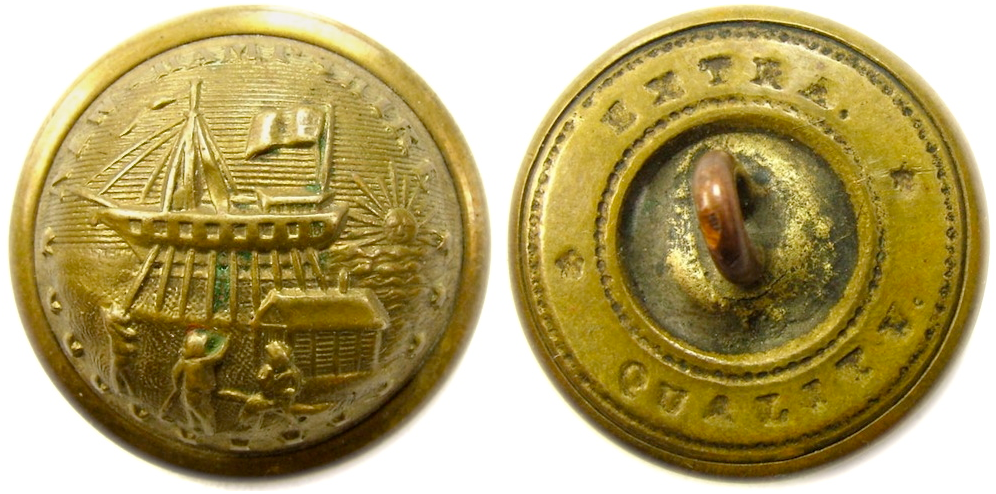
1860 New Hampshire Militia Infantry Unit-Officer's Button
Color: A Deep Yellow Brass
Metal: High Convex, 3-Piece, Raised Design, Gilt Brass.
Size: 24mm.
Albert's Number: Not Listed Variant:
Tice's Number: NH 210: Unlisted back mark
Variation: Coat of Arms / 13 Stars Below /
Present Condition: A Non Excavated Example, Exceptional
Planchet Casting, Strong High Relief Pattern.
Robert's Notes: Civil War examples of this particular
pattern are scarce. After 1865, they became more common. You
would have to have the correct back mark for Pre-War. The
button's pattern most likely depicts the frigate, "Raleigh"
under sail. There is a radiating sun on the horizon, along
with agriculture farmers next to a building on shore. This
is representative of the New Hampshire's Coat of Arms on a
lined field. Most New Hampshire buttons are variations of
this depiction. Above is the states name, New Hampshire" in
capital letters, and in the lower legend is 13 five pointed
stars. The high relief pattern is set on a high-convex lined
field with a false three part rim. These were most likely
produced by Steele and Johnson, and intended for staff
officers of militia units. This particular back mark dates to
1860. (Extra Q07)
Reverse Button Analysis: This is a false 3-Piece button with
a loop shank. EXTRA. /* QUALITY.* dm between channel of
dots.
New Hampshire Artillery Units
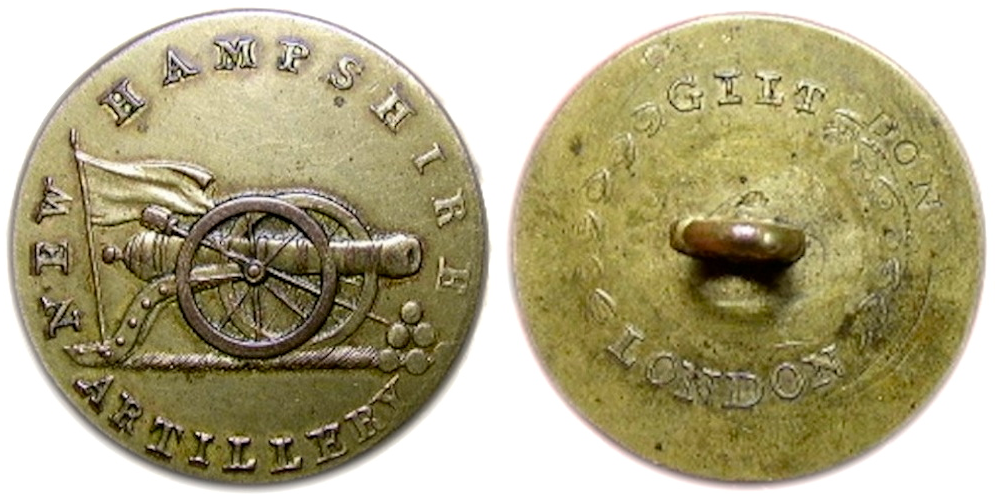
1812-15 New Hampshire Militia Artillery Unit
Color: Antique Brass With Silver Highlights.
Metal: Flat, 1-Piece, Raised Design, Gilt Brass.
Size: 24mm.
Albert's Number: NH 3: RV 45
Tice's Number: NH100A.1
Variation: Old Style Ringed Cannon with a Large Breech / Six
Cannon Balls / Unmarked Flag.
Present Condition: A Non Excavated Example, Exceptional
Planchet Casting, Exceptional High Relief Pattern.
Robert's Notes: AM Peasley of Boston took the design from
the Continental Artillery buttons in the American
Revolution. We know that in 1815 these were used by soldiers
in the Battle of New Orleans because of a recovered
specimen. The button's pattern depicts an Old Style Ringed
Cannon with a Large Breech. There is a pile of Six Cannon
Balls stacked in a pyramid in front, and an Unmarked Flag
behind the cannon. Circling around the edge is, "NEW
HAMPSHIRE ARTILLERY" in large Roman Font Capital Letters.
The high relief pattern is set on a plain flat field. This
is a rare specimen, un-dug are extremely rare to come upon.
Collectors should seek any specimen available.
Reverse Button Analysis: This is a flat one-piece button
with a loop shank. The shank is original, straight and
intact. GILT LONDON rm WREATH. Over stamp LONDON..
Jim Dew's Keemakoo Collection.
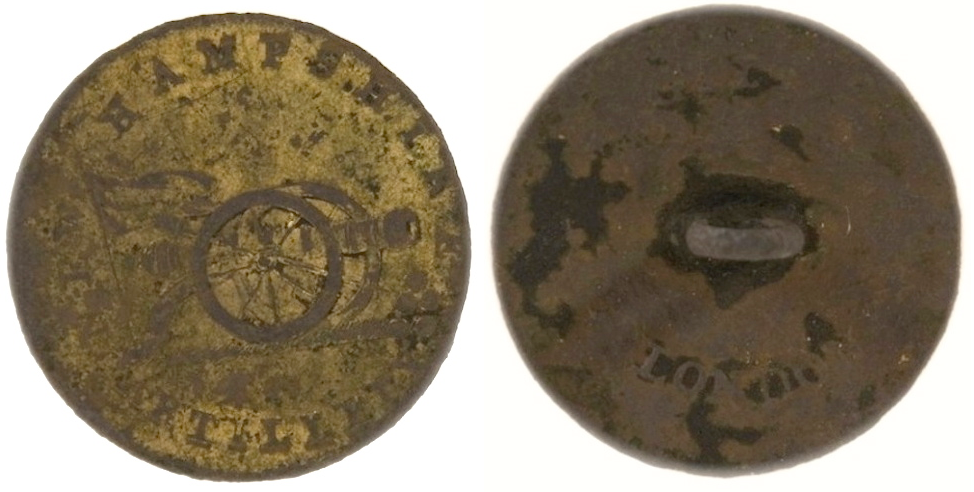
1812-15 New Hampshire Militia Artillery Unit
Color: Antique Brass With Silver Highlights.
Metal: Flat, 1-Piece, Raised Design, Gilt Brass.
Size: 24mm.
Albert's Number: NH 3: RV 45
Tice's Number: NH100A.1
Variation: Old Style Ringed Cannon with a Large Breech / Six
Cannon Balls / Unmarked Flag.
Present Condition: An Excavated Example, Good Planchet
Casting, Fair High Relief Pattern.
Robert's Notes: AM Peasley of Boston took the design from
the Continental Artillery buttons in the American
Revolution. We know that in 1815 these were used by soldiers
in the Battle of New Orleans because of a recovered
specimen. The button's pattern depicts an Old Style Ringed
Cannon with a Large Breech. There is a pile of Six Cannon
Balls stacked in a pyramid in front, and an Unmarked Flag
behind the cannon. Circling around the edge is, "NEW
HAMPSHIRE ARTILLERY" in large Roman Font Capital Letters.
The high relief pattern is set on a plain flat field. This
is a rare specimen, un-dug are extremely rare to come upon.
Collectors should seek any specimen available.
Reverse Button Analysis: This is a flat one-piece button
with a loop shank. The shank is original, straight and
intact. GILT LONDON rm WREATH. Over stamp LONDON..
New York Militia Infantry
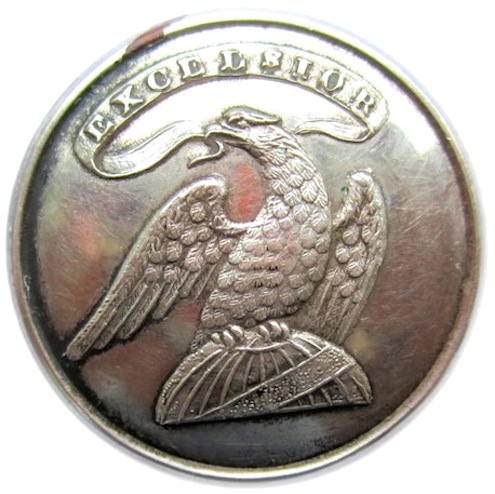
In the pre-colonial era, New York City and it's surrounding
areas were inhabited by the various bands of the Algonquin
Indian tribes. The actual first visit to New York by a
European was in 1524 by Giovanni da Verrazzano. He was a
Florentine explorer in the service of the French Crown. He
sailed his ship, "La Dauphine" into upper New York harbor,
where he spent one night aboard his ship, and then sailed
out the next day. Giovanni claimed the land for France, and
named it, "Nouvelle Angouleme". The following year in
January of 1525, a Portuguese sailor who was commissioned by
the emperor of Spain entered New York Harbor, and chartered
the mouth of the Hudson River. He named it Rio de San
Antonio. He would have sailed down the Hudson River, but the
heavy ice kept him from exploring any further. New York
remained for the most part untouched by the rest of the
world until 1609, when an English explorer named Henry
Hudson sailed his boat the Halve Maen (Half Moon) into NY
harbor, and re-discovered the region. Hudson was
commissioned by the Dutch East India Company to find a
faster trade route to the Orient (Northwestern passageway).
He sailed up the Hudson River for 10 days ( as far as
Albany) thinking it could be a passageway, but then turned
around when he realized the river was no longer salty and
narrowed. A few more years passed, and then in 1614 the
Dutch founded a fur trading settlement on the southern tip
of Manhattan, which was later called, "New Amsterdam" in
1625. The Dutch West India Company was then chartered in
1621 to settle a new North American colony called,"New
Netherlands". This establishment was based on giving large
land grants to a handful of quasi-feudal landlords with
little or no governing populations; rather then conveying
the land to young eager settlers. After a few years, the new
settlers of the Dutch Republic established a trading post in
1624. We accredit this establishment to what we we would
call the "grass roots" of New York. This colony slowly began
to populate, and then by 1664, the city and all of it's
surroundings came under English control, and was renamed,
"New York". Fearing bloodshed, Peter Stuyvesant who was the
Director-Generalof the colony of New Netherlands surrendered
New Amsterdam to King Charles of England who in-turn granted
the lands to his brother, The Duke of York. While under
British rule, NY became one of the most important trading
ports throughout the world. By 1730, it became the center of
the slave trade, and was just under Charleston South
Caroline with more then 42% of all households owning slaves.
By 1776, anti-British sentiments swept through the city, and
setting a stage for one of the largest battles of the
American Revolution. The Battle of Long Island took place in
August 1776, in what we know as modern day Brooklyn. With
heavy casualties and being outnumbered, the Americans
patriots fled along with sympathizers of the cause. New York
quickly became the military and political base of operations
in North America for the British Crown. In the next few
years, New York became a haven for Loyalist refugees and
escaped slaves who were quick to join the British line for a
promise of freedom. In 1777, the Americans were able to
contain the british to the city part of the state with a
major victory in Saratoga- Lake Champlain/ Hudson River
corridor. A State Coat of Arms was adopted in 1777, which
shows a river and mountains in-front of a rising sun. The
Crest depicts an American Bald Eagle perched on the top of a
Terrestrial Globe. A figure of Liberty supports the shield
on the left hand side, and Justice is to the right. Beneath
the shield is the motto, "Excelsior" which means higher.
Many early militia buttons used the Crest of the Eagle on
top of the globe, but only a few carried the complete Coat
of Arms on their device. By the Civil War, many common
buttons sported the state military seal which links the
State of New York, and the United States Arms on a shield to
symbolize the twin allegiance of her militia. By 1862, the
different militia units used variants of the Eagle and
Shield Design.
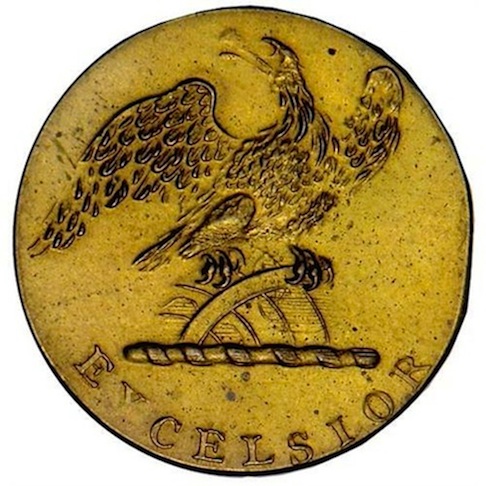
1800-15 New York Militia General Use
Color: A Brass Yellow with Brown Details.
Metal: Flat, 1-Piece, Raised Design, Gilt Brass.
Size: 23.10mm.
Albert's Number: NY 9-A:
RV 10
Tice's Number: NY 040-A.1.1
Variation: Eagle
with Upraised Wings / Perched on a Terrestrial Globe /
Excelsior.
Present Condition: An Excavated Example, Strong Planchet
Casting, Strong High Relief Pattern.
Isabela's Notes: This particular button seems to have at
least 6 die variants known. Most are variations are in the
depiction of the
eagle, and one variant has an "XLI" added to the deign. These early NY state
militia buttons were made prior, and during the War of 1812.
The button's pattern depicts the an
Eagle
with Upraised Wings
facing right, while
Perched on a Terrestrial Globe. The New York
motto,
"EXCELSIOR"
which means higher, is arced in capital
letters in the bottom legend. The high relief pattern is set on a plain
flat field with no raised edge border.
Reverse Button Analysis: This is a one-piece button with a
loop shank. The shank is original, straight, and intact.
Blank back.
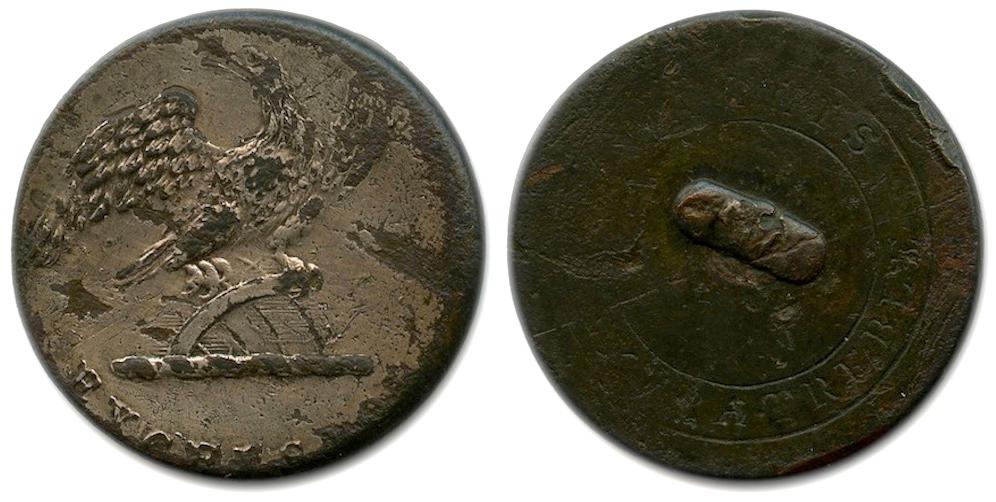
1800-15 New York Militia General Use
Color: Flat Silver Wash.
Metal: Flat, 1-Piece, Raised Design, Silver Wash.
Size: 23mm.
Albert's Number: NY 9-A: RV 10
Tice's Number: NY 040-D.1
Variation: Eagle
with Upraised Wings / Perched on a Terrestrial Globe /
Excelsior.
Present Condition: An Excavated Example, Good Planchet
Casting, Good/Strong High Relief Pattern.
Isabela's Notes: This particular button seems to
have at least 6 die variants known. This variant has a
subtle difference in the eagle depicted. These early NY
state militia buttons were made prior, and during the War of
1812. The button's pattern depicts the an
Eagle
with Upraised Wings
facing right, while
Perched on a Terrestrial Globe. The New York
motto,
"EXCELSIOR"
which means higher, is arced in capital
letters in the bottom legend. The high relief pattern is set on a plain
flat field with no raised edge border.
Reverse Button Analysis: This is a one-piece button
with an alpha shank. The alpha shank is on a raised
plateau-type anvil mark. This was a very unusual pedestal
structure. The shank is broken off. (indistinct) EXTRA
TREBLE dm.
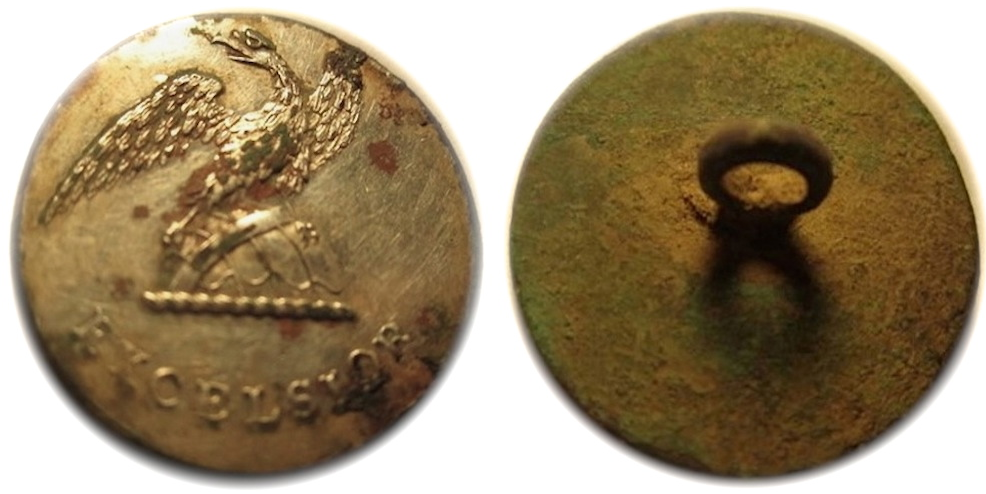
1800-15 New York Militia General Use
Color: Silver with Red Undertone.
Metal: Flat, 1-Piece, Raised Design, Silvered Copper.
Size: 23mm.
Albert's Number: NY 9-A- Unlisted Variant: RV 10
Tice's Number: NY 040-C.1.1
Variation: Plain Field.
Present Condition: An Excavated Example, Strong Planchet
Casting, Strong High Relief Pattern.
Isabela's Notes: This particular button seems to have at
least 6 die variants known. This die variant is similar, but
has small variations in the design of the eagle. The
button's pattern depicts the state crest of an eagle perched
on a terrestrial globe facing right. The New York motto,
"EXCELSIOR" which means higher, is arced in capital letters
below. The high relief pattern is set on a plain flat field
with no edge border. This die variant was also made prior,
and during the War of 1812.
Reverse Button Analysis: This is a one-piece button with a
loop shank. The shank is original, straight, and intact.
Blank back.
Excavated in Upstate New York.~
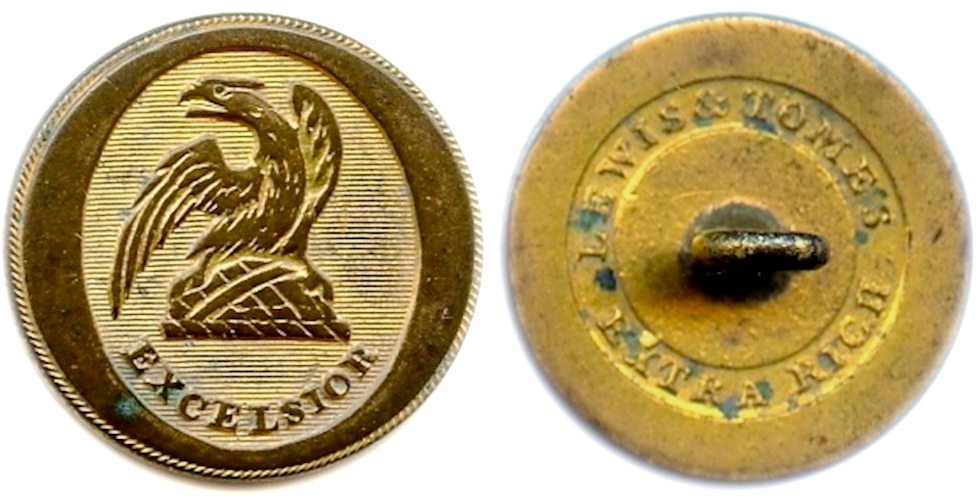
1812-29 New York Militia General Use
Color: Gilded Brass!
Metal: Flat, 1-Piece, Raised Design, Silver Plated Copper.
Size: 23mm.
Albert's Number: NY 10: RV 3
Tice's Number: NY 100-A.09
Variation: Excelsior in Legend.
Present Condition: A Non Excavated Example, Exceptional
Planchet Casting, Exceptional High Relief Pattern.
Isabela's Notes: Tice notes that British manufacturers
produced large quantities of these button in both gilt and
silver finishes before 1830. Some manufacturers even offered
hand chasing for an extra charge. The buttons pattern
depicts the NY State Arms Crest, which is an eagle facing
right while perched on top of a globe. The motto "EXCELSIOR"
is written in an arch on the bottom legend. The low-relief
pattern is set upon an oval lined field with a wide plain
border and thin pipe rope edging.
Reverse Button Analysis: This is a one-piece button with a
loop shank. The shank is original, straight, and intact.
LEWIS & TOMES EXTRA RICH rmdc.
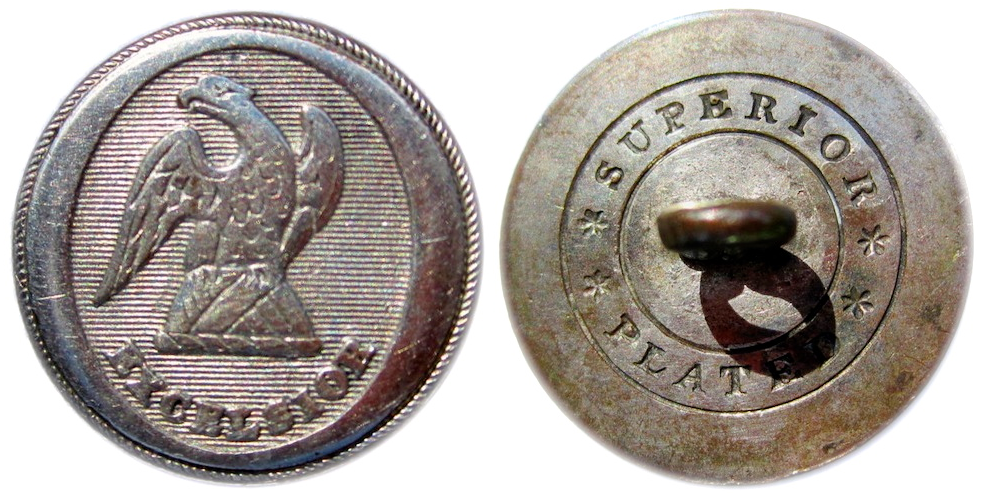
1812-29 New York Militia General Use
Color: Silver!
Metal: Flat, 1-Piece, Raised Design, Silver Plated Copper.
Size: 23mm.
Albert's Number: NY 10: RV 3
Tice's Number: NY100A.22
Variation: Excelsior in Legend.
Present Condition: A Non Excavated Example, Exceptional
Planchet Casting, Exceptional High Relief Pattern.
Isabela's Notes: Tice notes that British manufacturers
produced large quantities of these button in both gilt and
silver finishes before 1830. The buttons pattern depicts the
NY State Arms Crest, which is an eagle facing right while
perched on top of a globe. The motto "EXCELSIOR" is written
in an arch on the bottom legend. The low-relief pattern is
set upon an oval lined field with a wide plain border and
thin pipe rope edging.
Reverse Button Analysis: This is a one-piece button with a
loop shank. The shank is original, straight, and intact.
SUPERIOR** PLATED** in-between 2 dm rings.
The RJ Silverstein Collection.
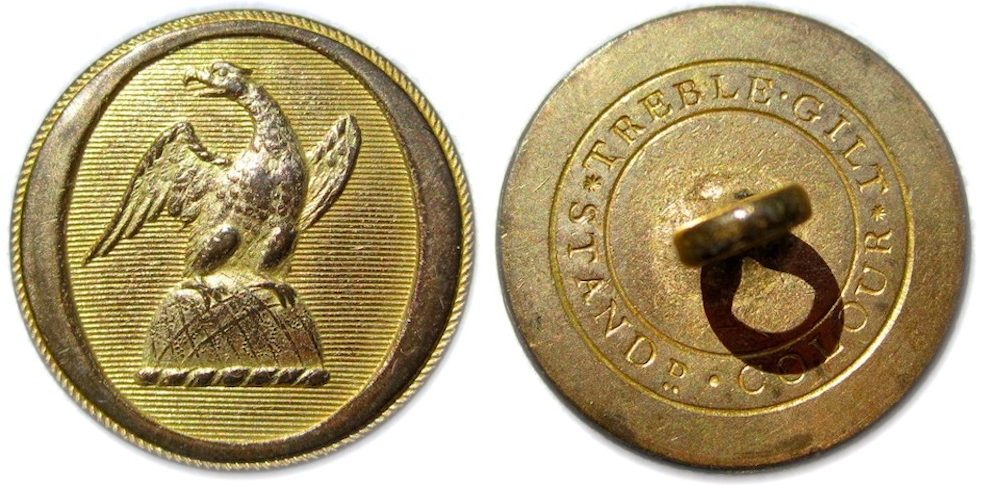
1830's New York Militia General Use
Color: Gold!
Metal: Flat, 1-Piece, Raised Design, Gilt Brass.
Size: 23mm.
Albert's Number: NY 11: RV 5
Tice's Number: NY105A.3
Variation: No Motto.
Present Condition: A Non Excavated Example, Exceptional
Planchet Casting, Exceptional High Relief Pattern.
Isabela's Notes: This New York Militia button was
manufactured in Britain during the early 1830's; and is much
more scarcer then the variation with the excelsior motto
written in the bottom legend. The buttons pattern depicts
the NY State Crest, which is an eagle facing right while
perched on top of a globe. The low-relief pattern is set
upon an oval lined field with a wide plain border and thin
pipe rope edging.
Reverse Button Analysis: This is a one-piece button with a
loop shank. The shank is original, straight, and intact. rm
LONDON- EXTRA-QUALITY within a set of 2 double Rm rings.
The RJ Silverstein Collection.
.png)
1815-30 New York Militia General Use
Color: Dark Silver.
Metal: 1-Piece, Low Convex, Raised Design, Silver Plated
Copper. (Gilt Specimen Known)
Size: 20.93mm.
Albert's Number: NY 12A.1: RV 5
Tice's Number: NY110A.3
Variation: Eagle on a Globe.
Present Condition: A Non Excavated Example, Exceptional
Planchet Casting, Strong High Relief Pattern.
Isabela's Notes: There are at least 17 known die variants
for this one-piece pattern. British manufacturers produced
these silver plated specimens in the early 19th century. The
button's raised pattern depicts the Crest of New York on a
plain field, with the motto above. The Crest is an eagle
perched on top of a terrestrial globe facing right with
droop wings. L & T made 2 known die variants with the wings
in slightly different positions to the body. The terrestrial
globe underneath has raised vertical lines with a thick
diagonal pebbled sash. In a ribbon above is the motto,
"EXCELSIOR" is in raised capital letters. One end of the
ribbon is grasped in the eagle's beak. The whole pattern is
set upon a plain convex field with a slightly raised edge
border.
Reverse Button Analysis: This is a one-piece concave button
with a loop shank. The shank is original, straight, and
intact. rm LEWIS & TOMES. EXTRA. within a 2 ring channel rm.
The RJ Silverstein Collection.
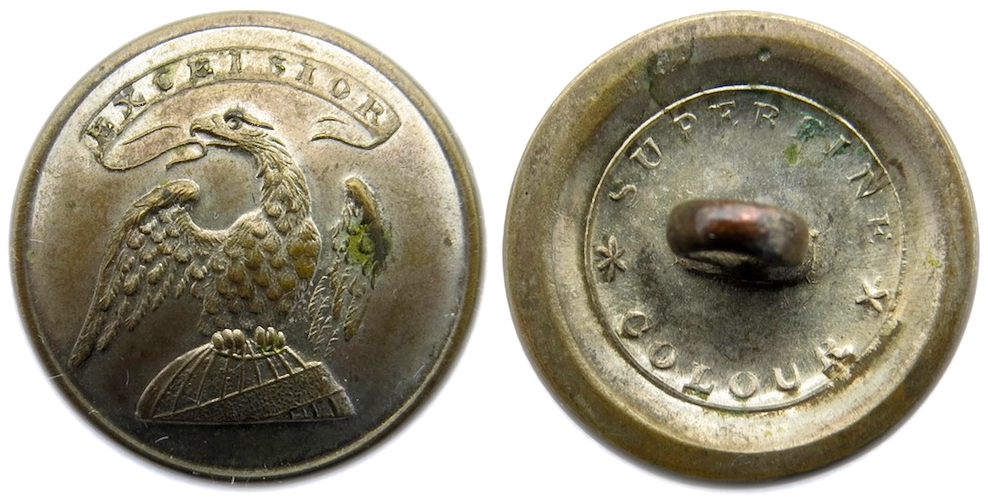
1815-30 New York Militia General Use
Color: A Silvery Brown with A Hint of Green.
Metal: 1-Piece, Convex, Raised Design, Silver Plated Copper.
Size: 21.10mm.
Albert's Number: NY 13A. Unlisted back mark: RV 15
Tice's Number: NY110A.10 Unlisted back mark
Variation: Eagle on a Globe Motto Within A Pebbled Ribbon.
Present Condition: A Non Excavated Example, Exceptional
Planchet Casting, Strong/Exceptional High Relief Pattern.
Isabela's Notes: This is another British manufactured silver
plated specimen that was made in the early 19th century for
NY's State Militia. The button's raised pattern depicts the
Crest of New York on a plain convex field, with the motto
above. The Crest is an eagle perched on top of a terrestrial
globe facing right with droop wings. The terrestrial globe
underneath has raised vertical lines with a thick diagonal
pebbled sash. In this variant, the motto, "EXCELSIOR" is in
a Dotted Ribbon, in raised capital letters. The right end of
the ribbon is grasped in the eagle's beak. The whole pattern
is set upon a plain convex field with a thin raised edge
border.
Reverse Button Analysis: This is a one-piece concave button
with a copper loop shank. The shank is original, straight,
and intact. rm .* SUPERFINE COLOUR * within a ring rm.
The RJ Silverstein Collection.
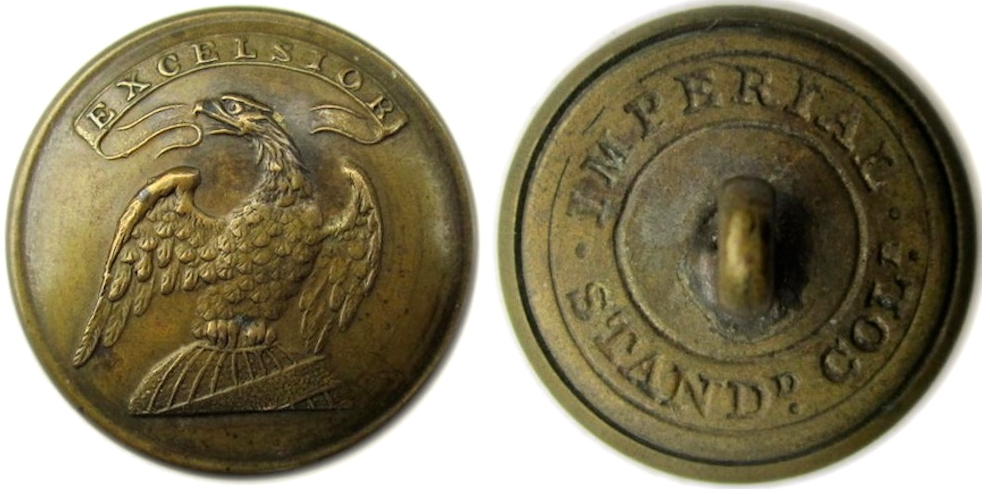
1835-40's New York Militia General Use
Color: Antique Brass.
Metal: 2-Piece, Low Convex, Raised Design, Gilded Brass.
(Silver Plated Variant)
Size: 20.63mm.
Albert's Number: NY 14: RV 4
Tice's Number: NY200A.1
Variation: Eagle on a Globe.
Present Condition: A Non Excavated Example, Exceptional
Planchet Casting, Exceptional High Relief Pattern.
Isabela's Notes: As with most NY buttons manufactured during
the early Antebellum period, it depicts the New York Crest
with the Motto above. This early specimen shows an eagle
perched on top of the globe facing right with droop wings.
Above the eagle in a ribbon is the motto, "EXCELSIOR" in
raised capital letters. The globe underneath has raised
vertical lines, and a diagonal pebbled sash. The whole
pattern is set on a plain convex field with a slightly
raised edge border. This two-piece New York Militia button
is much rarer then the earlier one-piece specimens. This can
be found in silver-plated examples, and this button is
occasionally excavated at early Civil War sites. There is a
later die variant in which the eagle's head is turned
upward.
Reverse Button Analysis: This is a two-piece button with a
loop shank. The shank is original, straight, and intact.
IMPERIAL./STANDd.COLr. within 2 dm rings.
The RJ Silverstein Collection.
North Carolina's Infantry Militia
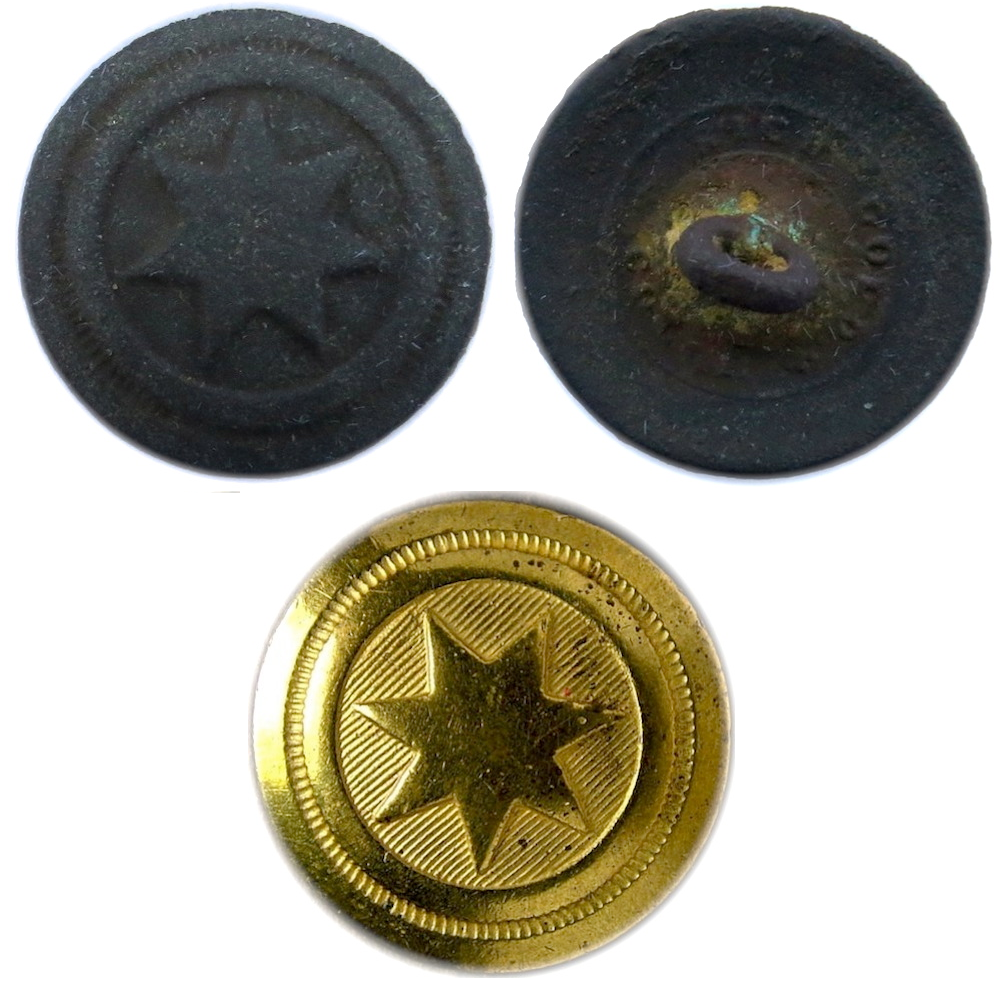
1830-40's North Carolina's Cherokee Indian Nation (Indian
Troops)
Color: Brass Yellow.
Metal: 1-Piece, Low Convex, Raised Design, Gilded Brass.
Size: 22mm.
Albert's Number: Unlisted. Robert's Rating: RV 75
Tice's Number: UM248A.1
Variation: 7 Point Star / Lined Field
Present Condition: A Non Excavated Example, Exceptional
Planchet Casting, Exceptional Pattern in High Relief.
Isabela's Notes: This coat size button has been identified
as belonging to the Cherokee Indian Nation who used the
seven point star as an emblem in the early 19th century.
Later, Cherokee Indians served as Confederate Troops in
North Carolina, and wore these earlier manufactured buttons
while in service. This button's seven pointed star is very
similar to Florida's Cherokee rose six pointed star buttons
that was used by both the states militia, and their Indian
Troops. The button's pattern depicts a raised seven point
star (Cherokee Rose) set on a lined field. Encircling the
star is a lined ring milled into a wide border. This high
quality button is most likely of English Manufacture, but
there is some doubt in my mind because of how the word color
is spelled. We do know for a fact that these was made
specifically for the Cherokee Nation during the 1830-40's.
This button's back mark is also identified as having
Confederate Army Indian Troop usage during the Civil War by
David F. Johnson in his book, "American Armed Forces
1784-1948". Only a few examples exist, and most known ones
have been dug directly from several Civil War battle sites,
including ones in Virginia. Collectors should only seek dug
specimens since a 1/2 card of unsold buttons was discovered
in England, and then sold slowly through e-bay in 2011-12.
If you have question about it's authenticity of being
American Indian Provenance, then don't buy it. Dug examples
usually range around $250-$300. Non Dug British card
specimens go for around $100-$200.
Reverse Button Analysis: This is a slightly concave
one-piece button with a loop shank. +RICH GOLD + COLOR
within a 2 rm channel.
The RJ Silverstein Collection.
Robert's Notes: Because of early prejudices, and the
distinct living areas of settlers and Cherokee Nation, I
highly doubt any Indians volunteered for North Carolina's
early militia units pre-civil war. I do believe that by the
mid 19th century, tensions eased enough for the confederacy
or state government to ask the Cherokees for help during the
Civil War. So to emphasize a point on this seven star
Cherokee Rose pattern; This button was not especially made
for Indian Troops who served for the Confederacy's North
Carolina Regiments, it was made many years earlier and used
by the Cherokees prior to the Civil War. As I have learned
with many Civil War items that were made Prior to the war,
they became Civil War items by the virtue of their usage!
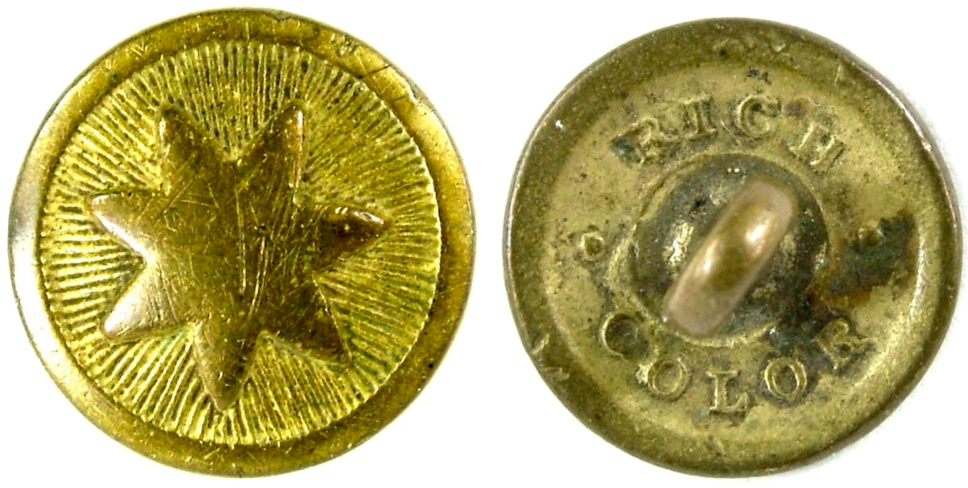
1830-40's North Carolina's Cherokee Indian Nation (Indian
Troops)
Color: Brass Yellow.
Metal: 1-Piece, Low Convex, Raised Design, Gilded Brass.
Size: 12.5mm. Cuff Size
Albert's Number: Unlisted. Robert's Rating: RV 250
Tice's Number: UM248A.1- Undocumented & Unlisted Variant.
Variation: 7 Point Star / Rayed Field
Present Condition: A Non Excavated Example, Strong Planchet
Casting, Strong High Relief Pattern.
Isabela's Notes: This extremely rare early button has been
identified as belonging to the Cherokee Indian Nation who
used the seven point star as an emblem in the early 19th
century. Later, Cherokee Indians served as Confederate
Troops in North Carolina, and wore these earlier
manufactured buttons while in service. This button's seven
pointed star is very similar to Florida's Cherokee rose six
pointed star buttons that was used by both the states
militia, and their Indian Troops. The button's pattern
depicts a raised seven point star (Cherokee Rose) set on a
rayed field. Encircling the star is a small plain border.
This high quality button is most likely of English
Manufacture, but there is some doubt in my mind because of
how the word color is spelled. We do know for a fact that
these was made specifically for the Cherokee Nation during
the 1830-40's. This button's back mark is also identified as
having Confederate Army Indian Troop usage during the Civil
War by David F. Johnson in his book, "American Armed Forces
1784-1948". Only a few examples exist, and most known ones
have been dug directly from several Civil War battle sites,
including ones in Virginia.
Reverse Button Analysis: This is a slightly concave
one-piece casting with a concave back and a loop shank. The
shank is original, straight, and intact. . RICH . COLOR
The RJ Silverstein Collection.
Robert's Notes: Because of early prejudices, and the
distinct living areas of settlers and Cherokee Nation, I
highly doubt any Indians volunteered for North Carolina's
early militia units pre-civil war. I do believe that by the
mid 19th century, tensions eased enough for the confederacy
or state government to ask the Cherokees for help during the
Civil War. So to emphasize a point on this seven star
Cherokee Rose pattern; This button was not especially made
for Indian Troops who served for the Confederacy's North
Carolina Regiments, it was made many years earlier and used
by the Cherokees prior to the Civil War. As I have learned
with many Civil War items that were made Prior to the war,
they became Civil War items by the virtue of their usage!
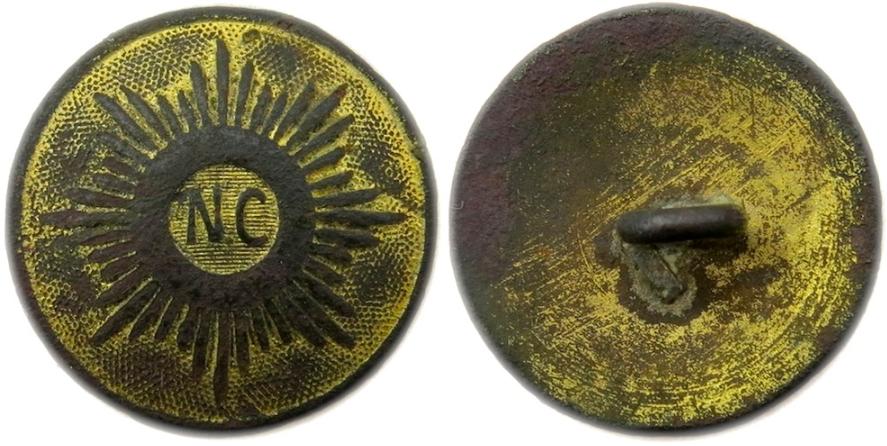
1860 North Carolina Militia
Color: Gilt Yellow Over Brown.
Metal: 1-Piece, Low Convex, Raised Design, Gilt
Brass.
Size: 21.26mm.
Albert's Number: NC 14-A RV 50
Tice's Number: 233A.1
Variation: Finely Stippled Gilded Field
Present Condition: An Excavated Example, Strong
Planchet Casting, Strong High Relief Pattern.
Isabela's Notes: This button is believed by Civil War
collectors to be a well made Confederate local made in the
early years of the war. All the buttons were fitted with a
non footed shank, showing that they are securely brazed into
place. The workmanship of the reverse reflects that these
were all lathe turned buttons. .
Reverse Button Analysis: This is a slightly concave
one-piece button with a loop shank. The shank is original,
straight, and intact. No back mark
The RJ Silverstein Collection.
South Carolina Infantry Militia
South Carolina is located in the Southeastern United States.
It is bordered by the Atlantic Ocean to the East, North
Carolina in the north, and the Savannah River to the west
with Georgia. The name Carolina takes it's name from Charles
I; which is Latin for "Charles land". Originally Spain
colonized the coastal areas, but frequent battles between
the Native Americans caused the Spanish people to retreat to
Florida, Cuba, and Mexico. Then a colony of Carolina was
established by British settlers from Barbados; and shortly
after in 1670, King Charles gave eight aristocrats a Royal
Charter, and they sponsored the first permanent settlement
in Charleston. At this point there was no North or South
Carolina, it was solely the Province of Carolina. John Locke
who was an English philosopher wrote a constitution for the
colony that covered topics for land division and social
ranking. This caused settlers not to buy land there, and
after a time proprietors were forced to lower prices to
attract new settlers. The Province of Carolina did not
develop as planned because of political reasons, and this
caused a split creating two different colonies. In 1719
settlers in South Carolina wanted more political power and
seized control from it's proprietors. This rebellion failed,
and the King assumed jurisdiction for a short time. Then in
1729, Carolina became two Royal Colonies- North Carolina and
South Carolina. Farmers from Virginia moved into North
Carolina and grew tobacco and sold timber and tar to the
English Navy. Since North Carolina lacked a good harbor,
they used Virginia's ports to conduct their trade.
As settlements spread in South Carolina, more Germans and
Scotch-Irish moved up from Virginia and traded in deer skin,
lumber, and beef. South Carolina farming prospered from the
fertility of their Low-Country, and the use of good harbors
such as, Charlestown. The Low Country ended up creating and
earthworks of dams and canals which irrigated rice fields
and indigo plants. Indigo is a blue flowering plant which
was used to dye textiles. This became a major commodity crop
for South Carolina. Slave labor slowly became an integral
part of South Carolina's economic success for farming. By
the time of the American Revolution, slaves exceeded the
number of Anglo-European colonists. In March of 1776, the
colony adopted the first constitution of South Carolina and
it became the first Republic in America; and John Rutledge
was elected as the first President. After the Battle at
Sullivan's Island in 1776, South Carolina approved their
Coat of Arms design. It depicts a Palmetto Tree on a
seashore, which is suppose to be symbolic of a Revolutionary
fort built that was built on Sullivan's Island by Palmetto
Trees. At the base of the Palmetto is a broken Oak Tree
which symbolizes the British fleet. Twelve Spears are bound
to the Palmetto's trunk which represents the other twelve
colonies. A band that ties the spears is inscribed in Latin,
"Quis Separabit" which means, "Who shall separate". Beneath
the oak is another Latin inscription, "Meliorem Lapsa
Locavit" which means, "Having fallen, set up better"; which
basically means the decline of British control and the
ascendance of South Carolina. The state also adopted a
motto,"Animis Opibusque Parati" which means, "Prepared in
Mind and Resources". (In 1831-32, Gov.Hamilton placed the
first order to Scovills with this design and motto in
defiance to the Federal Gov. Policy on Tariffs. The states
militia used these buttons several years later). In February
of 1778, South Carolina became the first state to ratify the
Articles of Confederation. In later years during the Federal
Period of 1783-95, politics was split between the Federal
elite who supported the central government in Philadelphia,
and the large portion of common people who wanted more
democracy. As far as foreign affairs, most people supported
the French Revolution (1789-95). Charleston was one of the
most French influenced cities in America. Leading figures
such as Governors Charles Pinckney and William Moultrie
backed with money and political support French commercial
goals in North America. This pro-French stance ended soon
because of the XYZ Affair, and Frances refusal to accept C.
Pinckney US Ambassador. By the beginning of 1800, with the
increasing value of cotton, ordinary farmers shifted into
slave major holders. With the collapse of the cotton prices
in the late 1820's and 1830's, South Carolina went into a
major economic crises. This was mostly blamed on the Federal
Tariffs Laws of 1828 & 32, in which northern tariffs were
placed on foreign manufactured goods. In 1832, John Calhoun
tried to nullify the Federal Tariff Act but failed because
President Andrew Jackson responded to the crises with the
threat of force. As the years progressed, festering problems
of northern domination and slavery led to another convention
in Charleston, and in December of 1860, South Carolina
became the first state to leave the Union. Shortly after
hostilities commenced when Cadets from the Citadel fired on
the Federal ship, "Star of the West" while attempting to
supply Fort Sumter.
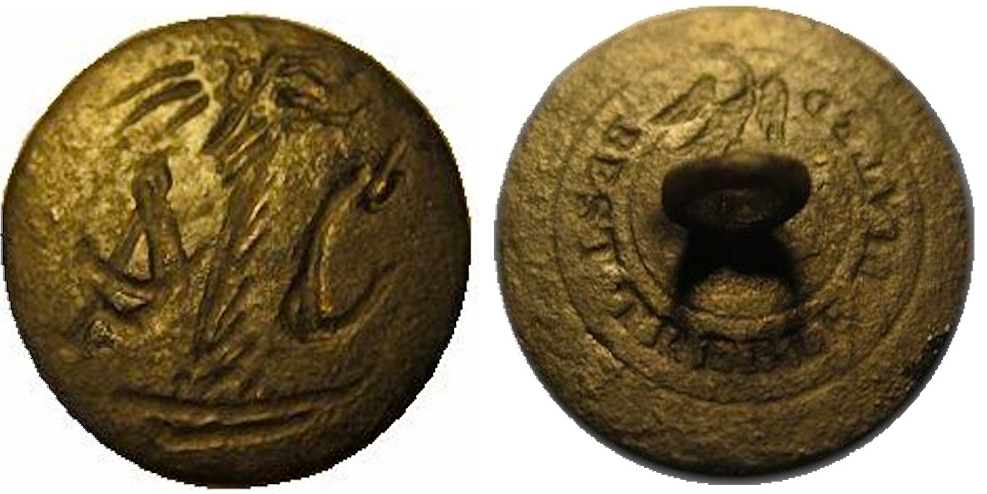
1790-1800? South Carolina Palmetto Button
Color: A Pewter Grey with Brown Undertones.
Metal: Flat, 1-Piece, Raised Design, Plated.
Size: 20mm.
Albert's Number: Unlisted RV 200
Tice's Number: Unlisted
Present Condition: An Excavated Example, Strong
Planchet Casting, Strong Impressions.
Isabela's Notes: This most likely was the first
English Palmetto Tree button manufactured. T
Reverse Button Analysis: This is a flat one-piece
casting for reverse shank. The original shank is original
straight and intact.
The Dale Collection.
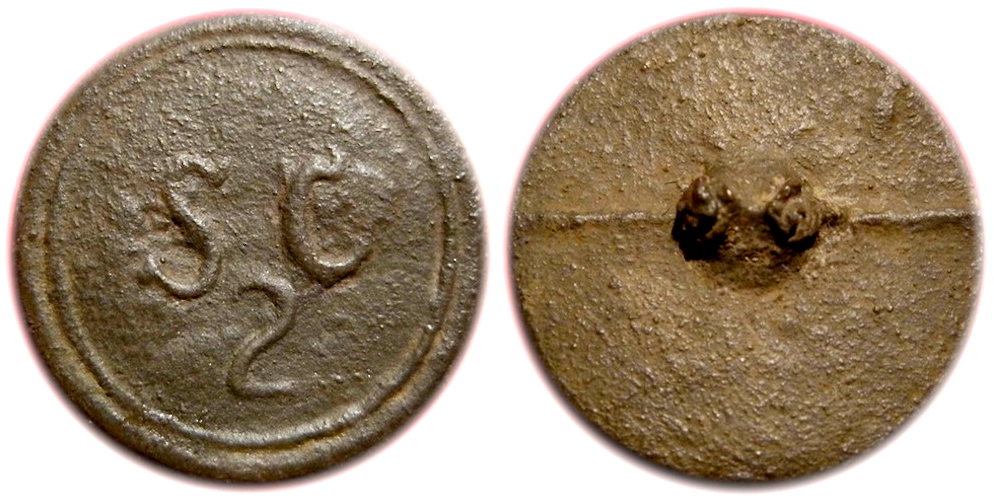
1775-1780 2nd South Carolina Regiment
Color: Muddy River.
Metal: Flat, 1-Piece, Raised Design, Pewter.
Size: 24.50mm.
Troiani's Number: A2SC.f.: RV 200
Tice's Number: Similar to SC006A.1
Present Condition: An Excavated Example, Good Planchet
Casting, Good High Relief Pattern.
Isabela's Notes: This is an extremely rare button, probably
only 5-8 known specimens. The button's pattern depicts South
Carolina's initials, "SC" above the Arabic number "2".
Encompassing the inner pattern is a concentric ring that
circles around the edge. The high relief design is set on a
plain flat field. Records show this unit organized in
Charleston in the summer of 1775, and served there until
1776. and then again in 1780. Consolidated with the 6th
Regiment in 1780. Also Served in Savannah and a detachment
in Florida.
Reverse Button Analysis: This is a flat one-piece casting
for reverse shank. The original shank is unfortunately
missing. Mold line present.
Excavated by Edisto River, South Carolina.~
The Bill Cross Collection.
1775-1780 3rd South Carolina Regiment
Color: Muddy River.
Metal: Slightly Domed, 1-Piece, Raised Design, Pewter.
Size: 24.50mm.
Troiani's Number: A3SC.a
Tice's Number: Similar to SC012A.1
Present Condition: An Excavated Example, Good Planchet
Casting, Good High Relief Pattern.
Isabela's Notes: This is another extremely rare Rev War
button, most likely under 5 specimens known. The button's
pattern depicts South Carolina's initials, "SC" above the
Arabic number "3". Encompassing the inner pattern is a
concentric ring that circles around the edge. The high
relief design is set on a plain slightly domed field. Served
in Charleston in 1775-76, and in Savannah, and Southern
Highlands. This unit served against the Cherokee Indians in
1776 and also in Florida in 1778. Captured by the British
with the fall of Charleston in May of 1780.
Reverse Button Analysis: This is a flat one-piece casting
for reverse shank. The original shank is original and
intact, but bent. Mold line present.
The Robert French Collection.
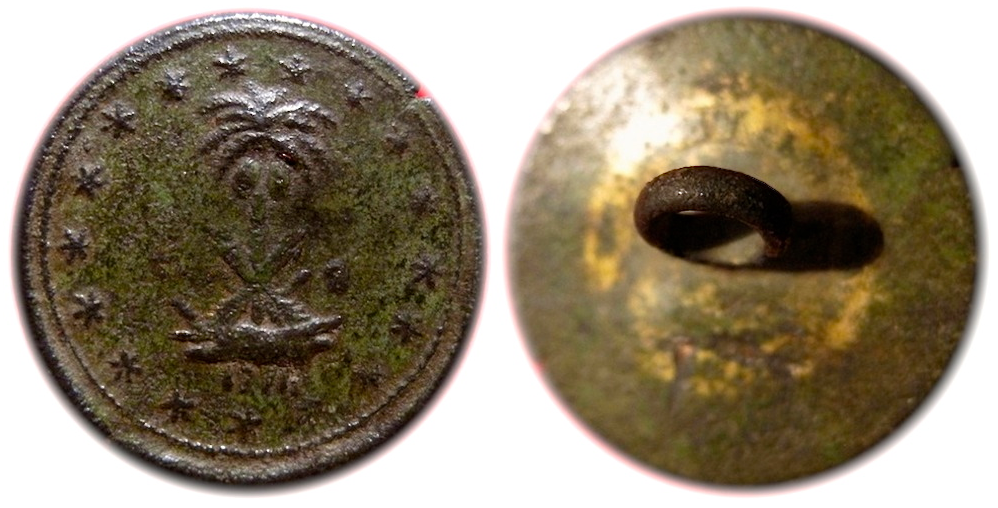
1805-12 South Carolina Palmetto Button
Color: A Forest Green with Brown Highlights.
Metal: Flat, 1-Piece, Raised Design, Pewter.
Size: 23.25mm.
Albert's Number: Unlisted RV 200
Tice's Number: SC033A.1
Present Condition: An Excavated Example, Good Planchet
Casting, Good High Relief Pattern.
Isabela's Notes: This most likely was the first Palmetto
Tree button produced. This was made by Raymond Chissey of
Charleston in 1808. He advertised in the newspaper he was
making these now for the South Carolina local Militia. The
button depicts a Palmetto tree in the center with the 1776
date underneath. enircling around the design is 17 Six
Pointed Asterisk Type Stars. This is encompassed by a
concentric rope-like ring around the edge. The high relief
pattern is set on a plain flat field.
Reverse Button Analysis: This is a flat one-piece casting
for reverse shank. The original shank is unfortunately
missing. Mold line present.
Excavated by Edisto River, South Carolina.~
The Bill Cross Collection.
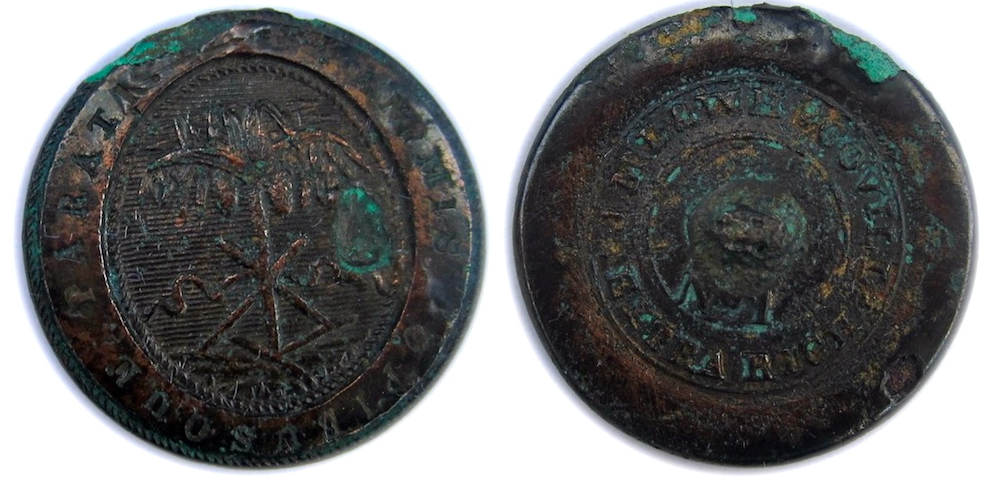
1832-65 South Carolina Nullification & State Militia Button
Color: A Coppery Brown.
Metal: Flat, 1-Piece, Raised Design, Copper (Poss. Brass).
Size: 22.5mm.
Albert's Number: SC1/PC9: RV 50 Isabela: RV 100
Tice's Number: SC 210A.1
Present Condition: An Excavated Example, Good Planchet
Casting, Strong High Relief & Impressed Pattern.
Isabela's Notes: These buttons were originally known as
Nullification buttons, or States Rights Buttons. In either
1831 or 1832, Governor Hamilton placed the original order
with Scovills for this pattern. Records indicate repeat
orders were made for several more years. They were
originally purchased as a symbol of political defiance to
the US Government's policy on Tariffs for foreign
manufactured goods (Federal Tariffs Act) namely, cotton. The
buttons were later adopted by the State's Militia. So this
is one of those rare buttons that had early political
significance, and later went on for military use. A number
of examples have been excavated on Civil War Battlefields.
The pattern shows the states coat of arms in an oval lined
field with a wide plain border with inner and outer rope
edging. The outside legend has the State's Motto, "ANIMIS
OPIBUSQUE PARATI .S.C." (Meaning Prepared in Mind and
Resources).
Reverse Button Analysis: This is a one-piece button. The
original shank is unfortunately missing. *J.M L &W.H.
SCOVILL*/EXTRA RICH/No 1" rm within a channel.
Excavated in Charleston, South Carolina 1 of 2 found.~
The Robert J. Silverstein Collection.
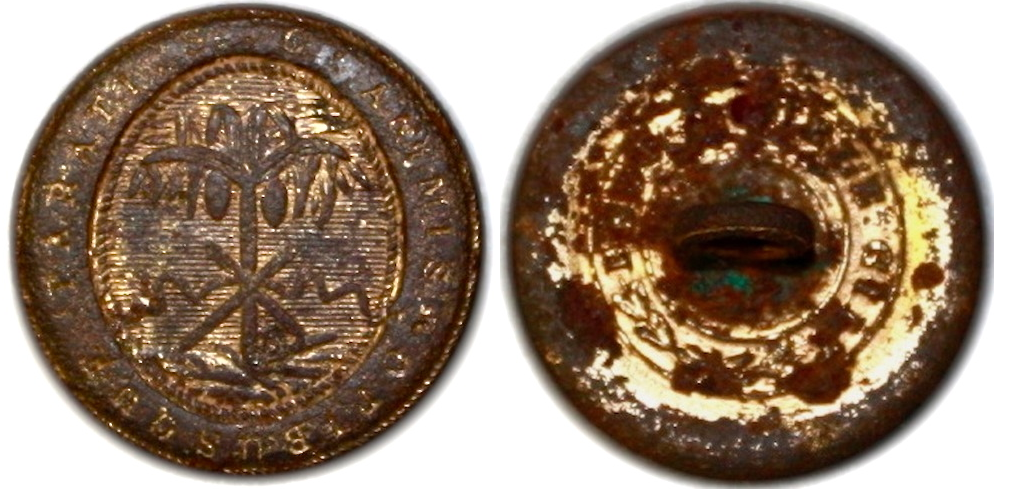
1832-65 South Carolina Nullification & State Militia Button
Color: A Gilt Brown.
Metal: Flat, 1-Piece, Raised Design, Gilt Brass.
Size: 23mm.
Albert's Number: SC1/PC9: RV 50 Isabela: RV 100
Tice's Number: SC 210A.3
Present Condition: An Excavated Example, Strong Planchet
Casting, Good/Strong High Relief & Impressed Pattern.
Isabela's Notes: These buttons were originally known as
Nullification buttons, or States Rights Buttons. In either
1831 or 1832, Governor Hamilton placed the original order
with Scovills for this pattern. Records indicate repeat
orders were made for several more years. They were
originally purchased as a symbol of political defiance to
the US Government's policy on Tariffs for foreign
manufactured goods (Federal Tariffs Act) namely, cotton. The
buttons were later adopted by the State's Militia. So this
is one of those rare buttons that had early political
significance, and later went on for military use. A number
of examples have been excavated on Civil War Battlefields.
The pattern shows the states coat of arms in an oval lined
field with a wide plain border with inner and outer rope
edging. The outside legend has the State's Motto, "ANIMIS
OPIBUSQUE PARATI .S.C." (Meaning Prepared in Mind and
Resources).
Reverse Button Analysis: This is a one-piece button with a
loop shank. The original shank is original, straight, and
intact. Double Best Gilt / Wreath
Excavated in Charleston, South Carolina 2 of 2 found.~
The Dave Gerber Collection.
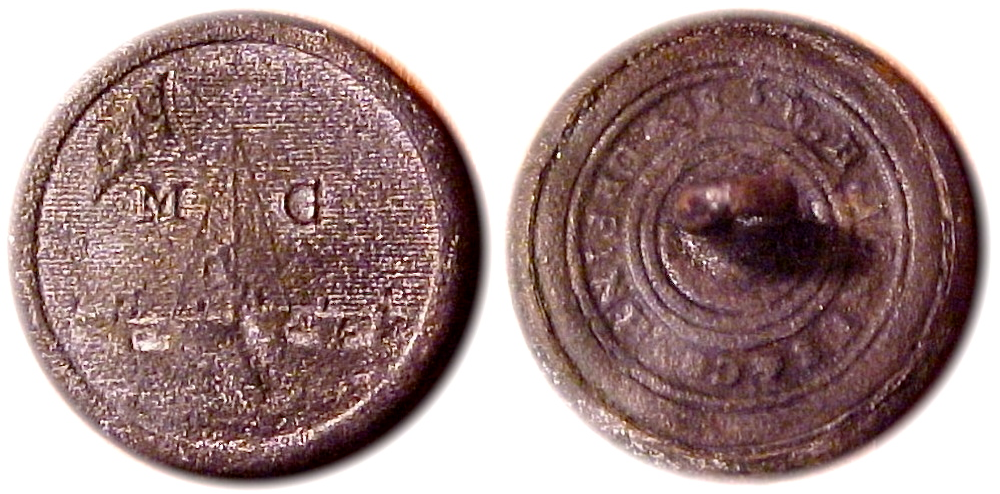
1835-40 Moultrie Guard
Color: Brown & White.
Metal: Flat, 1-Piece, Raised Design, Brass.
Size: 22.5mm.
Albert's Number: SC 32 (PG 497) RV 100
Tice's Number: SC292A.1
Present Condition: An Excavated Example, Good Planchet
Casting, Good High Relief Pattern.
Isabela's Notes: This is a very scarce button even though a
card turned up in auction miraculously in the 21st century.
All preceding examples were dug on civil war sites. The
button's pattern depicts Sergeant William Jasper remounting
the South Carolina Flag on Fort Sullivan during the British
attack on June 28, 1776.
Reverse Button Analysis: This is a flat two-piece button.
The shank is original, straight, and intact. W.H.JONES & CO
* / SUPERFINE rmdc
Excavated in Charleston, South Carolina.~
The Dave Gerber Collection.
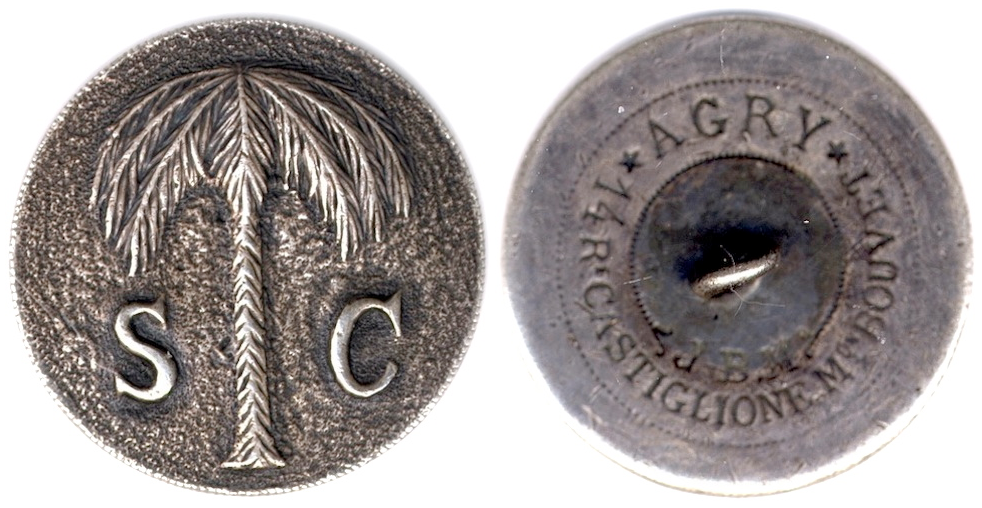
South Carolina Palmetto Tree Officer's Button
Color: Silvery Charcoal Gray.
Metal: Flat, 1-Piece, Raised Design, Solid Silver.
Size: 25mm.
Albert's Number: SC18: RV 50
Tice's Number: SC208A.1
Present Condition: A Non Excavated Example, Exceptional
Planchet Casting, Exceptional High Relief Pattern.
Isabela's Notes: This rare button has a large Palmetto Tree
in the center, with the states initials, "S C" separated on
each side of the tree. This high relief design is set upon a
speckled field. Jean Battiste Marie Muleur of Sens, France
and Agry of Paris made these buttons in a very limited
number from Silver Coins. Since the buttons were made from a
Silver, Mill marks were added around the rim to prevent
shaving off the original Silver Coin. Tice did note that
there was a single example dug at a Civil War Campsite, but
most are non excavated examples that were probably
cherished.
Reverse Button Analysis: This is a one-piece button for the
reverse shank. *AGRY*/14Re CASTIGLIONE Mon BOUVET/J-B.M dm
between an outer ring of dots and an inner semi circle of
dashes with fancy ends.
The Horse Soldier.~ |


